
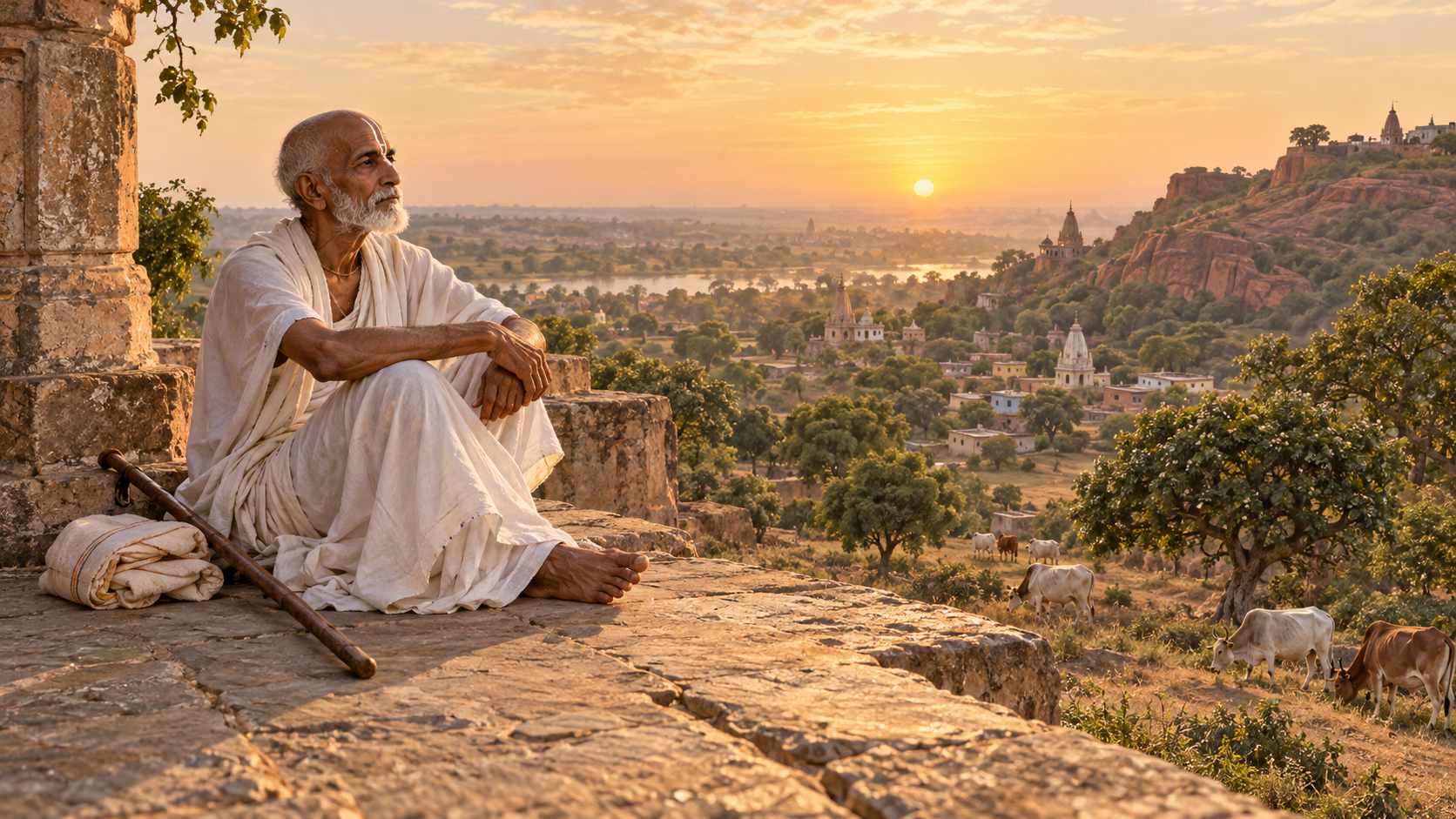
If you encountered Ramesh Baba Maharaj’s name only after his passing, a list of honours cannot tell you why his loss is being felt so deeply across Brajbhoomi. The essential fact is simpler: he chose Braj as a young renunciant and spent his life turning devotion to Radharani into sustained service for the dhama, its cows, its hills and the Yamuna.
That union of bhakti and responsibility is the key to understanding him. He did not treat sacred geography as scenery surrounding religious life. He treated its protection as religious life. If you want to remember him faithfully, look beyond the image of an honoured saint and examine what his seva required in practice.
Key takeaways
- Born in Prayagraj in 1938, Ramesh Baba Maharaj moved to Barsana at the age of 16, drawn by devotion to Srimati Radharani.
- His public legacy rests on three connected fields of seva: protecting the natural heritage of Braj, serving cows and campaigning for the Yamuna.
- His movement against illegal mining in the Braj hills contributed to a Supreme Court ban on mining in the affected area in 2008.
- He established Mataji Gaushala, where thousands of cows are served, and led Yamuna campaigns that included a march in Delhi.
- He received the Padma Shri in 2019 for service to the culture, environment and society of Brajbhoomi.
- He passed away at Maan Mandira in Barsana on Indira Ekadasi, 6 October 2026, at the age of 88.
Why a teenager’s move to Barsana explains the whole life
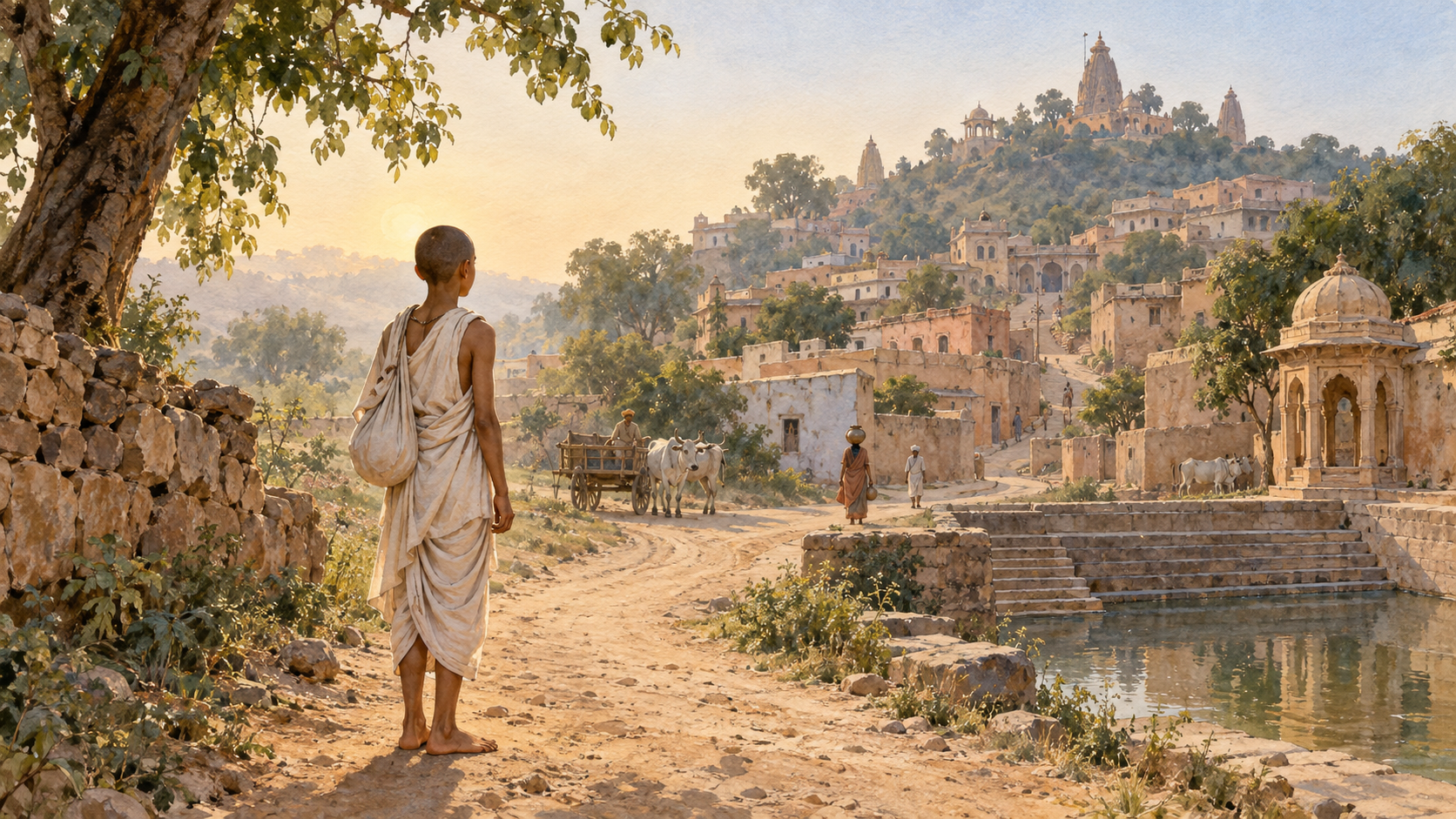
Ramesh Baba Maharaj was born in Prayagraj in 1938 and went to Barsana when he was 16. The reason matters as much as the journey: he was drawn there by Srimati Radharani and dedicated himself to the service of Vraja-dhama.
This was not simply a move from one city to another. It was the choice of a sacred centre and a field of duty. Barsana was not merely where he lived; it shaped what he understood himself to be responsible for. That distinction helps you read his later work correctly. His environmental and social efforts were not a separate career added to his spiritual life. They grew from his commitment to the dhama.
In the devotional understanding of Braj, reverence for Radharani cannot be neatly separated from reverence for the places associated with her. A hill, pond, forest, river or cow is therefore not valuable only when it is useful to human beings. Each belongs to a sacred relationship. When such a place is damaged, the injury is cultural and devotional as well as physical.
This is why the word seva carries more weight here than the English word “service” often does. Seva is not occasional benevolence offered from a safe distance. It means accepting a duty and returning to it when the work becomes difficult, expensive or politically inconvenient. Ramesh Baba Maharaj’s life becomes coherent once you see that continuity: the young renunciant’s attraction to Radharani matured into a lifelong obligation to protect her dhama.
After a long illness, he passed away at Maan Mandira in Barsana on 6 October 2026, the sacred observance of Indira Ekadasi. He was 88. Vaishnava remembrance often describes the departure of a saint as tirodhan, a withdrawal from mortal sight. For his devotees, the language of departure for Goloka expresses the relationship they believe continues beyond bodily death; it does not erase the human grief caused by his absence.
How his bhakti became protection, shelter and advocacy
It is tempting to divide Ramesh Baba Maharaj’s work into religious and secular categories. That division obscures his central contribution. The hills, cows and Yamuna were different responsibilities, but he approached all three through one Dharmic conviction: what is sacred must be served in material reality, not praised only in speech.
Defending the hills of Braj
Illegal mining threatened hills that form part of Braj’s natural and sacred inheritance. Ramesh Baba Maharaj sustained a movement against mining across the affected belt from Barsana toward Rajasthan. That struggle achieved a consequence far beyond symbolic protest: the Supreme Court banned mining there in 2008.
The lesson is not that every spiritual leader must become a litigant or campaigner. It is that reverence has to meet the mechanism causing the damage. A threatened hill cannot be protected by sentiment alone. The mining, permissions, enforcement and institutions involved must be confronted at the level where decisions are made.
You can apply that principle when a sacred site near you is threatened. First identify the physical harm precisely: encroachment, extraction, sewage, dumping or neglect. Then identify who has the authority to stop it. Devotional gatherings can build moral resolve, but documentation, lawful advocacy and persistence turn that resolve into protection. Ramesh Baba Maharaj’s achievement in the Braj hills shows why both are necessary.
Making go-seva an enduring institution
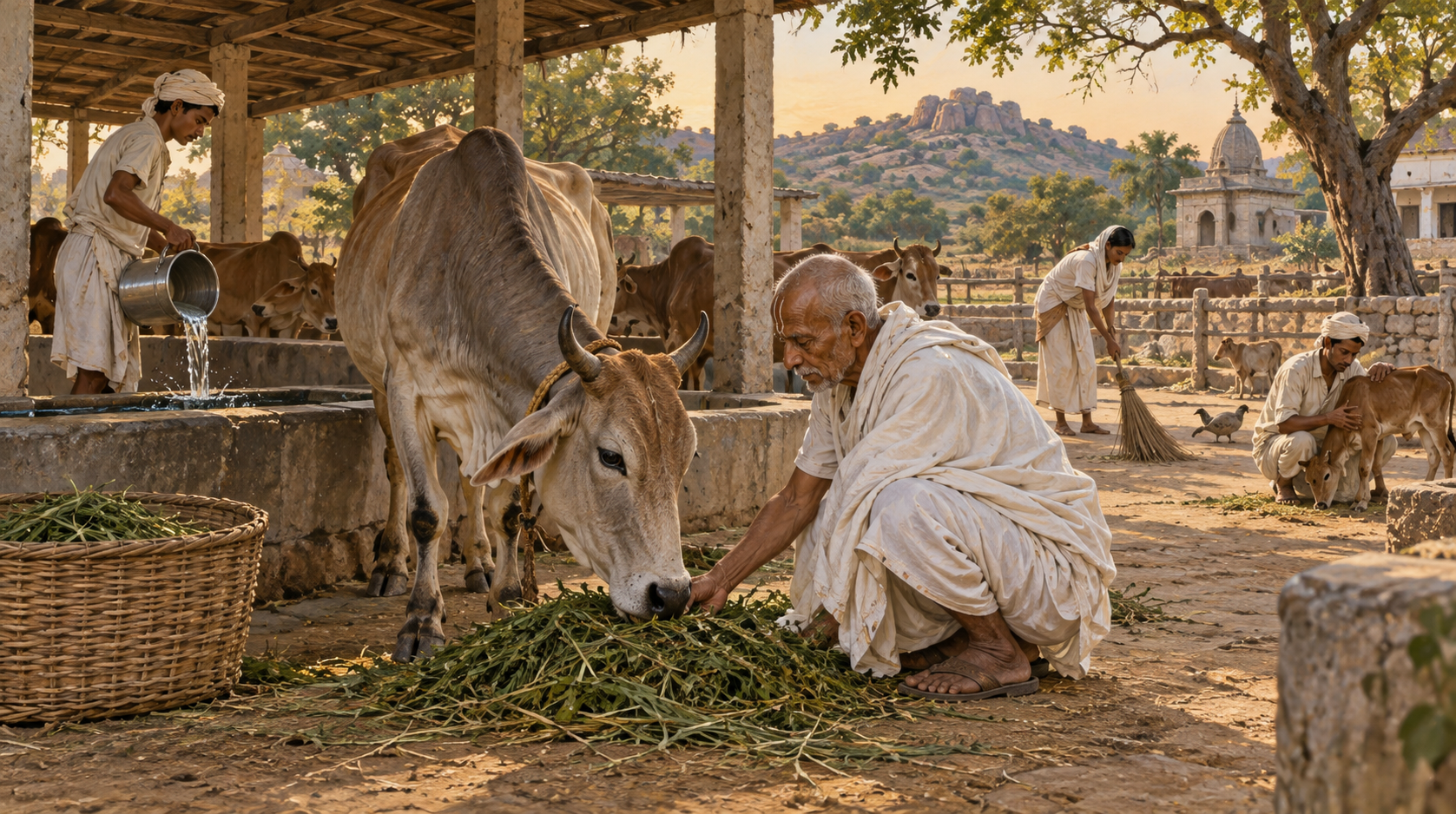
Ramesh Baba Maharaj also dedicated himself to cow service and established Mataji Gaushala, where thousands of cows are served. The scale matters because it reveals the difference between affection for the cow as an ideal and responsibility for actual animals.
A living cow needs fodder, water, shelter, sanitation and continuing care, including when she is old or no longer economically productive. Large-scale go-seva therefore requires land, workers, supplies, management and dependable support. The devotional impulse remains indispensable, but the quality of the seva is visible in the conditions maintained day after day.
If you want to support a gaushala in his memory, do more than respond to an emotional appeal. Find out how many animals it serves, whether it provides appropriate veterinary attention, how it houses elderly and infirm cows, and whether its finances and use of donations are transparent. Give to care that is both compassionate and competently organised. That is a more serious tribute than treating the cow as an emblem while ignoring her daily needs.
Taking the cause of the Yamuna beyond Braj
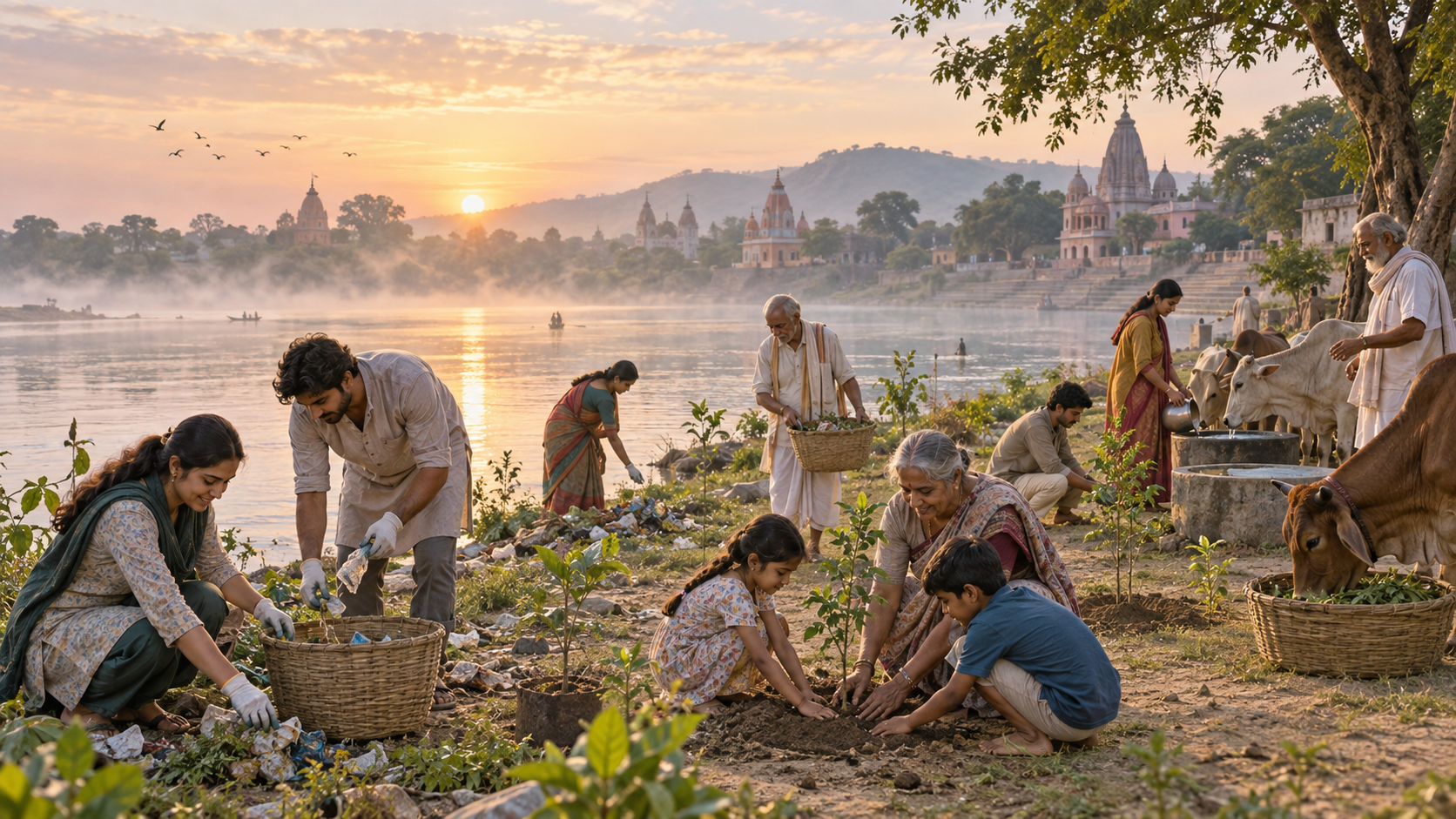
The Yamuna was another field in which Ramesh Baba Maharaj joined sacred concern to public action. He led campaigns for the river, including a march in Delhi, seeking a Yamuna free from pollution and restored to dignity.
A river does not become clean because people call it sacred. Pollution exposes the gap that can open between ritual honour and collective conduct. Closing that gap requires devotees to see water quality, waste disposal and river protection as matters within Dharma rather than as technical concerns belonging to someone else.
The march to Delhi also carried a strategic insight. Damage may be visible locally while the power to remedy it sits elsewhere. Effective service must sometimes travel from the affected tirtha to the seat of policy. If you work on a river, pond or temple water body, map that chain of responsibility before choosing your action. A cleanup treats what has accumulated; stopping the next discharge requires engagement with whoever controls the cause.
Receiving recognition without letting it define the work
The Government of India awarded Ramesh Baba Maharaj the Padma Shri in 2019 for his contribution to the culture, environment and selfless social service of Brajbhoomi. The honour is significant because it publicly recognised that protecting a sacred landscape can serve the wider nation.
Yet the award came after decades of commitment; it was not the reason for that commitment. This order is worth noticing. Recognition can amplify seva, but it cannot supply its foundation. Work that depends on applause usually weakens when attention moves elsewhere. Work grounded in a vow can continue before recognition arrives and after ceremonies end.
What his legacy asks of devotees now
A saint’s passing often produces an intense but brief period of homage. Photographs circulate, praises are offered and commemorations are organised. None of that is wrong. The danger begins when remembrance replaces the responsibility the life was meant to awaken.
You do not need Ramesh Baba Maharaj’s public stature to carry one part of his legacy. You do need to choose a duty concrete enough to survive emotion. The following approach keeps remembrance tied to work:
- Begin with a place or living being, not a slogan. Identify a real gaushala, riverbank, pond, grove, hill or sacred precinct whose needs you can understand. General concern becomes accountable only when it has a visible object.
- Learn what the problem actually requires. Cow care, water restoration and heritage protection need different skills. Ask the people doing the daily work what is missing before deciding what you will provide.
- Choose continuity over spectacle. A recurring commitment of time, funds, professional help or public advocacy usually matters more than a single ceremonial gesture. Make the commitment small enough to keep and serious enough to help.
- Join devotion to competence. Prayer and kirtan can sustain the heart of seva. Records, budgets, veterinary care, environmental knowledge and lawful engagement help the seva achieve its purpose. Treat these as partners, not rivals.
- Verify before you amplify. Share the documented milestones of Ramesh Baba Maharaj’s life without decorating them with unsupported claims. Accuracy is itself respect, especially when future readers may know him only through what today’s devotees preserve.
- Ask what will remain. The strongest tribute is not the number of memorial messages produced after a saint’s departure. It is the cow still receiving care, the hill no longer being cut and the water body becoming cleaner because someone accepted responsibility.
This approach also guards against reducing him to a single label. Calling him only an environmental campaigner leaves out the devotion that made Braj sacred to him. Calling him only an ascetic can hide the organised effort, civic pressure and institutional care through which his devotion entered public life. His distinctiveness lies in holding those dimensions together.
For a Dharma magazine and its readers, that is the enduring challenge. We often speak eloquently about the sanctity of Bharat’s rivers, animals and tirthas. Ramesh Baba Maharaj’s life asks the harder question: what burden are we prepared to carry because we call them sacred?
Choose one answer that can be acted upon where you live. Examine a gaushala before supporting it, help a local group protect a sacred water body, document a threatened heritage site, or strengthen an organisation already doing dependable work. Let remembrance become a duty you keep. That is how seva outlives the sevaka.
References

Leave a Reply
You must be logged in to post a comment.