
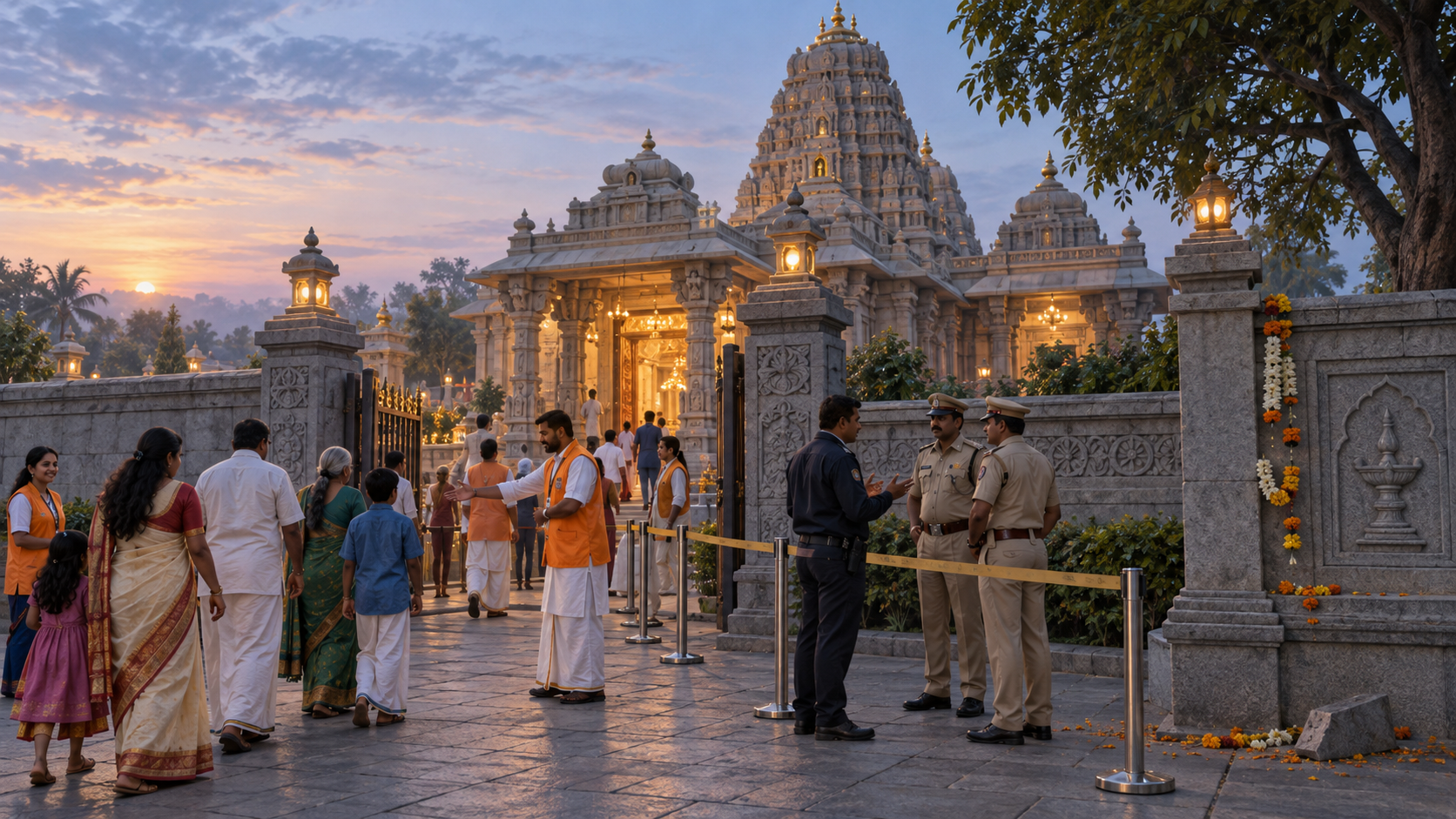
If you help run a mandir, the question is no longer simply whether an attack is possible. The practical question is whether your people will know what to do without creating further danger, destroying evidence, spreading an unverified accusation, or delaying the temple’s recovery.
Desecration and violence involving Hindu temples and murtis have been reported in India, Bangladesh, and the United States. Those countries have different laws and institutions, but a sound response rests on the same disciplines: protect life, preserve facts, communicate carefully, respect the sacred, and pursue accountability through lawful channels.
Key takeaways
- If danger is continuing, move people to safety and contact local emergency services. Do not confront, chase, or gather around an attacker.
- Keep worshippers and volunteers out of the affected area until the relevant authority releases it. Cleaning too soon can erase evidence.
- Preserve original photographs, video, messages, access records, and witness details. Publish copies only after considering safety, dignity, and legal risk.
- Do not announce a suspect, motive, or hate-crime classification as fact before it is substantiated. Condemn the act without assigning collective guilt.
- Run the legal investigation, physical recovery, and religious restoration as coordinated but distinct processes.
- After the immediate crisis, convert lessons into named responsibilities, controlled access, tested recording systems, and a written follow-up record.
When an incident is discovered, protect people and the scene
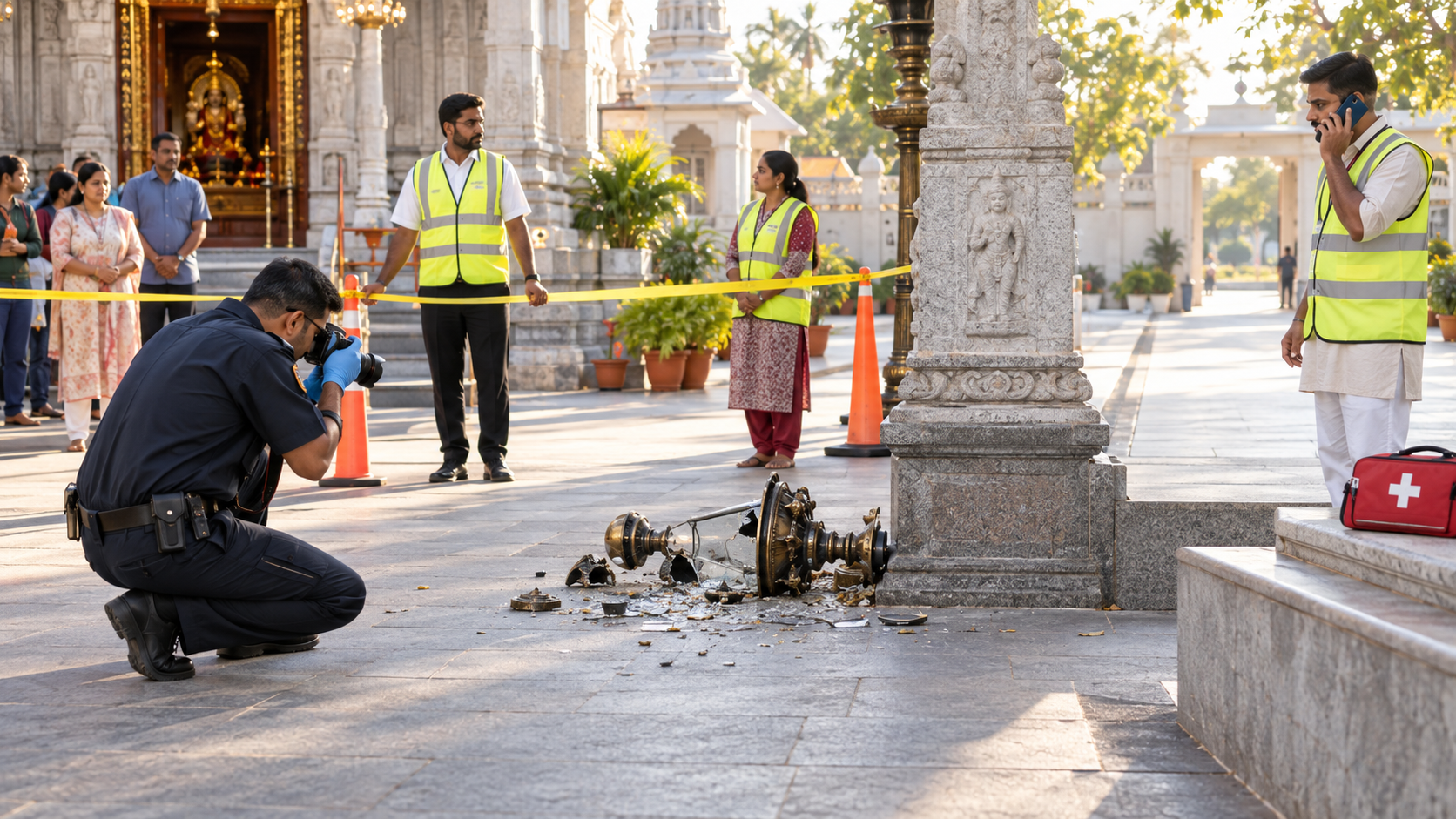
The person who first finds broken doors, damaged murtis, threatening material, fire, or an intruder should not have to invent a response under stress. Every temple needs a short discovery procedure available to priests, staff, trustees, security personnel, and regular volunteers.
Respond to the danger before documenting the damage
- Check for immediate danger from a safe position. If an attacker, fire, suspicious object, or other active hazard may still be present, withdraw and contact local emergency services. Do not approach merely to obtain video.
- Move worshippers away from the affected area. Keep entrances, exits, and routes for emergency responders clear. Account for priests, staff, volunteers, children, elders, and anyone who may need assistance.
- Arrange medical help where needed. Let trained responders provide care. Record the names of those taken for treatment only for legitimate operational use, and protect that information from public circulation.
- Appoint an incident lead. This person becomes the contact for police, emergency responders, trustees, the insurer, and the temple’s lawyer. Other volunteers should route questions to that person instead of issuing parallel instructions.
- Restrict access without creating a confrontation. Use doors, barriers, or volunteers at a safe distance. Record who enters after discovery, including officials, contractors, and temple representatives.
If a damaged murti or sacred object is exposed, there may be an understandable wish to cover, lift, cleanse, or restore it immediately. First ask the investigating authority whether the object or surrounding area must remain untouched. If dignity can be protected without entering or altering the scene, do so. Otherwise, wait for formal release and then follow the temple’s own sampradaya, Agama, or acharya. There is no responsible universal ritual prescription for every temple.
Preserve facts that can survive scrutiny
Good documentation is not the same as posting dramatic images. Its purpose is to establish what happened, what was damaged, who had access, and what evidence was handed to whom.
- Record when the damage was discovered, who discovered it, and when the area was last known to be undisturbed.
- Note the condition of gates, doors, locks, windows, alarms, donation areas, offices, sanctum access points, and exterior walls. Write only what was observed.
- From a safe and lawful position, capture broad views that show context, intermediate views that connect objects to their surroundings, and close views of particular damage.
- Preserve original image and video files. Do not crop, filter, annotate, recompress, or replace the originals. Copies can be prepared separately for public communication.
- Secure camera recordings before routine overwriting can occur. Confirm that the exported files open, retain their timestamps, and include the relevant approaches as well as the damaged area.
- Preserve threatening emails, direct messages, comments, voicemails, envelopes, and physical notices. Keep account names, links, headers, timestamps, and packaging where available.
- Invite witnesses to write their own recollections independently. Do not coach them toward a shared story or circulate one witness’s account before others have recorded what they remember.
- Maintain an evidence-handling log showing what was collected, where it is stored, who received it, and whether an original or a copy was transferred.
Do not ask devotees to upload evidence into an open messaging group. That makes personal information easy to copy, encourages speculation, and can contaminate witness accounts. Provide a private channel controlled by authorized temple representatives, then give relevant material to investigators through the process used in that jurisdiction.
Build temple security in layers, without making worship hostile

A camera mounted above a door is not a security plan. Protection works when governance, physical design, access control, detection, response, and recovery support one another. The aim is not to make every devotee feel suspected. It is to remove easy opportunities, notice abnormal activity early, and make the response predictable.
Start with ownership and access
- Assign roles by name or position. Identify who opens and closes the premises, checks alarms and recordings, receives threat reports, contacts police, speaks publicly, and authorizes repairs.
- Control keys, codes, and credentials. Keep an issue-and-return record. Revoke access promptly when a role ends. Avoid a permanently shared code whose circulation cannot be traced.
- Separate routine access from exceptional access. Contractors, delivery workers, event vendors, and occasional volunteers should enter only the areas and at the times required for their work.
- Use an opening and closing check. Include doors, windows, gates, sacred areas, offices, donation storage, alarms, exterior lighting, and anything unusual outside the property.
- Keep emergency contacts current. The list should cover local emergency and non-emergency services, trustees, priests, property management, the insurer, legal counsel, and the technicians responsible for alarms or cameras.
A written plan fails if only one trustee knows it. Give each person the portion relevant to the person’s role, rehearse how an alert moves through the team, and maintain an alternative when the usual decision-maker cannot be reached.
Inspect the route an intruder would actually use
Walk from the public boundary toward entrances, side passages, roofs, utility areas, offices, storage rooms, donation points, and the sanctum. Look for concealed corners, weak doors, objects that provide climbing access, unlit approaches, vegetation that blocks sightlines, and signs that can be removed or defaced without being observed.
- Position lighting so that people and approaches can be seen, while avoiding glare that makes cameras or human observation less useful.
- Cover entrances, likely approaches, external walls, office access, and other vulnerable points with recording systems where lawful. Avoid private areas and respect local notice and data-protection requirements.
- Check that camera clocks are correct, recordings are actually being retained, authorized people can export them, and loss of a recorder at the site would not erase every available copy.
- Use doors, frames, locks, gates, and fixings suited to the structure. A strong lock attached to a weak frame merely moves the failure point.
- Keep fire exits usable. A security measure that traps worshippers during an emergency creates a more serious hazard than the one it was meant to prevent.
- Provide a discreet way for priests, staff, or volunteers to summon help without leaving a threatened area.
Festivals, processions, construction, deliveries, and unusual opening hours change the risk. Review access and volunteer assignments whenever the normal pattern changes. Temporary workers should not inherit unrestricted access simply because the premises are busy.
Treat online threats as part of temple security
Threatening messages, publication of private details, impersonation, and attempts to seize an official account can precede or intensify an offline incident. Protect official email and social accounts with strong, unique credentials, multi-factor authentication, role-based access, recovery contacts controlled by the institution, and prompt removal of former administrators.
When a threatening message arrives, preserve it before blocking the sender or reporting the account. Do not provoke a reply. If the message identifies a target, method, place, or impending action, let local law enforcement assess its credibility. Platform reporting can accompany that step; it is not a substitute for it.
Communicate firmly without feeding rumour or retaliation
A temple should speak promptly enough to prevent an information vacuum, but not so quickly that suspicion becomes an accusation. Sort each claim into confirmed, unverified, or withheld for safety and privacy. Only the first category belongs in an initial public statement.
Suggested holding statement: “An incident has occurred at [temple] in [place]. The safety of worshippers and staff is our immediate priority. Local authorities have been contacted, and the affected area is being preserved. Confirmed updates will appear through [official channel]. Please do not circulate unverified names, motives, or images.”
Adapt that wording to the facts. Do not say that everyone is safe unless that has been confirmed. Do not call an act a hate crime, identify a suspect, or assign an ideological motive merely because the damage appears targeted. You can state that a murti was damaged, a wall was defaced, or a threat was received while making clear that responsibility and motive remain under investigation.
- Use one official webpage, account, or message channel as the public record. Mirror confirmed updates elsewhere without changing their meaning.
- Separate observed facts from interpretation. “The entrance was damaged” is an observation; “a named group did it” requires evidence.
- Do not publish a witness’s name, face, phone number, address, immigration status, medical information, or private message without a legitimate reason and appropriate consent.
- Avoid graphic or humiliating images of damaged murtis when words or a restrained contextual image will establish the fact. Preserve full-resolution originals privately for investigators.
- Ask community members to send evidence privately and not to confront people they suspect. A mistaken identification can endanger an innocent person and undermine the case.
- If an earlier statement is wrong, issue a visible correction through the same official channel. Do not quietly edit away a material error.
- Translate essential safety information for the communities that use the temple, but keep the underlying facts consistent across versions.
Anger at an attack is legitimate. Collective blame is not accountability. A temple can condemn anti-Hindu hatred in direct language while refusing retaliatory slogans, threats, or accusations against an entire religion, ethnicity, nationality, or neighbourhood. That discipline protects innocent people, keeps attention on the actual offence, and denies an offender the wider conflict that desecration may be intended to provoke.
Pursue accountability, recovery, and sacred restoration together
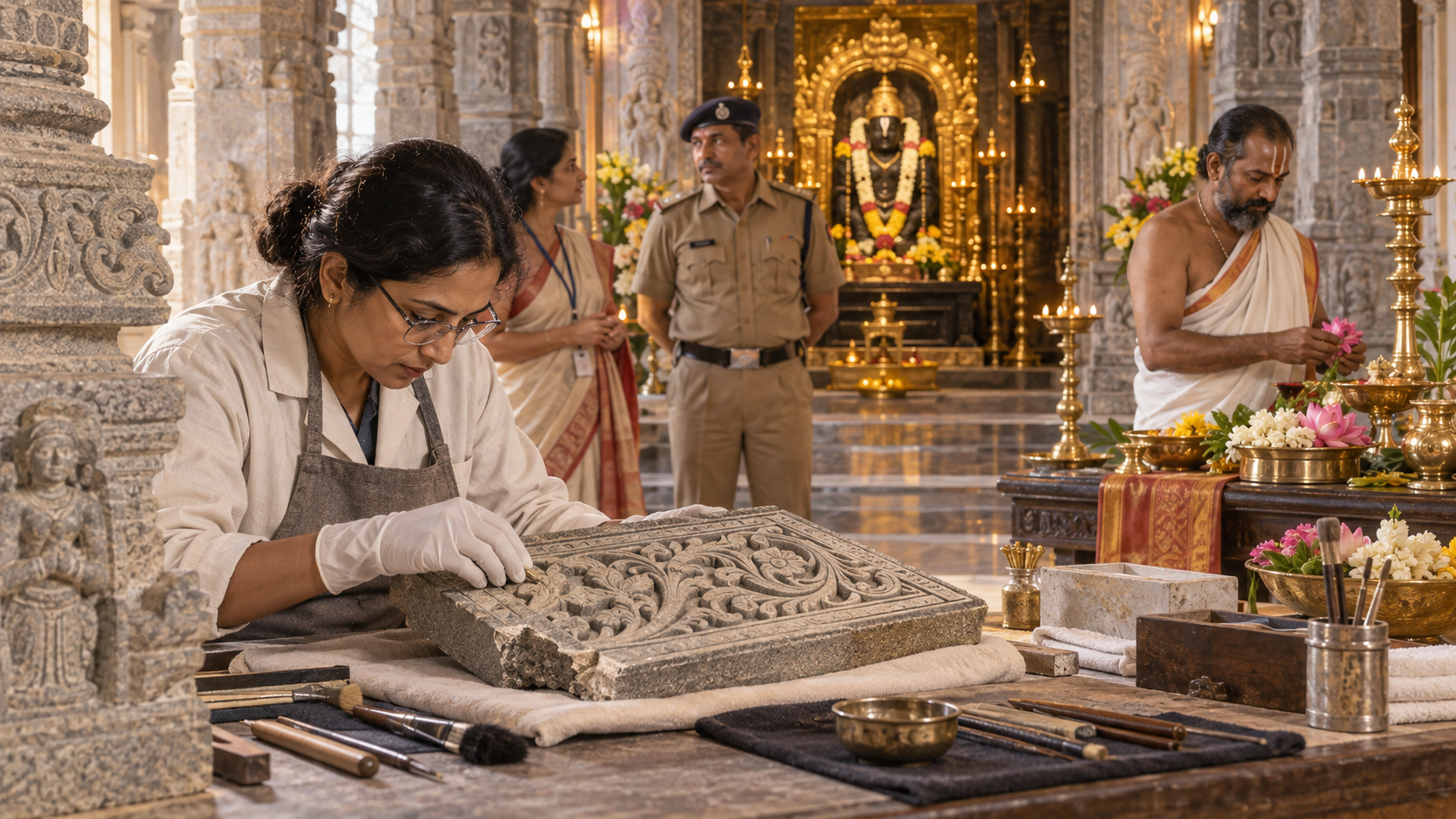
The day after an attack often exposes the weakness of an improvised response. The crowd has gone, the news cycle has shifted, and responsibility becomes fragmented. Keep a single institutional incident record so that the complaint, evidence, repair, insurance claim, public commitments, and religious decisions do not disappear into separate phones and inboxes.
Keep the legal and administrative track moving
- Obtain and retain the police or authority reference attached to the report. Record the responsible office and the appropriate contact route.
- Ask what evidence has been accepted, whether additional material is required, and when damaged objects or closed areas may be released.
- Prepare an itemized damage record covering the building, murtis, sacred objects, signs, equipment, furnishings, and interruption of normal operations. Keep estimates, invoices, and photographs together.
- Notify the insurer through the required channel before irreversible repairs, except for work needed to remove an immediate safety hazard.
- Have local legal counsel review serious public allegations, evidence disputes, access restrictions, fundraising representations, or concerns that a complaint is not being handled properly.
- If progress stalls, request a written status update and escalate through lawful supervisory, judicial, elected-representative, or civil-rights channels available in that jurisdiction.
For temples outside India, local police and courts remain the immediate legal route. Diaspora bodies, Hindu organizations, elected representatives, and diplomatic missions may help raise visibility or support the community, but they do not replace the local complaint and evidence process. In any country where reporting itself may create danger, temple leaders should first seek advice from trusted local counsel or an established community body familiar with the conditions on the ground.
Let qualified religious leadership direct sacred recovery
Police release answers a legal question; it does not decide the ritual status of a damaged murti or sanctum. Once investigators have released the site and objects, the temple’s qualified priestly and religious authorities should determine handling, temporary worship arrangements, repair or replacement, purification, and any required re-consecration. Social-media opinion should not override the temple’s tradition.
Keep ritual decisions distinct in the incident record. This protects both sides of the response: investigators can see that evidence was preserved until release, while devotees can see that sacred restoration was not reduced to an ordinary property repair.
Reopen with lessons, not just repaired walls
Before returning to normal operations, hold a structured review with the people who opened the premises, managed worshippers, contacted authorities, handled recordings, communicated publicly, and arranged restoration. Ask where time was lost, which contact failed, what evidence was nearly missed, where access was unclear, and which person carried too many responsibilities.
Turn each finding into an assigned change. Replace a vulnerable fitting. Correct a camera blind spot. Update a contact. Separate shared credentials. Create a private evidence channel. Clarify who can close the temple and who can authorize a public statement. Then test the changed process during an ordinary day, before another crisis tests it for you.
You do not need to wait for another headline to begin. At the next committee meeting, place the discovery procedure, emergency contacts, evidence responsibilities, spokesperson, and religious decision-maker on the table. A temple is better protected when calm action has already been agreed upon – and when vigilance serves darshan, community, and dharma without becoming fear.
References

Leave a Reply
You must be logged in to post a comment.