

You may have only a brief opportunity to speak with a respected acharya or community leader at a Dharma gathering. The real question is not whether you secure a photograph. It is whether the person understands your work, receives something useful, and knows what could happen next.
An interaction at Ujjain’s Yuva Dharma Sansad offers a compact model for young Hindu advocates: introduce the work clearly, connect it to the protection of Dharma, and leave behind a resource that can continue the conversation after the meeting has ended.
The Ujjain model: explain, equip and continue
During the Yuva Dharma Sansad in Ujjain, Hindu Janajagruti Samiti representatives met Pujya Swami Shri Mithilesh Nandini Sharanji Maharaj, explained their activities for the protection of Dharma and the Nation, and presented him with the Hindi book Dharmashiksha Falak.
Three distinct acts took place: a relationship was opened, the organisation’s work was explained, and an educational resource was handed over. That sequence is more useful than an unfocused appeal for support. It gives the recipient enough context to understand who is present, what is being done, and what material is available for further engagement.
It is equally important not to inflate what such an encounter means. A meeting establishes that a meeting occurred. Receiving a book does not, by itself, prove endorsement, partnership or a commitment to future action. Credible Hindu advocacy depends on making that distinction. When you communicate publicly, report what was discussed and presented without assigning words or positions to the other person.
This discipline protects everyone involved. It also makes later cooperation easier because the relationship begins with accuracy rather than publicity-driven exaggeration.
Arrive with a briefing that can survive a short meeting

A Dharma Sansad can bring many organisations, speakers and participants into the same setting. A long institutional history is unlikely to be the most useful opening. Prepare a short briefing that answers the questions the listener actually needs answered.
- Identify yourself plainly. Give the name of your organisation or local initiative and describe your role without overstating your authority.
- Name the Dharmic need. State the problem you are addressing in concrete language. Avoid treating words such as protection, awakening or unity as explanations in themselves.
- Describe the work. Mention the activities you can document, the people those activities are meant to serve, and the educational or community method being used.
- Offer a relevant resource. Explain what you are presenting and why it may be useful to this particular recipient.
- Make the next step clear. Ask for one proportionate action, such as permission to send further information, guidance on a question, or contact with the appropriate person.
A workable briefing can follow this structure: “We are working on [defined activity] because [specific Dharmic need]. This resource is intended for [defined audience]. We would value your guidance on [clear question] or permission to [clear next step].” Fill every bracket with something verifiable.
Do not invent reach, results or institutional backing to make the work sound larger. If an initiative is local, call it local. If it is still being developed, say so. A modest claim that can be substantiated is more persuasive than a grand claim that collapses under one follow-up question.
Make the educational material serve the recipient
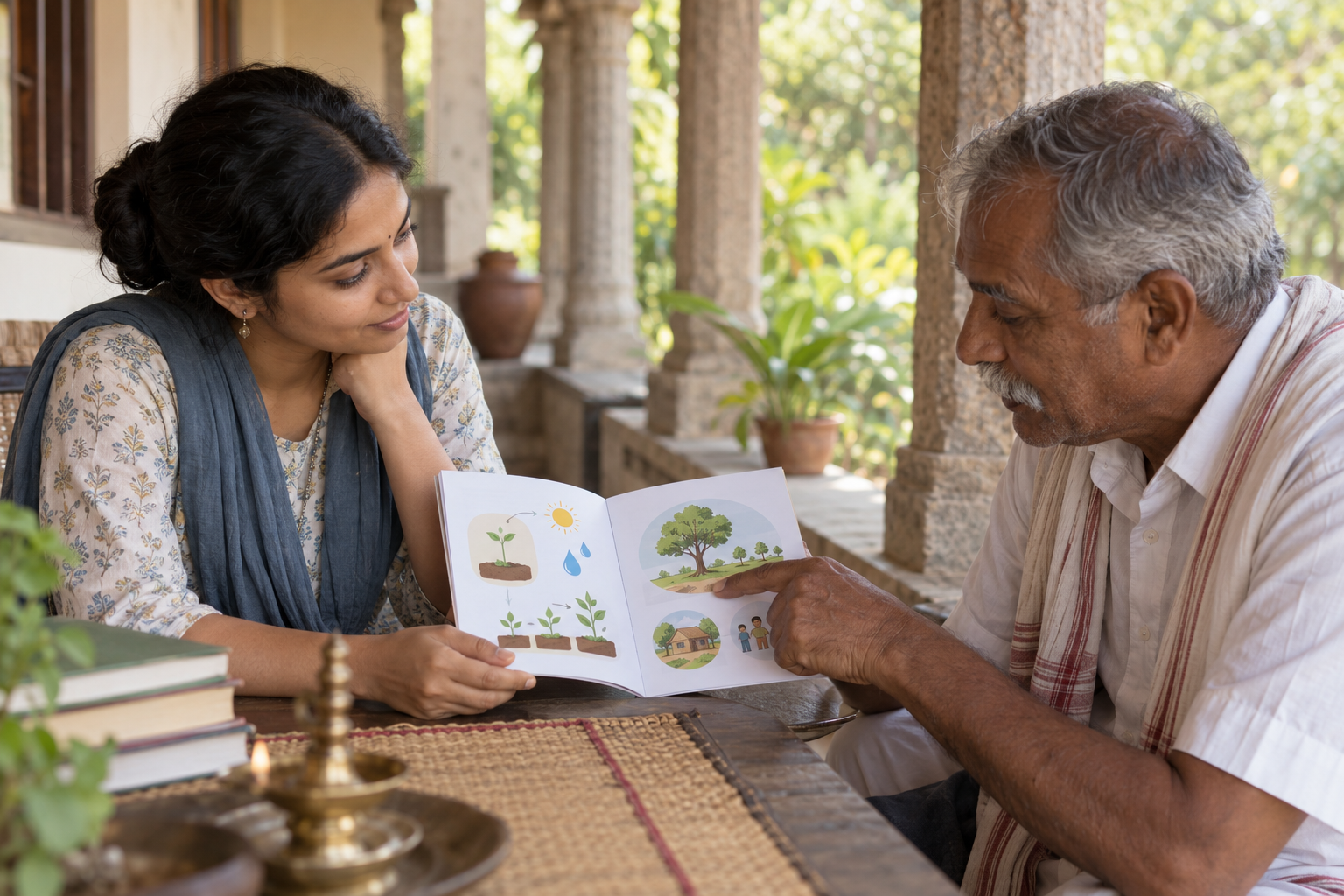
A book should not function merely as a ceremonial object in a photograph. Its advocacy value lies in what it enables after the event: learning, reflection, teaching or a more informed conversation. The presentation of Dharmashiksha Falak therefore points to a practical principle. Oral advocacy gains continuity when it is accompanied by something the recipient can examine later.
Before presenting any book, booklet or teaching aid, check four things:
- Audience: Is it written for an acharya, an organiser, a teacher, a parent, a volunteer or a beginner?
- Language: Is it in a language the intended reader actually uses? A Hindi resource may be appropriate in one meeting, while another recipient may need a different language.
- Purpose: Can you explain what the material helps the reader understand or do without making claims about content they have not yet read?
- Continuation: Does the recipient have a reliable contact for questions, additional copies or related educational activity?
Read the material yourself before distributing it. Mark the section most relevant to the conversation, if appropriate, so the recipient does not have to guess where to begin. Keep a digital version available when distribution rights permit it. If the resource is not suited to the person in front of you, do not force the exchange merely to complete a planned presentation.
This is where Dharmashiksha becomes advocacy rather than merchandise. The objective is not simply to place an item in someone’s hands. It is to make accurate Dharmic learning easier to access and easier to pass onward.
Turn access into accountable follow-through

The most common weakness in event-based advocacy is the gap between contact and continuation. People exchange greetings, distribute material and return home without recording what was actually discussed. The opportunity then becomes a memory rather than a relationship.
Immediately after a meeting, create a factual internal note containing:
- the correct name and title of the person met;
- the event and location where the interaction occurred;
- the work that your representatives explained;
- the exact resource that was presented;
- any question, guidance or next action that was explicitly discussed; and
- the volunteer responsible for any agreed follow-through.
Keep observation, agreement and interpretation separate. “We presented this book” is an observable fact. “The recipient supports our entire programme” is a much larger claim and should not be published unless that support was explicitly expressed and may properly be made public. A photograph confirms presence; it does not automatically confer approval.
When follow-through is welcome, send a concise message that identifies the meeting, provides the promised material and repeats only the next step that was actually discussed. Do not add the recipient to recurring messages or public supporter lists without permission. Respectful restraint is not hesitation. It is part of Dharmic conduct and sound community organisation.
You should also decide how success will be judged. Publicity may help people discover an initiative, but it is not the same as Dharmic education or durable cooperation. Better questions are whether the recipient could accurately describe the work afterward, whether the material reached an appropriate reader, and whether a legitimate next action was completed.
Key takeaways for a young Hindu advocate
- Enter the meeting with a defined purpose, not merely the hope of visibility.
- Explain one concrete area of work in language that a person outside your organisation can understand.
- Connect the activity to the protection and transmission of Dharma without relying on slogans to carry the argument.
- Present educational material only when you understand its audience, language and practical use.
- Ask for a proportionate next step instead of treating access as endorsement.
- Record and publish only what actually occurred, then assign responsibility for any follow-through.
If you are preparing for the next Dharma gathering, write your briefing and choose your educational resource before you arrive. Your aim is simple: help one person understand the work accurately, give that person a useful way to engage with it, and leave the relationship clearer than you found it.
References

Leave a Reply
You must be logged in to post a comment.