

You may already honor Srila Prabhupada, own his books, visit an ISKCON temple, or watch an arati online. The harder question is what fidelity looks like when admiration must become daily conduct.
His legacy remains living when teaching passes through a repeatable chain: hear carefully, practice what you have heard, serve within a Krishna-centered community, and transmit the tradition without dilution or self-display. That chain gives you a practical test for every book, class, pilgrimage, temple visit, and digital darshan.
Begin with the instruction, not the aura
Srila Prabhupada did more than carry an Indian religious identity across a geographical border. He made a rooted spiritual culture available to people who had not inherited its language, customs, or institutions. He established centers where people could encounter that tradition in their own cities, while his books gave them a way to continue learning after a lecture or temple visit ended.
Publishing was central to that work. Under his direction, the Bhaktivedanta Book Trust produced annotated translations of Indian spiritual classics, and by 1977 had produced and distributed more than sixty million volumes of his writings. The scale matters, but the deeper point is easy to miss: the teachings were made portable so that a reader could receive instruction beyond Srila Prabhupada’s physical presence.
Your first responsibility, then, is not to collect inspiring quotations. It is to let an instruction govern something specific. When you read, use a simple discipline:
- Read enough of the surrounding passage to understand the argument, not just the memorable sentence.
- State the instruction in your own words without weakening its demand.
- Name the habit, choice, or relationship to which it applies.
- Return to the passage after acting and ask whether your understanding became clearer.
Biographical accounts serve a different purpose. They show how principles were applied amid travel, institutional growth, criticism, financial difficulty, property disputes, illness, and responsibility for disciples. Srila Prabhupada’s later years included repeated global travel, the defense of his young movement against accusations in America, and resistance to unscrupulous business conduct encountered in India. Read such episodes to see judgment under pressure. Read his direct teachings to discover what should direct your own judgment.
Hold study, devotional practice, and service together

The heart of Srila Prabhupada’s teaching is devotional life centered on Krishna. That life cannot be reduced to intellectual agreement. Hearing gives practice its direction; chanting and worship turn attention toward Krishna; service prevents devotion from becoming private self-absorption; association makes correction and continuity possible.
- Study: Read to receive instruction. If a passage is difficult, mark the exact claim you do not understand and seek a contextual explanation rather than silently replacing it with a more comfortable idea.
- Chanting and remembrance: Give the divine names a stable place in your day. Consistency matters because a practice performed only when the mood is favorable remains governed by mood.
- Worship: Let reverence take visible form through prayer, arati, cleanliness, offerings, or attentive participation in temple worship. External action should train attention rather than become a performance for observers.
- Service: Choose work that is actually needed. Preparing a space, helping a visitor, distributing teachings responsibly, supporting worship, or completing an unnoticed task may express discipleship more honestly than public praise.
- Association: Stay close to practitioners whose conduct makes you more truthful, disciplined, and attentive to Krishna. Charisma without accountability is not a reliable measure of spiritual maturity.
These elements expose common imbalances. Study without practice can produce an impressive vocabulary with little surrender. Practice without study can become fragile habit, easily redirected by personality or fashion. Devotional emotion without service may remain centered on one’s own experience. Service without hearing can deteriorate into activity, status, or exhaustion.
You do not need to repair every imbalance at once. Identify the missing element and attach it to something already stable. If you read regularly but serve irregularly, accept one recurring responsibility. If you attend worship but rarely study, connect that visit to a passage or class. The aim is an integrated devotional life, not a crowded spiritual checklist.
Approach temples as gateways, not monuments
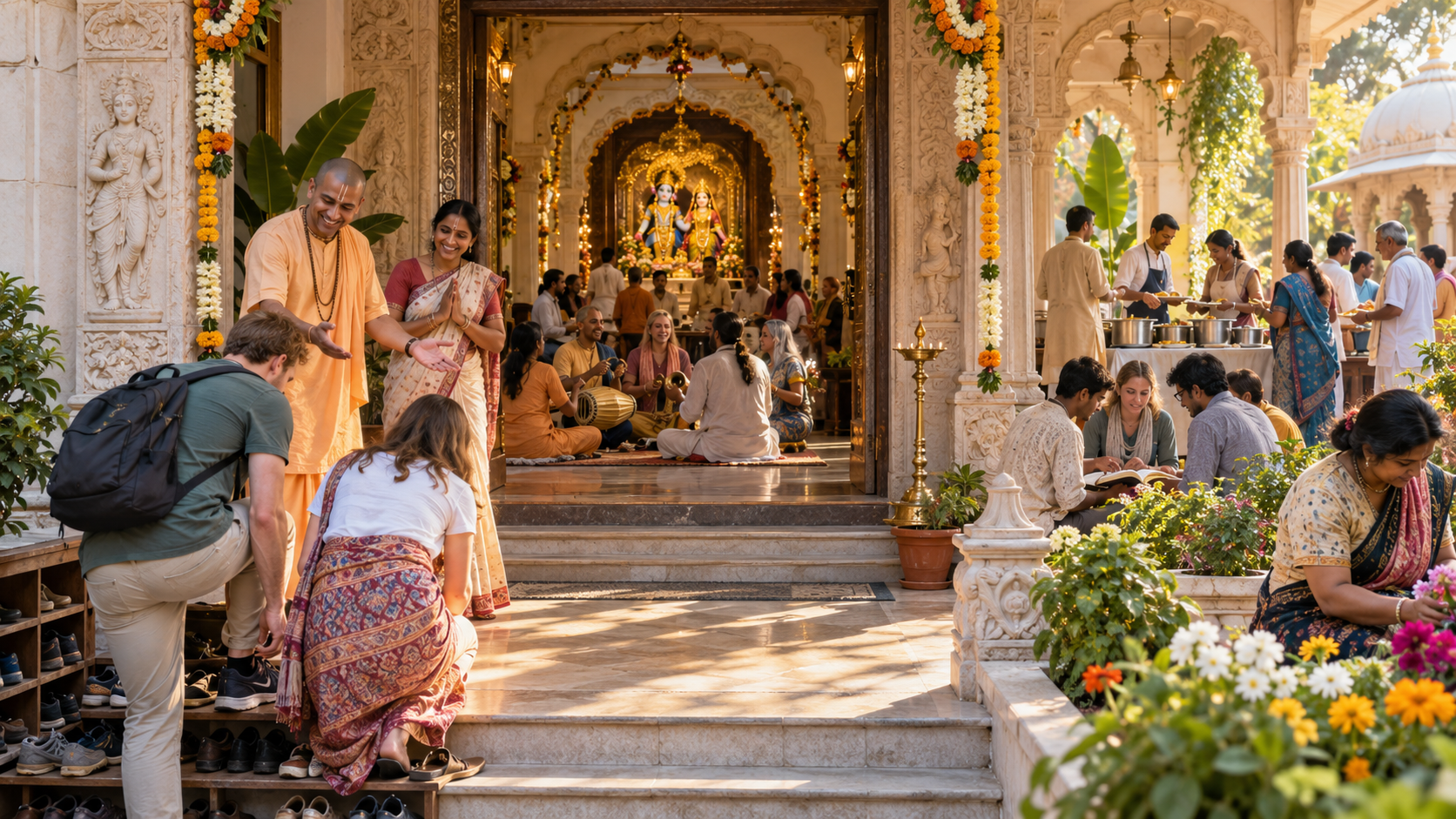
Beginning in 1971, Srila Prabhupada pursued major temple projects in Bombay, Vrindavana, and Mayapur. The locations carried different strengths: Bombay stood at the center of commerce, Vrindavana preserved sacred memory of Krishna’s earthly pastimes, and Mayapur marked the birthplace of Sri Caitanya Mahaprabhu. Together they linked urban access, sacred geography, worship, teaching, and institutional continuity.
This tells you how to use a temple well. Do not stop at admiring the architecture, taking darshan, or photographing the altar. Learn the worship schedule. Sit for instruction. Ask what regular service is needed. Return often enough that people can know you and correct you. A temple becomes part of your spiritual formation only when you move from visitor to participant.
Physical distance no longer prevents every form of contact. A live Mangal arati darshan from Sri Sri Krishna Balaram Mandir in Vrindavan can bring temple worship onto a screen far from the holy place. In ISKCON Delhi, a morning Srimad Bhagavatam class on 6 October 2026 continued the communal work of hearing, remembering, and interpreting Srila Prabhupada’s life.
Digital access is valuable, but access and participation are not identical. If you watch arati remotely, prepare the space and give it undivided attention. When the stream ends, carry one devotional act into the room you actually inhabit: chant, read, make an offering, contact the local community, or perform a needed service. The screen should open a door into practice, not simulate a practice that never begins.
Use modern tools without letting them become the teacher

Srila Prabhupada described cooperation between the resources of the West and the spiritual inheritance of India through a vivid analogy:
A blind man can carry a lame man, and together they can walk.
Srila Prabhupada on Indian spirituality and American technology
The analogy gives each side a role, but not the same role. Technology supplies reach, speed, reproduction, organization, and physical capacity. Dharma supplies direction. A tool can carry a teaching across the world; it cannot decide what the teaching means, cultivate humility, or perform surrender on your behalf.
That distinction is especially useful now. Recordings, livestreams, searchable texts, messaging groups, and publishing platforms can extend genuine access. They can also reward haste, decontextualized quotations, factional argument, and devotion performed for attention. Before you share spiritual material, ask:
- Have I preserved the speaker’s actual point and enough context to understand it?
- Will this help someone hear, practice, serve, or find trustworthy association?
- Am I sharing it to illuminate the teaching, or to display my identity and defeat an opponent?
- What concrete devotional action should follow the click?
This is not an argument for retreating from technology. Srila Prabhupada’s publishing achievement shows the opposite. It is an argument for putting instruments in their proper order. Use every available means to widen access, but let disciplined devotional purpose decide what deserves to be amplified.
Carry the legacy forward without reducing it
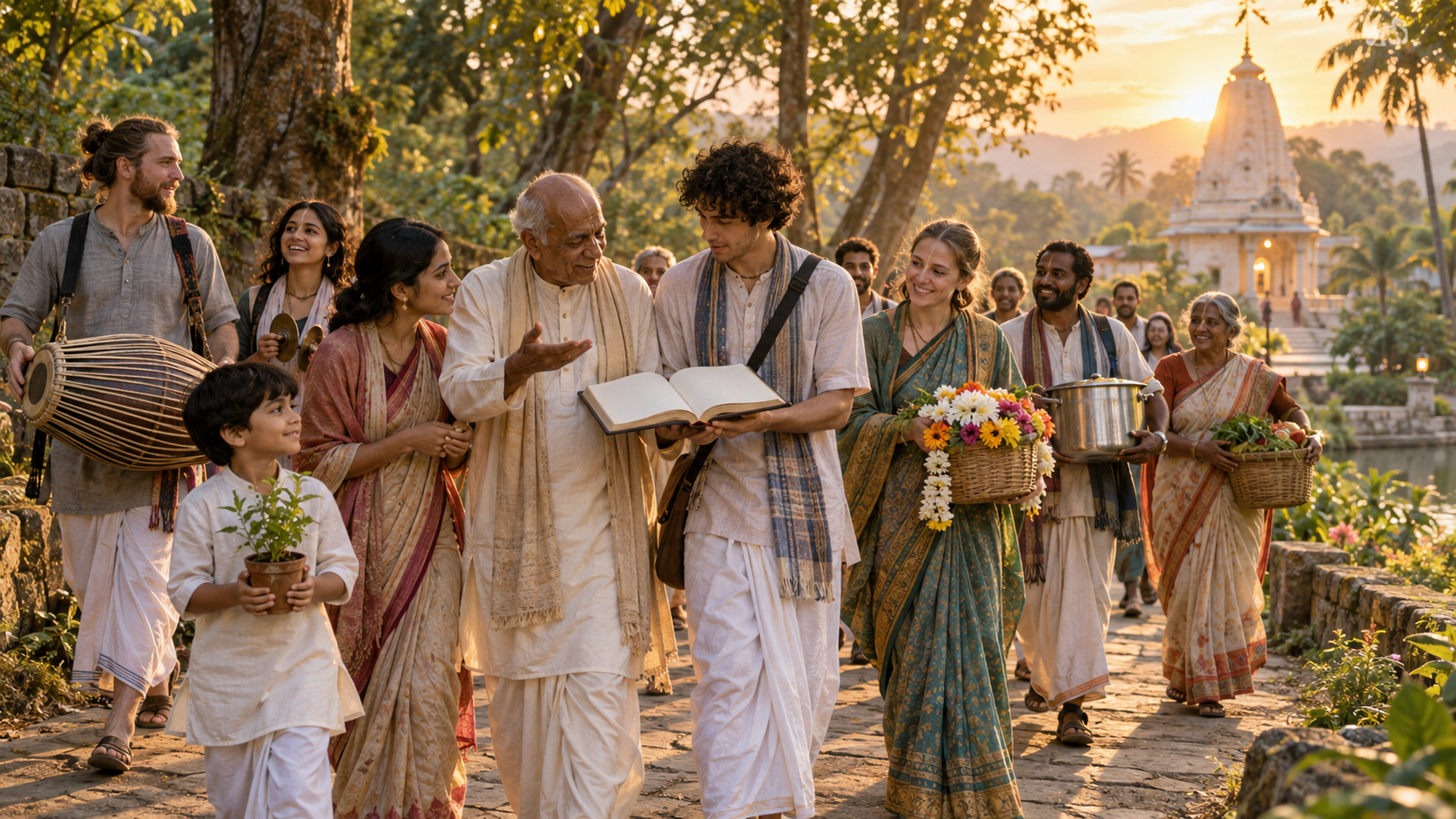
A legacy can be diminished in two opposite ways. One turns Srila Prabhupada into a museum figure: revered, commemorated, and safely confined to the past. The other turns him into a badge of institutional or personal identity: frequently invoked, but weakly reflected in conduct. Both reductions protect the admirer from the demand of discipleship.
There is a civilizational reduction to avoid as well. Srila Prabhupada’s success outside India should not be treated as though Western recognition finally made India’s spiritual inheritance valuable. Nor should modern organizational methods be rejected merely because they arose elsewhere. His mission joined Indian spirituality to modern technical and institutional capacity while keeping the spiritual purpose primary. It carried a tradition outward without requiring that tradition to forget where it came from.
His final period made continuity unavoidable. In 1977, at eighty-one and in failing health, he traveled in India before returning to Vrindavana, where disciples gathered from around the world as his physical departure drew near. The question facing them was no longer whether they admired their teacher. It was whether the society, worship, scholarship, service, and personal discipline he had cultivated would continue without his bodily presence.
A workable rule of devotional life
You can meet the same question on an ordinary scale. Build a rule of life simple enough to repeat and demanding enough to change you:
- Select a manageable passage from Srila Prabhupada’s teachings and read it in context.
- Write down one instruction in direct language: what you are being asked to understand, stop, begin, or sustain.
- Give chanting, prayer, or worship a fixed place rather than leaving it to spare time.
- Accept one concrete service whose completion benefits Krishna’s worship, devotees, visitors, or the wider community.
- Use a temple, class, or reliable practitioner for association and correction. Do not make private interpretation your only authority.
- Review your conduct regularly. Look for evidence in speech, appetite, reliability, relationships, and willingness to serve, not merely in devotional feeling.
If the rule becomes unmanageable, simplify it without abandoning its essential parts. If it becomes effortless because it asks nothing of you, deepen it. Stability and sincere growth belong together.
Key takeaways
- Honor Srila Prabhupada by applying complete instructions, not by collecting isolated quotations.
- Keep study, chanting, worship, service, and accountable association connected.
- Use temples as places of formation and responsibility, not only as destinations for darshan.
- Let technology extend access while devotional purpose remains in command.
- Measure a living legacy by transformed conduct and faithful transmission.
The next time you open a book, enter a temple, hear a class, or join an online darshan, choose one instruction and one act of service before you leave. That is the small, repeatable passage from inherited words to present-tense Dharma. It is also where Srila Prabhupada’s legacy becomes your responsibility.
References
- Dandavats – Today’s Featured Video: Ekadashi Special Class | His Divine Grace A.C. Bhaktivedanta Swami Prabhupada || 06-10-2026
- Dandavats – HH Guruprasad Swami || Srila Prabhupada-lilamrita Vol. 2

Leave a Reply
You must be logged in to post a comment.