
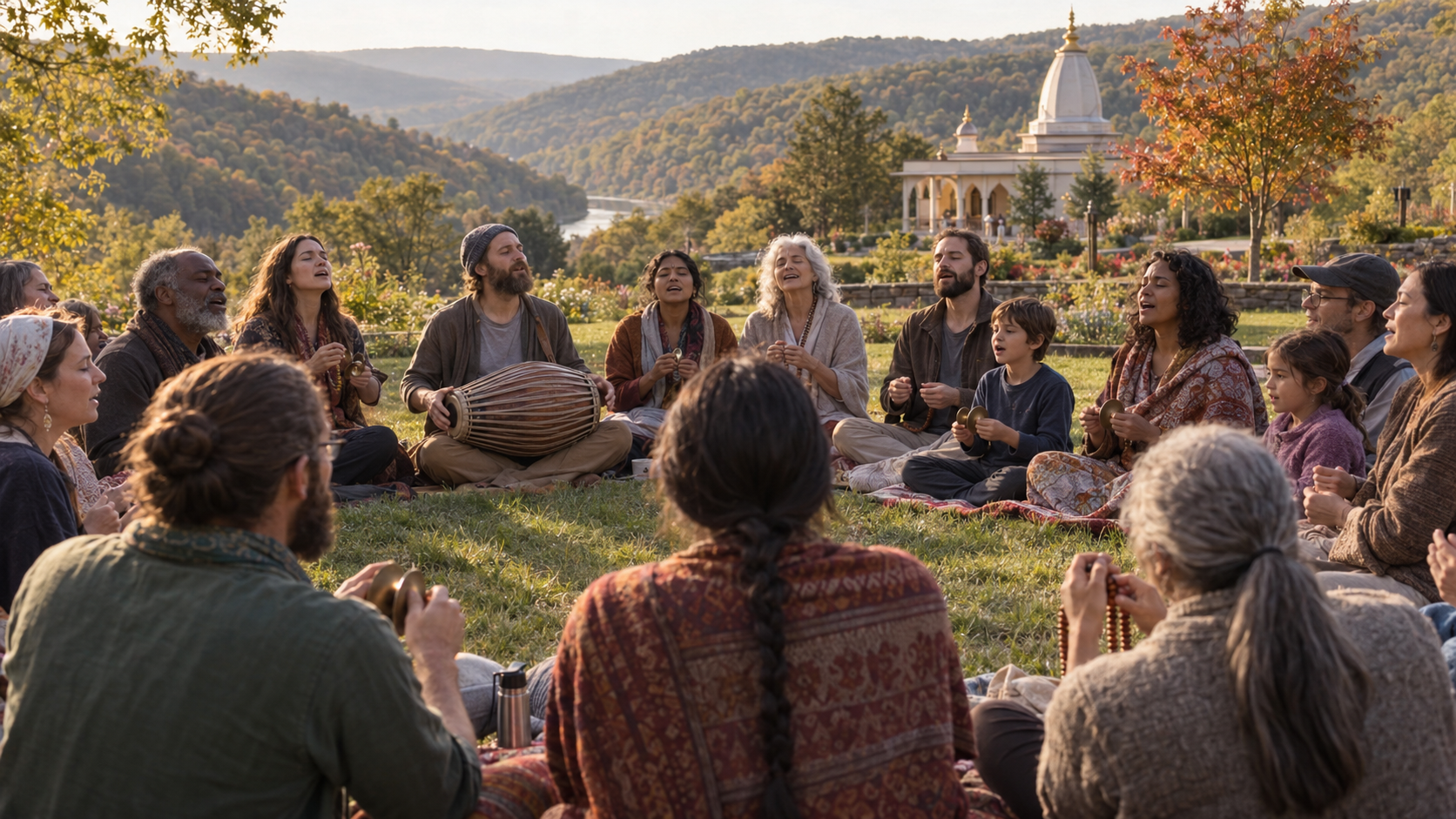
If you are considering a mantra retreat because ordinary life has made your practice scattered, the gathering in Moundsville offers a useful correction: do not measure a retreat only by how far it removes you from relationships. Measure it by how differently you return to them.
At New Vrindavan’s ninth annual MANTRA retreat on 2 October 2026, chanting and prayer stood alongside historical memory, household commitment, scriptural reflection, and the consequences of careless speech. That combination turns a retreat from a pleasant spiritual interval into training for daily conduct.
Key takeaways
- Begin with lineage rather than personal novelty. The opening presentation connected present practice with A.C. Bhaktivedanta Swami Prabhupada and the early Krishna-conscious community in Bombay.
- Do not treat household life as a distraction from bhakti. Yadubara’s long devotional service and equally long marriage were honoured together.
- Extend the discipline of mantra to ordinary speech. The Bhagavatam discussion showed how humiliating words can turn a family disagreement into collective conflict.
- Use the retreat setting to sharpen attention, but choose a concrete relationship, duty, or speech habit in which that attention will continue at home.
Begin with lineage, not spiritual self-invention
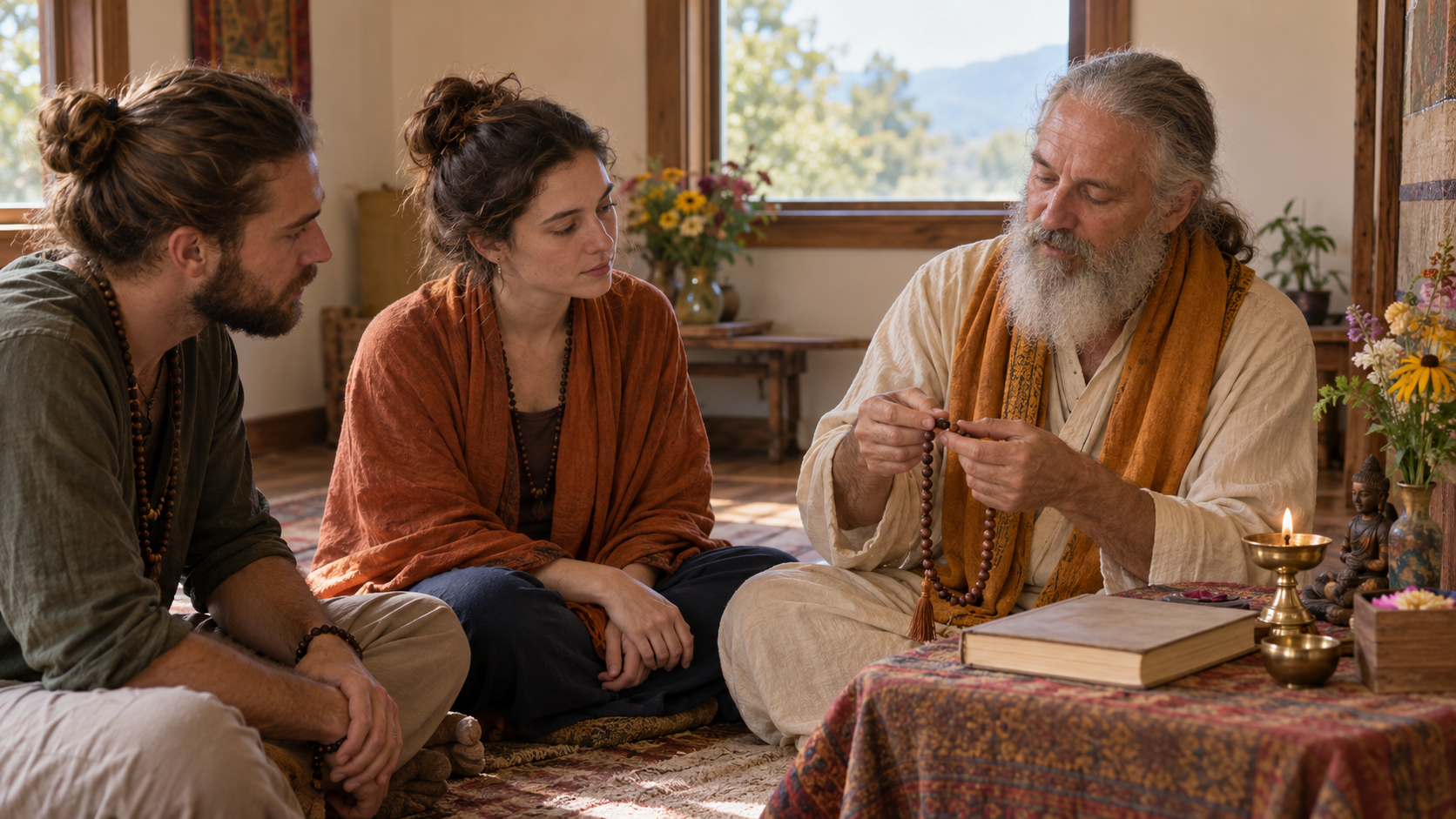
The retreat began in the Yogashala at 4 p.m. with Yadubara, an experienced filmmaker invited by HH Bhaktimarga Swami. His presentation revisited the early days in Bombay, now Mumbai, when Prabhupada drew Western seekers into Krishna consciousness. The choice of opening subject matters: before concentrating on your own experience, remember the people, sacrifices, and instructions through which the practice reached you.
Mantra can easily become private spiritual property. You may judge it only by whether you felt peaceful, concentrated, or inspired. Lineage introduces a more demanding question: what is this practice asking you to receive faithfully and embody? A retreat grounded in memory resists the temptation to manufacture a new meaning whenever inherited discipline becomes inconvenient.
Before your next extended period of chanting, write down who gave you the practice, what they taught it was for, and which part of that instruction you tend to neglect. If you do not understand the mantra’s place within its tradition, ask a qualified teacher. Uncertainty is a reason to learn, not permission to fill the gap with an attractive private interpretation.
Historical remembrance should also produce gratitude rather than nostalgia. The point is not to romanticize an earlier generation. It is to notice that the practice in your hands arrived through service sustained over time. Let that recognition affect how carefully you listen, chant, and pass the teaching onward.
Household responsibility belongs inside bhakti

Yadubara’s presentation carried another lesson. He had rendered his particular service for more than 52 years and had also been married for 52 years. His work and family life were presented together, and the assembled men responded with strong applause for him and Vishakha as grihastha role models.
That response corrects a common misunderstanding. Renunciation of selfishness is not the same as abandonment of responsibility. For a householder, patience, fidelity, caregiving, earning honestly, keeping promises, and repairing conflict are not interruptions between spiritual activities. They are places where the credibility of spiritual practice becomes visible.
If attending a retreat transfers your normal burdens to a spouse or another family member, preparation begins with them. Agree on the practical arrangements before you leave. Do not return with elevated language and an expectation that everyone else will immediately adapt to your new mood. Ask what would make your practice more supportive of the household rather than more disruptive to it.
Choose a concrete household application before the retreat ends. It might be protecting a regular chanting period without evading a shared duty, listening through a difficult conversation before defending yourself, completing an obligation you repeatedly postpone, or apologizing without attaching an excuse. Avoid the vague promise to be more spiritual. The people living with you need a change they can recognize.
Make careful speech part of mantra practice

Bhaktimarga Swami’s Bhagavatam class turned to an episode from the Fourth Canto involving Daksha and Shiva. Daksha directed harsh words at Shiva, his daughter’s husband. The hostility did not remain between two people: supporters entered the dispute, warnings followed, and the conflict descended into an unpleasant brawl.
The family setting makes the lesson uncomfortably practical. Speech delivered before an audience rarely affects only the speaker and the target. Humiliation invites people to choose sides. Once loyalty becomes part of the argument, resolving the original disagreement becomes harder because each side is now defending identity and status as well as substance.
Before speaking in anger, identify the relationship your words could damage. Separate a necessary correction from a desire to embarrass. Do not recruit relatives, friends, or fellow devotees merely to strengthen your position. If the exchange has become public and contemptuous, stop feeding the audience. Resume only when you can state the problem without attacking the other person’s dignity.
Mantra practice gives you a simple discipline for that moment: return before reacting. Take a full breath, remember the mantra, and then decide whether the sentence still needs to be spoken in the same form. The pause does not guarantee wisdom, and silence should not be used to avoid a necessary conversation. It creates enough space to replace impulse with intention.
This is a sterner measure of retreat progress than a peaceful mood. Concentration in a protected setting is valuable. Restraint when an in-law, spouse, friend, or fellow practitioner touches a sensitive point reveals whether that concentration has begun to shape character.
Carry New Vrindavan’s rhythm back into ordinary life
New Vrindavan gives contemplative practice a particularly supportive setting: rolling hills, a pond, a creek, cabins, cows, peacocks, swans, and the temple of Radha Vrindavan Chandra. Such surroundings can quiet the habits that fragment attention. They can also create a trap if you confuse the beauty of the setting with a permanent change in yourself.
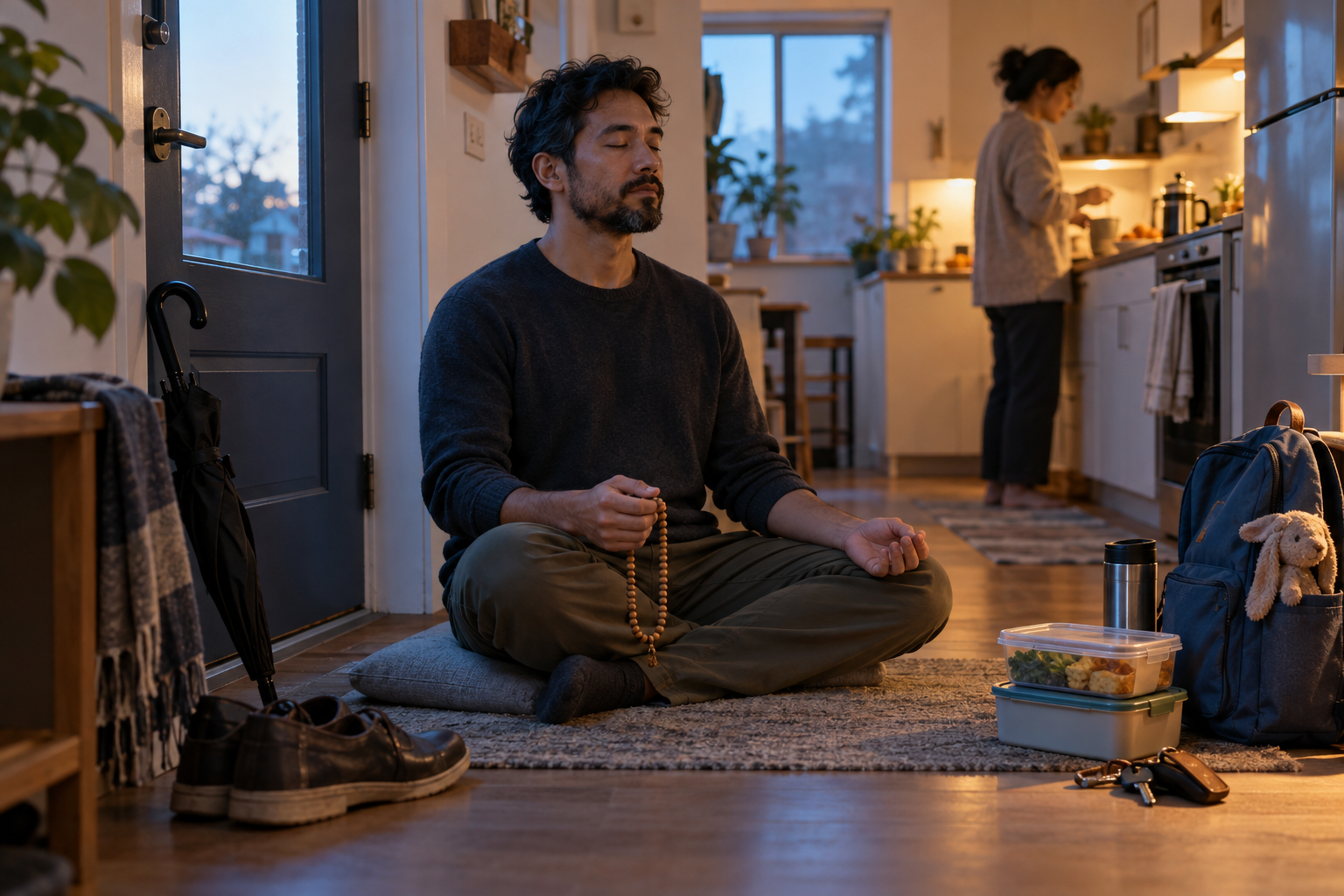
You do not need to reproduce the landscape at home. Reproduce the clarity it made possible. Keep a regular place for chanting. Reduce avoidable interruptions during that period. Retain a deliberate connection to scripture and lineage. Most importantly, watch how you speak when the atmosphere is no longer peaceful.
- Before leaving, write what you need to remember, what conduct you need to stop, and what duty you need to begin doing more faithfully.
- Connect each intention to a real setting: the prayer space, the family table, a difficult conversation, or a neglected responsibility.
- Tell an affected household member what you intend to change, then listen if that person identifies a different point of friction.
- Resume a sustainable chanting rhythm as ordinary obligations return. Do not build a routine that depends on retreat conditions you cannot maintain.
- Judge the result by conduct under pressure, not by how long the retreat feeling lasts.
If you are planning a future visit, treat the 2026 details as historical rather than as current booking information. Confirm the date, participant eligibility, programme, lodging, accessibility, cost, and temple expectations directly with the organisers before travelling.
Go ready to chant, listen, and remember. Then carry a particular relationship and a particular duty into your practice. When the discipline of mantra becomes audible in the way you speak and visible in the way you serve at home, the retreat has crossed the distance from inspiration to bhakti.
References

Leave a Reply
You must be logged in to post a comment.