
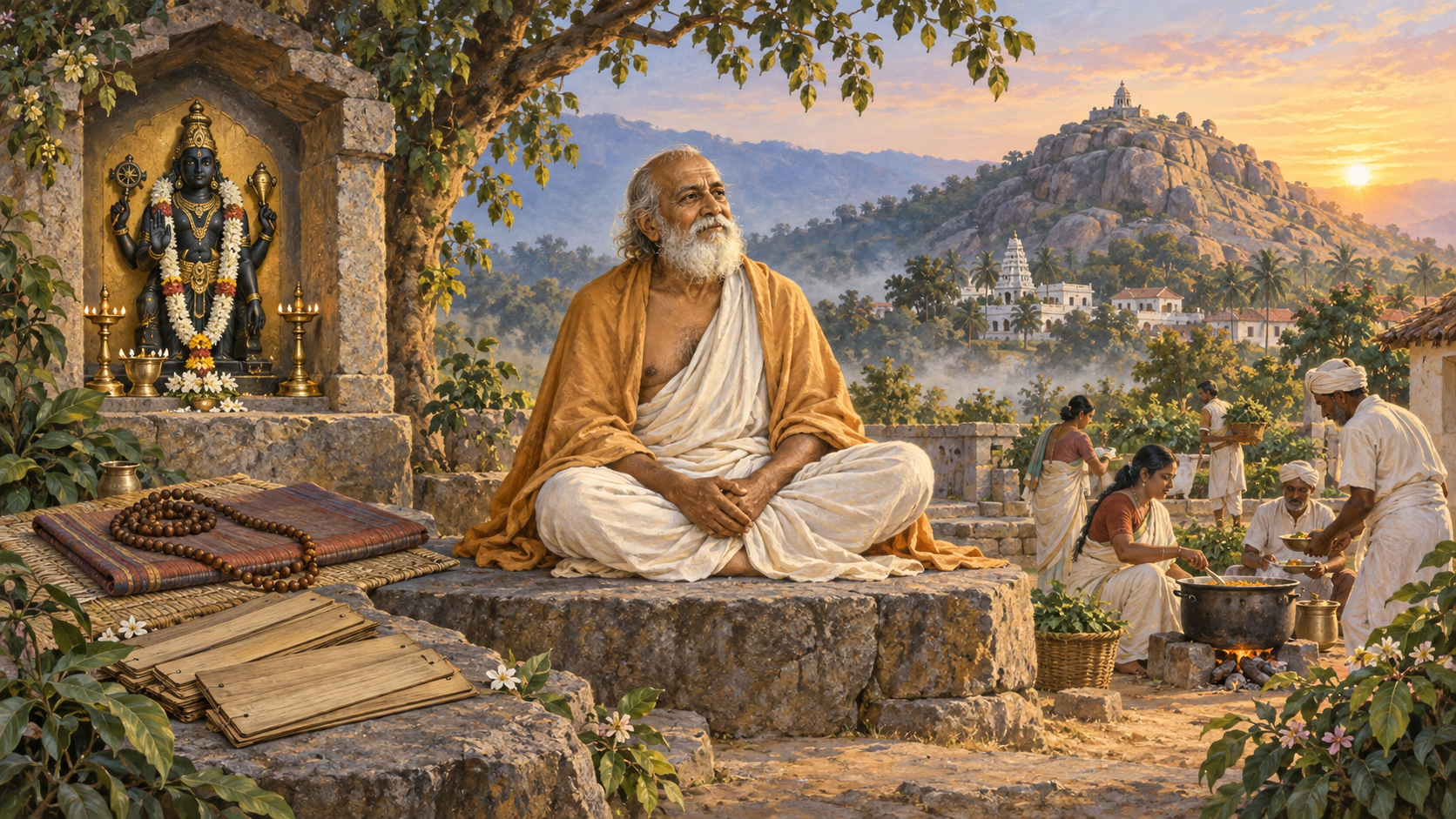
You may know Kaivara Narayana Tatayya only as the serene yogi represented in a temple murti. Or perhaps you have heard his name in a bhajana and wondered what makes devotees call him a Sadguru. Either way, collecting a few biographical facts will not take you very far.
The more useful question is how you should approach a teacher whose presence is carried through an ishta-devata, spiritual practice, poetic speech, a sacred place and a community of service. Once you see those elements together, Kaivara stops being merely a destination and Tatayya stops being merely a personality from the past.
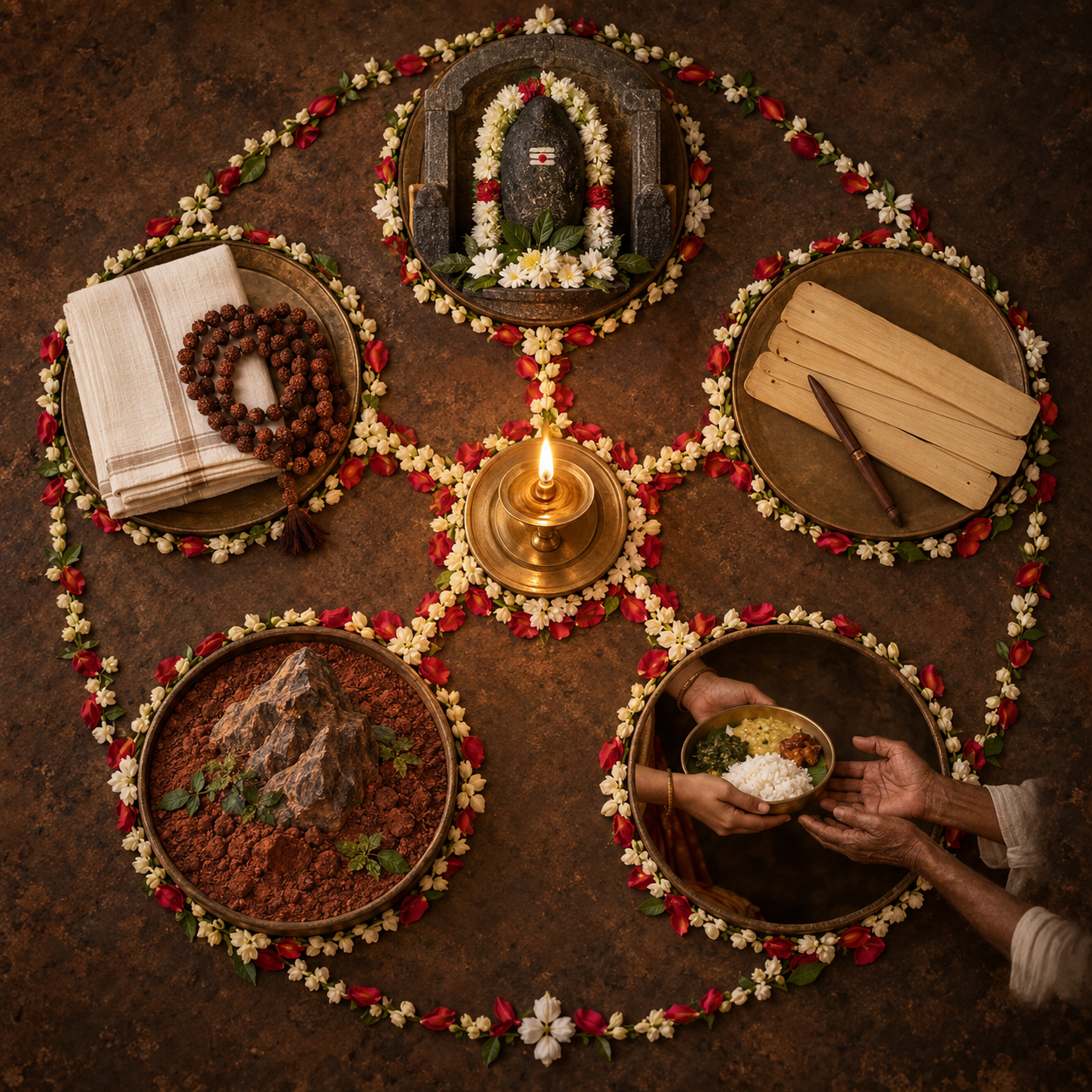
The five anchors of Tatayya’s Sadguru tradition
In this setting, Sadguru is not just a respectful title for a knowledgeable speaker. It identifies a guide whose upadesha, or spiritual instruction, is received as a means of inner transformation. That instruction may be expressed in words, but it is also embodied in worship, discipline, ethical conduct and the life sustained around a sacred centre.
Five anchors help you understand Tatayya without turning him into either a remote icon or a modern celebrity:
- Ishta-devata: Amara Narayana stands at the devotional root of Tatayya’s life and family memory.
- Sadhana: Tatayya is remembered as a yogi, not simply as a poet or public teacher.
- Vani: His teaching voice is associated with compositions in Kannada and Telugu, including kirtanas sung by devotees.
- Kshetra: Kaivara gives the tradition a physical centre where memory, worship and practice meet.
- Seva: Bhajana, hospitality, annadana and the work of affiliated centres keep the tradition communal rather than merely commemorative.
This five-part lens gives you a practical test whenever you encounter a claim about Tatayya. Ask which anchor it belongs to. Is it about his devotion, his discipline, his words, the sacred geography of Kaivara or the community that bears his memory? If it belongs to none of them, it may be decorative folklore rather than something that helps you understand his path.
The first three anchors already reveal the shape of that path. Tatayya is remembered for his devotion to Amara Narayana, yogic sadhana and Kannada-Telugu vani. Devotion, contemplation and teaching are therefore not separate departments of his legacy. Each gives the others their meaning.
Kaivara turns teaching into a sequence of practices
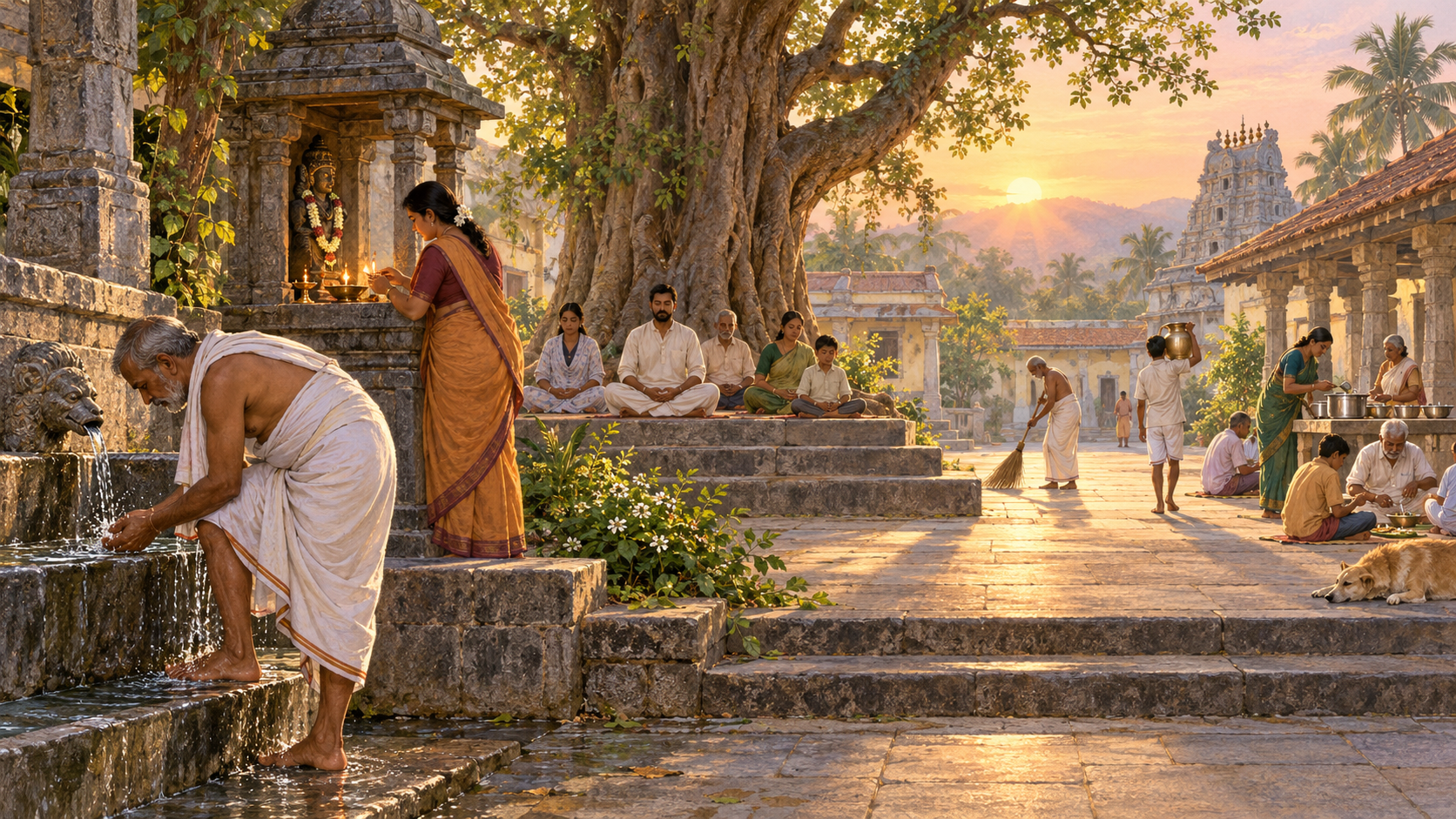
The Shri Yogi Narayana Matha makes this integration visible. Tatayya’s murti is seated in a composed yogic posture. Behind it is the sacred jiva samadhi associated with him. Bhajanas and kirtanas attributed to Tatayya are heard in the matha, while devotees offer namaskara, perform pradakshina, sit quietly and receive annadana.
The jiva samadhi deserves careful language. Matha tradition holds that Tatayya entered jiva samadhi at this place. A devotee may receive that claim as sacred truth. A historical reader may describe it specifically as the tradition preserved by the institution. These responses need not be collapsed into hostility on one side or careless certainty on the other. Reverence becomes stronger, not weaker, when you know which claims are visible, which are inherited and which are matters of spiritual conviction.
A simple visit can follow the teaching sequence already built into the kshetra:
- Pause before entering. Set aside the impulse to photograph everything immediately. Decide what you are seeking: darshana, historical understanding, quiet reflection or an introduction to Tatayya’s vani.
- Listen before interpreting. If a bhajana is underway, hear its cadence and repeated names before searching for an instant translation. In an oral devotional setting, repetition itself is part of the practice.
- Offer namaskara deliberately. Treat the gesture as an acknowledgement that you have entered a discipline, not as a transaction intended to secure a favour.
- Perform pradakshina attentively. Notice how the murti, samadhi and movement of devotees locate Tatayya within a continuing sacred environment.
- Sit after darshana. A few quiet minutes help prevent the visit from becoming a rapid sequence of sights. Write down one question only after you have allowed the place to work on your attention.
- Receive annadana respectfully if it is available. Sitting with other devotees makes visible an important part of the tradition: spiritual belonging is expressed through shared food and service, not only private feeling.
Kannada, Telugu and Hindi may all be heard among visitors, and the spiritual network reaches through affiliated centres in parts of Karnataka and towards the Andhra region. That breadth matters. It shows how a tradition grounded in one kshetra can travel without losing its centre. If you come from outside the local linguistic setting, you are not disqualified; you are simply responsible for listening carefully and asking modest, precise questions.
Amara Narayana connects devotion with the ethics of work
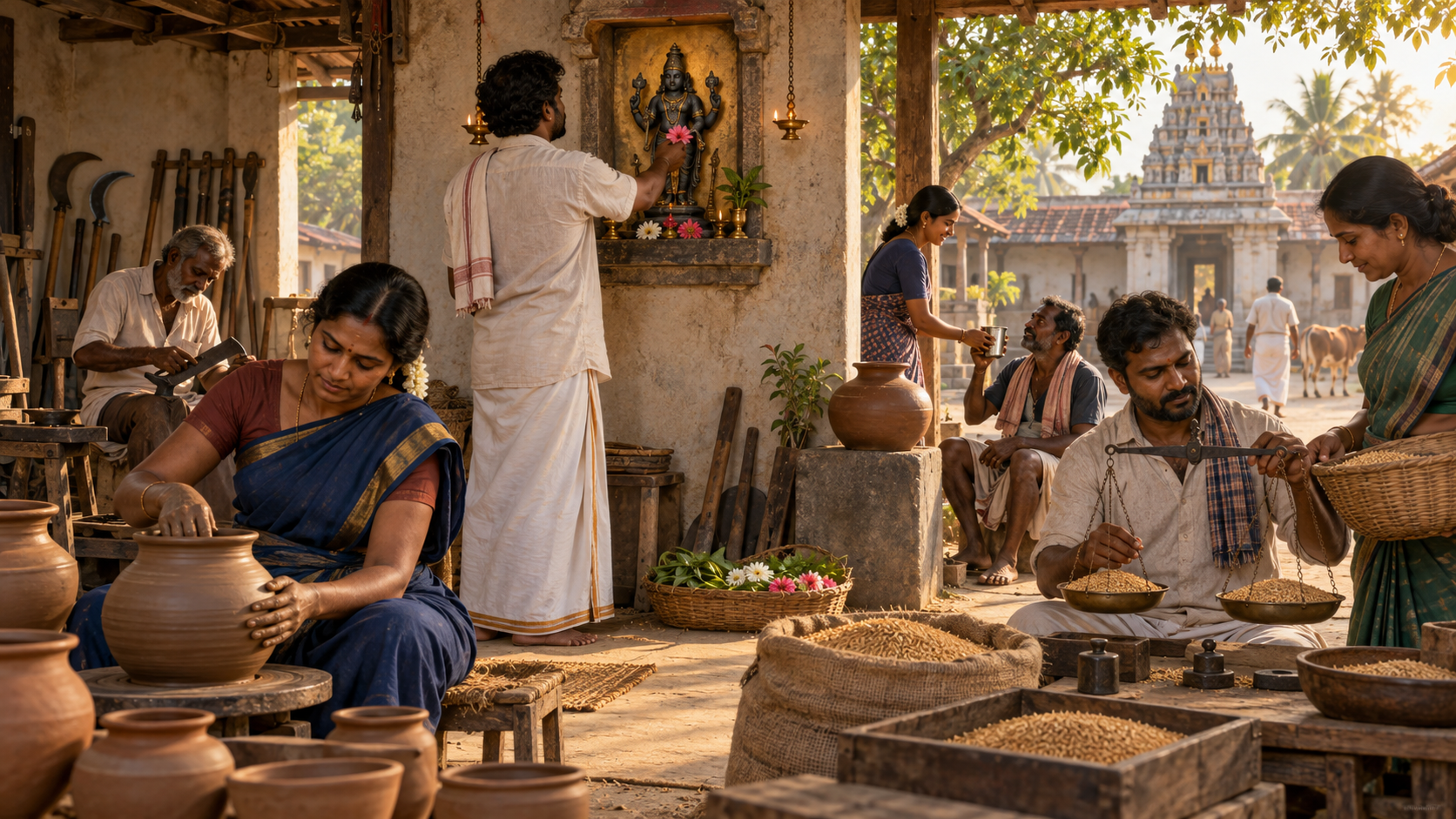
The Amara Narayana temple near the matha is not an optional side visit. It supplies the devotional ground from which Tatayya’s remembered life emerges. His parents, Kondappa and Muddamma, are remembered as worshippers of Amara Narayana who offered flowers and prayed for a child. Tatayya’s birth was received within the tradition as the answer to that prayer, and Amara Narayana became his ishta-devata.
This family memory is linked to an unusually concrete teaching about vocation. Kondappa and Muddamma followed the traditional occupation of balegaras, or bangle sellers. In the ethical ideal attached to that vocation, the bangle seller occupied a position of exceptional trust because his work involved touching a woman’s hand while fitting bangles. He was therefore expected to see every woman as Jaganmata-svarupa, a manifestation of the Divine Mother.
You do not need to reproduce every feature of an older social arrangement to grasp the dharmic principle. The more intimate your professional access to another person, the greater your duty of restraint. Skill does not cancel reverence. Commercial exchange does not turn a human being into an object. Trust granted by a role creates obligations beyond the minimum required to complete the transaction.
Apply that principle to your own work by asking three questions:
- What private space, personal information, physical proximity or emotional vulnerability does my role give me access to?
- What restraint should accompany that access even when no written rule forces it?
- Would my conduct change if I consciously saw the person before me as bearing sacred dignity rather than merely serving a function in my day?
This is a central clue to the Sadguru tradition. Dharma is not confined to the sanctum or the hour of meditation. It enters the marketplace through the way a vocation is performed. A visit to Amara Narayana’s temple should therefore send you back to your own occupation with a sharper standard of conduct.
Read Tatayya’s vani without reducing it to quotations
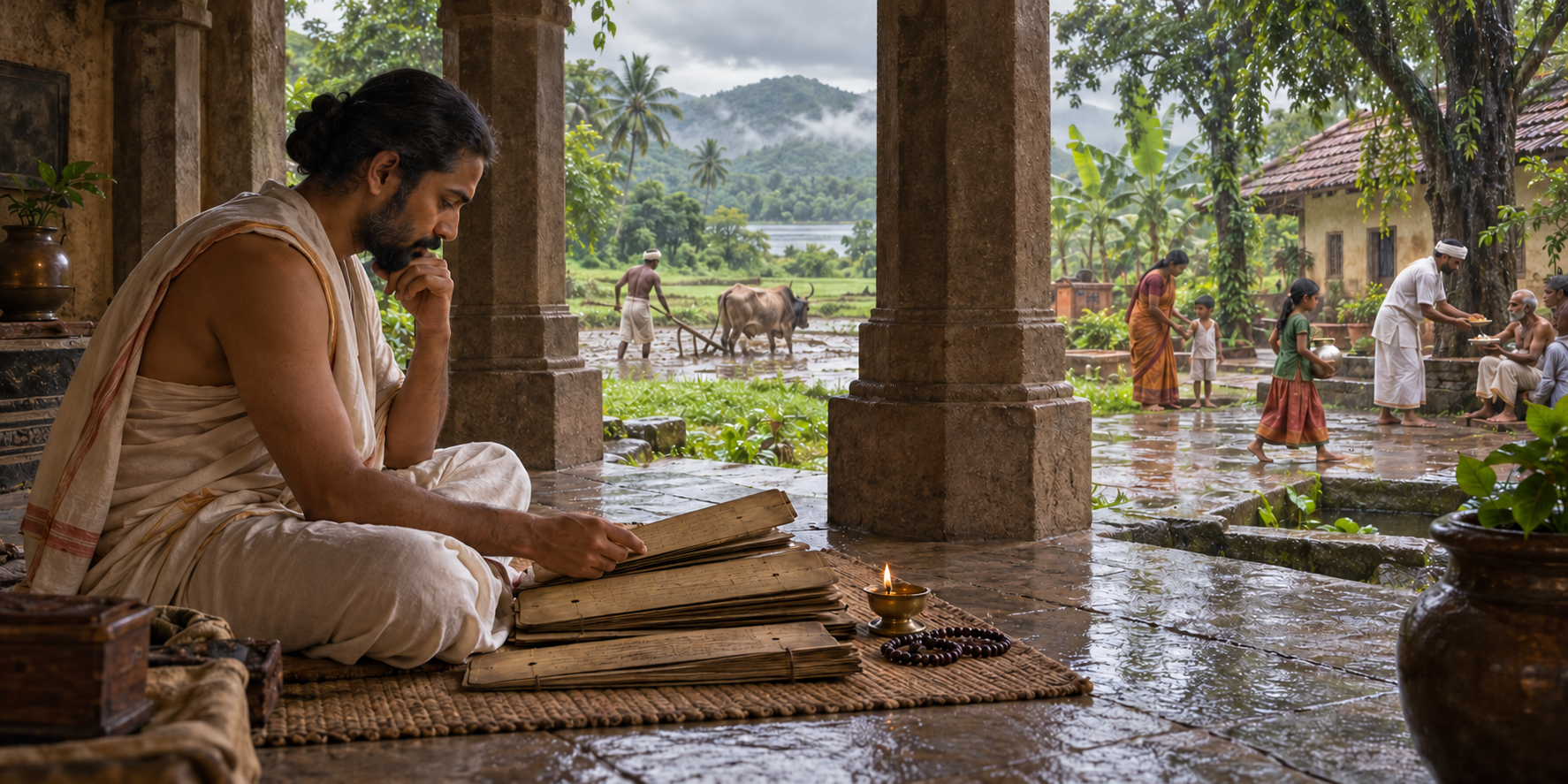
Tatayya was also a kavi whose vani moved through Kannada and Telugu. The works associated with him include the Amara Narayana Shataka, Kalajnana and Brahmanandapuri Shataka. Their names give you starting points, not shortcuts. A title detached from its language, full passage and devotional setting can easily become a screen onto which a modern reader projects whatever he already wants to believe.
Use a disciplined reading method:
- Identify the language and edition. Tatayya’s bilingual legacy makes it especially important to know whether you are reading Kannada, Telugu, a transliteration or a translation.
- Record who translated the passage. A translation is an interpretation, even when made with care. Do not silently treat it as identical to the original wording.
- Read the complete poetic unit. A memorable line can change meaning when separated from the verses around it.
- Separate Tatayya’s words from later explanation. Mark commentary, oral interpretation and institutional tradition as such. All may be valuable, but they do different work.
- Track recurring terms. Note repeated references to the deity, guru, mind, conduct, time, liberation or spiritual practice rather than building a conclusion around one dramatic phrase.
- Return the words to practice. Ask what the passage requires you to notice, restrain, remember or do. Upadesha that never reaches conduct has been turned into ornament.
The bhajana tradition at the matha supplies an important corrective to purely textual reading. Vani here is not only material to be analysed on a page. It is voiced, repeated and heard in company. Study the words closely, but also notice what happens when a community sings them. The literary and devotional forms illuminate different dimensions of the same inheritance.
Reverence needs both openness and discrimination
A healthy encounter with a Sadguru tradition avoids two easy mistakes. The first is credulity: accepting every circulating claim merely because it sounds devotional. The second is reductionism: assuming that anything transmitted through reverence must be historically worthless. Both reactions prevent you from seeing the tradition on its own terms.
Keep three levels distinct. First are things you can directly observe at Kaivara: the matha, the Amara Narayana temple, the murti, the sacred samadhi site, bhajana, pradakshina, devotees and annadana. Second are affirmations preserved within the tradition, including Tatayya’s entry into jiva samadhi and the understanding of his birth as Amara Narayana’s grace. Third is your own interpretation of what these things mean spiritually. Clarity about the level of a claim lets you remain receptive without becoming careless.
Key takeaways
- Approach Tatayya through five connected anchors: Amara Narayana, sadhana, vani, Kaivara and seva.
- Treat the matha as a place of practice. Listen, offer namaskara, perform pradakshina, sit quietly and participate respectfully in annadana when available.
- State the jiva samadhi claim as the sacred tradition of the matha when speaking in a historical or public setting.
- Carry the balegara ideal into your own occupation: privileged access to another person creates a higher duty of restraint and reverence.
- When reading Tatayya, identify the original language, edition, translator and boundary between verse and commentary.
- Judge your encounter by its effect on conduct, not by the number of stories, quotations or photographs you collect.
Your next step can be small and exact. Visit Kaivara with one question, listen closely to one kirtana, or study one complete passage from a text associated with Tatayya. Keep four headings in your notes: deity, teaching, conduct and community. That will show you whether you are meeting a coherent spiritual path or merely accumulating impressions.
The most fitting response to a Sadguru is not fascination without consequence. Let Tatayya’s name return you to your speech, work and treatment of other people with a direct question: what has this upadesha asked you to do differently? That is where a visit to Kaivara begins to become sadhana.
References

Leave a Reply
You must be logged in to post a comment.