
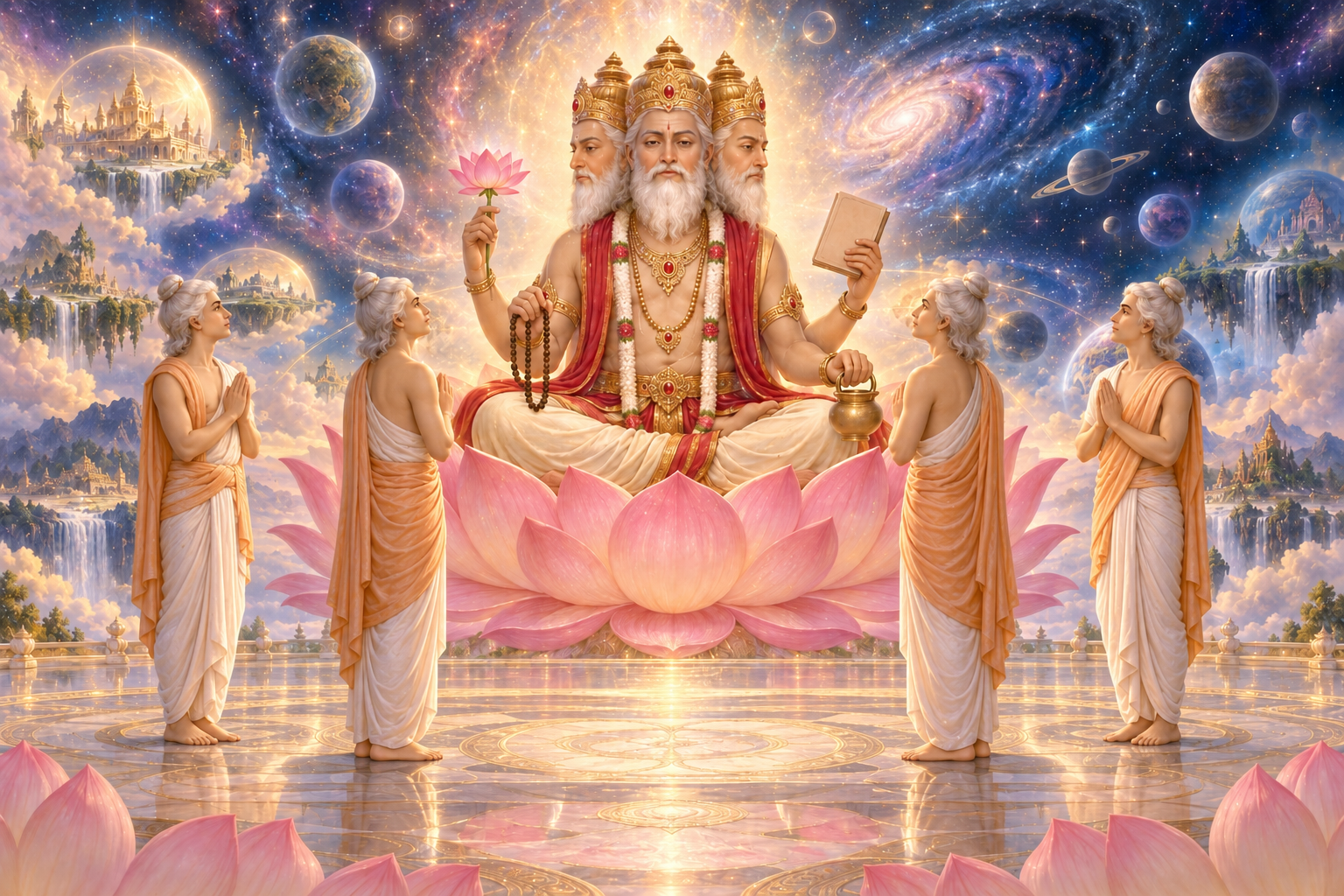
You may understand the individual figures yet still find the scene puzzling. Why does the creator bring forth sons who will not continue creation, and why is Brahma shown with four heads? Read as an inner map, the apparent contradiction becomes the point.
The Sanat Kumars show the mind before it becomes entangled in the world it perceives. Brahma’s four heads show that same intelligence facing multiplicity, making distinctions and participating in creation. You need both capacities: the freedom not to be carried away by experience, and the discernment to act within it.
One sacred scene, two movements of mind
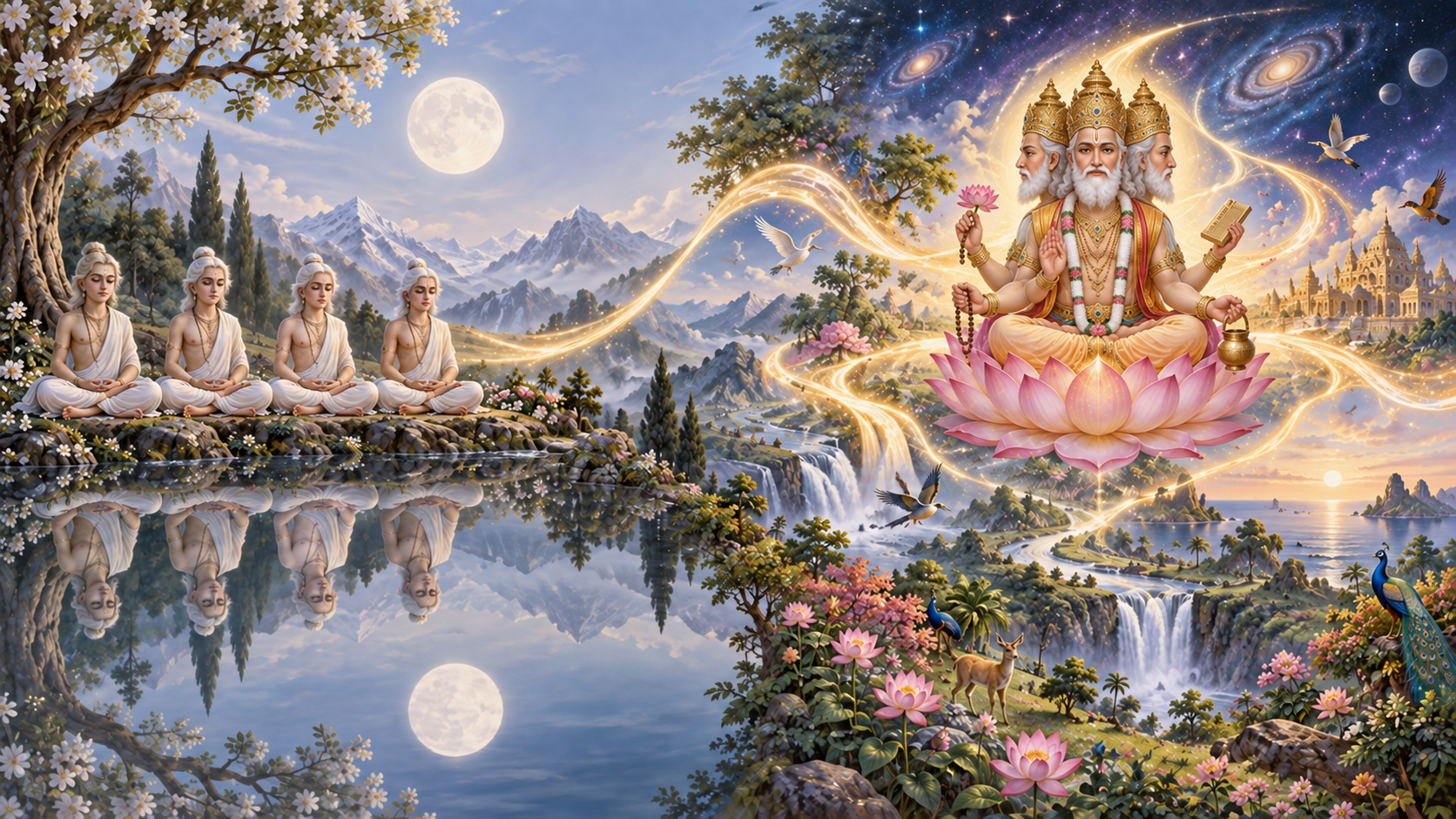
In the Puranic vision, Brahma is more than a craftsman assembling a material universe. He embodies cosmic intelligence: the ordering power through which an undivided possibility becomes a world of forms, names and relationships. His children and his form can therefore be read as expressions of intelligence itself.
The mind-born Sanat Kumars and the four-headed form of Brahma present a contrast between still awareness and intelligence turned toward manifestation. The Kumars arise from mind but do not take up the work of generating further worldly life. Brahma, meanwhile, faces the created field in its many-sidedness.
This is a symbolic reading, not a claim that the deities are merely parts of human psychology. A sacred image can speak at cosmic, devotional and contemplative levels without one level cancelling the others. Here, the contemplative level gives you a practical question: what happens within your own mind between simple awareness and involvement with an object?
The word world has a precise meaning in this question. It does not mean that the earth disappears when the mind becomes quiet. It means the personally constructed world of my success, my insult, my possession, my fear and my desired future. An object may be present without yet becoming part of that possessive network.
Mind before the world is therefore not blankness, sleep or incapacity. It is lucid awareness before an experience has been seized, labelled and extended into a personal drama. Mind after the world appears is the same intelligence engaged in difference, relationship, intention and action.
Do not treat this as a one-time sequence located at the beginning of the universe. You can watch it recur whenever a sound becomes an annoyance, praise becomes a new identity, or a delayed reply becomes a story about rejection. The symbolic sequence is useful because it slows down a movement that ordinarily feels instantaneous.
The Sanat Kumars represent thought without proliferation

The Kumars are born of mind, yet they do not multiply creation through descendants. At the psychological level, that refusal represents a rare capacity: a thought can arise without being compelled to produce a chain of further thoughts, desires and actions.
Most inner entanglement is created through continuation. You see something. The mind names it. The name acquires a value. The value is related to your identity. Memory supplies supporting evidence. Imagination predicts a future. An urge then appears to defend, possess, avoid or repeat the experience. By the end of the chain, you are no longer responding only to what happened. You are responding to a world the mind built around it.
The Kumar state interrupts that multiplication. It does not require you to deny what you saw or felt. It asks whether the first perception must become the beginning of an entire inner lineage.
Suppose someone criticises your work. The spoken words are one event. Bodily tension is another. The conclusion that you are not respected is an addition. Rehearsing old grievances is another addition. Imagining a future confrontation extends the chain again. The Sanat Kumar symbol directs attention to the interval in which each addition could arise but does not have to.
That is different from suppression. Suppression says, I must not have this thought. Non-proliferation says, This thought has appeared, but I do not have to feed it. The first position creates a struggle with the mind. The second sees the thought clearly while withholding further investment.
You can test the distinction with one question: What is present before I finish the story about it? Look for the bare perception, feeling or fact. If anger remains, acknowledge anger. If uncertainty remains, acknowledge uncertainty. The purpose is not to manufacture serenity. It is to stop confusing the immediate experience with everything subsequently built upon it.
Brahma’s four heads show intelligence facing multiplicity
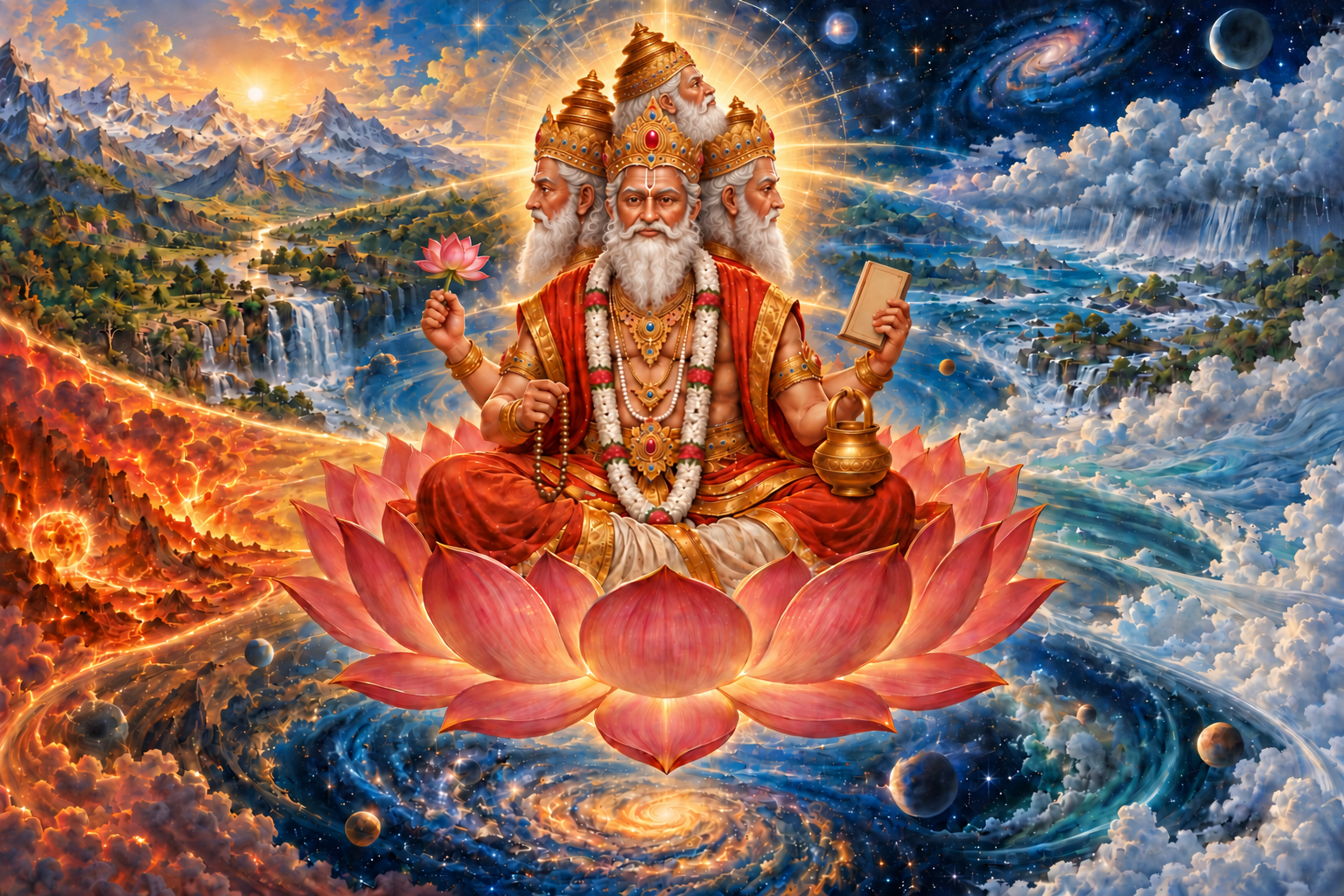
Creation requires distinctions. To form a world is to distinguish this from that, before from after, cause from consequence and one responsibility from another. Brahma’s many-sided gaze can be read as intelligence turning toward a field that can no longer be approached as a single undifferentiated object.
The contrast with the Kumars is not a contest in which stillness is holy and creation is a mistake. Outward-facing intelligence makes language, duty, craft, family life, learning and deliberate action possible. The difficulty begins when the mind forgets that its categories are instruments and starts treating every label, preference and fear as absolute.
A useful reading of the four heads is therefore breadth of orientation. The engaged mind must look around rather than cling to its first angle. When you are caught in a problem, ask:
- What fact is receiving my attention?
- What judgement have I added to that fact?
- What identity am I trying to protect or enlarge?
- What consequence will follow if I act from this state?
These questions are a diagnostic exercise, not a claim that each traditional head has one fixed psychological label. Forcing the image into a rigid chart would make the symbolism narrower than it needs to be. Its practical force lies in the contrast: awareness can remain unbound, and intelligence can also turn toward a complex world.
Brahma’s mode is needed when a decision must be made. The Kumar mode is needed so that the decision is not dictated by the first desire or fear to arise. Stillness without engagement can become withdrawal from duty. Engagement without stillness becomes compulsion. Mature discernment moves between them.
This also corrects a common misunderstanding of detachment. Detachment does not mean refusing to care about outcomes or abandoning your responsibilities. It means that attention is not owned by the object in front of it. You can examine the object, decide what dharma requires and act without making the result the sole foundation of your identity.
Use the image when thought turns into a personal world

The symbolism becomes useful when you apply it to an actual event rather than admiring it as an abstraction. Choose a recent situation that still produces a mental replay: an unanswered message, a disagreement, a coveted purchase or a decision you keep postponing. Then work through the following sequence.
- State the observable fact. Write a sentence that does not assign a motive. The reply has not arrived is a fact. I am being deliberately ignored is already an interpretation.
- Locate the first addition. Complete the sentence From this fact, I added the thought that… This identifies where perception began generating a private world.
- Notice the identity being formed. Ask who you become inside the story: the neglected person, the superior person, the threatened person or the person who must win. Identity makes a passing thought feel non-negotiable.
- Allow the chain to stop. Let the sensation and uncertainty remain without immediately explaining them. This is the Kumar movement: mind is present, but it does not produce another generation of conclusions.
- Turn toward dharmic action. Now use Brahma’s outward-facing intelligence. What response is truthful, restrained and appropriate to your responsibility? You may need to send a clear follow-up, apologise, set a boundary, gather more information or simply wait.
Consider the unanswered message. Returning to still awareness does not prove that everything is fine, nor does it prove that the other person has good intentions. It removes an unsupported conclusion. Once that conclusion loosens, you can decide whether to follow up or change your plan on the basis of the situation rather than imagined motives.
Use the exercise before sending a charged response, after a meditation period, or whenever the same scene keeps replaying without producing new information. Repetition is the clue. Productive thought discovers something or prepares an action; proliferation merely strengthens the emotional reality of its own story.
Do not turn the Kumar ideal into an excuse for passivity. If harm, dishonesty or neglected duty is plainly present, refusing to name it is not spiritual clarity. Pause long enough to separate fact from projection, then face the relevant facts fully. The movement back to stillness is meant to free action from compulsion, not to eliminate action.
Likewise, do not make mental blankness the goal. A mind incapable of discrimination cannot carry out dharma. The image asks for mastery of movement: remain inwardly unpossessed when no action is needed, and become intelligently responsive when the situation calls you into the world.
Key takeaways
- Brahma represents cosmic intelligence becoming active as an ordered, differentiated world.
- The Sanat Kumars symbolise the mind’s capacity to let awareness or thought arise without multiplying it into attachment and compulsion.
- Brahma’s four-headed form can be read as intelligence facing the many-sided demands of manifestation, not as a condemnation of worldly life.
- The practical discipline is to separate the fact, the interpretation, the identity and the resulting urge before choosing a responsible action.
The next time an experience begins constructing a whole world inside you, do not argue with the completed story. Return to its first addition. Let the chain rest, then look outward again and do what the situation actually requires. In that movement, the stillness of the Kumars and the creative intelligence of Brahma become parts of one disciplined mind.
References

Leave a Reply
You must be logged in to post a comment.