

You want to honour Surya Bhagawan on the right day, but you may not have a detailed family procedure to follow. The safest approach is to get the tithi right, preserve any practice your household has inherited, and keep the worship simple enough to perform with attention.
For 2026, the date to mark is November 15. What gives the observance its identity, however, is not merely that civil date. It is Kartik Shukla Shashti: the sixth lunar day of the bright half of Kartik.
Begin with the tithi, not a generic Sun-worship date

Surya Shashti is observed on the sixth day of Shukla Paksha in Kartik, and in 2026 it falls on November 15. Shukla Paksha is the waxing half of the lunar month, beginning after Amavasya and moving toward Purnima.
The distinction between date and tithi matters. A civil date runs from midnight to midnight, while a tithi follows the relationship between the Sun and Moon and may begin or end during a civil day. That is why two calendar displays can appear confusing even when they are describing the same lunar observance.
If you are arranging worship for yourself, use November 15 as your planning date and check a panchang prepared for your location before fixing the exact time. If you are organising a temple or community observance, confirm the local timing with the officiating priest rather than copying a schedule from another city. Location can affect which part of a tithi is available locally.
Put three entries in your calendar: one for confirming the local panchang, one for preparing the worship space and offerings, and one for the observance itself. This prevents the most avoidable mistake: discovering on the morning of the vrata that a necessary family or temple arrangement was never made.
Why Kartik Shukla Shashti has a distinct place
Both Shukla Paksha Shashti and Saptami are associated with worship of Surya Bhagawan, but Kartik Shukla Shashti is regarded as especially auspicious. That gives you a clear answer if you are deciding which day to prioritise for this particular observance: choose Shashti.
This does not make worship on Saptami improper. A household may maintain a related Saptami practice, a temple may follow its established programme, or a regional tradition may extend the devotion beyond one tithi. The special place of Kartik Shukla Shashti identifies the principal day; it does not require you to erase compatible customs around it.
Approach the day as worship, not as a search for ritual novelty. Surya is encountered through the light by which daily life becomes possible, so the observance naturally lends itself to gratitude, steadiness and honest self-examination. Ask what in your life needs greater clarity, punctuality or discipline. A sankalpa tied to a real duty is more meaningful than an elaborate promise that will be forgotten after the festival.
A simple home worship sequence when you lack a family manual
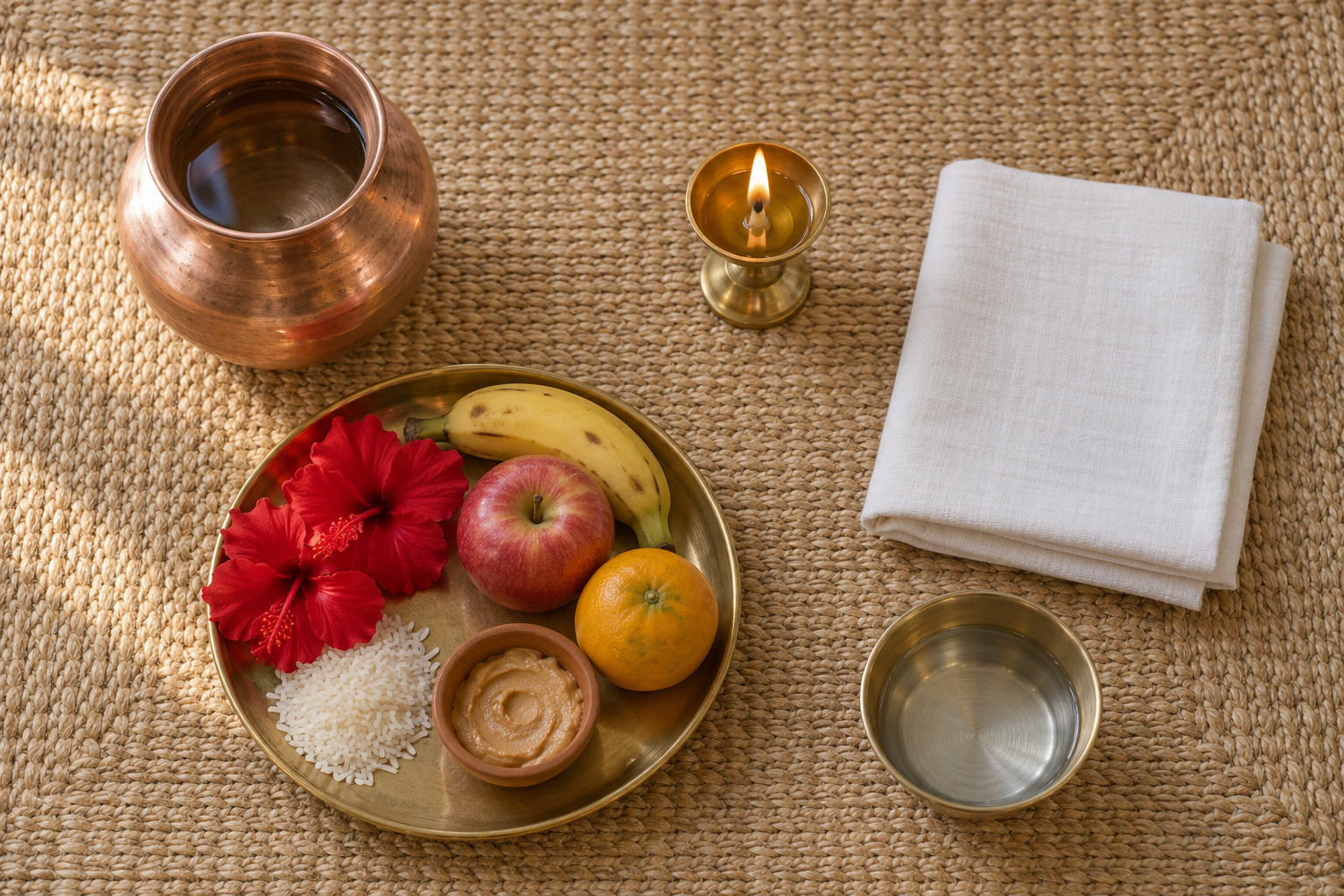
There is no need to manufacture precision where your tradition has not supplied it. Numbers of offerings, particular flowers, long recitations and severe vows should not be presented as universal merely because they appear on a checklist. If your family or sampradaya has a defined vidhi, follow it. Otherwise, the following restrained sequence gives you a coherent home observance without pretending that every Hindu household performs the same rite.
- Confirm the local observance time. Check a location-appropriate panchang or ask a trusted temple. Do this before the day itself, especially if other family members will participate.
- Prepare a clean place. Set aside an uncluttered worship area and arrange only the items you already understand how to use. Clean water and a lamp may be sufficient for a modest observance; inherited household practice should determine anything more elaborate.
- Begin in a composed state. Bathe or wash as your circumstances allow, wear clean clothing and silence avoidable distractions. The purpose is to make attention available for worship, not to turn external preparation into a display.
- State your sankalpa. Name Surya Bhagawan, the Kartik Shukla Shashti observance and the duty or quality you intend to strengthen. Keep the intention concrete: regularity in prayer, truthfulness in work, care for family responsibilities or better use of daylight are commitments you can actually examine later.
- Offer your worship. Join your palms and offer pranam. If offering water to Surya is part of your practice, do so reverently and in a place where the water will not create a hazard. Never stare directly at the Sun. If outdoor worship is impractical, maintain the devotional act at your home shrine rather than abandoning it.
- Recite what you know correctly. Use a Surya mantra, prayer, stotra or divine name already taught in your home or tradition. If you have not learned one, speak a short prayer of gratitude in a language you understand. Sincere, attentive words are preferable to hurried syllables copied without guidance.
- Conclude according to household custom. Offer aarti or pranam if that belongs to your practice, share appropriate prasad, and remember the sankalpa you made. Keep the conclusion orderly rather than allowing the observance to dissolve into distraction.
If children are participating, give them one visible responsibility: arranging the clean space, carrying a non-breakable item or joining the final pranam. Participation teaches more than a dense explanation delivered while adults perform everything for them.
Preserve family discipline without declaring every custom mandatory
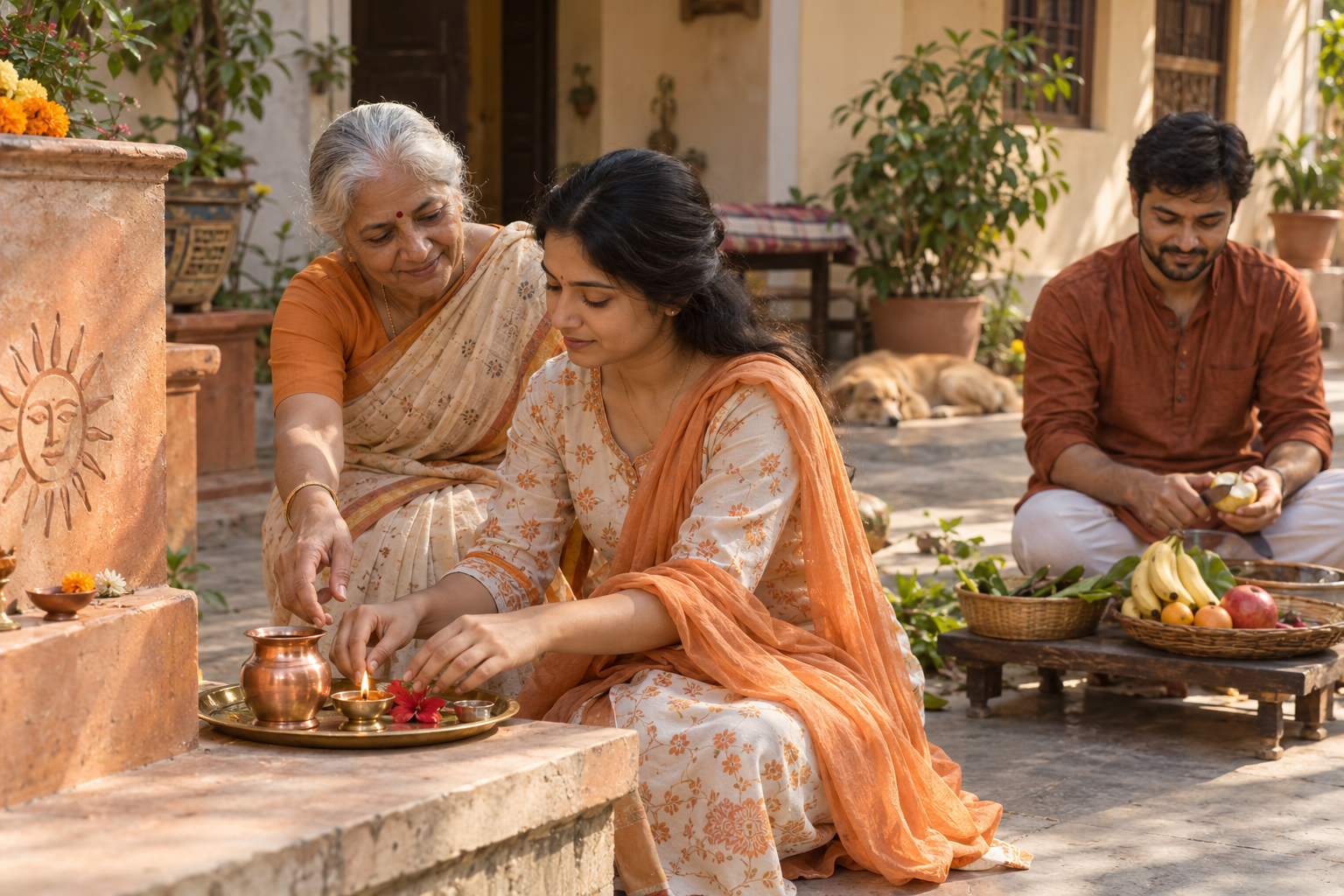
Surya Shashti may look different across households and regions. That variation is not a problem to be solved by assembling every available practice into one oversized ritual. It is a reason to identify which authority governs your own observance.
Before adding a rule, ask three questions:
- Is this practice part of our inherited family or regional tradition?
- Has a guru, acharya or officiating priest prescribed it for this observance?
- Do we understand its purpose well enough to perform it respectfully?
If the answer to all three is no, treat the practice as optional until you receive reliable guidance. This is particularly important with fasting. Do not undertake a severe fast merely to make the day appear more devout. If fasting belongs to your tradition but conflicts with a health condition, pregnancy or prescribed medication, seek qualified medical advice and ask a trusted religious guide about an appropriate adaptation. Worship should not depend on concealing a preventable health risk.
For a family observance, settle differences before Shashti. Ask the elder who carries the household practice what is essential, what is optional and what should not be changed. For a community event, publish the tithi, local time and expected items clearly. Do not pressure attendees to adopt a household-specific vrata as though it were the only authentic expression of Surya worship.
The fixed centre is straightforward: Surya Bhagawan is the deity of the observance, Kartik is the lunar month, and Shukla Shashti is the principal tithi. Around that centre, let legitimate family, regional and sampradaya customs remain recognisable.
Key takeaways
- Surya Shashti in 2026 falls on November 15.
- The defining time is Kartik Shukla Shashti, so confirm the local tithi rather than relying only on a midnight-to-midnight date.
- Shashti is the day to prioritise for this observance, even though Shukla Paksha Saptami is also associated with Surya worship.
- If your family has an established vidhi, preserve it. If it does not, use a simple sequence of cleanliness, sankalpa, prayer, offering and pranam.
- Do not imitate strict fasting, exact repetition counts or unfamiliar ritual details without appropriate guidance.
Before November 15 arrives, confirm your local timing and ask one knowledgeable person in your family or temple what must be prepared. Then choose one realistic discipline to carry beyond Shashti. The worship will have done its work when the clarity you seek from Surya becomes visible in how you use the following morning.
References

Leave a Reply
You must be logged in to post a comment.