

You want the steadiness of an ashram without neglecting the people who depend on you. The difficulty is not a lack of sincerity. A household has school mornings, income to earn, elders to care for, meals to prepare and a spouse whose duties matter as much as yours. A discipline that ignores those realities will soon become either unsustainable or unfair.
The workable path is to carry the inner logic of renunciation into ordinary duties. Self-command replaces impulsiveness. Simplicity replaces accumulation. Sacred attention comes before voluntary distraction. Service takes priority over spiritual display. Vedanta need not remain the preserve of a recluse; it can be practised from hearth and home.
Renounce compulsion, not household responsibility
A renunciant discipline and a renunciant social position are not the same thing. A householder should not imitate every external condition of monastic life. Leaving dishes for someone else because you were meditating, withholding necessary expenditure in the name of simplicity, or becoming unavailable to your children does not turn neglect into tapasya.
Translate each discipline by asking what it is meant to train. Few possessions train freedom from dependence on possessions. A fixed schedule trains steadiness when the mind wants an easier option. Sexual restraint trains mastery over appetite. Service trains humility and loosens the demand to be the centre of every situation. These aims remain available inside family life even when their outward forms must change.
- Translate material austerity into deliberate simplicity: own what serves a real purpose, maintain it and stop using acquisition as consolation.
- Translate obedience to an ashram schedule into a reliable household rhythm agreed with the people affected by it.
- Translate celibate self-command into faithful, respectful and mutually governed sexuality appropriate to your vows and stage of life.
- Translate institutional service into dependable care for spouse, children, elders, guests, colleagues and community.
- Translate tolerance of discomfort into the ability to meet inconvenience without making everyone else absorb your frustration.
The test is visible in conduct. If your practice makes you more dependable, attentive, honest and ready to serve, renunciant training is entering household life. If it makes you controlling, self-important or chronically unavailable, you are protecting an image of austerity rather than its purpose.
Write a household rule that can survive a difficult day
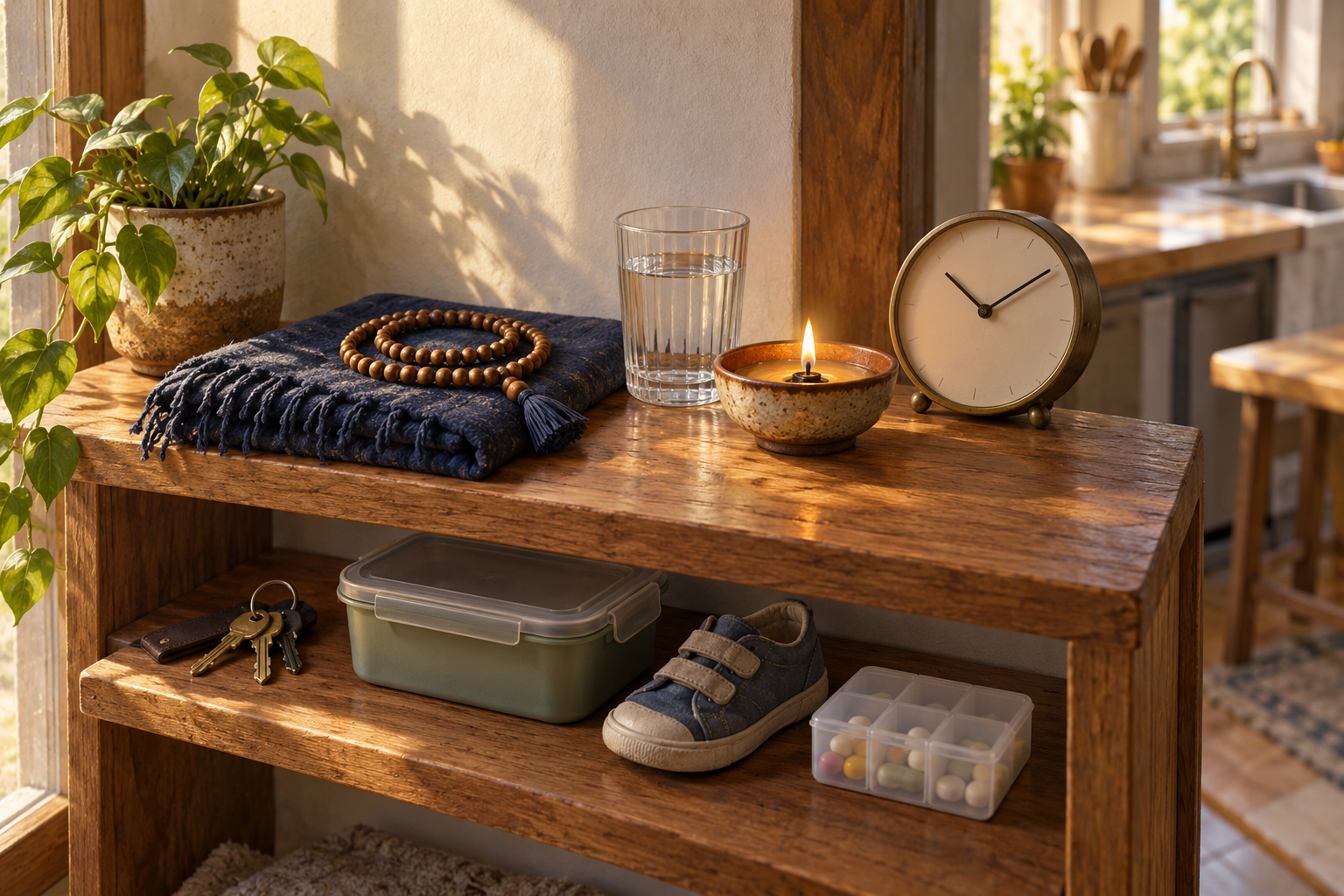
Good intention is too easy to renegotiate. Write a short rule of life in verbs: rise, remember, serve, clean, work and examine. Keep it simple enough to follow during travel, illness in the family or an unusually demanding workday.
- Anchor your waking. Choose a realistic rising time or window that accounts for sleep, shift work and caregiving. Once awake, do not conduct a debate with yourself in bed. The point of rising at the appointed time is to train the mind to obey a considered decision, not to prove holiness through exhaustion.
- Give your first voluntary attention to the sacred. Before news, entertainment or casual messages, chant, pray, meditate or read the text used in your sampradaya. An infant, an ill relative or another urgent duty may rightly come first. Attend to that duty and return to the practice instead of declaring the whole morning lost.
- Define minimum, normal and expanded forms. Your minimum might be the brief prayer, mantra practice or reading that keeps the thread unbroken. The normal form is what fits an ordinary day. The expanded form belongs to days with more room. Decide their contents beforehand so that inconvenience changes the scale of practice, not its existence.
- Reset the spaces you use. Keep the place of worship clean. Put away the book, beads, clothes and work materials you have used. Wash what should not be left for another person. Cleanliness, order and the ability to live with few necessities are practical disciplines precisely because they turn inner intention into visible habits.
- Examine the day without theatrics. Ask whether you kept your duties, where an urge overruled judgement, whom you burdened and what repair is needed. Make the repair directly. Do not convert self-examination into prolonged self-condemnation.
Agree on the household consequences, not only the private aspiration. If you plan to rise earlier, settle who responds to a child during the night. If you want a longer morning practice, decide when breakfast, transport and elder care will happen. A vow becomes dharmic when it is joined to responsibility.
Restrain the senses without turning the home into a barracks

Sense restraint works best as a rule for your own conduct, not as a licence to police everyone around you. Your spouse and children are not junior inmates in a private ashram. Restrictions affecting shared money, food, leisure, intimacy or space require discussion and consent.
For optional consumption, place a pause between wanting and acting. Name the urge plainly: entertainment, recognition, comfort, novelty or escape. Then defer the decision until your planned review rather than purchasing, eating, scrolling or speaking at the first impulse. The aim is not to label every pleasant thing sinful. It is to recover the power to choose.
For possessions, require a place and a purpose. Before bringing home a nonessential item, decide where it will live, what duty it serves and whether something already present serves the same purpose. This converts simplicity from an admired idea into a decision rule.
For sexuality, do not import a celibate rule into marriage unilaterally. The transferable discipline is that appetite does not outrank fidelity, consent, mutual respect or your vows. Intimacy is neither a private entitlement nor an embarrassment to be denied for spiritual prestige. The appropriate discipline must be held together, not imposed by the more austere partner.
For status and comparison, notice when another person’s income, home, recognition or apparent freedom disturbs your own duty. Renunciant training develops freedom from envy of material wealth. In household life, that means refusing to redesign your commitments merely because someone else’s life looks more impressive.
Bare suppression is not the whole method. The mind also needs a worthy direction. Sacred reading, mantra, worship and service give attention a higher object, while disciplined work gives it a present duty. When an urge arises, return to one of those two grounds: what is sacred, and what must be served now.
Let the discipline improve how you work and serve

The office, shop, classroom and kitchen reveal whether practice has become character. A quiet morning means little if you become careless, dishonest or resentful as soon as work begins.
- Use discrimination before urgency takes over. Before opening the stream of requests, identify the duty that most needs honest completion. This applies the trained ability to separate what matters from what can wait.
- Practise undivided attention. When reading scripture or chanting, finish the chosen unit without switching to messages. At work, use the same habit during a chosen task. Sustained attention, purposeful reading and memory are portable fruits of disciplined spiritual training.
- Refuse dishonest shortcuts. Self-sacrifice is not only giving something away. It is also surrendering the advantage that could be gained through concealment, exaggeration or misuse of another person’s trust.
- Make order serve other people. Keep commitments visible, return shared objects, prepare what the next person needs and communicate before a delay becomes someone else’s emergency.
- Receive correction without defending a spiritual identity. Humility is most useful when a spouse, colleague or elder can show you a failure without having to defeat your self-image first.
None of this guarantees promotion, prosperity or admiration. Renunciant discipline is not a technique for making the world reward you. It gives you steadiness when the reward is absent and a clearer basis for deciding which rewards are not worth their price.
Key takeaways
- Do not copy the outer hardship of a monastery when your dharma requires household care; translate the purpose of the hardship into self-command.
- Agree on a realistic waking rhythm and give the first voluntary attention of the day to sacred practice.
- Keep minimum, normal and expanded forms of practice so a disrupted day does not become an abandoned day.
- Apply austerity first to your own impulses. Shared restrictions involving money, intimacy or family routines require mutual agreement.
- Judge the practice by its fruit: greater dependability, cleaner conduct, steadier attention, honest work and less envy.
Begin tonight with one sentence: “After I wake and complete any urgent care, I will ______ before I open or begin ______.” Fill the first blank with a sacred act and the second with your usual voluntary distraction. Tell anyone whom the change affects, prepare the necessary space and follow the sentence when morning comes.
Keep that vow until it feels ordinary. Then add the next discipline where your household actually needs it: possessions, attention, cleanliness, speech or service. A home becomes a place of sadhana through promises that make you more present to dharma and more trustworthy to the people already in your care.
References

Leave a Reply
You must be logged in to post a comment.