

You may feel drawn to stop eating meat as your yoga practice deepens, yet still be unsure what the change should involve. Is it a spiritual commitment, a dietary experiment, a household rule, or all three? The answer matters because a vague promise is difficult to keep and easy to turn into guilt.
The practical connection between yoga and a meat-free diet becomes clearer when you treat eating as part of your practice. Your food should support non-harm, steadiness, attention, and responsible care of the body. It should not become a badge of superiority or an excuse to neglect sound nutrition.
Key takeaways
- Begin with a clear intention such as reducing harm or cultivating self-restraint, not with a label you feel pressured to defend.
- Define what meat-free means in your home, including how you will handle eggs, dairy, travel, hospitality, and additional rules from your tradition.
- Replace the structure of a meal instead of merely removing meat. Include a substantial protein-rich food, a staple, vegetables, and enough variety to make the meal sustainable.
- Judge the transition by steadiness, digestion, energy, recovery, and concentration. Persistent symptoms deserve practical attention, not a spiritual explanation.
- Extend ahimsa to family members, cooks, hosts, and people who make different choices. Harshness does not become yogic because it concerns food.
Begin with a vow you can actually keep

A durable change begins with a reason. You might want to reduce avoidable harm, bring daily conduct closer to ahimsa, develop restraint, or make meals more compatible with meditation and asana. Write your reason in one sentence. If you cannot state it simply, you will struggle to use it when convenience, travel, or social pressure tests the decision.
Then define the boundary. “Meat-free” usually answers only the first question. Your family or lineage may have separate views about fish, eggs, dairy, intoxicants, fasting foods, or ingredients considered unsuitable for a particular observance. Do not bundle every possible restriction into one undefined idea of purity. Decide which rule you are adopting now and which questions remain open.
- State the purpose: “I am doing this to reduce harm and make my daily life more consistent with my practice.”
- State the food boundary: Write down what you will and will not eat instead of deciding again at every meal.
- State the social boundary: Decide how you will respond when travelling, eating at work, or receiving hospitality.
- Set a review date: Revisit the practical results after you have had enough ordinary days to notice patterns.
- Protect health: Allow medically necessary adjustments without treating them as spiritual failure.
This turns a broad aspiration into abhyasa: a discipline you can repeat. It also prevents one lapse from becoming an excuse to abandon the whole effort. If you eat something outside your boundary, identify what made the situation difficult, improve the plan, and return to it at the next meal.
Replace a complete meal, not only an ingredient
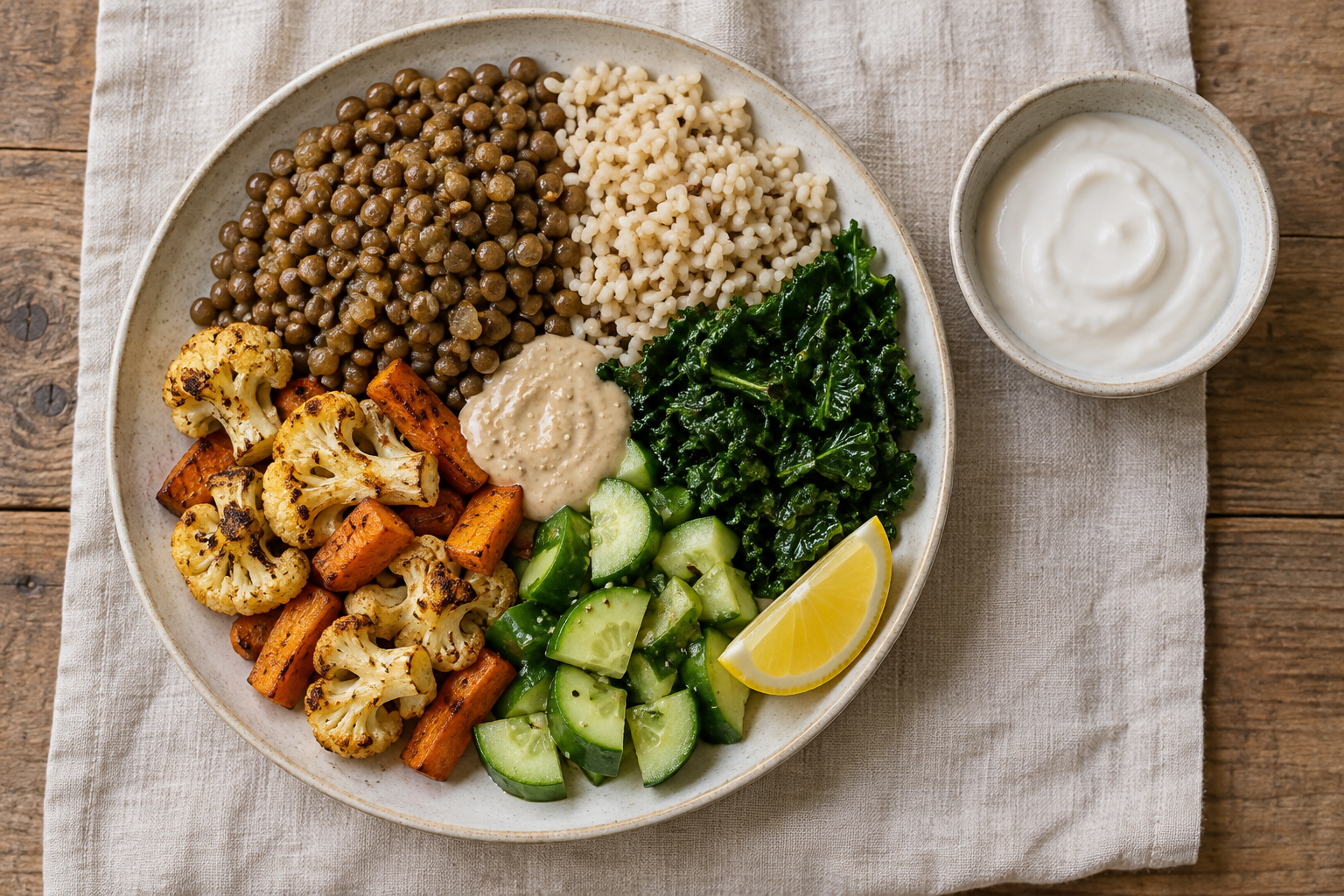
The most common practical mistake is subtraction. Meat disappears, but nothing substantial takes its place. The result may be a plate built mostly from refined starch, fried snacks, sweets, or a token vegetable. It is technically meat-free, but it may leave you hungry, distracted, and unable to sustain the commitment.
Build each main meal around a simple structure. Choose a staple, add a meaningful protein-rich component, include vegetables or fruit, and use enough seasoning and nourishing fat to make the food satisfying. Familiar combinations already do this well: rice or roti with dal, rajma, or chana and sabzi; idli or dosa with sambar; or a grain with beans, tofu, vegetables, and nuts or seeds. If you use dairy, curd or paneer can contribute, but they need not carry every meal.
Start with the meal you eat most predictably. Redesigning one weekday lunch that appears again and again is more useful than planning an elaborate feast you will rarely cook. Once that meal works, repeat the method with breakfast, dinner, and food away from home.
- At home: Keep a few dependable foods available, such as lentils, chickpeas, beans, tofu, curd if you use dairy, nuts, seeds, vegetables, rice, and atta.
- At work: Bring or choose a meal with a recognisable protein-rich component rather than relying on side dishes.
- While travelling: Identify acceptable meals before hunger narrows your choices. Carry a simple backup when the route is uncertain.
- When dining out: Ask whether stocks, gravies, sauces, or garnishes contain ingredients outside your boundary. “Vegetable” in a dish name does not always define the whole preparation.
- When receiving hospitality: Tell the host early and offer to bring a dish. Advance notice is kinder than a confrontation at the table.
A meat-free label cannot tell you whether your diet is nutritionally adequate. Vitamin B12, iron, calcium, iodine, vitamin D, protein, and overall food variety may require attention depending on what you eat and whether you include eggs or dairy. Do not guess your way through a persistent concern. A qualified clinician or registered dietitian can assess your actual pattern and advise whether testing, fortified foods, or supplementation is appropriate.
Professional guidance is especially important during pregnancy or breastfeeding, for children and adolescents, for older adults with reduced appetite, and for anyone with a chronic illness, prior nutrient deficiency, digestive disorder, or history of disordered eating. A spiritual intention does not remove the body’s particular needs.
Let the body give you honest feedback

Yoga asks for attention, and that attention should include the effects of your meals. Notice whether you can practise, work, rest, and serve others with steadiness. Do not assume that every unpleasant response is purification or “detox.” Persistent weakness, dizziness, unusual fatigue, declining concentration, or poor recovery calls for a review of what you are eating and, when symptoms continue or are severe, medical advice.
Meal timing also matters. A large meal immediately before vigorous asana may be uncomfortable, while practising without enough nourishment may leave some people light-headed. There is no universal interval that suits every meal, body, and form of practice. Give yourself enough digestion time to move comfortably, and adjust according to meal size and the intensity of the session.
Fasting is a separate discipline. Do not introduce strict fasting, a major dietary transition, and a demanding physical routine all at once. If you observe a religious fast, adapt the intensity of your asana and follow any medically necessary guidance concerning food or fluids. Self-restraint is not proved by ignoring a dangerous symptom.
A brief private record can keep the assessment honest. Note what you ate, whether hunger returned unusually quickly, how digestion felt, how your practice went, and whether energy remained stable through ordinary duties. You are looking for repeated patterns, not judging a single meal. If a pattern is poor, change the meal’s composition or timing before concluding that meat-free living itself is unworkable.
Keep ahimsa in the way you treat people

Food choices become spiritually distorted when they produce contempt. You may have made a sincere commitment, but another person may be moving gradually, following a different tradition, managing a health condition, or simply remaining unconvinced. You can explain your boundary without turning the shared table into a tribunal.
Use plain language: “I do not eat meat, but I would be glad to share the vegetarian dishes.” If cross-contact or a particular ingredient matters to you, say so politely and specifically. Do not force a host to guess what your practice permits. In your own home, serve food generous enough that meat-free guests and non-vegetarian relatives can eat together without the meal feeling like a punishment.
Ahimsa also reaches beyond the visible ingredient. Avoiding meat while wasting food, humiliating a cook, or treating service workers harshly preserves the rule and loses its spirit. Buy what you can use, learn to store staples, reuse suitable leftovers safely, and express gratitude to the people whose labour brought the meal to you.
Your next step can be modest and exact. Choose one meal you eat often, rebuild it around a satisfying meat-free combination, write down your boundary, and place a review date on your calendar. After practice, ask whether the change is making you less harmful, more steady, and better able to fulfil your duties. Keep what serves those aims. Adjust what does not.
References

Leave a Reply
You must be logged in to post a comment.