
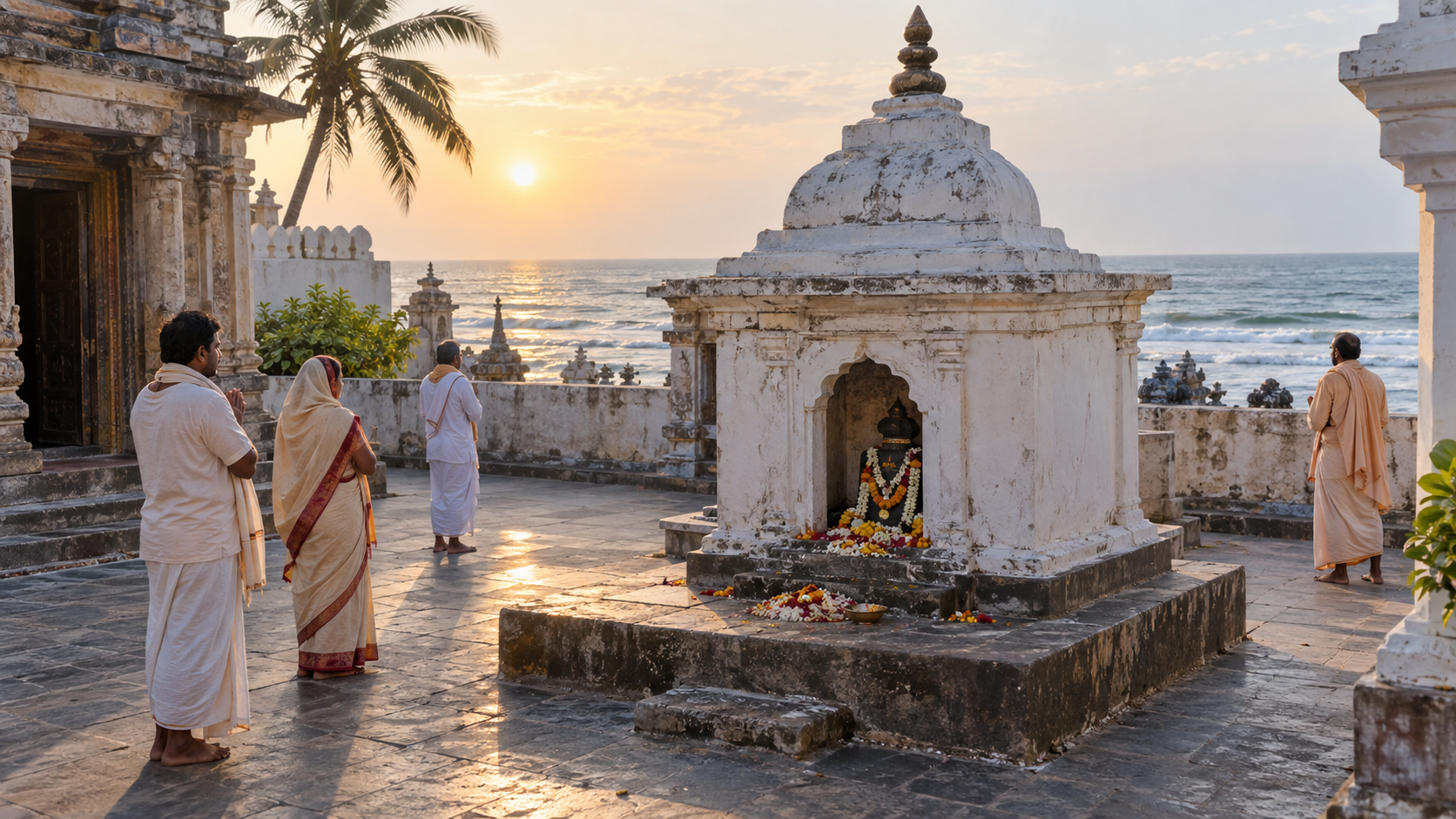
If you are planning to honour Srila Haridasa Thakura in Jagannatha Puri, settle one point before you set out: Siddha-Bakula and Haridasa Thakura’s Samadhi are two different sacred places. At Siddha-Bakula, he lived, practised nama-bhajana, and departed from the body. At the oceanfront Samadhi, Sri Caitanya Mahaprabhu personally placed his body in the sand.
Visit them as two stages of one sacred journey. Siddha-Bakula reveals how Haridasa lived; the Samadhi reveals how Mahaprabhu honoured him. Knowing that distinction turns a quick stop into a coherent pilgrimage.
Key takeaways for your pilgrimage
- Do not use “Siddha-Bakula” and “Haridasa Thakura Samadhi” interchangeably. The former is associated with his residence and departure; the latter is his resting place.
- The Samadhi stands near the oceanfront in the Svargadvara area of Jagannatha Puri, where its central feature is a small tomb in a courtyard.
- Haridasa is honoured as Namacarya, the teacher whose life embodied devotion to Krishna’s holy names.
- His relationship with the Jagannatha Temple must be understood carefully: he remained outside its boundary, yet Mahaprabhu came to him and personally brought Jagannatha prasada.
- If you can choose your date, Ananta-caturdasi is traditionally observed there as the annual commemoration of his departure.
What the oceanfront Samadhi preserves
The word samadhi can refer to profound meditative absorption, but at this site it also denotes a saint’s burial shrine. Haridasa Thakura’s Samadhi is situated near the sea in Puri’s Svargadvara area. The ground was a sandy beach in Mahaprabhu’s time, and part of the surrounding area was used for cremation. The small tomb now visible in the courtyard marks the place where Mahaprabhu interred Haridasa with his own hands.
That setting matters. The sea, the sands, and the neighbouring cremation ground place the shrine amid unmistakable signs of impermanence. Yet the site is not remembered principally as a place of defeat. It preserves the Gaudiya Vaishnava understanding that a life centred on the divine name reaches its fulfilment in remembrance, kirtana, service, and prasada.
Look west of the Samadhi when you enter the courtyard. Three altars enshrine seated forms of Lord Gauranga, Lord Nityananda, and Sri Advaita Acarya. Their posture carries the memory that, after bathing in the ocean, Mahaprabhu would come to the Samadhi, offer prasada, and sit in bhajana. The deities therefore help you read the shrine correctly: Haridasa is not being remembered in isolation, but within the devotional fellowship of Mahaprabhu and his associates.
Pause before moving around the courtyard. Offer pranama, notice the small scale of the tomb, and allow the place to resist the hurried habits of sightseeing. Its significance does not depend on monumental architecture. It rests on the relationship between the devotee, the holy name, and the Lord who personally honoured him.
Why Siddha-Bakula belongs to the same pilgrimage
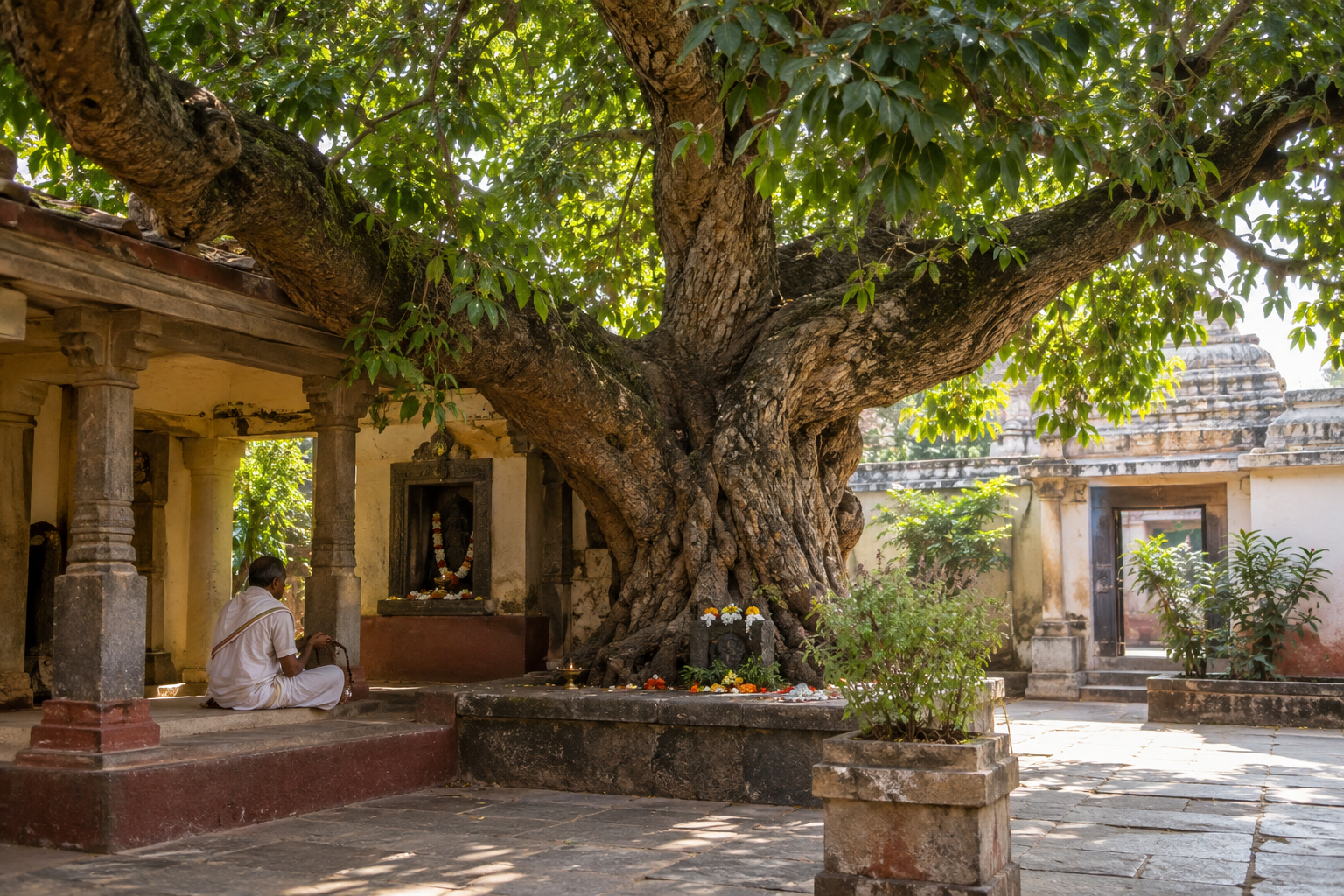
Haridasa Thakura lived in a bhajana-kutira behind the Gambhira at the place now known as Siddha-Bakula. Sri Rupa Goswami and Sri Sanatana Goswami stayed with him when they came from Vrindavana to Puri. This was therefore not merely a private shelter. It became a place of chanting, association, and service within Mahaprabhu’s Puri pastimes.
Within Gaudiya Vaishnavism, Haridasa is honoured as Namacarya, the teacher of the holy name. His daily discipline is described as 192 rounds, or 300,000 names, before his single meal. You need not imitate that extraordinary count to learn from it. Its practical meaning is that chanting was not one activity among many for him. He arranged eating, time, and bodily comfort around the name rather than fitting the name into whatever time remained.
That is a useful standard to carry into your own visit. Decide before arriving what you will offer: one attentive round of japa, a period of quiet hearing, or the maha-mantra recited without haste. A smaller practice completed with attention is more fitting than announcing an ambitious count and spending the visit monitoring your phone or rushing toward the next destination.
Haridasa was born into a family identified in the devotional account as Yavana or Muslim. Because caste-conscious people could have objected to his presence in the Jagannatha Temple, he did not approach the temple and instead offered obeisances to its Cakra from a distance. This restraint should not be misread as evidence that he stood at the edge of Mahaprabhu’s community. Mahaprabhu visited him after attending Lord Jagannatha’s mangala-arati and brought him Jagannatha prasada.
The contrast is one of the site’s most demanding lessons. A social boundary kept Haridasa outside the temple, but it did not determine his spiritual worth. Mahaprabhu crossed the distance himself. For a pilgrim, the response is not to use Haridasa’s humility to justify exclusion. It is to notice how divine grace and devotional recognition overturned the hierarchy implied by birth.
How Mahaprabhu transformed departure into a victory festival
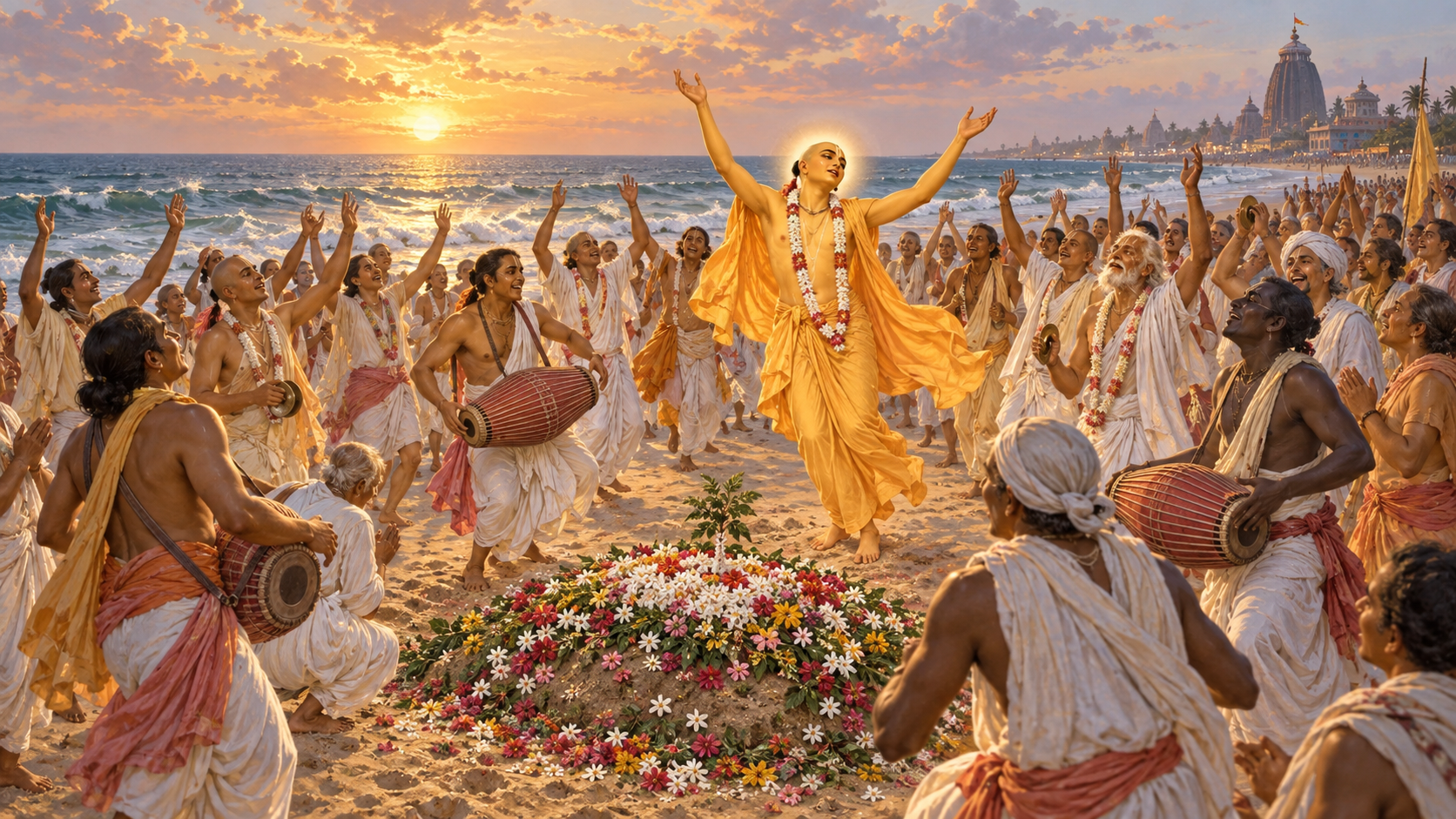
Haridasa’s final passage began at Siddha-Bakula in the presence of Mahaprabhu and the assembled devotees. As his life ended, kirtana filled the gathering. Mahaprabhu took Haridasa’s body into his arms and danced, after which the devotees carried him in a harinama procession to the sea.
At the oceanfront, Mahaprabhu placed the body in the sand, covered it, and established the burial place. He then bathed in the sea, obtained Jagannatha prasada from local shopkeepers, and distributed it among the devotees. Each act gave the community something devotional to do with its separation: chant, carry, bathe, serve, receive prasada, and honour the Vaishnava.
Sri Caitanya-caritamrta, Antya-lila 11, remembers the occasion as haridasera vijaya-utsava, the victory festival of Haridasa Thakura’s passing, as well as haridasa-thakurera niryana, his departure. “Victory festival” does not make bereavement unreal. It identifies what the community believed had triumphed: a life of unwavering nama-bhajana completed in the presence of the Lord and his devotees.
This is why the Samadhi should not be approached only as a historical grave. Its sequence of kirtana, procession, samadhi, bathing, and prasada presents a disciplined devotional response to separation. Grief is neither dismissed nor allowed to become spiritually directionless. It is given the form of remembrance and seva.
How to make the visit an act of nama-bhajana
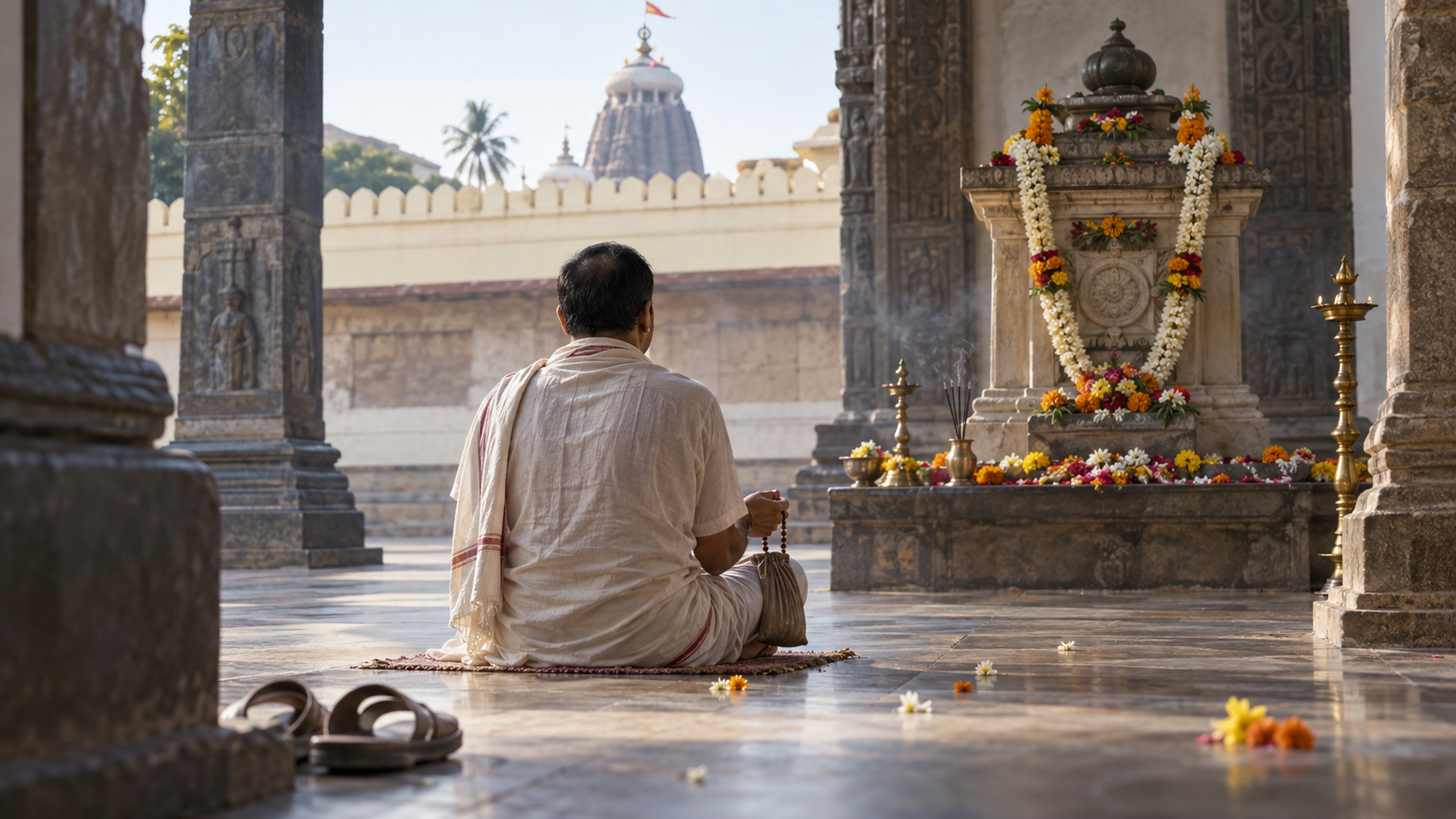
If your schedule permits, begin at Siddha-Bakula and proceed afterwards to the Samadhi near Svargadvara. That order follows the remembered movement from Haridasa’s residence and place of departure to the ocean and burial site. If you can visit only the Samadhi, hold that sequence in mind as you enter.
At Siddha-Bakula, focus on the life that preceded the final procession: sustained chanting, association with Rupa and Sanatana, and devotion maintained without demanding social recognition. At the Samadhi, focus on Mahaprabhu’s response: bodily service to his devotee, public kirtana, burial by the sea, and the distribution of prasada. The two places teach complementary movements—steadfast practice during life and loving honour at departure.
You may chant the maha-mantra associated with Haridasa’s practice: Hare Krishna Hare Krishna, Krishna Krishna Hare Hare; Hare Rama Hare Rama, Rama Rama Hare Hare. Chant in a way that respects the shrine’s current atmosphere. If vocal chanting would interrupt worship already underway, use japa or silent remembrance. Ask the serving devotees before photographing the altar or Samadhi, and follow any instructions given at the site.
Do not rely on an old directional description as if it were modern navigation. The traditional account places the Samadhi on the route from Tota-Gopinatha toward the sea, but contemporary roads, entrances, hours, and local rules can change. Confirm practical details locally and ask specifically for “Haridasa Thakura Samadhi near Svargadvara” so that it is not confused with Siddha-Bakula.
The annual departure observance is held on Ananta-caturdasi. A festival-day visit can offer kirtana and communal remembrance, while an ordinary day may give you more quiet for japa. Choose according to the kind of attention you can actually offer; the spiritual purpose is not improved by choosing a crowded occasion if you will be too hurried to remember why you came.
Before leaving Puri, give these two places one continuous period of attention. Carry a fixed chanting commitment from Siddha-Bakula to the Samadhi, however modest. That simple thread will let you encounter Haridasa Thakura not only as a personality from the past, but as Namacarya—the teacher who still asks you to decide what place the holy name will hold in your own day.
References

Leave a Reply
You must be logged in to post a comment.