
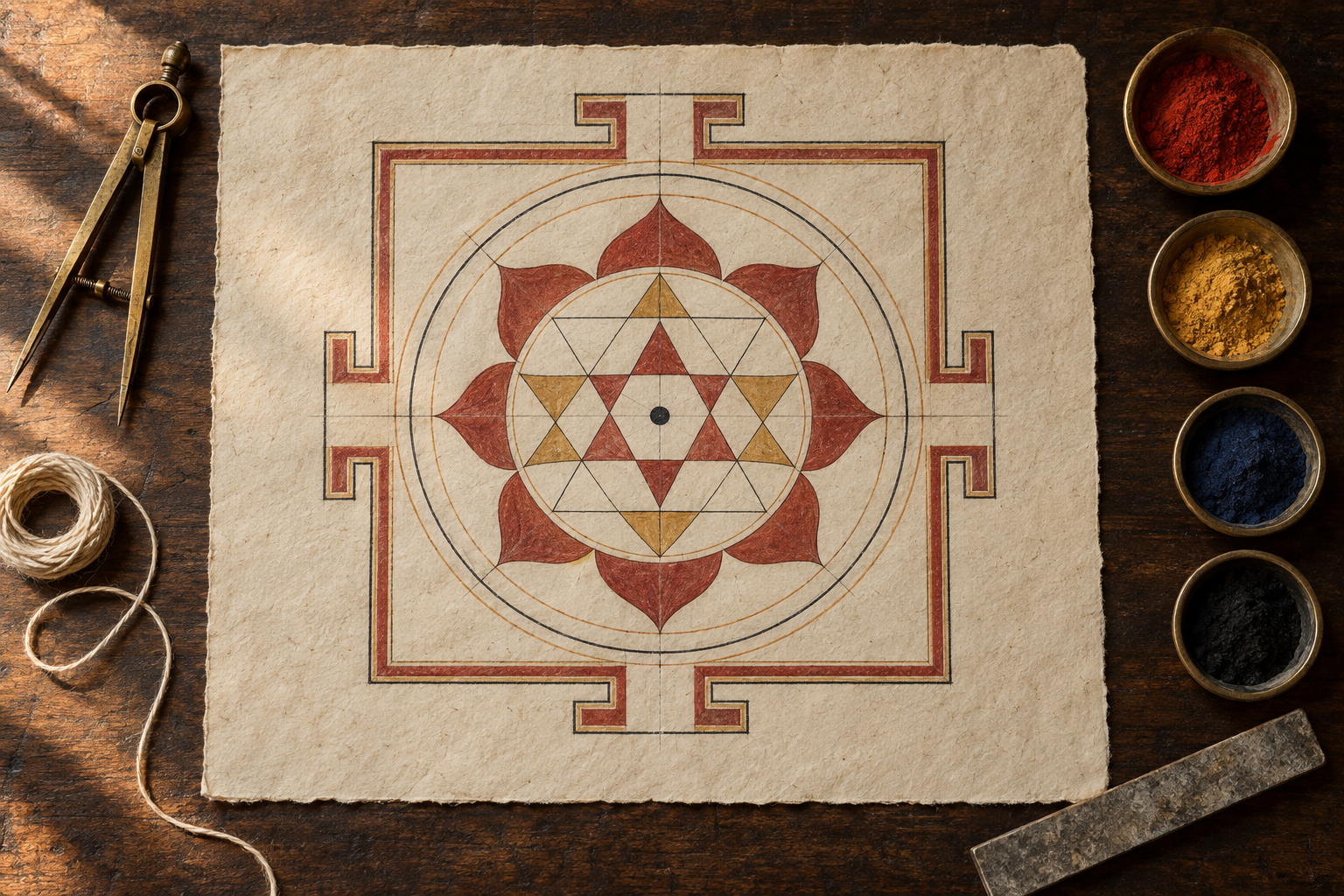
You see a circle enclosing overlapping squares and know that the design is meant to say something. The temptation is to search for a fixed definition: circle equals one idea, square equals another, and the entire image can be decoded like a signboard. That shortcut usually produces a neat answer but a shallow reading.
A better method is to watch what the shapes do to one another. Enclosure, orientation, rotation, crossing, and centering are the real grammar. Once you learn to read those relationships, sacred geometry becomes less mysterious without being reduced to decoration or a rigid code.
Read relationships before assigning meanings
Hindu sacred geometry works through composition. A shape may carry familiar associations, but its meaning changes when it encloses another form, shares a center with it, crosses it, or turns against its axes. In the motif considered here, a circle contains two squares, with one square aligned to the cardinal directions. The important fact is not merely that these shapes are present. It is that they occupy the same field while keeping different geometric characters.
Begin with verbs rather than nouns. The circle encloses. The cardinal square orients. A differently turned square introduces tension and movement. Their common center holds the layers together. This approach prevents you from treating each shape as an isolated emblem.
It also protects against false certainty. Hindu traditions contain many visual languages, ritual settings, and philosophical interpretations. No single dictionary can make every circle or square mean exactly the same thing. Geometry gives you disciplined observations first; context tells you how far an interpretation can responsibly go.
When you encounter a sacred diagram, therefore, separate what you can see from what you infer. “A circle encloses two differently oriented squares” is an observation. “Wholeness contains both ordered form and generative movement” is an interpretation. The second may be persuasive, but keeping the distinction visible stops an illuminating reading from hardening into an unsupported rule.
What the circle and cardinal square establish
A circle has continuity but no corners. Your eye can travel around its circumference without meeting a privileged stopping point. At the same time, a drawn circle creates an inside and an outside. It can therefore suggest an encompassing whole while also defining the field in which manifestation appears.
Do not rush from that visual fact to the word “infinity.” Ask a more useful question: what does the circle contain here? When it surrounds a square, continuity is holding a bounded, directional form. The image places an ordered world within a more comprehensive unity.
The square changes the experience of the field. It has edges, corners, intervals, and an orientation that can be located. When its sides are aligned to the cardinal directions, it evokes an order that can be entered, inhabited, and related to the world of direction. It turns an undifferentiated field into a structured one.
Notice that the circle does not vanish when the square appears. Nor does the square dissolve into the circle. The design preserves both. That matters because the geometry is not presenting unity and structure as mutually exclusive alternatives. Structure exists within wholeness, while wholeness remains greater than the structure it contains.
You can test this relationship by reading the design in both directions. Move from the circumference inward and you see the encompassing field becoming ordered and centered. Move from the center outward and you see a centered order opening into a larger whole. Neither direction needs to cancel the other. The possibility of both readings is part of the image’s strength.
Why the second square changes the cosmological picture
A second square would add little if it merely repeated the first. Its different orientation changes the visual logic. Where its corners fall between the directions established by the cardinal square, the eye encounters alternating points, crossings, and intervals. A settled enclosure begins to feel active.
This is where the image can support a reading in terms of culture, nature, and cosmic desire. The cardinal square can be read as cultivated order: boundaries, orientation, and a world made inhabitable. The turned square can be read as dynamic nature: energy that does not disappear merely because an ordered pattern has been established. The circle contains their relation without declaring that one must destroy the other.
That is a lens, not a universal translation. The same geometric relationship could carry a different emphasis in another setting. Use the nature-and-culture reading when it explains the visible tension between the two orientations and fits the surrounding context. Do not paste it onto every pair of squares you encounter.
The word “desire” also needs care. In this cosmological reading, it need not mean private appetite, temptation, or moral failure. It can name the impulse by which stillness tends toward expression and possibility assumes form. The first square establishes order; the second makes that order visually generative. Geometry gives motion a structure without turning the cosmos into chaos.
This guards against a common misreading. Nature is not simply the disorder outside culture, and culture is not simply a cage imposed upon nature. The two squares occupy the same circle and depend on the same center. Their difference generates the pattern. Remove either orientation and the image loses the tension that makes it cosmologically suggestive.
The center is therefore as important as the perimeter. Even if it is not marked by a separate object, it organizes every surrounding form. The squares can differ in orientation because they remain centered together. When reading the image, ask what permits multiplicity without fragmentation. Geometrically, the answer is the shared center.
A practical method for reading any sacred diagram
You do not need to begin with a catalogue of symbols. Start with the visible construction and delay interpretation until you can describe it accurately.
- Copy the main outlines. Draw only the circle, squares, center, and major axes. Removing ornamental detail lets you see the underlying relationships.
- Name each operation. Record which form encloses, divides, crosses, repeats, turns, or shares a center with another. These actions usually tell you more than a list of symbolic keywords.
- Check the orientation. Determine whether a square is cardinally aligned, turned between established directions, or merely offset. Do not assume that the top of an unfamiliar image represents a particular direction unless its context establishes that fact.
- Follow the eye’s movement. Notice whether the composition leads you inward, sends you outward, circulates around the boundary, or alternates between competing axes. Your visual movement is part of how the diagram communicates.
- Locate the stable element. Ask what remains constant while other forms turn or intersect. In the two-square motif, the shared center can hold different orientations in one ordered field.
- Restore the context. Examine any associated deity, inscription, ritual use, architectural placement, or surrounding imagery that is actually available. If the context is unknown, stop at a careful geometric interpretation rather than inventing a doctrinal identification.
After completing those steps, write two short statements. The first should contain only observable facts. The second should offer your interpretation. For this motif, you might write: “A circle encloses two squares that share a center but not an orientation.” Then: “An encompassing unity holds stable order and dynamic manifestation together.” The first disciplines the second.
A sound interpretation should account for every major form. If your explanation discusses the circle but ignores the second square, it is incomplete. If it depends on a direction that the image does not establish, it is overconfident. If it treats one layer as meaningless decoration, check whether that layer changes the balance or movement of the whole.
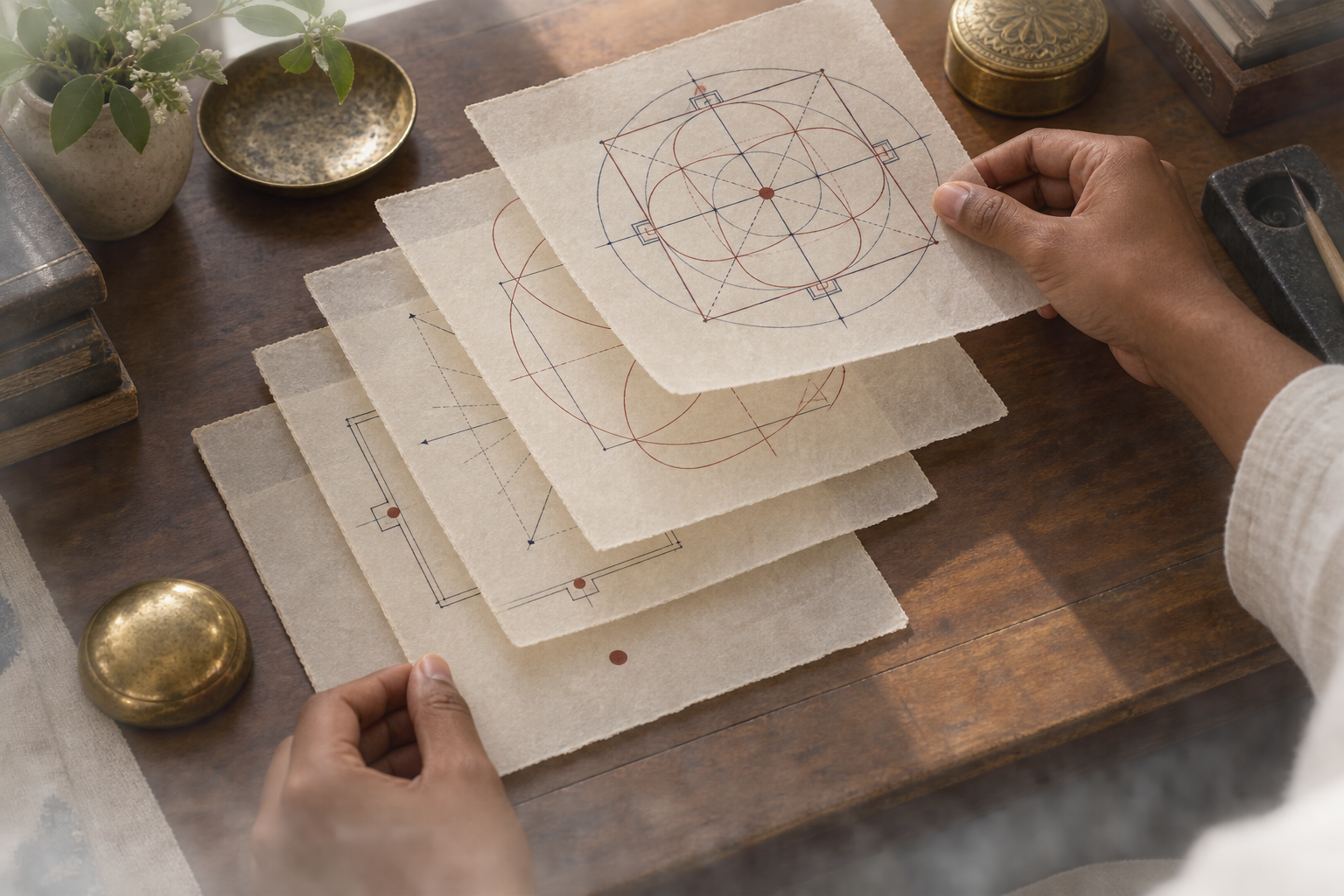
You can also use the diagram contemplatively without pretending to perform a ritual. Sketch each layer separately, then combine them. Observe the change from continuity to orientation and from orientation to dynamic tension. The act of reconstruction makes the relationships easier to notice than passive viewing does.
Key takeaways
- Read Hindu sacred geometry through relationships among forms, not through isolated shape definitions.
- The circle can be approached as an encompassing field: continuous, bounded in the drawing, and able to contain differentiated forms.
- A cardinally aligned square introduces direction, limit, stability, and an inhabitable order.
- A second square with another orientation adds crossings and visual movement, allowing the design to hold structure and generative energy together.
- Nature, culture, and cosmic desire provide a useful interpretation of this motif, but they are not a universal code for every circle or square.
- The shared center explains how distinct orientations can remain parts of one composition rather than collapsing into disorder.
- Keep observation and interpretation separate, then test the interpretation against the diagram’s actual religious, ritual, artistic, or architectural context.
The next time you meet a sacred geometric image, resist the urge to label it immediately. Trace its boundary, mark its orientations, find its center, and ask what changes from one layer to the next. You will not force the image into a slogan. You will give it the patient attention needed to disclose its own order.


References

Leave a Reply
You must be logged in to post a comment.