
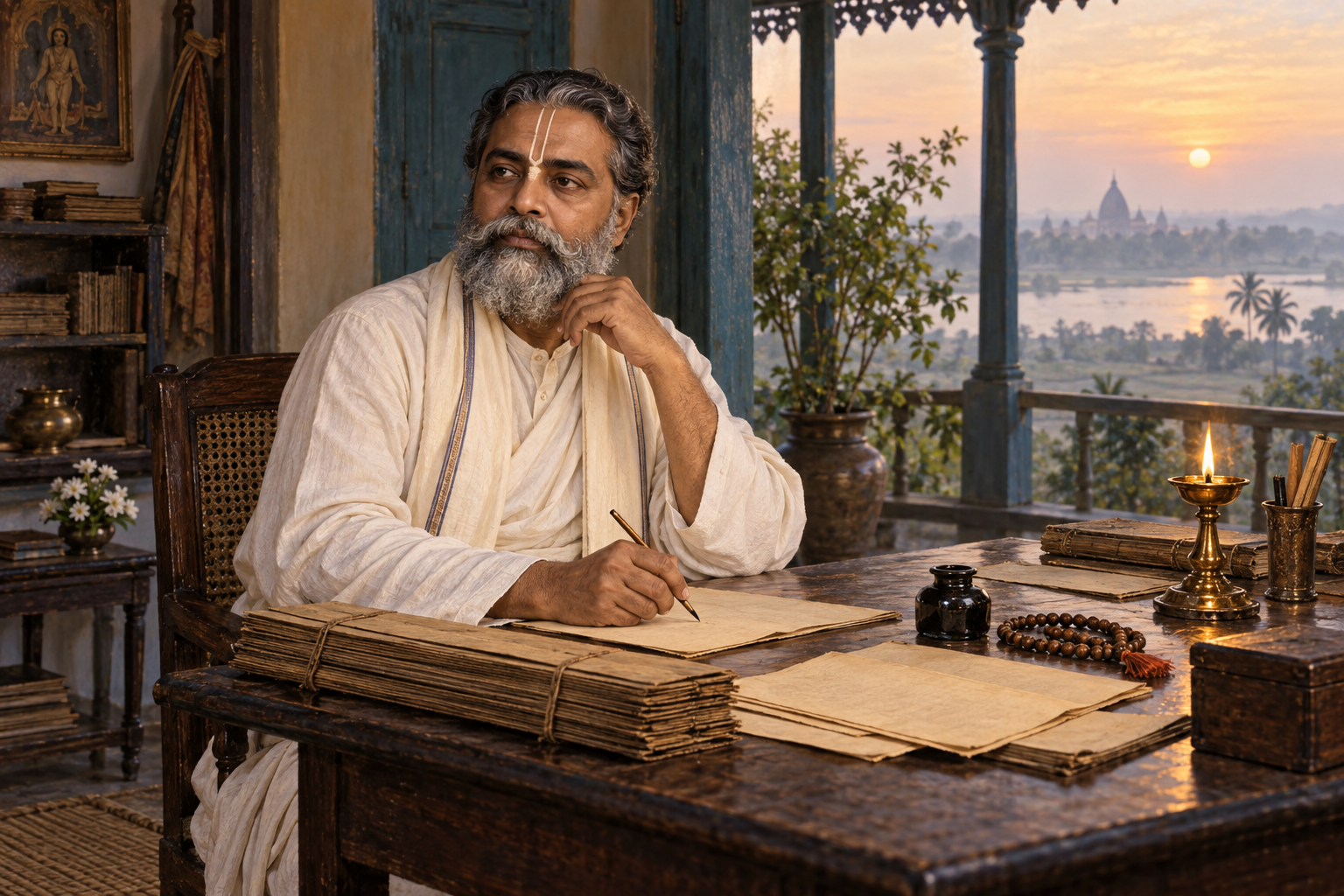
If you have encountered Bhaktivinoda Thakura while learning about Sri Caitanya, Mayapur, or Gaudiya Vaishnava literature, you may be wondering why his name carries such weight. The real question is not merely what he accomplished. It is how a householder, government officer, spiritual practitioner, and author helped give a threatened tradition intellectual clarity, a recovered sacred centre, and a global horizon.
His life becomes easier to understand when you see those tasks as one mission. He preserved inherited teachings, expressed them for different audiences, anchored communal memory in a place of worship, and imagined people far beyond Bengal participating in Caitanya Mahaprabhu’s sankirtana movement.
A householder life that resists easy categories
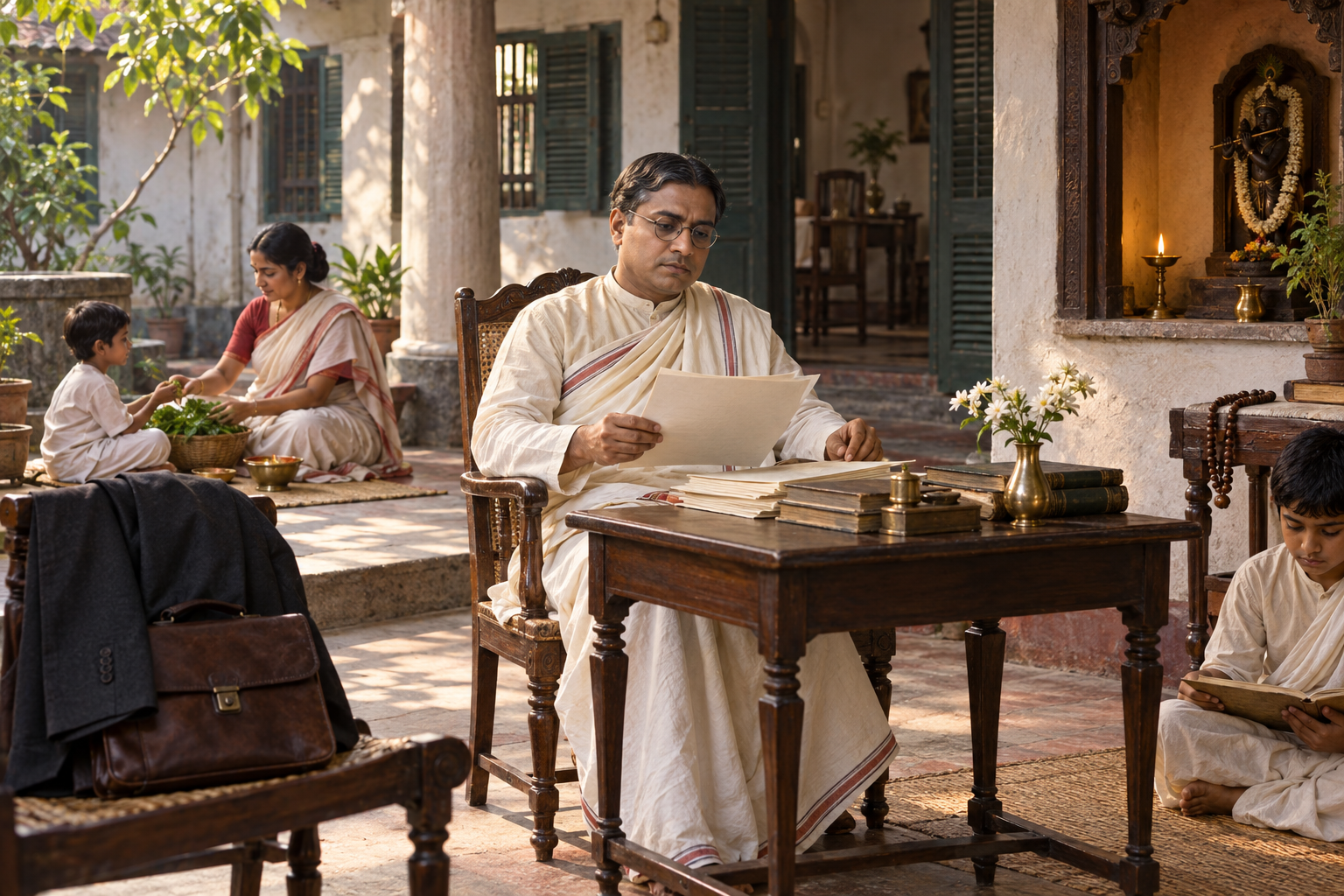
Bhaktivinoda Thakura was born in 1838 into a prosperous family in the Nadia region of Bengal. Gaudiya Vaishnavas revere him not simply as a gifted nineteenth-century thinker but as an eternal associate of Sri Caitanya Mahaprabhu. That devotional understanding is essential to his place within the tradition, even though the public record of his life can also be examined through his offices, books, institutions, and dated acts.
He remained in the grhastha ashrama for most of his life. He held a responsible government position as a district magistrate, maintained a Krishna-conscious household, and produced a large body of devotional writing. In Srila Prabhupada’s description, Bhaktivinoda completed his official duties, slept for four hours, rose at midnight, and wrote until morning; he ultimately produced nearly one hundred books.
That severe schedule should not be turned into a universal sleep prescription or a productivity contest. Its useful lesson is structural: Bhaktivinoda did not treat spiritual service as something that could begin only after family and professional responsibilities disappeared. He protected time for it within a demanding life. If you are trying to do the same, write down your fixed duties, identify the devotional work that genuinely matters, and give that work a recurring protected period. Admire the priority, not merely the austerity.
During his final years, he withdrew from household life and accepted babaji. His earthly departure is dated to 1914, on the disappearance day of Sri Gadadhara Pandit. Gaudiya tradition describes this as his entry into the eternal service of Gaura-Gadadhara and Radha-Madhava, and identifies his form in the eternal Vraja lila as Kamala-manjari. These are theological claims, not ordinary administrative facts. A careful reader need not blur the distinction: historical chronology tells you when he lived, while the tradition’s sacred account tells you who devotees understand him to be.
Why the title Seventh Gosvami describes his work
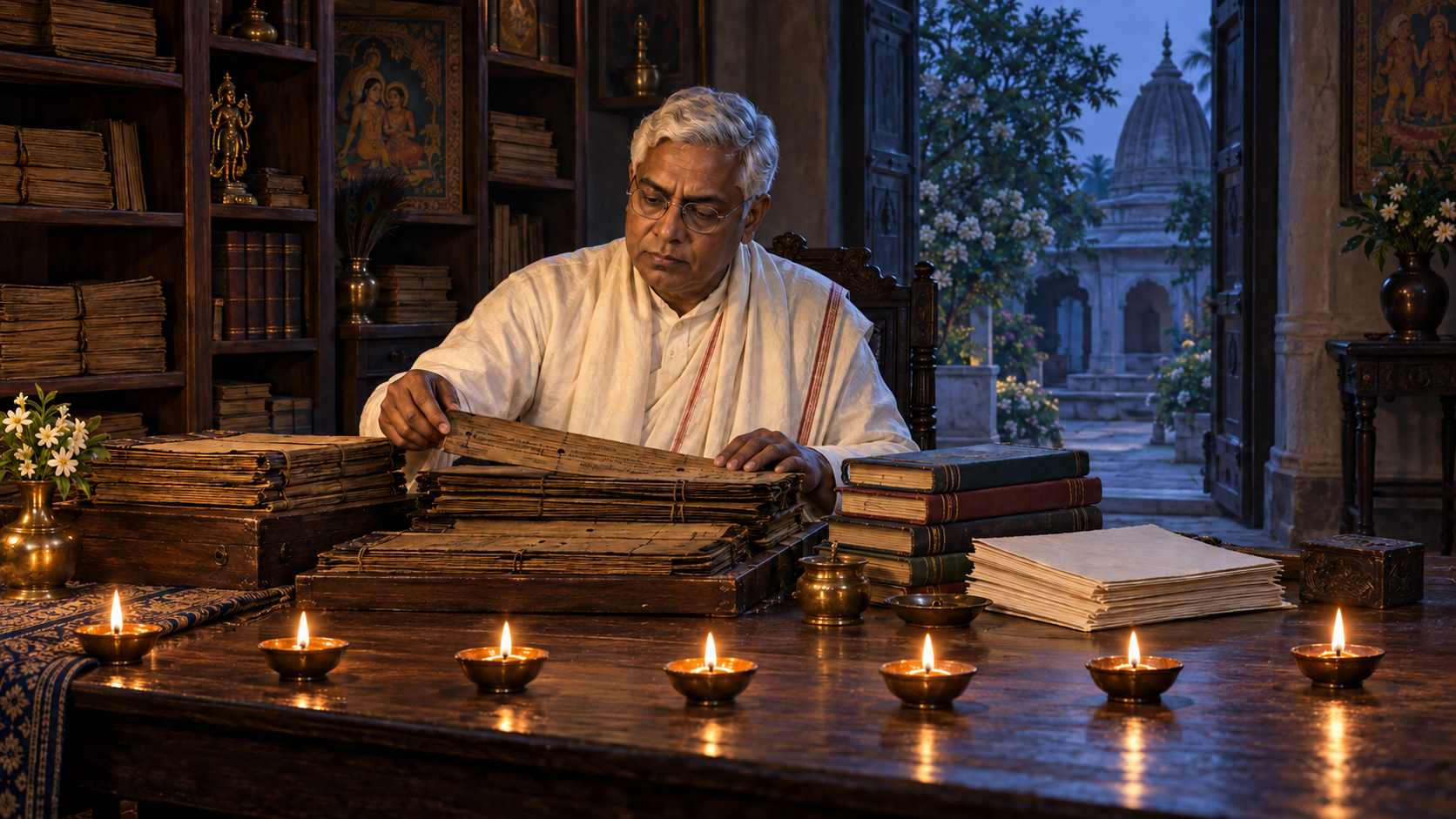
Bhaktivinoda is sometimes called the Seventh Gosvami. The title does not literally add him to the historical group of six Gosvamis of Vrindavana. It compares the function of his work with theirs. Srinivasa Acarya praised the six for examining the sastras deeply, establishing enduring religious principles, and working for the welfare of others. Bhaktivinoda’s admirers saw that same pattern in his combination of study, doctrinal clarity, writing, and public teaching.
His authority was also grounded in relationships of transmission. He received Vaishnava diksa from Sri Vipinvihari Goswami in the line of Sri Jahnava Mata, and later received spiritual inspiration and direction from Srila Jagannatha Dasa Babaji. This matters because Gaudiya authority is not meant to rest on literary talent or personal charisma alone. Lineage, disciplined learning, realised guidance, and service to the community belong together.
You can use that pattern when assessing any modern religious teacher. Ask where the teacher received instruction, which recognised guides shaped the teaching, whether the presentation is accountable to sastra, and what durable benefit the work creates for others. Bhaktivinoda’s life does not make institutional affiliation a substitute for spiritual depth. It shows why depth and accountable transmission should not be pulled apart.
His literary range reinforces the point. He wrote in Bengali, Oriya, and English, producing books as well as hundreds of poems and songs. The songs were not decorative additions to a philosophical project; they carried devotional emotion together with siddhanta, or reasoned theological conclusion. Reading him only as a scholar misses the inner life of his work. Approaching him only through devotional sentiment misses the precision with which he sought to explain and defend the tradition.
Mayapur turned recovered memory into lived sacred geography

One of Bhaktivinoda Thakura’s defining achievements concerned the birthplace of Sri Caitanya Mahaprabhu. The traditional location had been obscured for centuries amid changes associated with the Ganges. In 1888, Bhaktivinoda identified the Yogapitha at Sridhama Mayapur as Caitanya Mahaprabhu’s janmasthana. Srila Jagannatha Dasa Babaji confirmed the identification, giving it the recognition of a revered siddha saint within the Gaudiya community.
Devotional language calls this a revelation; historical language may call it an identification. You can respect the tradition without pretending that those two forms of description answer the same kind of question. The first concerns sacred disclosure and saintly recognition. The second concerns location, chronology, and public action. Bhaktivinoda’s legacy contains both.
The work did not end with naming a point on a map. Bhaktivinoda established the worship of Lord Gauranga and Srimati Vishnupriya at the Yogapitha. That sequence is important: a location was identified, recognised within the community, and connected to worship. Sacred geography becomes durable when memory is embodied in practice.
If you visit or study Mayapur, do not treat the Yogapitha as a historical signboard to be checked off. Notice how the worship of Gauranga and Vishnupriya interprets the place. Ask what understanding of Caitanya’s appearance, household life, and mission the site asks a pilgrim to carry away. This turns pilgrimage from religious sightseeing into attentive participation.
His global vision joined translation with participation
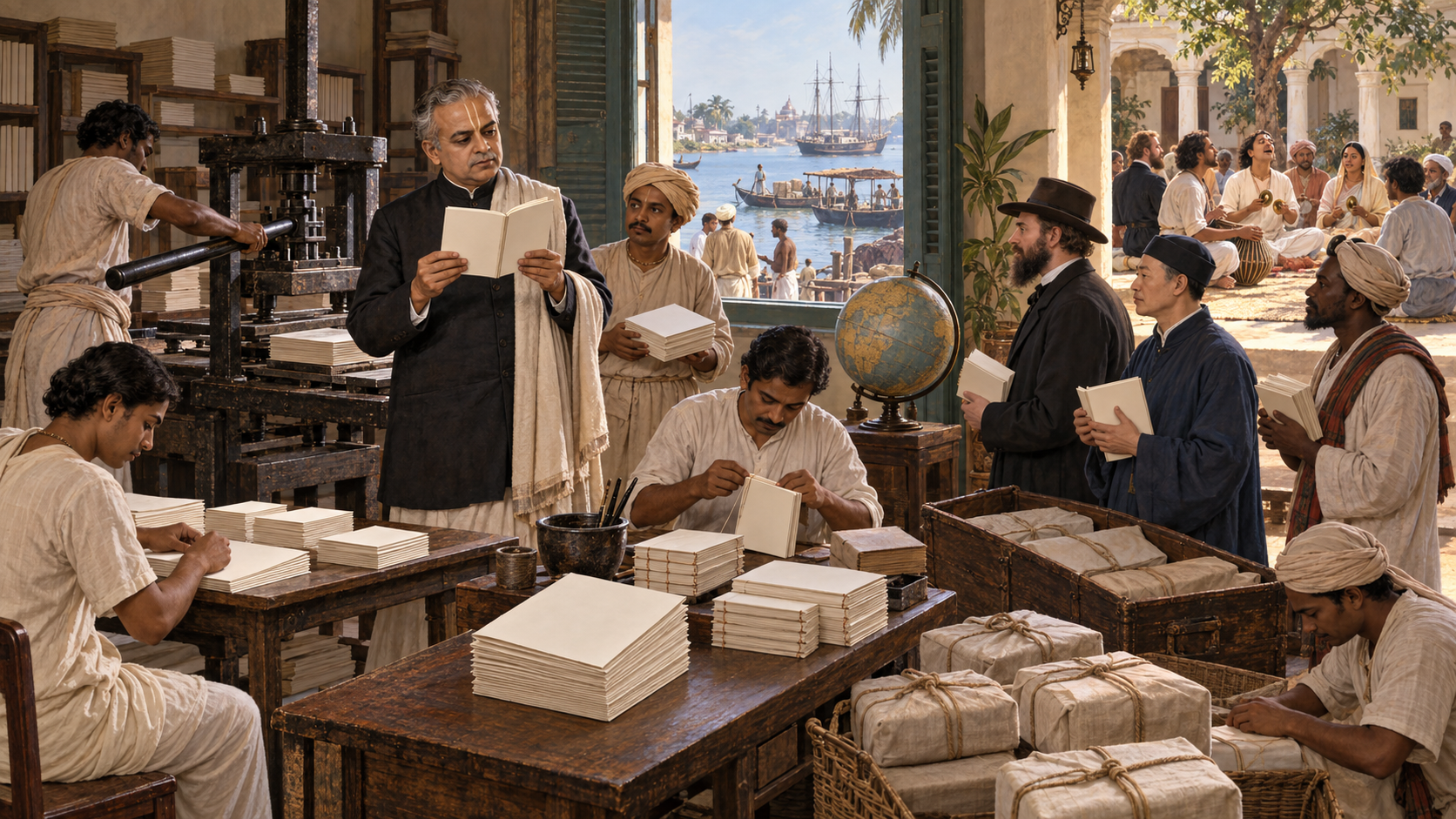
Bhaktivinoda’s international outlook was practical before it became predictive. In 1896, he sent Sri Gauranga-lila smarana to universities around the world. The Sanskrit verses were accompanied by a forty-seven-page English introduction titled “Sri Caitanya Mahaprabhu: His Life and Precepts.” The choices are revealing: he used an international language, offered substantial explanation, and placed the work in channels capable of reaching readers outside the inherited Bengali devotional world.
He also voiced three closely related expectations. A personality would travel throughout the world to teach Caitanya Mahaprabhu’s message. Harinama sankirtana would spread internationally, including to America, England, France, Germany, and Russia. Foreign devotees would come to Mayapur and chant with Bengali Vaishnavas. Whatever theological weight you give these predictions, their direction is unmistakable: Bhaktivinoda imagined a rooted tradition becoming genuinely shareable across languages and nations.
The final image is especially instructive. Foreign participants were not imagined as distant admirers consuming a simplified export. They would come to the dhama and chant alongside Bengali Vaishnavas. His globalism therefore joined translation with place, and outreach with participation. The tradition could cross borders without becoming detached from its sacred geography or its custodial community.
Anyone communicating dharma beyond its inherited audience can learn from that method. Use language an unfamiliar person can understand, but do not conceal the tradition’s actual names, practices, or claims. Enter channels where new readers already seek knowledge. Most importantly, invite participation in a living discipline rather than offering only cultural information. Bhaktivinoda combined all three moves: intelligible explanation, deliberate distribution, and a vision of shared practice.
Key takeaways for putting his legacy into practice
- Do not postpone meaningful seva until an imagined future without family or professional duties. Protect a sustainable, recurring period for it within the life you have.
- Evaluate spiritual authority through lineage, serious engagement with sastra, guidance from realised teachers, and benefit to the wider community – not charisma alone.
- Read devotional poetry and philosophical explanation together. In Bhaktivinoda’s method, bhava and siddhanta strengthen rather than replace each other.
- Approach sacred places through the practices and relationships that sustain their meaning. A tirtha is more than coordinates or an episode from the past.
- When presenting dharma internationally, translate the explanation without erasing the tradition. Give newcomers a genuine point of entry into its language, places, and practices.
- Keep historical and theological claims distinct enough to understand each properly. Respect does not require confusion, and critical clarity does not require dismissal.
To move from admiration to understanding, begin with Sri Gauranga-lila smarana and its English introduction. Mark where Bhaktivinoda explains Caitanya Mahaprabhu for an unfamiliar reader and where he retains Gaudiya categories rather than replacing them with generic spirituality. Then pair that prose with one of his devotional songs or poems. You will see the method behind the legacy: disciplined thought serving devotion, and devotion seeking a language through which others can enter it.
References

Leave a Reply
You must be logged in to post a comment.