
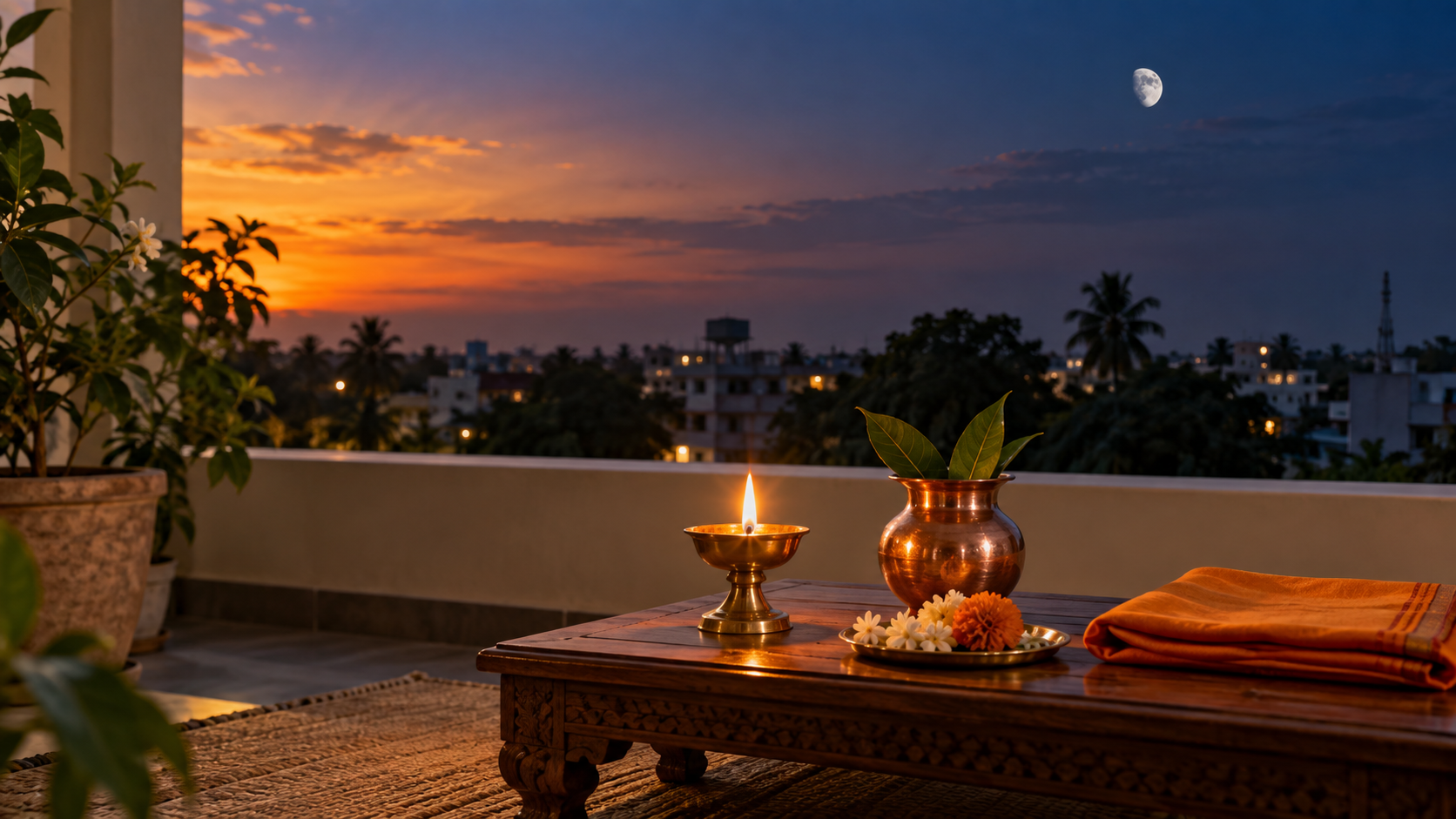
If you are arranging a puja, vrata, temple visit, or sankalpa for Tuesday, September 29, 2026, the important detail is the evening tithi change. The date does not carry one tithi from midnight to midnight.
Krishna Paksha Tritiya continues until 6:38 PM. Krishna Paksha Chaturthi follows from that transition onward. Use the time of your observance—not merely the date printed on your calendar—to identify the applicable tithi.
The Panchang reading for September 29, 2026
| Calendar element | Reading |
|---|---|
| Civil date | Tuesday, September 29, 2026 |
| Paksha | Krishna Paksha, the waning phase of the Moon |
| Tithi before the evening transition | Tritiya, the third tithi |
| Published transition time | 6:38 PM |
| Tithi after the transition | Chaturthi, the fourth tithi |
In practical terms, an observance completed before the listed cutoff falls under Krishna Paksha Tritiya. One performed after the transition falls under Krishna Paksha Chaturthi. This Tritiya-to-Chaturthi change at 6:38 PM is the central calendar fact to carry into your planning.
Why the tithi changes while Tuesday is still in progress
A civil date begins and ends at midnight. A tithi is a lunar measure, so it begins and ends according to the changing angular relationship between the Sun and Moon. Its boundary therefore need not coincide with midnight, sunrise, or sunset.
That distinction prevents a common mistake. Tuesday remains the weekday throughout September 29, but the lunar designation changes during the evening. Writing only “September 29—Tritiya” would be incomplete for anything scheduled after 6:38 PM. Writing only “Chaturthi” would be equally misleading for a morning or afternoon observance.
The clearest diary entry is: “Krishna Paksha Tritiya until 6:38 PM; Krishna Paksha Chaturthi thereafter.” That wording preserves the transition instead of forcing the entire civil date into one lunar label.
How to use the cutoff for your observance
First decide what you are actually timing. A brief home prayer, an all-day vrata, a temple sankalpa, and a formal samskara do not necessarily use the calendar in the same way. For a simple time-specific activity, the tithi prevailing when you perform it is the useful starting point. A vrata or prescribed rite may instead follow sunrise prevalence, a required period of tithi coverage, or a rule particular to the sampradaya.
- Write down the intended start time. “Evening” is too vague when the boundary itself falls in the evening.
- Place that time on the correct side of 6:38 PM. Before the listed transition, note Tritiya; after it, note Chaturthi.
- Check the rule governing the rite. If a vrata, temple observance, or family tradition specifies the tithi at sunrise or requires the tithi to prevail during a particular ritual period, follow that rule rather than choosing solely by convenience.
- Confirm the locality. Panchang timings are location-sensitive. If you are outside the region for which the published time applies, consult a Panchang calculated for your city instead of treating 6:38 PM as a universal worldwide cutoff.
- Keep the transition visible in shared plans. When several family members are participating, include both tithis and the cutoff in the message or calendar invitation.
If the rite has formal requirements and you are uncertain which rule applies, ask the officiating priest or the temple conducting it. The question to ask is precise: “Which tithi must prevail during this rite, and which local Panchang should we follow?”
What the 6:38 PM transition does not tell you
A tithi boundary is not automatically a declaration that everything before it is auspicious and everything after it is inauspicious. It identifies the lunar day in force. It does not, by itself, establish a complete muhurta.
A traditional Panchanga considers several limbs, including vara, tithi, nakshatra, yoga, and karana. A practical muhurta decision may also depend on the location, local sunrise, the nature of the proposed activity, and the tradition being followed. Rashi information answers a different astronomical or astrological question and should not be inferred from the tithi alone.
Therefore, use the September 29 entry confidently for the stated tithi change, but do not manufacture a “good time” from that one fact. If you are selecting a wedding, griha pravesh, major purchase, initiation, or another consequential ceremony, obtain a complete location-specific Panchang assessment.
Key takeaways
- Tuesday, September 29, 2026 begins under Krishna Paksha Tritiya.
- Tritiya continues until the published cutoff of 6:38 PM.
- Krishna Paksha Chaturthi begins after that evening transition.
- The civil date stays the same even though the tithi changes.
- Use a local Panchang and the rule prescribed for your particular observance before fixing a formal ritual time.
- Do not treat the tithi cutoff alone as a complete auspicious-time recommendation.
Put the exact time of your September 29 observance beside the 6:38 PM boundary now. That one comparison will tell you whether to prepare the sankalpa with Tritiya or Chaturthi, while a local calendar or priest can settle any rite-specific rule.
References

Leave a Reply
You must be logged in to post a comment.