
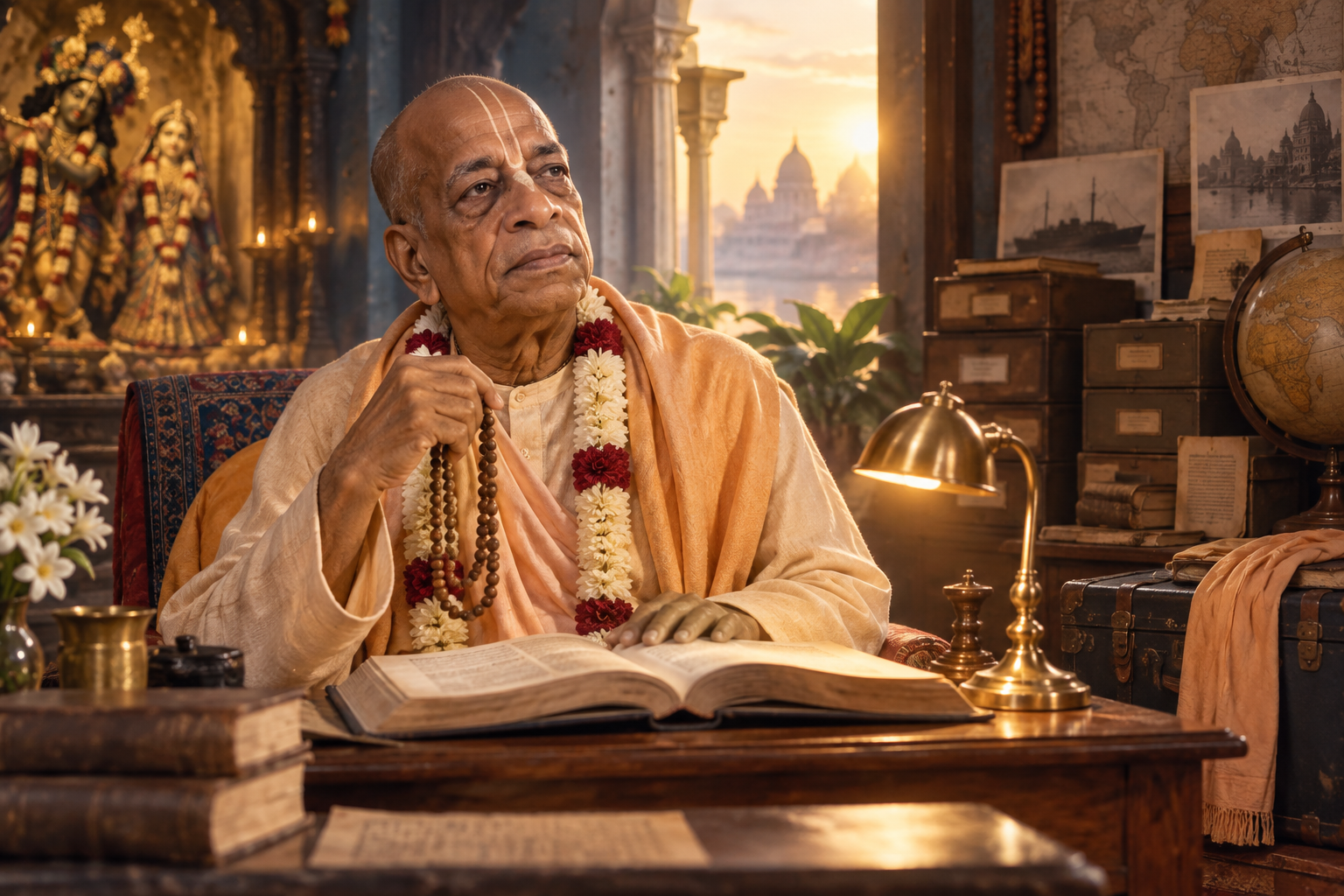
You may remember a striking incident from Srila Prabhupada’s life yet remain unsure what to do with it. Should you treat it as history, devotional instruction, evidence of an acharya’s character, or a model to imitate?
The safest answer is not to choose only one of those possibilities. Read his life with devotion and historical care, then carry one clear principle into your own sadhana. That approach protects you from two common errors: reducing sacred remembrance to interesting biography, and repeating an inspiring account without understanding its context.
Why the word pastime changes how you read a life
Ordinary biography asks what happened, when it happened, and who was present. Devotional remembrance asks an additional question: what does this event reveal about service to Bhagavan? You need both sets of questions. Historical care keeps the account intelligible; the devotional frame keeps its spiritual purpose visible.
When devotees call an acharya’s activities pastimes, they are using the language of lila in an honorific devotional sense. This does not erase the distinction between Bhagavan and Bhagavan’s devotee. It recognizes that the acharya’s life is remembered in relation to divine service, not merely as a record of private achievements.
A pastime can therefore work on three levels. It records an event, discloses a devotional quality, and forms the person who hears it attentively. Trouble begins when one level displaces the others. Admiration without practice becomes sentiment. Historical scrutiny without spiritual receptivity can miss why devotees preserved the memory. Credulity can turn an uncertain retelling into a rigid claim.
Key takeaways
- Ask what happened before deciding what the event means.
- Distinguish a witness’s recollection, a later retelling, a paraphrase, and a direct quotation.
- Let shastra and established siddhanta determine doctrine; let remembered pastimes show devotional principles embodied in life.
- Follow the principle appropriate to your adhikara, rather than copying an exceptional outward act.
- Complete remembrance with one specific act of sadhana or service.
Use four questions for every account you hear

A memorable story can move faster than its context. Before forwarding a clip, teaching from an incident, or building a strong conclusion on it, slow the account down with four questions.
- What is actually said to have happened? Write the event in one plain sentence. Separate the action from praise, interpretation, and assumptions about motive.
- How has the account reached you? Note whether you are hearing a first-person recollection, a report attributed to a named witness, a later retelling, or a teaching that paraphrases an incident. These forms can all be valuable, but they do not establish detail in the same way.
- Which devotional principle is visible? Name it precisely. Patience, courage, discipline, compassion, fidelity to guru, attention to service, and humility are not interchangeable lessons.
- What response is appropriate for you? Choose an action small enough to perform and specific enough to verify. A principle has not yet shaped you if it remains only an admired idea.
A useful notebook entry needs only four lines: event, provenance, principle, and practice. Keeping those lines separate prevents interpretation from quietly becoming part of the remembered event. It also lets you revisit the account later without mistaking your first reaction for the speaker’s actual meaning.
Provenance is not a ranking of spiritual purity. A later retelling may preserve genuine devotional insight, while a direct witness may remember only one angle of a complex moment. The point is clarity. Say what kind of account you have, preserve any uncertainty, and receive its teaching without claiming more precision than the telling supports.
Listen to oral Lilamrita without losing the context

Oral remembrance carries qualities that a transcript cannot fully preserve: cadence, affection, emphasis, hesitation, and the relationship between speaker and audience. Those qualities help you hear how a memory lives within a devotional community. They do not, by themselves, prove the exact wording or chronology of every detail.
A recorded Srila Prabhupada Lilamrita narration by HG Daivi Shakti Mataji can be approached with this double attention. Listen receptively to the devotional purpose, but keep the speaker, setting, and form of the narration attached when you share anything drawn from it.
Before quoting or circulating an oral account, check five things:
- Did the speaker present the incident as personal memory, something heard from another person, or a commonly repeated account?
- Are you preserving the distinction between exact words and your paraphrase?
- Does the excerpt include enough of the preceding and following discussion to retain the intended meaning?
- Are you adding a motive or conclusion that the speaker did not state?
- Can another listener locate the full recording rather than receiving only a detached clip?
If two tellings differ, do not silently combine them into a smoother version. Record what they share, identify the differing detail, and leave the difference open when it cannot be resolved. Honest uncertainty is not disrespect. It protects the memory from embellishment and allows later listeners to understand what is established and what remains interpretive.
Be especially careful when an account includes an unusual command, a sharp correction, or an exceptional act of renunciation. Ask who received it, what responsibility that person held, what problem was being addressed, and what result followed. A guru’s response to one disciple in one circumstance is not automatically a universal instruction for everyone.
The same restraint applies to doctrine. A vivid incident can illuminate siddhanta, but it should not be made to carry an entire theological conclusion by itself. Doctrine is grounded in shastra and received teaching. Remembrance shows what those teachings can look like when embodied in service.
Turn remembrance into practice within twenty-four hours

The measure of attentive hearing is not how many incidents you can repeat. It is whether remembrance changes the quality of your next duty, decision, or encounter. Use a simple twenty-four-hour discipline whenever you hear or read an account from Srila Prabhupada’s life.
- Begin with one question. Ask what the account might teach you about service, steadiness, responsibility, compassion, or surrender. A focused question prevents passive consumption.
- Hear the complete account once. Do not begin by hunting for a dramatic quotation or a shareable fragment. First understand the movement and context of the narration.
- Write the four-line note. Record the event, provenance, principle, and possible practice. If a detail remains uncertain, label it as uncertain.
- Choose one proportionate action. If the principle is discipline, protect one neglected period of practice. If it is compassion, perform one concrete service for a person you routinely overlook. If it is courage, complete one duty you have been avoiding. If it is humility, correct one instance in which you claimed more credit than was due.
- Review the action the next day. Note whether you performed it and what resisted it. Then either repeat it or choose the next appropriate expression of the same principle.
This is where adhikara matters. Your capacity, duties, stage of life, and commitments shape how a principle should be practiced. A renunciant’s austerity is not automatically a household prescription. A leader’s forceful correction is not permission for ordinary harshness. Following an acharya means serving the principle faithfully within your actual responsibility, not reproducing the most dramatic surface behavior.
It is also where abhyasa, repeated practice, protects you from temporary emotion. One account may awaken resolve, but repetition gives that resolve a form. Return to the same principle through a modest daily observance until it begins to affect conduct without needing the original emotional intensity.
Choose one complete narration today. Listen without extracting a slogan, make the four-line note, and perform one fitting action before the same time tomorrow. That is a practical way to let Srila Prabhupada’s remembered life become more than information: it becomes an invitation to serve.
References

Leave a Reply
You must be logged in to post a comment.