
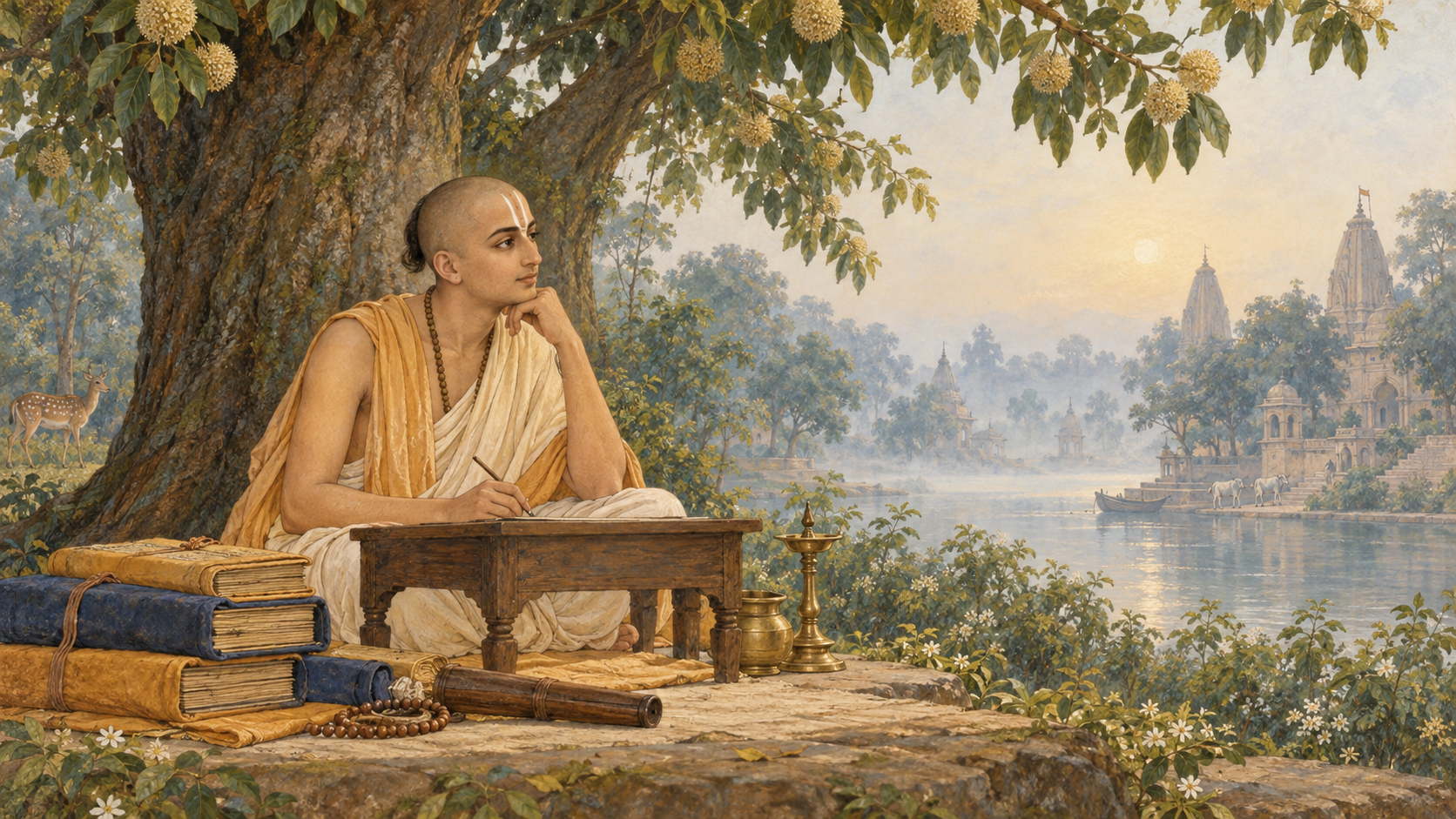
If you know the path of Sri Chaitanya mainly through kirtan, temple worship, or the language of prema, Sri Jiva Goswami may seem like a specialist standing at the edge of the tradition. He belongs at its intellectual center. His work shows how devotion to Krishna can be emotionally intimate, grounded in scripture, and argued with philosophical precision.
You may be asking a practical question: who was he, why does he matter, and which of his formidable books should you approach first? The answer depends on whether you want to understand scriptural authority, the nature of reality, Krishna’s position, the practice of bhakti, or the culmination of devotion in divine love.
Key takeaways
- Sri Jiva Goswami was one of the Six Goswamis of Vrindavan, a nephew and disciple of Sri Rupa Goswami, and a major systematizer of Gaudiya Vaishnava thought.
- His importance lies not merely in the number of books he wrote, but in the intellectual architecture he gave the tradition: a disciplined account of knowledge, Bhagavan, the individual self, the cosmos, bhakti, and prema.
- His principal theological achievement is the Sat-sandarbhas, or Six Sandarbhas, built around the Bhagavata Purana.
- The first four Sandarbhas primarily establish sambandha, the nature of reality and our relationship with Bhagavan. Bhakti-sandarbha explains abhidheya, the means of spiritual realization. Priti-sandarbha explains prayojana, the ultimate goal.
- Acintya-bhedabheda does not mean that contradictions should be accepted without thought. It describes the irreducible relationship of simultaneous unity and difference between Bhagavan and his dependent energies.
- Choose your first text according to your question. Do not begin by collecting isolated quotations from all six volumes.
Why Sri Jiva mattered to a living devotional tradition
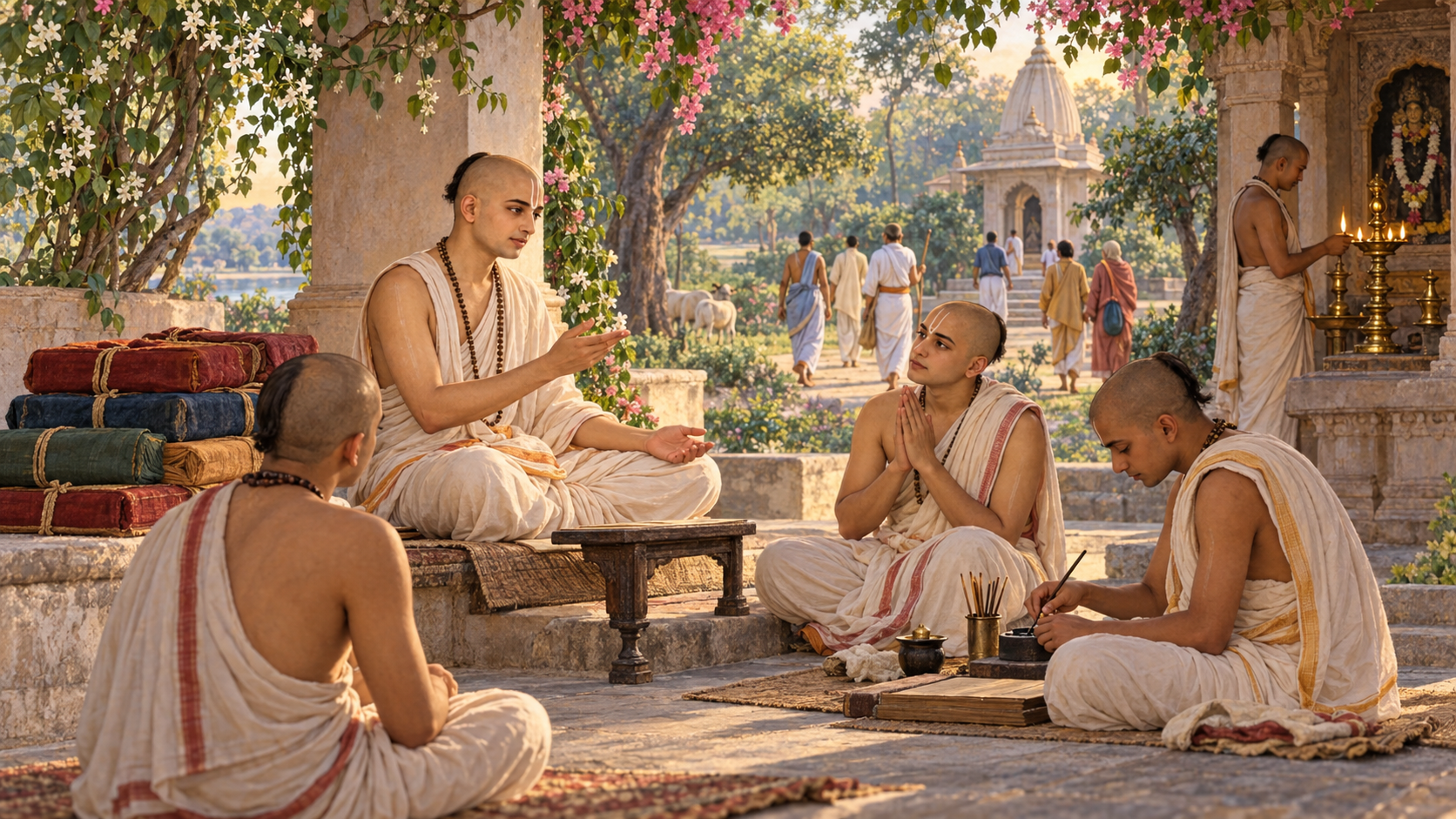
Sri Jiva belonged to the generation that gave durable literary and institutional form to the devotional current associated with Sri Chaitanya. Traditional accounts place his early life in Ramakeli in Bengal, followed by study in Navadvipa and Kashi before he joined his uncles, Sri Rupa and Sri Sanatana, in Vrindavan. There he became a teacher, commentator, philosopher, poet, and guardian of an expanding body of Vaishnava literature.
This matters because a spiritual awakening cannot be sustained by inspiration alone. A tradition also needs a vocabulary, a way of interpreting scripture, answers to objections, methods of teaching, and standards by which later claims can be judged. Sri Jiva helped provide all five. He carried the insights of a founding devotional generation into a form that students separated by geography and time could examine.
A useful, though deliberately simplified, distinction can help you place him among the Goswamis. Sri Rupa supplied much of the tradition’s analytical language for bhakti-rasa. Sri Sanatana made foundational contributions to commentary, theology, practice, and sacred geography. Sri Jiva gathered, defended, extended, and organized the emerging theological system. Their work overlaps, so this is a division of emphasis rather than a competition among acharyas.
Sri Jiva’s career also corrects a persistent misunderstanding about the bhakti traditions of Bharat. Devotion was not an abandonment of disciplined thought. In his hands, Sanskrit exegesis, logic, grammar, poetry, and contemplative practice served the same devotional end. If you have been told to choose between a warm heart and a trained intellect, his library shows why the choice is false.
There is one small but important reading distinction to make at the outset. Sri Jiva is the author. The word jiva inside a philosophical passage usually means the finite individual self. Capitalization and transliteration differ among editions, so use the context rather than typography alone.
What the Six Sandarbhas are designed to accomplish

The Sat-sandarbhas form Sri Jiva’s great theological synthesis. They do not read like six unrelated essays. Each volume prepares concepts needed by the next. The sequence moves from the question of reliable knowledge to the nature of divine love.
A six-book map
- Tattva-sandarbha: What counts as trustworthy knowledge about realities beyond ordinary perception? Sri Jiva examines sources of knowledge and establishes the Bhagavata Purana as the central scriptural authority for the system that follows.
- Bhagavat-sandarbha: What does Bhagavan mean? This volume examines the nature of the Absolute and the relation of Bhagavan to divine energies and manifestations.
- Paramatma-sandarbha: How are Paramatma, the individual jiva, material nature, and the manifested cosmos related? This is crucial if you want to avoid confusing the finite self with the Supreme.
- Krishna-sandarbha: What is Krishna’s position within the many manifestations of divinity described in Vaishnava scripture? Sri Jiva develops the Gaudiya conclusion that Krishna is Svayam Bhagavan, Bhagavan in the original and fullest sense.
- Bhakti-sandarbha: What is bhakti, who may undertake it, and how is it cultivated? The discussion moves from ontology into the actual means of spiritual life, including hearing, remembrance, worship, and service.
- Priti-sandarbha: What is the ultimate purpose of bhakti? The final volume treats priti, perfected love for Bhagavan, as the culmination toward which the preceding inquiry has been moving.
If these titles begin to blur together, remember three words. Sambandha concerns reality and relationship; the first four volumes principally establish that ground. Abhidheya is the means, developed through bhakti in the fifth. Prayojana is the goal, divine love in the sixth. When a difficult paragraph leaves you disoriented, ask which of these three tasks it is performing.
Acintya-bhedabheda is precise, not evasive
Sri Jiva is closely associated with the systematic articulation of acintya-bhedabheda, inconceivable simultaneous difference and non-difference. It is sometimes reduced to a vague claim that everything is somehow one and somehow different. That misses the discipline of the teaching.
Non-difference means that nothing exists independently of Bhagavan. The jivas and the cosmos depend upon divine reality and are understood in relation to divine energies. Difference means that the individual self is not Bhagavan in every respect, the world is not simply another name for the Supreme Person, and devotional relationship is not erased by metaphysical identity.
The word acintya marks the limit of reducing this relationship to categories formed from ordinary material objects. It does not grant permission to abandon reasoning or accept any contradiction bearing a religious label. When someone invokes acintya, ask four questions: What two realities are being related? In what respect are they one? In what respect are they different? What role does divine energy play in the relation? If those questions receive no answer, the explanation has probably become a slogan.
Bhakti is both disciplined practice and the road to love
The movement from Bhakti-sandarbha to Priti-sandarbha keeps two errors apart. Bhakti is not merely a feeling added after the philosophical work has been completed. It is the prescribed means through which the relationship with Bhagavan is lived and realized. Yet disciplined practice is not the final destination when treated as a mechanical achievement. Its culmination is priti, loving devotion centered on Bhagavan rather than on the practitioner’s prestige, control, or escape.
This sequence gives you a practical test for spiritual instruction. Sound practice should rest on a coherent understanding of Bhagavan and the jiva, while sound philosophy should direct life toward hearing, service, remembrance, and transformed love. If either half disappears, Sri Jiva’s architecture has been cut in two.
His wider library joins learning to remembrance
The Sandarbhas are central, but they do not exhaust Sri Jiva’s range as a scholar and devotional author. His other works help you see what systematic theology was meant to nourish.
- Gopala-campu presents Krishna’s Vrindavan pastimes through an elaborate literary and devotional form. Approach it when your purpose is contemplative entry into lila rather than an initial outline of philosophical categories.
- Harinamamrita-vyakarana organizes the study of Sanskrit grammar through Krishna-centered terminology. Its very form refuses to isolate education from remembrance.
- Sarva-samvadini supplies Sri Jiva’s own further explanations of arguments associated with the Sandarbhas. It is valuable when a terse conclusion requires clarification, but it is not the easiest doorway for a beginner.
- Krama-sandarbha follows the sequence of the Bhagavata Purana as a commentary, allowing readers to encounter his interpretation alongside the scriptural text rather than only through topics arranged systematically.
- Commentaries on earlier Goswami works show him acting as an interpreter within a living lineage. He did not merely repeat inherited formulations; he clarified their terms and protected their internal coherence.
Choose among these works by purpose. Read the Sandarbhas for a structured theological argument. Turn to Krama-sandarbha when following the Bhagavata Purana passage by passage. Read Gopala-campu for devotional literary vision. Consult the grammatical and commentarial works when you are ready to see how thoroughly the tradition joined scholarship to Krishna-smriti, remembrance of Krishna.
Do not mistake this range for scattered productivity. It reveals a single educational ideal: what you study, how you reason, how you read scripture, and what you remember should eventually point in the same direction.
How to begin reading Sri Jiva without flattening him

You do not need to read the whole corpus before gaining anything from it. You do need a question and a method. Starting with whichever quotation appears most inspiring online usually leaves you with conclusions detached from the argument that supports them.
- Name your question. Start with Tattva-sandarbha for scriptural authority and valid knowledge; Bhagavat- and Paramatma-sandarbhas for divine reality, the self, and the cosmos; Krishna-sandarbha for Krishna’s theological position; Bhakti-sandarbha for practice; or Priti-sandarbha for the goal of divine love.
- Use an edition that exposes the structure. Prefer a translation that preserves section numbering, identifies citations from the Bhagavata Purana and other texts, separates Sri Jiva’s words from the translator’s commentary, and uses technical terms consistently.
- Keep a working glossary. Record terms such as tattva, pramana, Bhagavan, Paramatma, jiva, shakti, bhakti, and priti. Write the contextual meaning rather than assuming that one English equivalent will work everywhere.
- Track the argument, not just the conclusion. For each short unit, write four lines: the claim, its scriptural basis, the possible objection, and the resolution. This prevents a preferred conclusion from becoming detached from Sri Jiva’s reasoning.
- Read the cited Bhagavata passage in context. Check the surrounding verses and the speaker. Sri Jiva’s method depends upon interpreting scripture as a coherent body, not treating a verse as an isolated slogan.
- Let study correct practice and practice test attention. Continue hearing, chanting, worship, or seva according to your path while you study. Devotional feeling does not replace careful interpretation, and intellectual collection does not replace devotion.
Warning signs in a modern explanation
- It uses acintya as an excuse to avoid defining either unity or difference.
- It makes the jiva identical to Bhagavan in every respect, or treats the jiva and Bhagavan as wholly unrelated beings.
- It discusses rasa while bypassing sambandha, disciplined bhakti, and the ethical formation of the practitioner.
- It gives polished conclusions but removes the scriptural citations and intermediate reasoning.
- It turns every Vedantic school into the same doctrine, or caricatures other schools so that Gaudiya conclusions appear to win without real engagement.
- It presents scholarship and devotion as rivals, even though Sri Jiva’s own body of work repeatedly joins them.
Your best first step is small and concrete. Write one question at the top of a page, open the Sandarbha that actually addresses it, and work through one numbered unit by recording its claim, evidence, key term, and implication for practice. That disciplined encounter will take you closer to Sri Jiva than a large collection of decontextualized quotations.
References

Leave a Reply
You must be logged in to post a comment.