
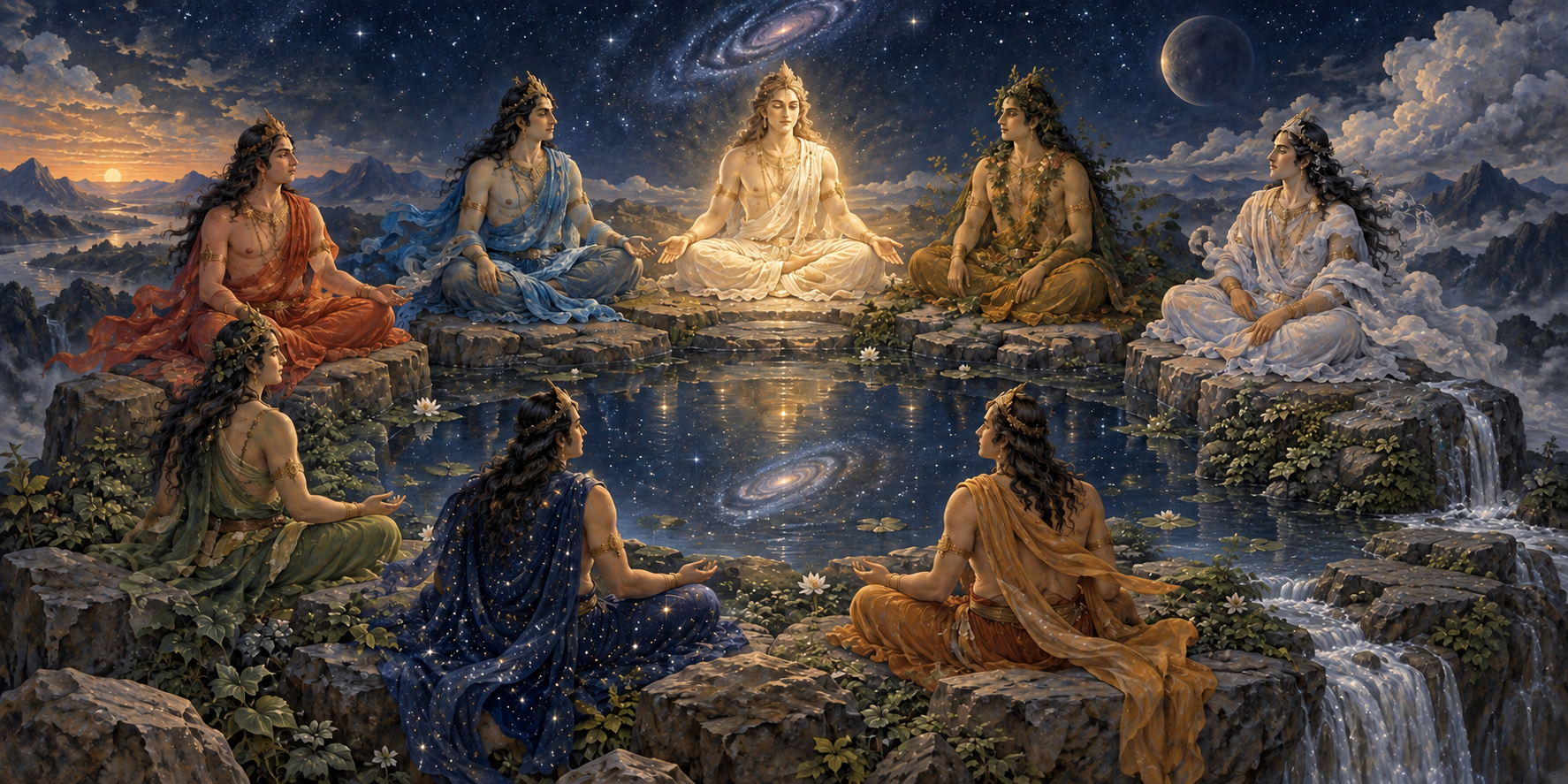
If you have encountered Prabhasa in a list of deities, a temple description, or an image caption, the difficult part is not remembering his name. It is understanding why radiance should be represented as a divine being and why that being belongs to a group of eight.
The clearest approach is to read Prabhasa at three levels: as one of the Ashtavasus, as the personification of radiance, and as part of an ordered sacred cosmos. That distinction also helps you assess sculpture and modern explanations without turning every luminous figure into Prabhasa.
Begin with the eight Vasus, not with Prabhasa alone
The Ashtavasus are eight elemental deities who attend Indra, and Prabhasa is the Vasu associated with radiance. The number eight is therefore part of the identity of the group, not incidental decoration around an otherwise independent deity.
Here, “elemental” belongs to the language of cosmology, not modern chemistry. It points toward powers through which an ordered universe can be experienced and understood. Hindu sacred thought does not have to choose between a natural force and a divine personality: a cosmic principle can possess sacred agency, participate in relationships, and occupy a place within a larger divine order.
This keeps you from making two common mistakes. The first is to treat Prabhasa as an isolated solar deity merely because radiance evokes the sun. The second is to dismiss him as a “minor god” because he attends Indra. Attendance expresses relationship and cosmic function; it does not make the being religiously meaningless.
When you explain Prabhasa to someone else, start with one dependable sentence: “Prabhasa is one of the eight Vasus and represents radiance within their elemental order.” Add further interpretation only after that foundation is clear.
Radiance is more than a bright surface
Radiance is visible, but its meaning is not exhausted by brightness. Light allows things to appear. It reveals form, makes distinctions perceptible, and turns an unseen environment into an intelligible one. Prabhasa can therefore be approached not simply as something that shines, but as sacred luminosity through which the world becomes manifest.
That gives you a disciplined way to contemplate the symbolism without claiming that every possible meaning is a fixed scriptural definition. Begin with what radiance actually does. It illuminates. It discloses. It reaches beyond its apparent point of origin. From there, you can consider how divine radiance conveys presence, order, or clarity.
The distinction between symbol and reduction matters. Prabhasa should not be reduced to a poetic synonym for a lamp, sunrise, or state of mind. He is presented as a member of a divine collective. His radiance is consequently personal and relational as well as elemental: it belongs within a cosmos populated by beings whose functions fit together.
If you are writing, teaching, or speaking about him, use “radiance” before more speculative terms such as enlightenment, knowledge, or consciousness. Those ideas may support a reflective interpretation, but they should not silently replace the deity’s stated identity.
How to assess a sculpture said to depict Prabhasa
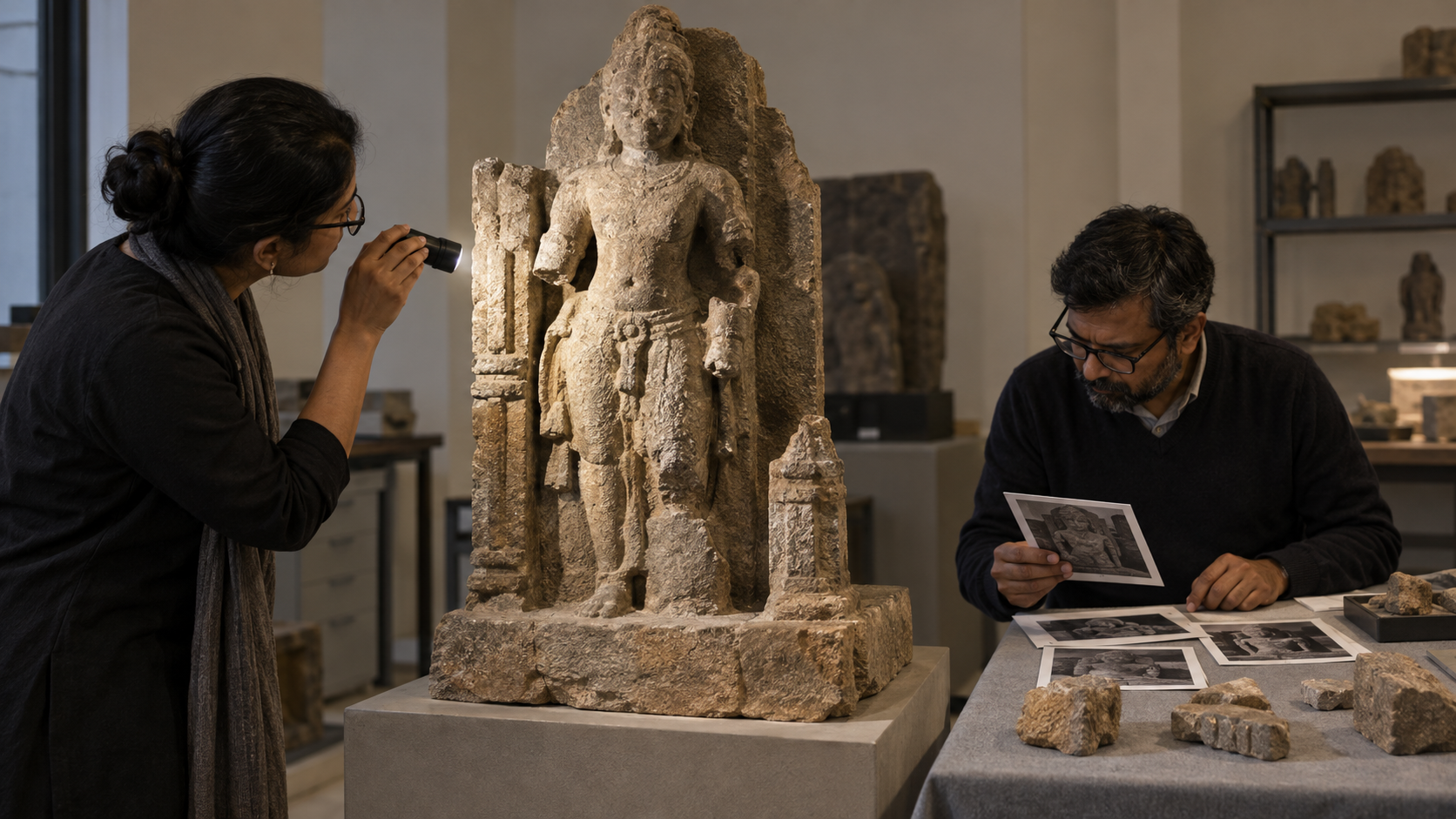
A halo or shining ornament is not enough to identify Prabhasa. Radiant visual language appears around many Hindu deities, and beauty alone is not an identifying attribute. A sound identification must come from context.
- Read the entire composition. Ask whether the figure stands alone or belongs to an ensemble. If there are eight coordinated figures, an identification with the Ashtavasus becomes more plausible, though the number by itself is not conclusive.
- Look for a name before interpreting an attribute. An inscription, temple label, catalogue entry, or established local identification carries more weight than a viewer’s impression that the figure looks luminous.
- Separate radiance from decoration. A halo, polished surface, bright pigment, or elaborate crown can communicate sanctity without uniquely identifying Prabhasa.
- Notice hierarchy and placement. A surrounding group, repeated scale, common posture, or relationship to a central deity may indicate a collective celestial role. Composition can reveal function even when individual members are not labelled.
- Preserve uncertainty when the evidence is incomplete. “Possibly one of the Vasus” is more accurate than confidently naming Prabhasa from brightness alone.
This method is useful because Hindu sculpture is not merely a collection of isolated portraits. Placement, repetition, direction, scale, gesture, and association can all contribute to meaning. You read the figure and the sacred arrangement together.
When visiting a temple or museum, photograph or transcribe the label if photography is permitted. Record the number of figures, the central deity, the arrangement, and any visible inscription. Those details will be more useful later than a general memory that the sculpture appeared radiant.
What Prabhasa reveals about Hindu cosmology
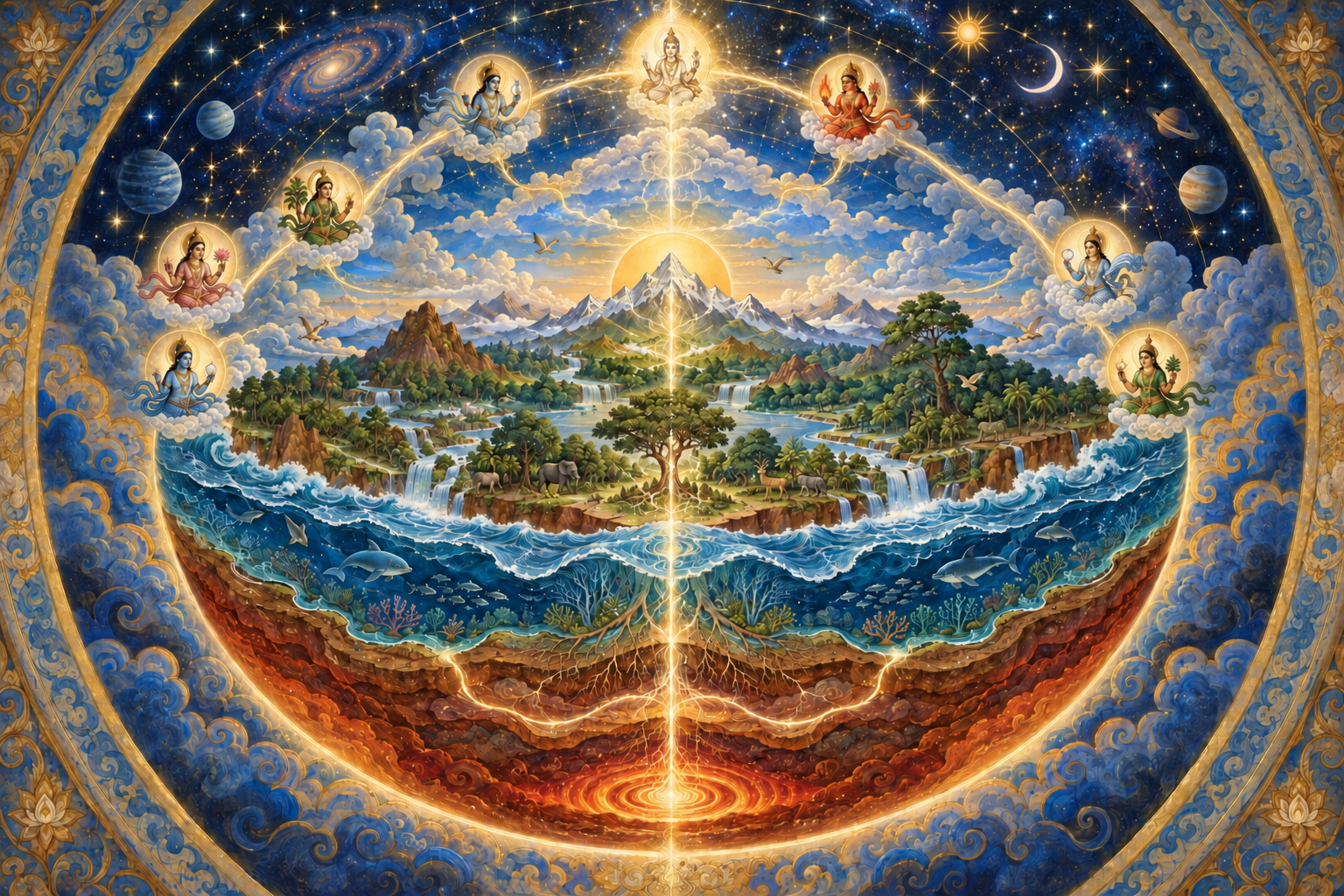
Prabhasa becomes easier to understand when you stop forcing Hindu cosmology into a choice between “nature” and “person.” The Ashtavasus belong to a worldview in which features of cosmic existence can be encountered as divine presences. Nature is not thereby made less real, and deity is not reduced to an impersonal mechanism.
His place among eight also shifts attention from isolated power to coordinated order. Radiance matters, but it does not constitute the cosmos by itself. Prabhasa belongs to a collective, and that collective serves within a wider divine structure associated with Indra. The image is one of relationship: distinct powers retain their identities while participating in a greater whole.
This is a useful corrective when reading lists of Hindu deities. A long list is not necessarily evidence of random multiplication. A named group may classify powers, express relationships, or show how diverse aspects of existence belong to one ordered vision. Before asking why Hindu tradition “needs another god,” ask what distinction the particular deity allows the tradition to preserve.
In Prabhasa’s case, the preserved distinction is radiance itself. Light is not treated merely as background scenery. It receives a name and a place. You can therefore notice luminosity as an active condition of manifestation rather than as an ornamental effect added after the world is formed.
Key takeaways
- Prabhasa is the Vasu associated with radiance and should first be understood as one member of the eight Vasus.
- The Ashtavasus are elemental deities connected with Indra’s celestial order.
- Radiance can be contemplated as the power by which forms become visible, but reflective meanings should not replace Prabhasa’s identity as a deity.
- A halo or bright appearance cannot identify Prabhasa on its own; group context, labels, inscriptions, and placement are stronger evidence.
- The Ashtavasus show how distinct cosmic powers can retain individual identities while participating in a coordinated sacred order.
A careful way to carry the symbolism into practice

You do not need to invent a ritual or claim a traditional observance in order to learn from Prabhasa. A simple reflective exercise is enough. Look at a flame or the daylight falling across an object and ask three questions: What has become visible? What distinction can you now perceive? What in your own conduct needs to be made clearer?
Treat this as personal contemplation, not as a prescribed rite attributed to scripture. Its value lies in keeping the symbolism concrete. Radiance reveals; it does not merely impress. The practical question is therefore not whether you can surround spiritual language with brightness, but whether greater light produces greater discernment.
The next time you meet Prabhasa in a name, image, or group of deities, pause before searching for an elaborate story. Establish the group, identify the elemental association, and examine the surrounding context. Then let the radiance do what radiance does: make the structure easier to see.
References

Leave a Reply
You must be logged in to post a comment.