

You may have sincere speakers, shelves of sacred books and people willing to listen, yet still lack a clear path from someone’s first class to sustained scriptural study. The missing piece is usually not more content. It is a dependable handoff between hearing, understanding, reading, returning and eventually helping another person learn.
Build that handoff deliberately. Treat the class, recording, printed text and follow-up conversation as parts of one teaching system. Each part should direct the learner toward the next encounter with the scripture rather than becoming a devotional experience that ends without a next step.
Start with one passage and one honest promise

A class becomes easier to trust when the listener knows exactly what is being taught. Name the text and passage before announcing the theme. Verse-centered sessions on Srimad-Bhagavatam 4.25.8, Srimad-Bhagavatam 4.6.33, Bhagavad-gita 2.40 and Srimad-Bhagavatam 11.5.1 model the useful precision of an exact textual anchor.
That precision is not merely good labelling. It lets a listener reopen the passage, compare the explanation with the text, read the surrounding verses and arrive at the next class with a real question. A broad title such as faith, surrender or the inconceivable may attract attention, but the verse reference gives the learner somewhere to return.
Prepare every lesson around the following sequence:
- Passage: give the work, chapter and verse, then use the wording of the edition actually in front of the group.
- Context: identify who is speaking, who is listening and what question or event has brought the passage into view.
- Commentarial lens: name the acharya, commentator, translation or sampradaya whose interpretation you are presenting.
- Central distinction: state the point learners must not blur, such as the difference between the scriptural wording and a teacher’s present-day application.
- Application: offer one practice, reflection or reading action that follows from the teaching without pretending that every listener has the same adhikara, duties or circumstances.
- Return point: give the next passage or question so the class opens a path instead of closing a topic.
Your promise to the learner should be modest and verifiable: by the end of the class, you will be able to locate the passage, state its central issue in your own words and identify what to examine next. That is more useful than promising a sweeping transformation from a single discourse.
Keep the textual layers visible. Say when you are reading a verse, paraphrasing a commentary, explaining your tradition’s siddhanta or making a practical inference. If you are relying on a translation rather than establishing the meaning of a Sanskrit term independently, say that too. Devotional conviction does not require blurred attribution.
Build a study path, not a collection of isolated classes

A first hearing can awaken interest, but it is not yet a curriculum. Learners need to know where they are, what comes next and how much background is assumed. Without that map, regular attendees may hear many worthy talks while remaining unable to follow an argument through a chapter or explain why one interpretation belongs to a particular lineage.
Use a progression that matches the learner’s actual relationship with the text:
| Stage | What the learner needs | What you provide | Clear handoff |
|---|---|---|---|
| Encounter | A reason to open the text | One passage, plain context and a question worth carrying | An exact place to read next |
| Orientation | A map of the work and the teaching tradition | Speaker, listener, setting, edition and commentarial lineage | A short sequence of connected passages |
| Continuity | Practice following an argument rather than collecting quotations | Sequential study with recurring terms and prior context | A stable class rhythm and preparation prompt |
| Participation | Permission to test understanding and ask precise questions | Discussion grounded in the passage rather than free association | A reading, reflection or service connected to the lesson |
| Transmission | The ability to explain faithfully without overstating certainty | Supervised summaries, citation habits and correction | A bounded teaching responsibility suited to competence |
Do not move everyone through these stages at the same speed. A visitor may need the setting of the dialogue and a glossary. A long-standing practitioner may need sustained engagement with a commentary or a difficult doctrinal distinction. Serving both in one room does not mean pretending they need the same lesson. Give newcomers a visible entry point and experienced students a clearly marked path for deeper study.
Sequential teaching is especially valuable because it restrains selective quotation. When a difficult verse appears, the group has to understand its literary and theological setting rather than replacing it with a preferred slogan. A theme such as conceiving the inconceivable in connection with Srimad-Bhagavatam 4.6.33 remains tied to a passage that learners can inspect.
A temple class also carries a relational dimension that a detached file cannot reproduce. A setting such as a class at Bhaktivedanta Manor can connect study with a community in which questions, conduct, worship and service are visible. Use that advantage carefully: belonging should support inquiry, not pressure a learner to pretend understanding.
Make live, recorded and printed teaching hand off to one another
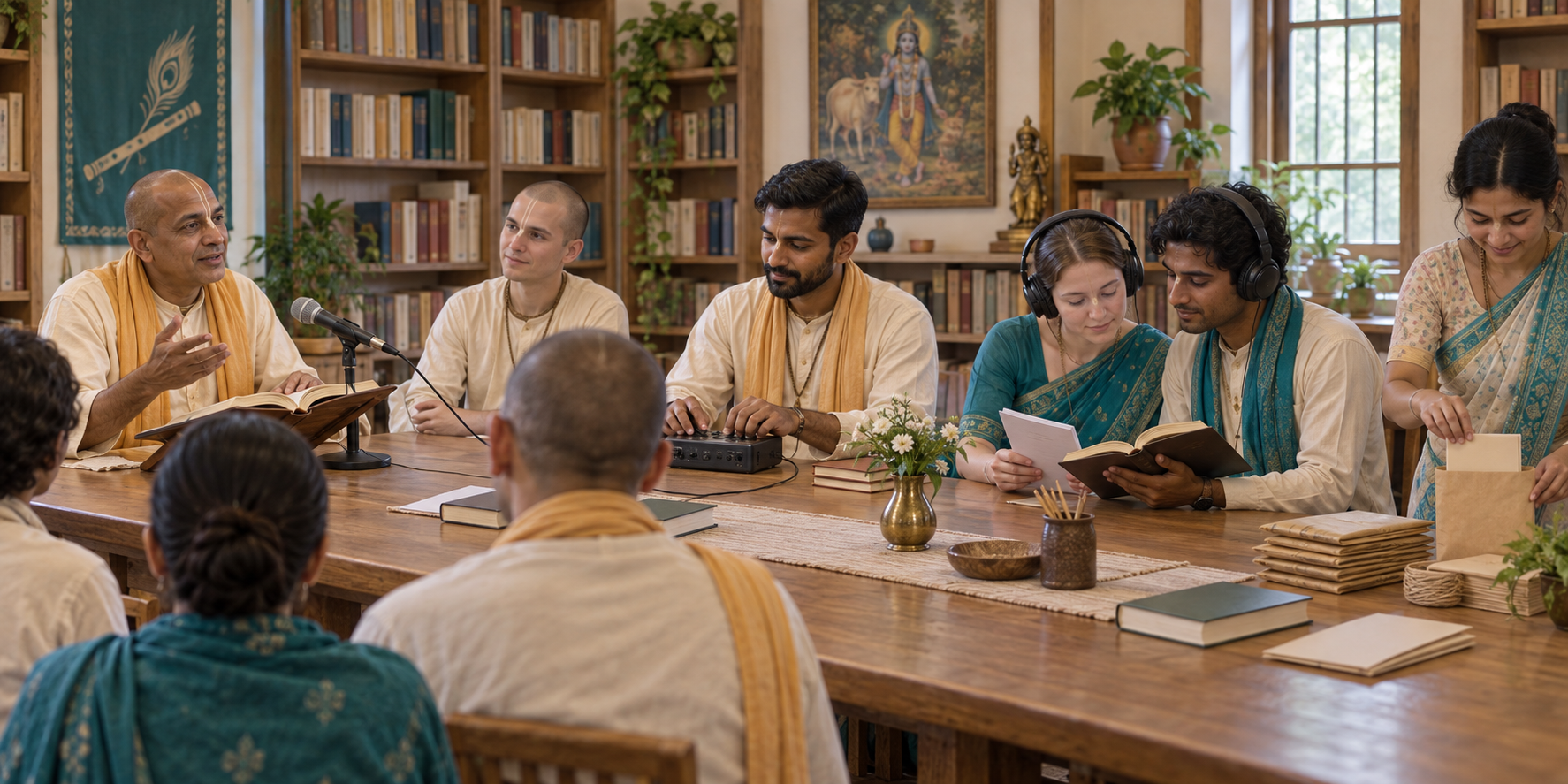
Each medium solves a different problem. Live teaching creates attention and allows a question to be heard. An archive serves people separated by place or schedule; a discourse identified with San Diego in 1994 shows how teaching can remain accessible beyond its original room. A printed scripture gives the learner a durable object to revisit without depending on a feed or platform.
The weakness appears at the joins. A live listener is not shown where to find the recording. A recording lacks the edition, verse and next lesson in its description. A recipient receives a book but no invitation to read a manageable passage with someone. Repairing those joins is one of the most practical things a temple, teacher or study circle can do.
Before the class
- Publish the exact passage, language of instruction, intended audience and access details.
- Name the edition or translation that will be used. If participants may use different editions, tell them that wording can vary.
- Give a preparation prompt that sends people to the text, such as identifying the question being answered or noting an unfamiliar term.
- Use a stable naming pattern for announcements and recordings so someone can find the next entry in the sequence.
During the class
- Repeat the passage reference aloud and display it wherever the medium allows.
- Explain necessary Sanskrit terms without making the vocabulary itself a test of belonging.
- Signal transitions clearly: text, commentary, doctrinal explanation, pastoral counsel and personal application are not interchangeable categories.
- Invite questions that return to the passage. Record unresolved questions rather than improvising certainty.
- End by naming the next reading or gathering while attention is still present.
After the class
- Attach the verse reference, edition, main terms, next reading and contact route to the recording.
- Provide a short written outline for learners who cannot reliably use audio or video. Accessibility is part of dissemination, not an optional extra.
- Place corrections beneath the archived material if a citation, pronunciation, translation or attribution needs amendment.
- Invite one concrete reply: a question, a short summary or confirmation that the learner found the next passage.
- Link the recording to an actual study opportunity rather than leaving it as an isolated item in a growing media library.
Live broadcasting can widen the doorway, as the Simhachalam live presentation of Srimad-Bhagavatam 4.25.8 demonstrates. The broadcast itself, however, cannot tell you whether a viewer understood the passage or knows where to continue. Give every remote learner the same three anchors available in a well-run room: the text, a route for questions and the next appointment with the teaching.
Protect fidelity without turning the class into a gate

Vaishnava teaching is not a single, context-free voice. Different sampradayas and acharyas preserve real distinctions in metaphysics, authority, devotional mood and practice. You do not honour that inheritance by flattening those distinctions into a vague Hindu consensus. Nor do you serve a learner by presenting one lineage’s explanation as though no other Vaishnava reading exists.
Use four guardrails whenever you teach or publish:
- Provenance: identify the scripture, edition, translator and commentary. If a quotation came through an intermediary, verify it before building an argument upon it.
- Interpretive boundary: distinguish what the passage states from what a commentator concludes and what you are asking the learner to do.
- Lineage clarity: speak from your tradition with confidence, but name significant differences when they affect the meaning under discussion.
- Correction practice: if you do not know, say so. Check the text and relevant commentary, then return with an answer or an explicit correction.
This discipline becomes even more important when two teachers share a subject, as in the teaching associated with Bhagavad-gita 2.40. Multiple voices can enrich a session when listeners can tell whether the speakers are reinforcing one interpretation, supplying complementary applications or marking a genuine difference. Do not make the audience infer those relationships unaided.
Accessibility and fidelity are allies. Define a technical term the first time it matters. Translate before elaborating. Keep the verse visible. Explain why the surrounding passage changes the reading. A newcomer should not need insider vocabulary to identify the argument, while a serious student should be able to trace that argument back to the text.
Questions also need boundaries. A teacher may offer scriptural and tradition-specific guidance, but should not convert a general class into individualized medical, legal, financial or psychological direction. When a question crosses into those fields, preserve the spiritual principle while directing the person to appropriate qualified help.
Launch a teaching cycle people can actually continue
Distribution goals can create energy and mobilize a community. The call to strive for 100,008 Srimad-Bhagavatam sets is an explicit example of large-scale ambition. But circulation and assimilation are different outcomes. Counting a set placed into someone’s hands measures reach; it does not show whether the recipient opened it, found an entry point or joined a continuing relationship with the text.
Pair every distribution effort with a learning invitation. Place a simple reading route with the set. Give the recipient a way to ask a question without being pushed into public participation. Connect the text to a local class, an accessible remote session or a person willing to read alongside them. Follow up only with consent, and collect no more personal information than the follow-up requires.
You can put the whole system into operation with this sequence:
- Define the learner: newcomer, regular congregant, home study group, youth cohort or advanced reader. Do not build for an imaginary average participant.
- Select a connected passage sequence and name the edition and commentarial lens.
- Prepare a reusable lesson sheet containing the passage, context, key distinction, terms, likely question, application and next reading.
- Announce a stable rhythm that your teachers and learners can realistically sustain.
- Connect the room, livestream, archive and printed text through consistent titles, descriptions and links.
- End every encounter with one next action that can be completed without guessing what you meant.
- Review the completed cycle by asking what people could locate, explain and continue, not merely how many appeared.
Your scorecard should therefore include more than audience size or books distributed. Notice whether learners return, bring the correct passage, ask questions grounded in the text, distinguish quotation from interpretation and complete the agreed reading. For those moving toward teaching, listen for accurate attribution and the humility to mark uncertainty. These signs reveal whether dissemination is producing scriptural literacy rather than momentary exposure.
Key takeaways
- Anchor every class in an exact passage, named edition and identifiable interpretive lineage.
- Design the route from first hearing to continuing study before promoting the event.
- Make live classes, recordings and printed scriptures direct learners toward one another.
- Pair large distribution goals with consent-based follow-up and a manageable reading entry point.
- Measure return, comprehension and faithful explanation alongside reach.
- Correct mistakes openly; visible correction strengthens rather than weakens responsible teaching.
Begin with the next class already on your calendar. Add its exact passage, identify the edition, write the next reading and decide where an unresolved question will go. Then make sure the recording and any book placed in a learner’s hands lead back into that same path. A durable Vaishnava teaching culture grows when no sincere encounter with scripture is left without a faithful next step.
References
- Dandavats — HG Arcita Prabhu – Srimad-Bhagavatam 4.25.8 – Simhachalam
- Dandavats — SB 4.6.33 – Conceiving the Inconceivable (San Diego 1994)
- Dandavats — HH Bhaktimarga Swami/HH Bhaktivinoda Swami BG 2.40
- Dandavats — Bhaktivedanta Manor | Class
- Dandavats — His Holiness Radha Raman Swami Maharaj | SB 11.05.01 | 18-09-2026
- Dandavats — Strive to Achieve 100,008 Srimad Bhagavatam Sets – Bhadra 2026 Message by Mahatma Prabhu

Leave a Reply
You must be logged in to post a comment.