
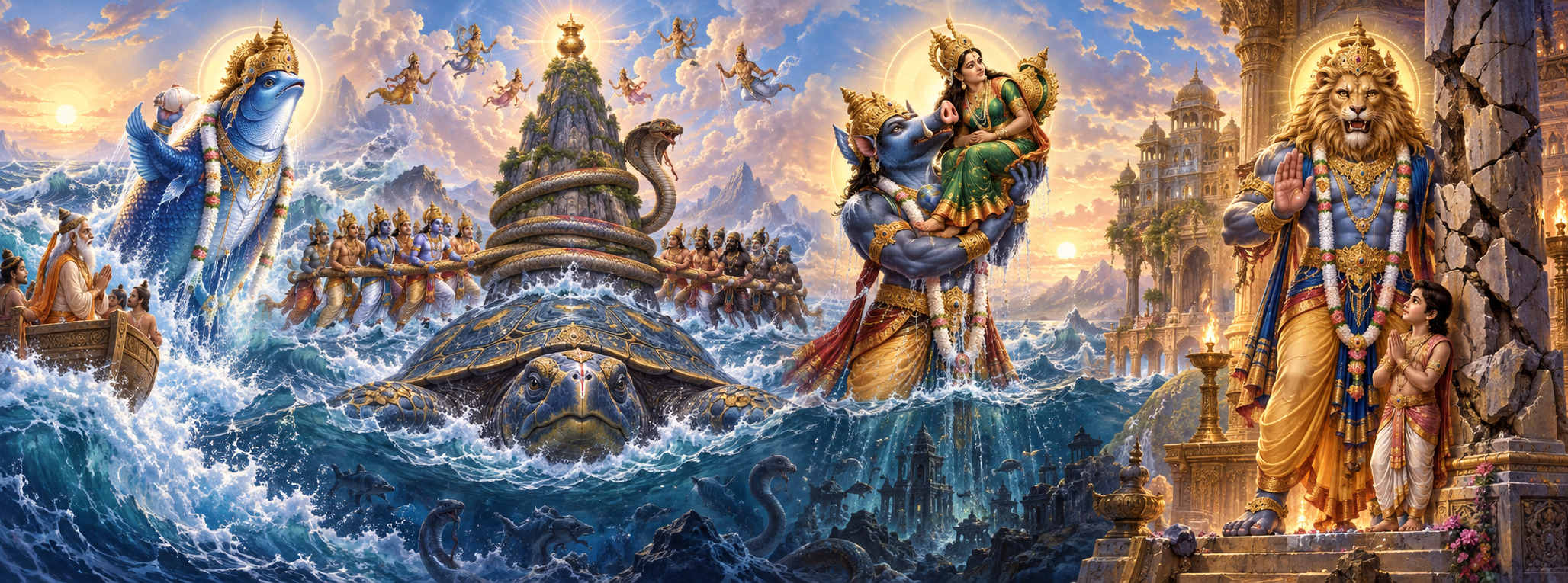
If you have seen the Dashavatara listed as Matsya, Kurma, Varaha, and Narasimha before any recognizably human form, you may wonder what the sequence is trying to say. Is it describing evolution, ranking different bodies, or teaching something about Satya Yuga?
The most useful answer is also the simplest: an avatara’s body fits the work that must be done. Vishnu does not move from an inferior animal state toward a superior human one. He assumes the precise form through which dharma can be restored.
The short answer: four task-shaped forms
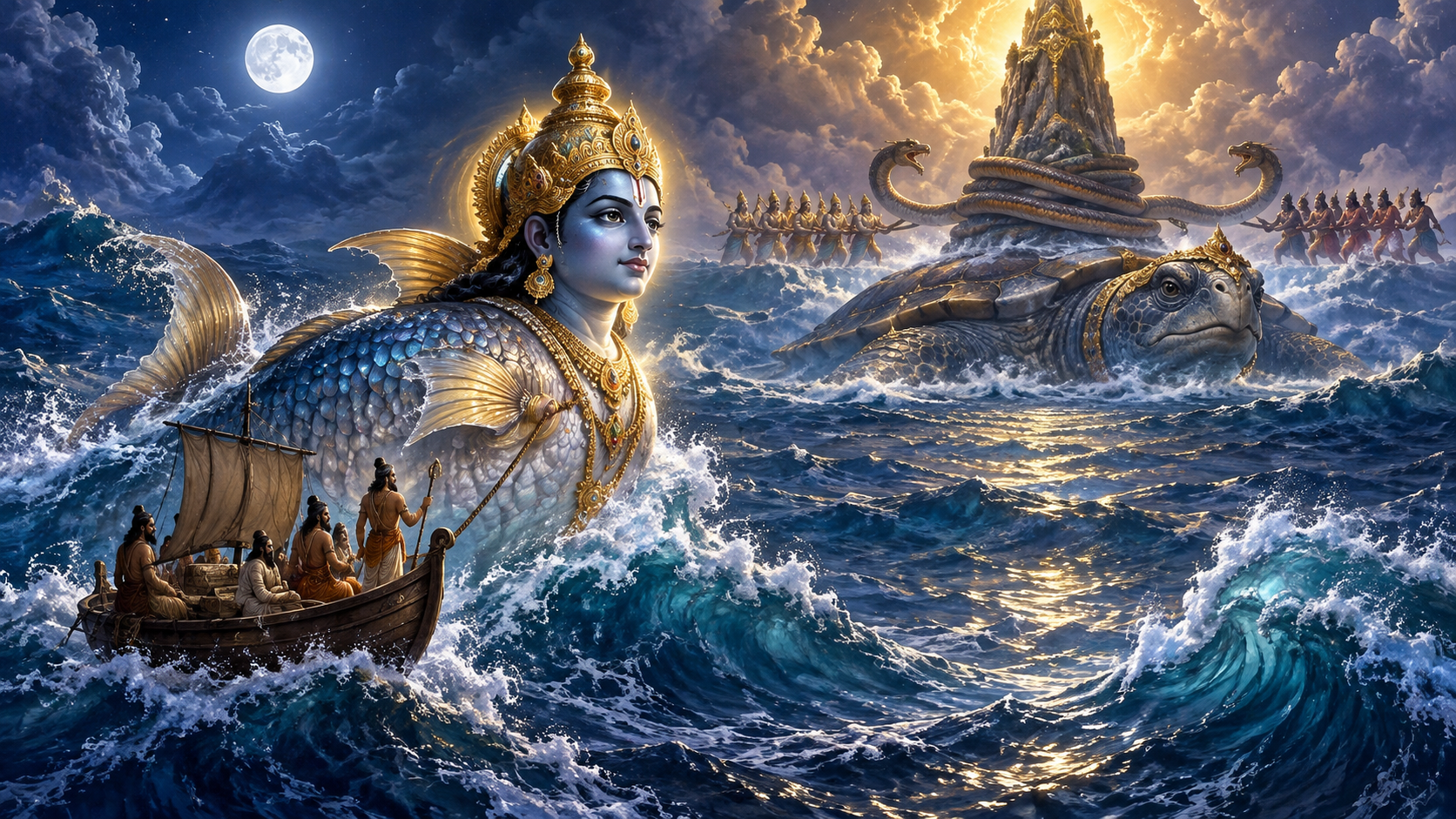
Satya Yuga is also called Krita Yuga. In the familiar Dashavatara arrangement, the four earliest forms are commonly treated as non-human manifestations associated with this yuga. They are Matsya, Kurma, Varaha, and Narasimha.
This wording matters. Hindu traditions do not all enumerate Vishnu’s avataras or assign them to yugas in exactly the same way. When you are teaching the sequence, discussing it with your family, or writing about it, call these the four Satya Yuga forms in the commonly known Dashavatara scheme. That is more accurate than presenting one arrangement as the only Hindu account.
| Avatara | Manifested form | Central work | What the form reveals |
|---|---|---|---|
| Matsya | Fish or human-fish form | Preserves life and sacred knowledge through a deluge | The divine enters the threatening element and guides life through it |
| Kurma | Tortoise | Provides the stable base needed for the churning of the cosmic ocean | Great transformation requires an unseen foundation capable of bearing its strain |
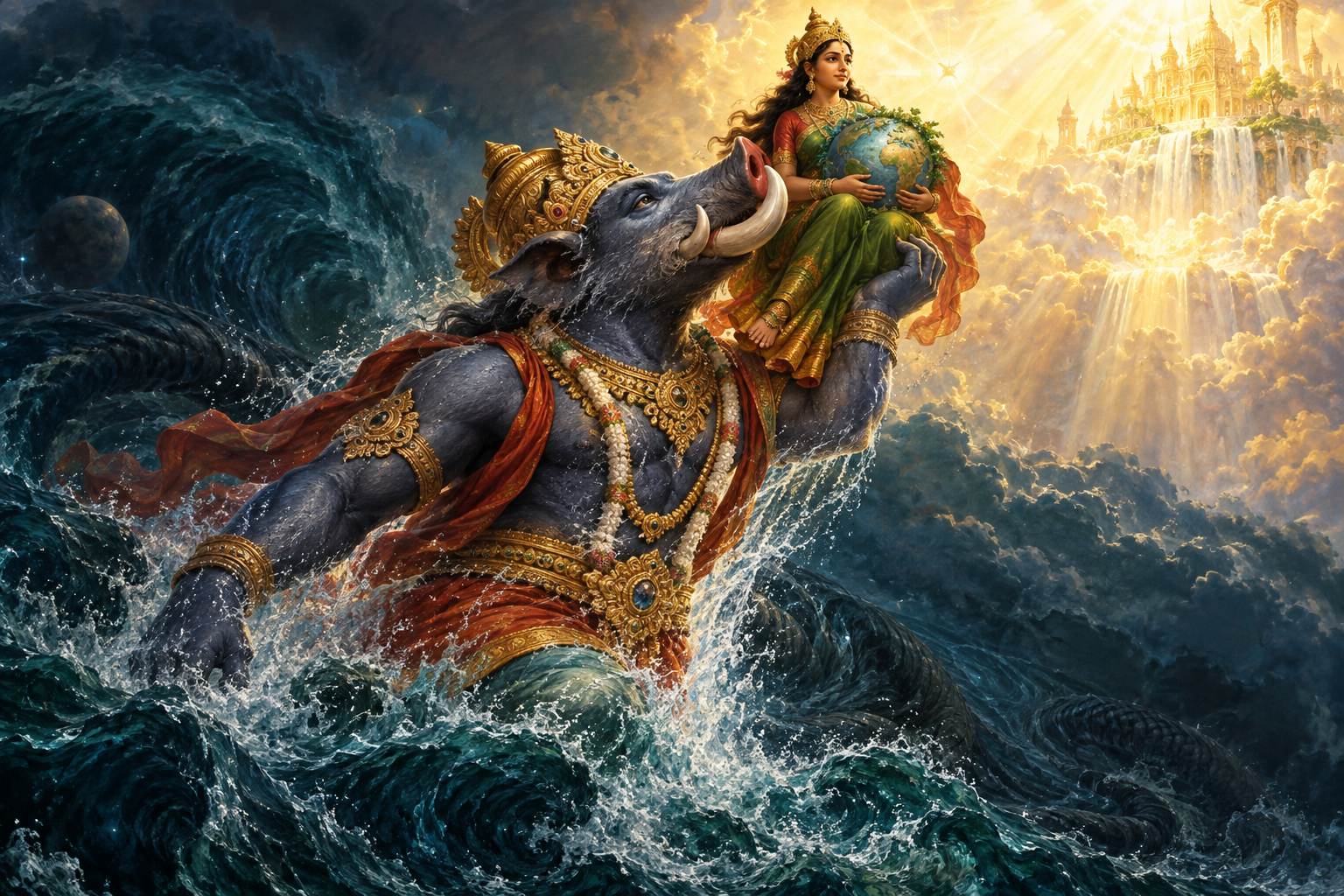
| Varaha | Boar or boar-headed form | Raises the Earth from the cosmic waters and defeats Hiranyaksha | No depth or condition of defilement lies beyond divine recovery |
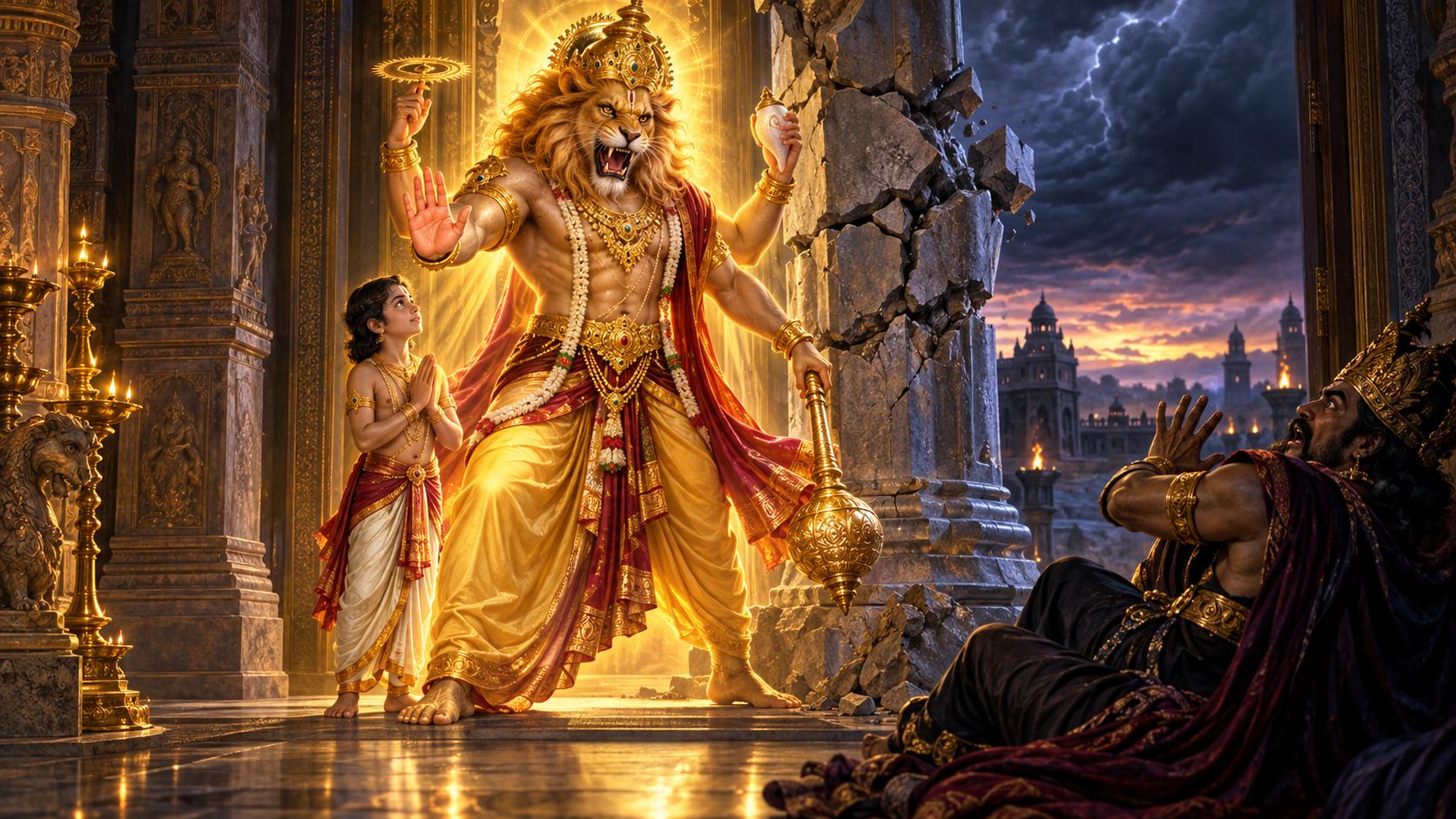
| Narasimha | Man-lion form | Protects Prahlada and brings Hiranyakashipu’s tyranny to an end | Dharma cannot be imprisoned within a tyrant’s convenient categories |
The phrase “non-human” is therefore only shorthand. Matsya, Kurma, and Varaha appear through animal forms or animal-associated iconography. Narasimha is deliberately composite: neither an ordinary man nor merely a lion. His liminal form is the point, not an awkward exception to the pattern.
Why the form answers the problem
An avatara is not Vishnu wearing a decorative costume. Form and function belong together. If you separate them, the stories become a list of fantastic creatures. If you read them together, each embodiment becomes an explanation of how divine intelligence responds to a particular disorder.
- The environment helps determine the form. Matsya can move through the waters that overwhelm ordinary terrestrial life. The threatening element becomes the field of rescue.
- The burden helps determine the form. Kurma supplies support beneath a momentous undertaking. Varaha can descend into the depths, confront the force holding the Earth down, and raise her again.
- The apparent constraint helps determine the form. Hiranyakashipu places his confidence in categories and conditions. Narasimha’s man-lion embodiment demonstrates that reality, and therefore divine action, exceeds a tyrant’s binary logic.
This also corrects a common misunderstanding. Saying that Satya Yuga’s familiar avataras were not ordinarily human does not mean humanity was absent, unimportant, or unworthy. It means an ordinary human body was not the instrument required by these particular interventions. Cosmic waters, a world-bearing task, a submerged Earth, and protection hedged about by unusual conditions call for forms proportionate to them.
Nor does “non-human” mean “less than human.” Within this theological vision, the divine is not diminished by appearing as fish, tortoise, boar, or man-lion. One lesson you can carry from the sequence is that sacred presence is not restricted to the human outline. Creation is not merely scenery surrounding human spiritual life; its many forms can disclose divine purpose.
Satya Yuga was truthful, not eventless
The name Satya Yuga can tempt you into imagining an age in which nothing went wrong. The avatara narratives themselves prevent that reading. An age associated with truth and a strong establishment of dharma can still contain beings who threaten cosmic continuity, displace the Earth, abuse power, or persecute a devotee.
The distinction is between the general character of the age and the flawless conduct of every being within it. Satya Yuga does not make divine intervention unnecessary. It establishes the setting in which the earliest Dashavatara manifestations address disorders that are often cosmic, elemental, or primordial in scale.
The first three forms can be read as a movement through conditions needed for an ordered world: continuity amid the waters, support beneath a transformative action, and restoration of the Earth. Narasimha then brings the question into a more recognizably moral and devotional relationship. Prahlada’s fidelity stands against Hiranyakashipu’s coercive power. Protection is no longer only about preserving a world; it is also about defending a devotee within that world.
This progression is a helpful interpretive pattern, but it should not be turned into a rigid doctrine that every tradition must accept. Modern readers sometimes see a biological analogy in the movement from fish to tortoise, land animal, composite being, and later human forms. You may find that analogy thought-provoking. Still, the narratives establish a theological sequence of fitting interventions, not a scientific account of biological descent. Treating the Dashavatara solely as a coded evolutionary chart strips away the crises, relationships, and restoration of dharma that give each manifestation its meaning.
A reliable way to study any avatara
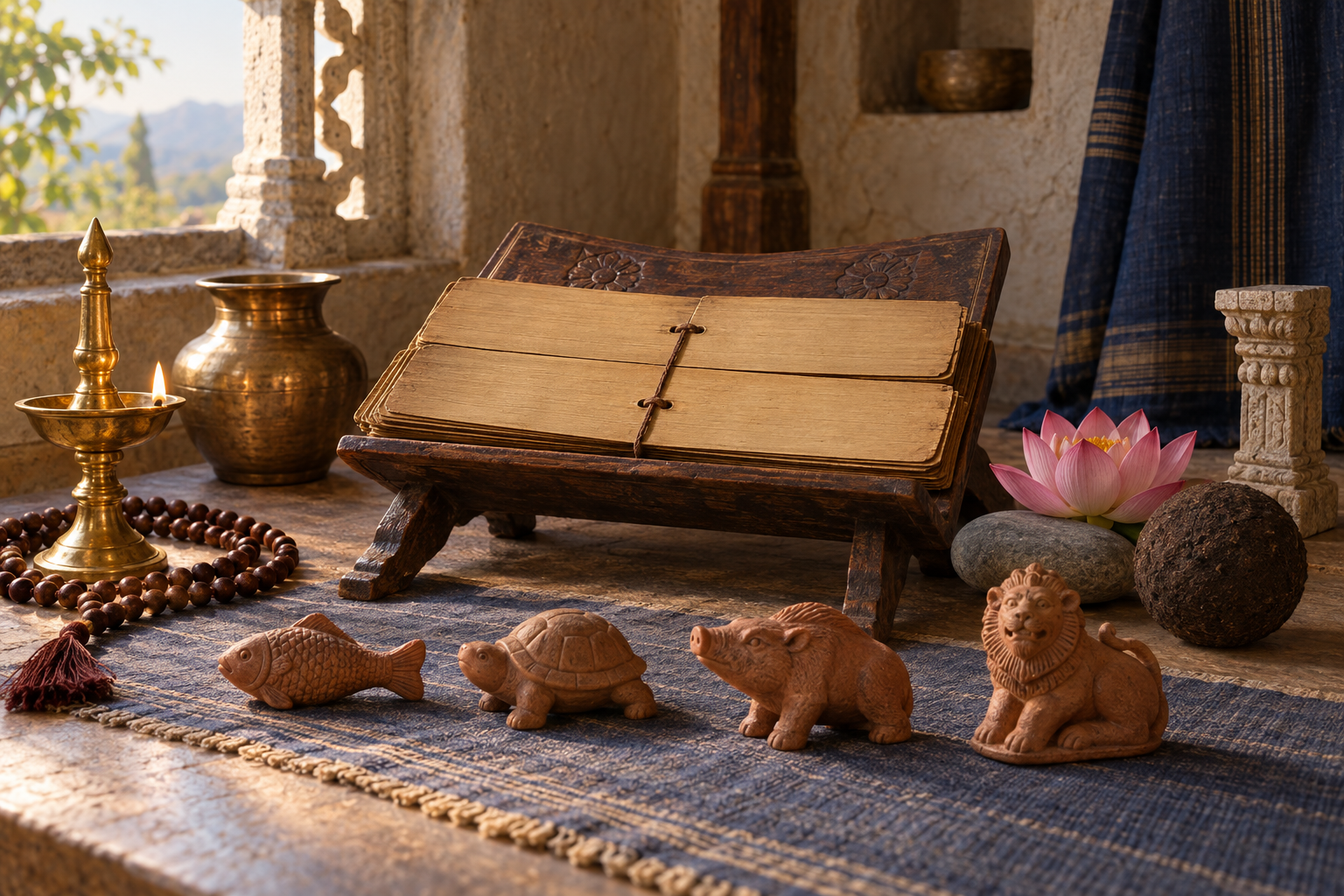
When you encounter a Vishnu avatara in scripture, temple art, a calendar, or a retelling, do not begin by asking where it ranks. Work through four questions instead:
- What is threatened? Identify the actual crisis: continuity of life, the foundation of a cosmic undertaking, the Earth herself, a devotee, or the rule of dharma.
- Why is an ordinary response insufficient? Look for the environment, burden, power, or condition that prevents a conventional solution.
- How does the body fit the task? Connect the avatara’s form to the obstacle instead of treating its appearance as an incidental miracle.
- What is restored? Notice whether the result is preservation, stability, recovery, protection, or the removal of oppressive power.
Narasimha makes the method especially clear. The immediate crisis is the persecution of Prahlada under Hiranyakashipu’s rule. The tyrant believes that carefully framed protections have placed him beyond defeat. A being that is not confined to the simple category of man or beast answers that false security. Prahlada is protected, tyranny ends, and the attempted manipulation of categories is shown to be weaker than dharma.
The same method keeps Matsya from becoming merely “the fish avatara.” The waters are not background decoration; they are the condition of danger. A form able to move through them converts the realm of destruction into a path of preservation.
You can also use form and action together when identifying these avataras in sacred art:
- Matsya may appear as a fish or as a composite human-fish figure, depending on the artistic tradition.
- Kurma is recognized through the tortoise form and its association with sustaining the churning of the ocean.
- Varaha appears in boar or boar-headed form, frequently in the act of raising or accompanying Bhudevi, the Earth.
- Narasimha combines a leonine head with a humanlike body. Different images may emphasize his fierce intervention, his protection of Prahlada, or his peaceful state after the crisis.
Regional and sectarian iconography varies, so do not identify a murti from body shape alone when other attributes, companions, or actions are visible. Read the entire composition.
Four common questions about the Satya Yuga forms
Were these the only manifestations of Vishnu in Satya Yuga?
That conclusion is safe only within the familiar Dashavatara framework. Hindu traditions preserve broader avatara lists and do not always organize manifestations identically. Say “the four forms commonly assigned to Satya Yuga in the Dashavatara sequence” when the distinction matters.
Why did Vishnu not appear as an ordinary human?
Because these narratives present elemental, cosmic, and category-defying crises. The chosen embodiment is the means of intervention: Matsya navigates the waters, Kurma bears the foundation, Varaha retrieves the Earth, and Narasimha crosses the human-animal boundary.
Should Narasimha be called an animal avatara?
Not without qualification. Narasimha is a composite or liminal manifestation. Calling him simply a lion loses the theological force of a form that is neither conventionally human nor merely animal.
Does the order prove that the Dashavatara teaches evolution?
No such conclusion is required. The sequence can support a modern evolutionary analogy, but analogy is not identity. Its direct religious logic concerns the fitness of each form to its crisis and the restoration of dharma. Keep that primary before adding a biological interpretation.
The next time you meet one of these forms, replace the question “Why was Vishnu not human?” with “What made this exact embodiment necessary?” That change takes you beyond memorizing four names and into the dharmic logic joining body, action, and restoration.
References

Leave a Reply
You must be logged in to post a comment.