
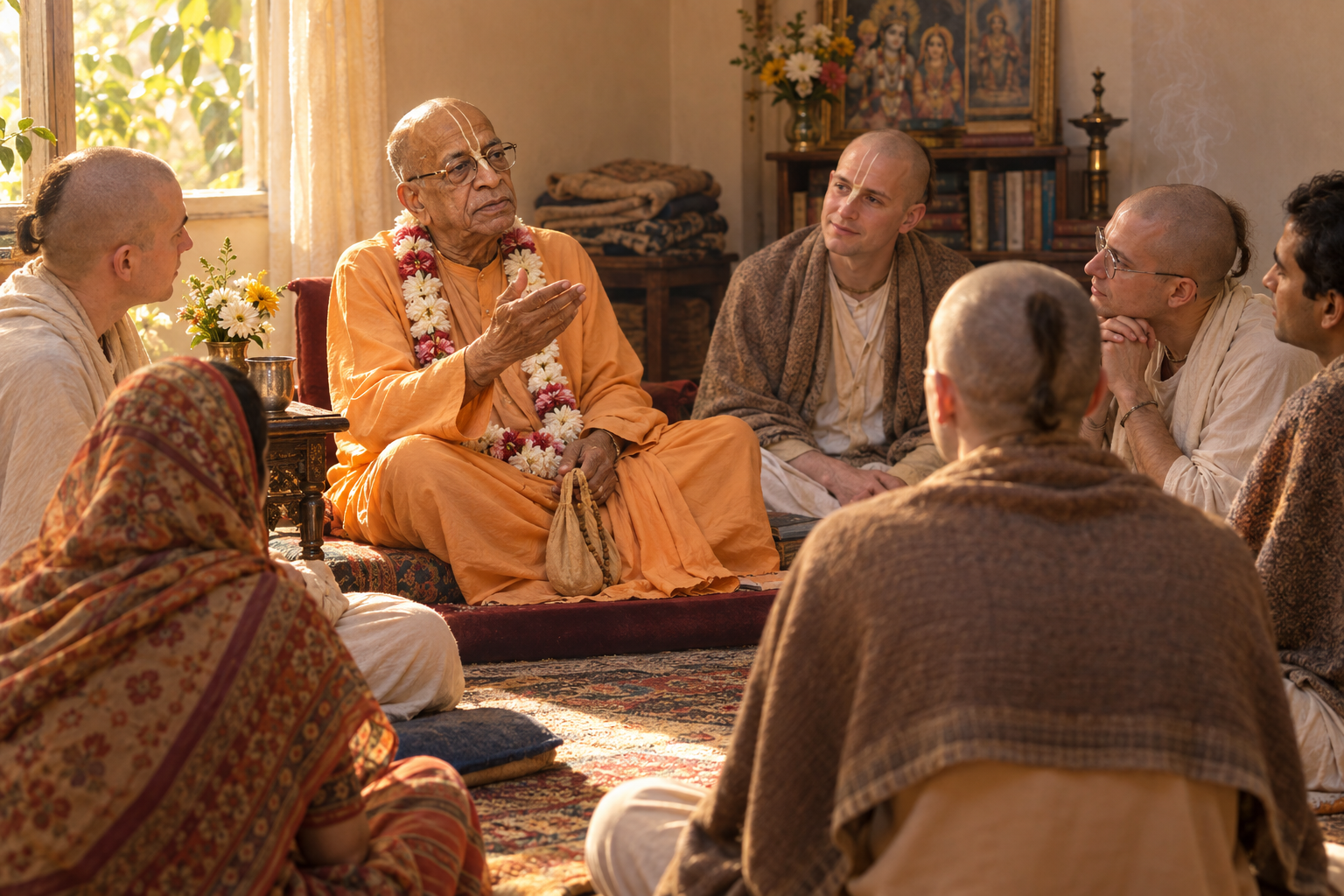
You may seek memories of Srila Prabhupada because you never met him, because you miss his physical presence, or because you want to understand what discipleship looked like around him. The real test of your listening is not whether a story briefly moves you. It is whether you notice something that changes how you hear, serve, chant, welcome others, or accept correction.
The 15 September 2026 remembrance by HG Srutakirti Prabhu associated with ISKCON Ujjain gives you an occasion for this kind of disciplined hearing. Approach it as devotional testimony: receive it with reverence, preserve its context, and ask what responsibility it places before you.
Listen for the relationship, not only the remarkable moment

A memorable incident naturally draws attention to what was unusual. Yet the deeper lesson may sit in the relationship around the incident: how service was understood, how a correction was received, how an ordinary duty was treated, or how the disciple’s attention shifted toward Krishna. If you chase only dramatic moments, you can miss the habits that made those moments spiritually meaningful.
Pause after each self-contained recollection. Do not immediately move to the next story. Write a short note in your own words and answer these questions:
- What does the narrator actually remember Srila Prabhupada doing or saying?
- What changed in the narrator’s understanding, conduct, or service?
- Which part of the account is observable, and which part is an interpretation of its meaning?
- What response would express the same principle in your present responsibilities?
This slows down devotional consumption. You are no longer collecting anecdotes about a revered personality; you are learning to notice how an acharya’s teaching becomes visible in conduct. That distinction matters. Admiration can remain safely distant, but a principle recognized in conduct asks something of you.
Keep the remembered event, its principle, and your application distinct

A personal memory is neither disposable nostalgia nor a substitute for siddhanta. It is testimony carried through the witness’s perspective. It can illuminate character, relationships, circumstances, and the lived meaning of service, but it should not be made to bear a claim larger than the recollection itself supports.
Use the following labels in your notes:
- Remembered event: what the narrator reports seeing, hearing, or experiencing. Preserve any uncertainty or qualification instead of silently making the account more definite.
- Inferred principle: the lesson you think the event demonstrates. State this as your understanding, not as additional remembered fact.
- Proposed application: the change you might make in your own conduct. This belongs to your circumstances, not to the historical event.
Do not push your application backward and make it part of the memory. A direction given to a particular disciple in a particular circumstance does not automatically become a universal rule. Before generalising it, ask whether the proposed rule agrees with established teaching and whether the original situation is sufficiently clear. If you are unsure, take the account and your interpretation to a mature teacher in your sampradaya.
Apply the same discipline to quotations. Use quotation marks only when you have exact wording. If you possess only a recollection or paraphrase, describe it as such. Devotional respect does not require artificial certainty; preserving the boundary between exact words and remembered meaning is itself a form of respect.
Convert inspiration into a change you can observe

Inspiration fades when it has no address in your daily life. A useful application names the situation, the behaviour, and the next opportunity to act. Phrases such as be more sincere or serve better are too broad to guide you when the moment of choice arrives.
- Extract the event without ornament. Write a plain account of what you heard. Remove the adjectives you supplied yourself.
- Name the principle precisely. Choose the clearest description you can defend, such as attentiveness in service, steadiness under inconvenience, careful speech, hospitality, or willingness to accept correction.
- Locate the friction. Identify where your present conduct conflicts with that principle: rushed japa, delayed temple service, inattentiveness to a guest, a neglected duty, or defensiveness when corrected.
- Choose the smallest complete response. Put the phone outside the room before japa, arrive before a service begins, prepare a place for a newcomer, finish the neglected duty, or write down a correction before answering it.
- Review the result honestly. Ask whether the action made you more available for seva and remembrance of Krishna. If it merely made you feel accomplished, refine the application.
The point is not to imitate another devotee’s circumstances. You probably do not share the same service, place, responsibilities, or relationship. Imitate the devotional value where it genuinely applies. Fidelity to a principle may require a different outward action in your life.
Resist making a large vow while you are emotionally stirred. Complete a modest duty first. A remembered lesson becomes part of your character through repeated obedience in ordinary moments, not through the intensity of the promise made while listening.
Preserve reverence by preserving accuracy
Stories change when they travel. A reteller shortens the setting, joins separate details, turns a paraphrase into a quotation, or removes an uncertainty because the cleaner version sounds stronger. These changes may be well intentioned, but they make it harder for the next listener to know what was actually remembered.
When you share a Srila Prabhupada memory, keep the narrator’s name, the date, the place, and the original link attached whenever those details are available. Say plainly whether you are quoting, paraphrasing, or explaining what the incident means to you. Do not combine similar retellings into a seamless account unless you can identify which detail belongs to which witness.
If accounts appear to differ, preserve the difference rather than manufacturing certainty. Memory can be spiritually valuable without functioning as a verbatim transcript. Accuracy protects both the witness and the person being remembered.
In a family or satsanga discussion, ask one participant to restate the event without commentary, invite another to identify the apparent principle, and let everyone name a fitting application. With children, keep the questions concrete: What did the person do? Why might that have mattered? What could we do when a similar choice appears? This teaches attentive hearing instead of passive admiration.
Do not turn a cherished memory into a weapon for winning a community argument. If a recollection exposes carelessness, pride, or indiscipline, apply that light inward before directing it at someone else. Remembrance remains spiritually alive when it increases responsibility; it becomes factional folklore when it is used mainly to establish who is right.
Key takeaways
- Hear Srila Prabhupada’s memories to become accountable to a devotional principle, not merely to collect moving stories.
- Keep the witnessed event, your inferred lesson, and your proposed application clearly separated.
- Do not convert a context-specific direction into a universal command without testing it against established teaching.
- Reserve quotation marks for wording you can verify; label recollection and paraphrase honestly.
- Act on a lesson within your real duties before searching for another memory to consume.
Before you move on from this remembrance, write down the event that stayed with you, the principle you discerned, and an action you can complete within your present routine. Then do that action before beginning another talk. That is how a memory stops being distant history and begins to guide living seva.
References

Leave a Reply
You must be logged in to post a comment.