
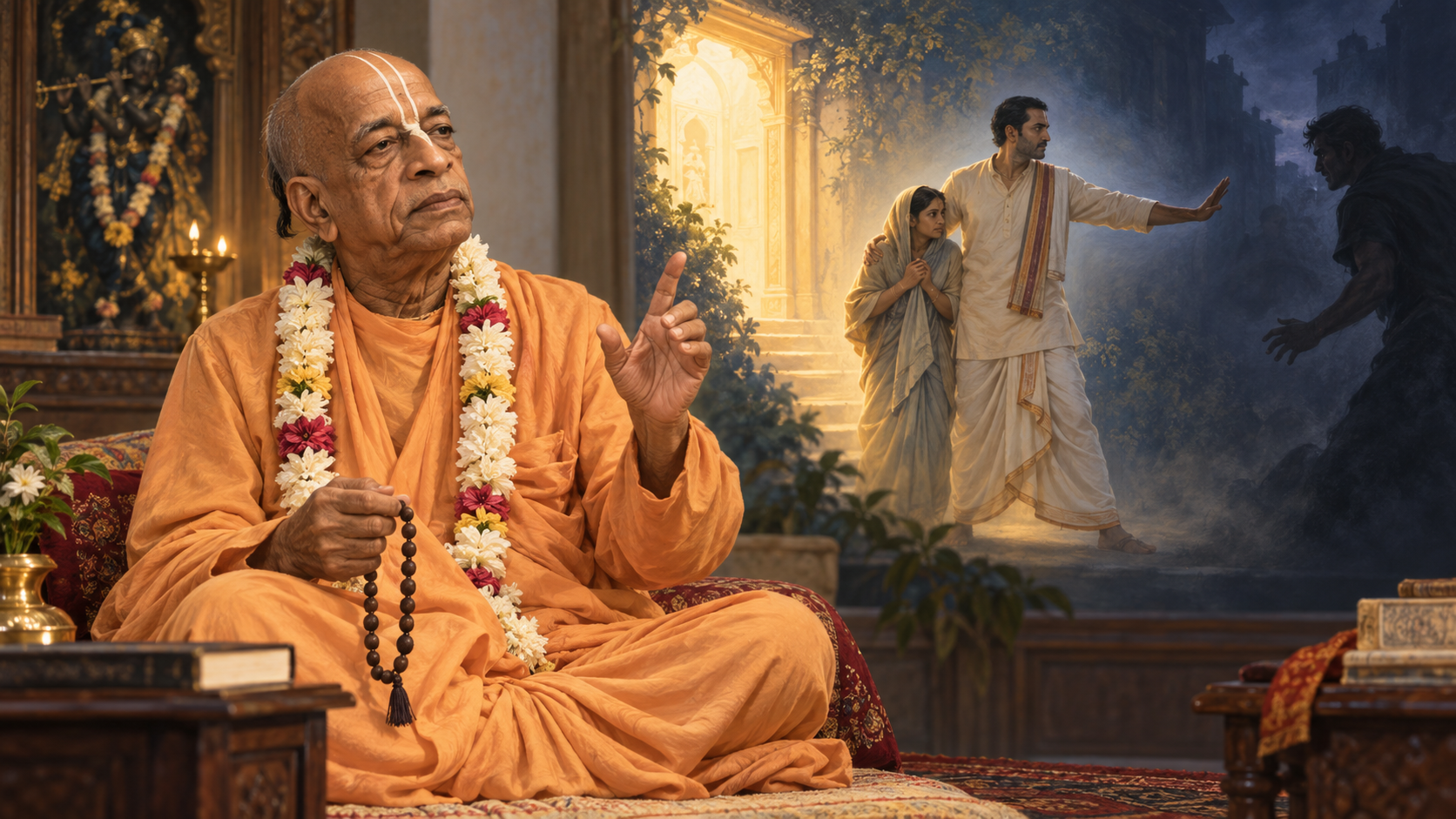
If you are asking whether dependence on Krishna means remaining passive while someone harms you or another person, the clearest answer is no. Yet self-defense in Srila Prabhupada’s teaching is not a blank check for rage, vigilantism, or retaliation.
The governing order is crucial: remember Krishna, protect whoever is most exposed, seek legitimate help, and act only for protection. That order keeps courage from becoming ego and surrender from becoming an excuse for inaction.
Surrender governs action; it does not erase duty
Srila Prabhupada placed personal protection first within spiritual life. He taught that chanting the Hare Krishna maha-mantra, remembering Krishna, and depending upon Him protect a devotee from danger and illusion. He also warned that offenses against devotees can damage the spiritual life one is trying to preserve.
This dependence is a discipline of consciousness, not a claim that practical duties disappear. Remembering Krishna gives your response a governor. The aim is to stop harm without allowing panic, pride, or hatred to decide what happens next.
If danger is immediate, do not delay escape, assistance, or an emergency call in order to complete a ritual. Move to safety first. If you have even a brief moment to collect yourself, use remembrance to recover the right intention: protect life, do not punish an enemy, and do not turn a necessary response into vengeance.
Before entering a conflict that is not physically urgent, ask yourself:
- What exact harm am I trying to prevent?
- Am I defending someone, or trying to humiliate an opponent?
- Will my action end when the danger ends?
- Can I remain truthful without becoming cruel?
If you cannot answer those questions clearly, pause. The fighting spirit may be real, but it has not yet been placed under dharma.
Protection begins with the person most exposed

In his purport to Srimad-Bhagavatam 1.8.5, Srila Prabhupada identifies children, women, older adults, brahmanas, and cows as requiring active protection. These are traditional social categories, but the operational principle is plain: greater vulnerability creates a greater duty of care.
That changes the first question in a crisis. Do not begin with, “How do I defeat the aggressor?” Begin with, “Who can be harmed most easily, and how do I move that person or being out of danger?” Protection may mean escorting a child away, helping an older person reach an exit, placing a barrier between an aggressor and a target, calling trained assistance, or ensuring that animals are not abandoned when a community faces disruption.
The same principle should shape preparation before any incident occurs. At your next family, temple, or community meeting, attach names to responsibilities:
- Who supervises children and confirms that they leave with an authorized caregiver?
- Who assists older adults or anyone with limited mobility?
- Who calls local emergency services, site security, or another legitimate authority?
- Who preserves messages, photographs, or other records if threats have been made?
- Who communicates verified facts to the congregation instead of allowing rumors to spread?
- If cows or other dependent animals are in the community’s care, who maintains feeding, shelter, and continuity of care during an emergency?
A protection plan without assigned responsibility is only a good intention. The vulnerable person usually cannot organize everyone else while danger is unfolding.
Srila Prabhupada’s longer-term answer was varnasrama-dharma. He insisted that a functioning social order needs both brahmanas and kshatriyas: people capable of preserving spiritual knowledge and people trained to exercise protective responsibility. A community cannot expect teachers alone to manage every security problem, nor can it let protective power operate without spiritual and ethical direction.
This is why self-defense cannot be reduced to private combat ability. Durable protection requires competent people, clear authority, education, care for dependants, and accountability. Ask not only whether someone is brave, but whether that person is disciplined, knows the limits of the role, and will accept scrutiny after acting.
Defending dharma is usually an educational task
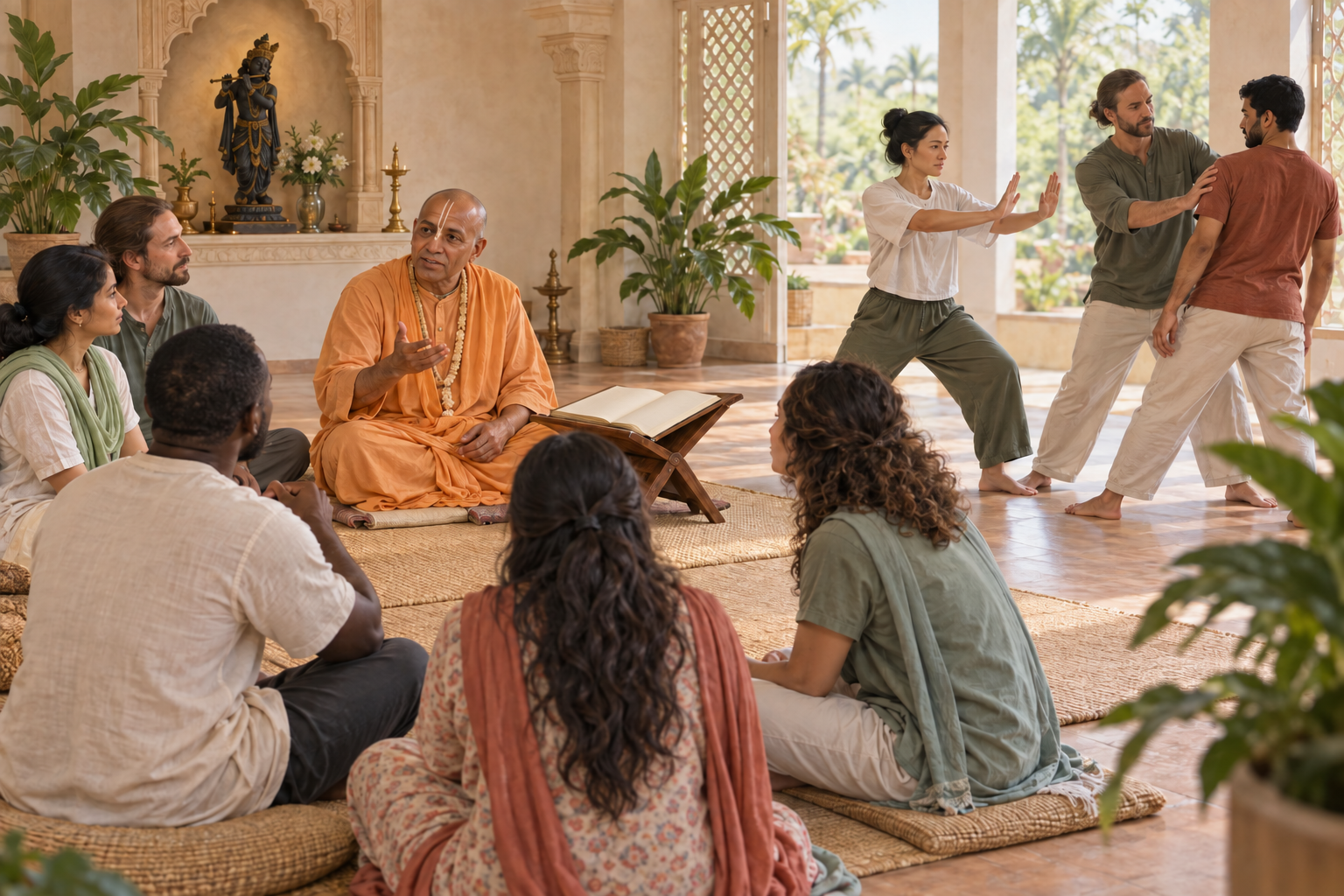
Srila Prabhupada did not treat cultural preservation as a retreat from public life. Temples, study of sacred texts, and regular spiritual practices educate people in a way of life directed beyond repeated birth and death. Protecting those institutions therefore means keeping their teaching alive, accessible, and intelligible.
He also encouraged the vigorous use of the communications available in his time, including printing, radio, television, recordings, and air travel. The practical lesson is that a tradition is not defended merely by guarding a building. It is defended when families teach it, temples embody it, qualified people explain it, and false claims receive clear answers.
Srila Prabhupada acknowledged that the fighting spirit and anger cannot simply be wished away. His characteristic direction was to redirect them primarily into philosophical struggle against atheism, materialism, and ideas hostile to devotion. The object of attack is falsehood, not the basic dignity of the person who currently believes it.
When you encounter hostility toward Hindu or Vaishnava traditions, distinguish the kind of challenge before choosing a response:
- An inaccurate claim calls for evidence, context, and patient correction.
- A hostile public campaign may require coordinated teaching, publication, lawful advocacy, and a reliable record of what occurred.
- Targeted harassment calls for boundaries, documentation, platform or institutional reporting, and support for the person being targeted.
- An imminent physical threat calls for distance, protection of vulnerable people, legitimate emergency assistance, and only such intervention as is reasonably necessary to create safety.
Confusing these categories creates two opposite errors. Treating disagreement as physical aggression makes devotees reckless. Treating an immediate attack as merely a debate leaves people unprotected. Discernment means answering the threat that actually exists.
In public argument, isolate the exact assertion rather than attacking an entire population. Answer it from the relevant text, history, or reasoning. Correct the record where the audience can see it. If the exchange becomes abusive, preserve the evidence and withdraw from fruitless escalation. Philosophical firmness does not require personal contempt.
A dharmic response plan for immediate danger

No spiritual formulation can tell you exactly what is lawful in every jurisdiction or safe in every physical encounter. Self-defense laws differ, physical intervention can intensify danger, and a person facing weapons, stalking, domestic abuse, or organized threats needs trained local help. Do not confront such danger alone when escape and professional assistance are available.
- Name the threat accurately. Decide whether you are facing an offensive idea, harassment, a credible threat, or violence already underway. Each requires a different response.
- Steady your intention if time permits. Remember Krishna or chant briefly, but do not let devotional practice delay escape, an emergency call, or urgent assistance to another person.
- Create safety first. Move away, help vulnerable people leave, use available barriers, and avoid positions that trap you or the people you are protecting.
- Summon legitimate assistance. Contact local emergency services where available, trained security, responsible community leaders, or another appropriate authority. Give clear facts rather than speculation.
- Intervene only for protection. If physical action is unavoidable, its purpose is to break contact, enable escape, or stop immediate harm. Use the least risky effective option available within local law. Do not chase, punish, or continue once the danger has ended.
- Care for the aftermath. Obtain appropriate medical attention for injuries, preserve relevant evidence, report credible threats, and seek advice from a qualified local legal professional when rights or liability are at issue.
- Repair the failed safeguard. After immediate needs are addressed, identify what allowed the danger to reach the vulnerable person. Assign responsibility for correcting that gap rather than relying on promises to be more alert.
This sequence keeps spiritual dependence, practical protection, and lawful restraint in the same frame. It also establishes a definite stopping point: when the danger ends, defense ends. Anything pursued afterward for the pleasure of hurting or humiliating the other person belongs to retaliation, not protection.
Key takeaways
- Dependence on Krishna disciplines protective action; it should not be used to excuse avoidable passivity.
- Your first practical duty is to move protection toward the person or being most exposed to harm.
- Long-term defense depends on trained, accountable social roles, not merely on individual courage.
- The fighting spirit is most often put to dharmic use through teaching, truthful argument, publication, and lawful cultural advocacy.
- Immediate danger requires distance, legitimate assistance, and proportionate action directed only toward safety.
- Defense becomes vengeance when it continues after the threat has ended.
Do not wait for a confrontation to discover that no one knows who is responsible. At the next gathering you help organize, name who protects children and elders, who calls for assistance, who records threats, and who speaks publicly. Keep remembrance of Krishna at the center of that plan and keep vengeance outside it.
References

Leave a Reply
You must be logged in to post a comment.