

If Bhadra Purnima is approaching and you are hearing appeals to sponsor a set of Srimad Bhagavatam, you may be wondering what actually counts as an observance. In the tradition shaped by Srila Prabhupada, the clearest answer is to help the Bhagavatam pass from reverence into someone’s hands and, ideally, into that person’s reading life.
You can do that by giving a complete set yourself, joining others to sponsor one, or arranging a responsible placement where people will genuinely have access to it. The expense and ceremony are not the centre. The centre is a carefully chosen gift of scripture that can continue serving its recipient long after Bhadra Purnima has passed.
The observance is about giving scripture, not merely owning it

First, clear up a common confusion. Here, Bhadra refers to the lunar month and its full-moon day. It does not mean the Bhadra or Vishti Karana that appears as a restricted interval in some muhurta calendars. For this observance, you need the locally applicable date of Bhadra Purnima, not a time slot labelled Bhadra.
Srimad Bhagavatam 12.13.13 gives this full moon its special devotional significance. It praises giving Srimad Bhagavatam on Bhadra Purnima and presents the gift with the honour symbolised by a golden seat. The movement of the verse matters: the scripture is treasured, honoured and then given. Reverence becomes transmission.
That should not be reduced to a magical transaction. Acquiring a set only to tick a religious box, then leaving it sealed indefinitely, misses the relational work of the gift. Nor should the image of a golden seat turn Bhadra into a spending contest. Present the scripture cleanly and respectfully, but direct your main effort toward a complete, readable edition and a willing recipient.
Does it need to be a complete set?
A complete Srimad Bhagavatam set is the customary focus of the Bhadra campaign in Srila Prabhupada’s tradition. The work unfolds across its cantos, and the full set preserves both that progression and Prabhupada’s accompanying purports. Giving scattered volumes can leave a reader with gaps that are difficult or expensive to fill later.
If one person cannot fund a complete set, pooled sponsorship is a sensible solution. Ask the organiser to apply your contribution toward a specific complete set rather than treating it as an unspecified donation. If you are buying the Bhagavatam for your own home, that can certainly support your study, but the Bhadra injunction specifically centres on giving. To align your observance closely with it, include an actual gift or share in the sponsorship of one.
Why Bhadra belongs so naturally to Prabhupada’s mission

For Srila Prabhupada, sacred literature was not an accessory to temple life. Books could carry Krishna-bhakti beyond the physical reach of a temple, teacher or travelling preacher. A person might have only a brief encounter with a devotee, while a book could remain available for years and answer questions when that person became ready to ask them.
That is why the distribution of transcendental literature remained dear to Srila Prabhupada’s heart. Bhadra concentrates that continuing mission into a clear annual act: place the Bhagavatam where it can be received, opened and heard.
This also tells you how to judge a proposed Bhadra project. Do not ask only how many sets will be counted. Ask whether the edition is complete, whether the recipient can read its language, whether the books will be accessible and whether anyone will help the new reader begin. A smaller number of thoughtful placements can honour the purpose better than a larger number of sets sent to indifferent recipients or storage rooms.
Giving scripture is seva, not a claim over another person. The recipient does not owe you conversion, a donation, public gratitude or agreement with every teaching. Ask permission where possible, explain what you are offering and leave room for an honest refusal. A sacred gift loses something important when pressure is attached to it.
A practical Bhadra plan you can complete

Start early enough to solve the ordinary problems that can otherwise consume the observance: an uncertain date, an incomplete set, the wrong language, delayed delivery or no confirmed recipient. Use this sequence.
- Confirm the local date. Ask your temple or consult the panchanga followed by your community. Lunar observances do not always match a date assumed from another location. If you are working through a campaign, also ask whether its handover or sponsorship deadline comes before Bhadra Purnima itself.
- Choose your form of service. Decide whether you will give a set personally, sponsor a named placement, contribute toward a pooled set or arrange an institutional placement. A precise commitment is easier to complete than a general intention to help.
- Set a sustainable budget. Do not treat the cost of a full set as a test of devotion. If it exceeds what you can responsibly give, join with family, friends or a temple programme. Confirm that the combined contributions will culminate in a complete gifted set.
- Verify the edition before paying. Ask whether it is complete, whether it contains Srila Prabhupada’s translations and purports, which language it uses, what physical condition it is in and when it can be delivered. Do not assume that every listing described as Bhagavatam set contains the same material.
- Confirm the recipient. Check interest, language, available space and willingness to receive a substantial collection. For a library, ashram or educational institution, obtain acceptance before dispatch and confirm that the books can be catalogued or made accessible.
- Present it with dignity. Use a clean place, cloth or suitable seat, and follow any simple worship customary in your community. Include a short card explaining why Bhadra Purnima matters and whom the recipient can contact for help with reading. Do not let an elaborate ceremony become a condition that delays the gift.
- Close the loop. Confirm that the complete set arrived with the intended recipient. If you contributed through an organiser, request a basic acknowledgement or placement confirmation. Then make one respectful follow-up focused on access and reading, not on extracting praise.
Choose a recipient before you choose a shipping address
A promising recipient might be someone already asking sustained questions about Krishna and bhakti, a household that wants to study together, a temple reading group that lacks a complete set, or an institution willing to place the books in an accessible collection. The common feature is not prior expertise. It is a credible path from delivery to reading.
A random person who has shown no interest, someone unable to read the chosen language, or a facility that will keep the set in storage is a poor match. If you do not yet know the recipient, work through a trusted temple team that identifies and follows up with willing readers. Ask how recipients are selected rather than assuming that distribution alone guarantees use.
If a complete set is beyond your budget
Combine contributions with others, ask a local temple whether it has a pooled Bhadra fund, or take responsibility for part of the placement work while another devotee sponsors the books. You can also help with transport, recipient coordination or a reading group built around a set already present in the community.
Those supporting services are valuable, but keep the distinction clear: they are not by themselves the literal gift described in the Bhadra verse. If your intention is to participate directly in that gift, make sure your money or work is connected to a complete set that will actually be given.
Turn the gifted set into a living reading practice
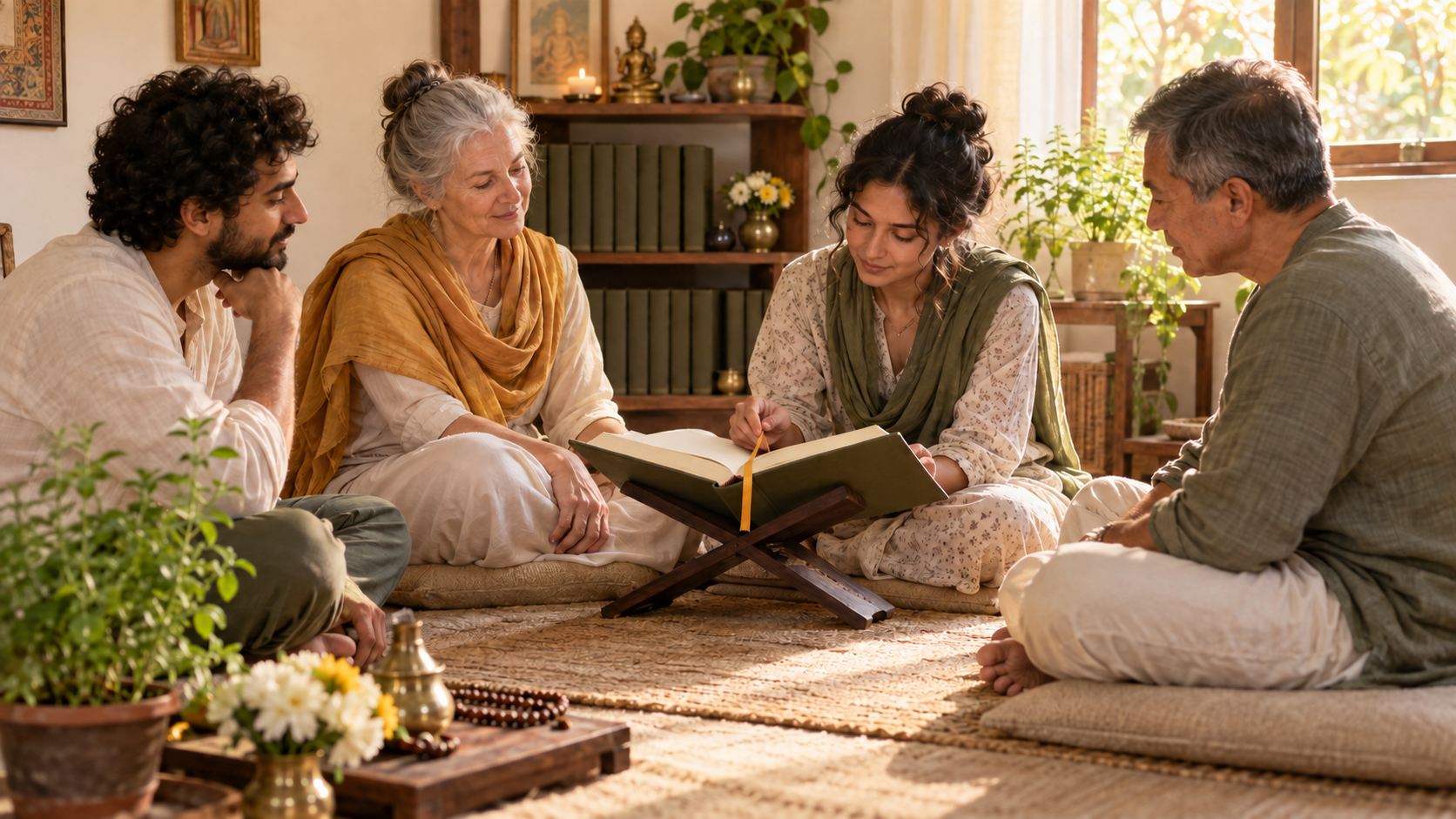
A complete Bhagavatam can be inspiring and intimidating at the same time. The recipient may not know where to begin, how the cantos relate to one another or how to approach Prabhupada’s purports. Remove that first layer of friction without turning the gift into an imposed syllabus.
- Give a brief orientation. Explain that Srimad Bhagavatam is a Purana centred on Bhagavan, bhakti and the lives and teachings through which devotion is understood. Show the recipient how the set is ordered.
- Offer a simple starting point. Beginning with the First Canto preserves the work’s opening progression unless the recipient’s teacher or study group recommends another route.
- Choose regularity over volume. A short, sustainable reading period is more useful than an ambitious target abandoned after a few days. Let the reader choose a rhythm compatible with household and work duties.
- Make questions welcome. Provide the contact details of a knowledgeable devotee or invite the recipient to a suitable reading circle. Do not pretend that difficult philosophical or narrative passages require no guidance.
- Protect institutional access. If the set goes to a library, temple or community centre, identify who will catalogue, shelve and care for it. A placement is incomplete when nobody owns that practical responsibility.
- Follow up without monitoring. Ask whether the reader can find the volumes and whether any orientation would help. Do not demand a report on spiritual progress.
For a household gift, opening the first volume together can be more useful than staging an elaborate presentation followed by silence. Keep the set in a clean, visible and accessible place rather than treating it as an object too precious to touch. Respect for scripture should invite attentive reading, not prevent it.
Key takeaways
- In this observance, Bhadra means the lunar month and its full-moon day, not the Bhadra interval found in muhurta calculations.
- The central Bhadra act in Srila Prabhupada’s tradition is giving a complete Srimad Bhagavatam set, not simply purchasing one for yourself.
- Confirm the locally observed date and any campaign deadline before arranging delivery.
- Match the set’s language, edition and physical format to a willing recipient who has a realistic path to reading it.
- If a full set is beyond your budget, join a pooled sponsorship and verify that the combined gift will be complete.
- Plan the first reading conversation when you plan the gift; delivery is the beginning of the service, not its end.
Before Bhadra Purnima, write down four things: the local date, the exact set, the recipient and the handover plan. If one remains blank, solve that before adding more ceremony. Then make the offering with humility and protect the path from shelf to reader. That is how Bhadra becomes the kind of service Prabhupada wanted: the Bhagavatam is not merely praised; it is given the opportunity to speak.
References

Leave a Reply
You must be logged in to post a comment.