
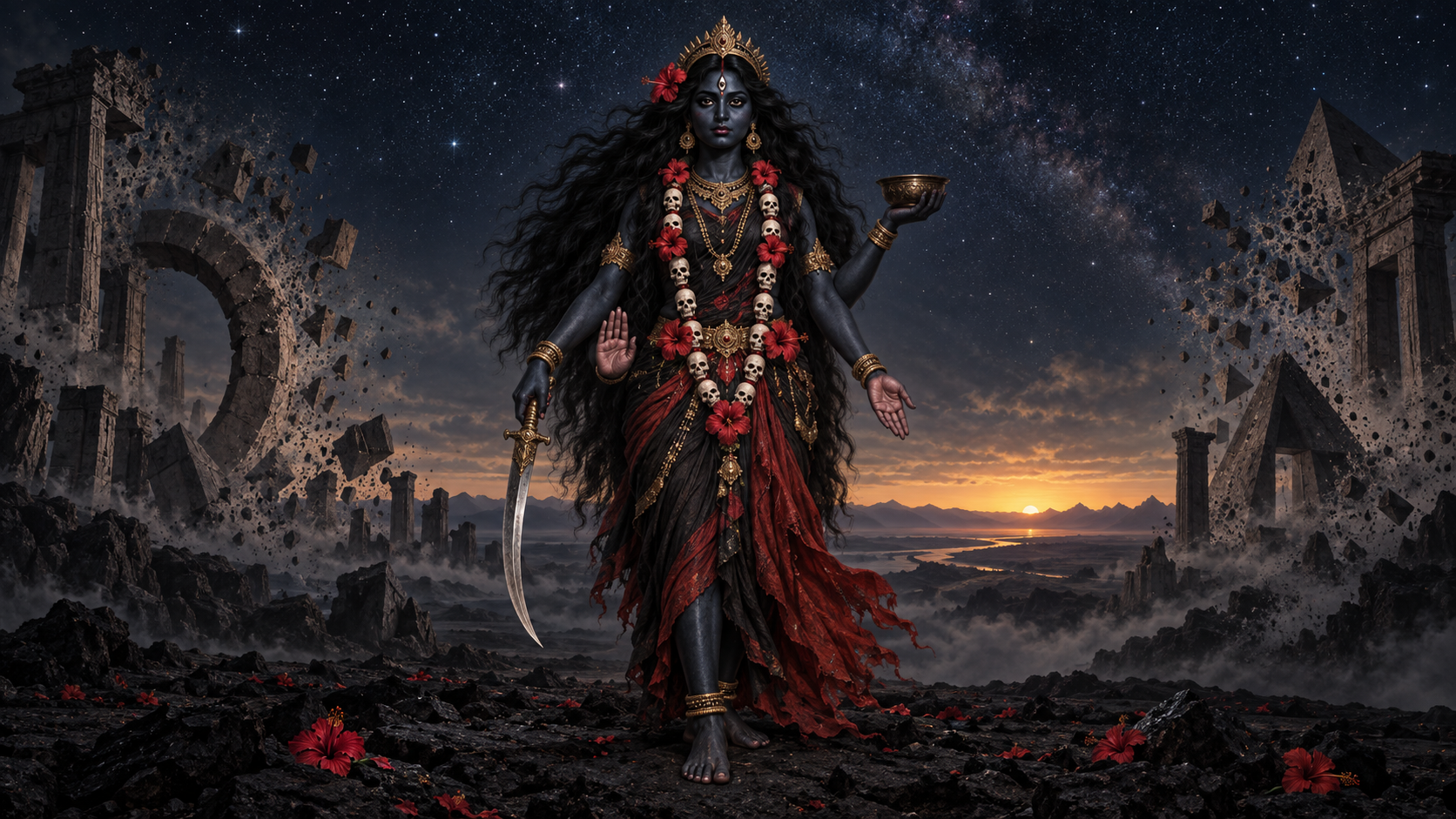
If Mahakali’s darkness unsettles you, the discomfort may come from a familiar equation: light means divine, while darkness means evil. That equation cannot carry the weight of her form. Her darkness is not permission for cruelty, despair or confusion. It points toward what remains when the forms you relied upon no longer hold.
Read that symbol carefully and it becomes practical. It can help you face an ending without calling it failure, accept necessary rest without disguising avoidance, and take the next dharmic action without waiting for perfect certainty.
Why Mahakali’s darkness is not the opposite of the divine
Most of daily life depends on visible form. You recognise a person by a face, security by a role, progress by an outcome and devotion by an image or action. When those forms disappear, the mind easily concludes that nothing remains. It mistakes what cannot presently be seen for what does not exist.
Mahakali’s darkness can instead be approached as the still, unformed condition preceding manifestation: the unseen interior of a womb, the quiet from which music can arise, and the interval in which an exhausted form dissolves before another becomes possible. This is darkness as potential and sacred cessation, not darkness as moral evil.
The distinction matters because dissolution is part of life. A role ends. A plan fails. An identity that once protected you becomes too narrow. A relationship changes beyond recovery. Mahakali does not require you to pretend that these events are painless. Her symbolism gives you a way to stop treating every ending as evidence that dharma has abandoned you.
Nor does the image of darkness before dawn promise that every loss will be reversed. Dawn need not mean getting the old form back. It may mean seeing clearly that the old form is gone, recognising what remains true, and becoming willing to act from that truth. The spiritual movement is not always from pain to pleasure. It is from concealment to honesty and from clinging to right action.
When you enter such an interval, ask three direct questions:
- What has actually ended, apart from what I fear might end?
- What am I trying to preserve only because I cannot imagine myself without it?
- Which duty remains mine even though the outcome is uncertain?
These questions prevent sacred darkness from becoming vague consolation. They turn it into discernment.
Tamas can describe a threshold, but it can also bind you

In the familiar language of the gunas, tamas is associated with heaviness, obscuration, inertia and resistance to movement. Rajas is associated with activity and restless propulsion, while sattva is associated with clarity and harmony. These are not simply labels for three kinds of people. They are qualities whose influence can be noticed in states of mind, habits and actions.
Mahakali should not be reduced to tamas, and tamas should not automatically be declared sacred because it resembles darkness. That would turn a profound symbol into an excuse. The tamasic pause becomes spiritually meaningful only when dissolution clears falsehood and makes truthful action possible. Inertia that continually hides reality, weakens responsibility or protects attachment remains binding.
You can test the difference by looking at what the pause produces.
- A sacred pause admits the facts. Binding inertia keeps postponing the moment when you must name them.
- A sacred pause releases a form that no longer serves dharma. Binding inertia abandons a valid duty because it feels difficult.
- A sacred pause restores your ability to act. Binding inertia steadily narrows the range of actions you believe are possible.
- A sacred pause can include grief without making grief your identity. Binding inertia turns pain into a permanent reason not to move.
- A sacred pause loosens the demand to control every result. Binding inertia refuses even the effort that remains within your control.
This is the practical test: after resting, are you more able to meet reality, or more determined to avoid it? If stillness makes you more honest and more capable of fulfilling your obligations, it is serving transformation. If it becomes indefinite withdrawal while neglected duties accumulate, do not sanctify it by calling it surrender.
Mahakali’s sacred darkness is fierce precisely because it does not protect every preference. It exposes the bargain hidden inside conditional devotion: I will trust the divine only if this identity, relationship, plan or public image survives. Dissolution breaks that bargain. What remains is a harder question: can you practise dharma without first receiving the outcome your ego demanded?
A grounded way to contemplate sacred dissolution

You do not need to manufacture a crisis or improvise an esoteric ritual to work with this teaching. If you already follow a family, temple or lineage practice, remain faithful to its discipline. The following reflection is not a substitute for formal worship or initiation. It is a way to examine an ending through the symbolism of Mahakali.
- Name the form that is dissolving. Use one plain sentence, such as: “The role through which I measured my worth has ended.” Do not begin with cosmic explanations.
- Separate fact from interpretation. “The plan did not happen” is a fact. “Nothing good can happen now” is an interpretation produced by fear.
- Name the attachment beneath the pain. It may be control, approval, certainty, status, familiarity or the wish to remain the person you were.
- Identify the duty that survives. Care for a dependent, tell the truth, keep a commitment, apologise, seek sound counsel or complete necessary work. Dissolution changes forms; it does not erase every obligation.
- Release the result you cannot command. This is not passivity. It is the refusal to make right action conditional on guaranteed success.
- Choose the next concrete act that expresses the duty you named. Make the call, write the truthful message, complete the neglected task or ask the qualified person for help.
End the reflection deliberately. Stand up, return your attention to your surroundings, and perform the chosen action. The movement back into conduct matters. Without it, contemplation can become another refined way of circling the self.
You can also use a simple sentence as a vow: “Let what is false dissolve; let the duty that remains become clear.” The value of the sentence lies neither in repetition nor drama. Its value lies in whether you accept the loss of a false support and then live differently.
Do not romanticise suffering in Mahakali’s name

Sacred darkness does not mean that pain is automatically purifying. Some pain teaches nothing by itself. Some darkness is caused by deception, exploitation, illness, abuse or neglect. Dharma may require you to leave danger, set a boundary, report wrongdoing, obtain treatment or accept protection. Remaining in preventable harm is not proof of surrender.
Keep these guardrails clear:
- Do not seek loss, deprivation or danger in order to feel close to Mahakali. The teaching concerns how you meet dissolution, not how much suffering you can collect.
- Do not confuse surrender with compliance. Releasing your demand to control an outcome does not require tolerating coercion, dishonesty or abuse.
- Do not use non-attachment to evade repair. If your action harmed someone, dissolution of the ego’s self-image must be followed by accountability where repair is possible.
- Do not call every impulse destructive wisdom. An action that violates duty, truth or the safety of others does not become sacred because it feels fierce.
- Do not treat contemplation as a substitute for medical or psychological care. If distress is preventing ordinary functioning, producing persistent isolation or creating a danger to you or someone else, seek qualified professional or emergency support appropriate to your situation.
- Do not improvise initiatory or esoteric practices from fragments found online. If you wish to undertake a formal practice, seek instruction from a competent teacher within a responsible lineage.
These limits do not weaken the symbolism. They protect it from a common distortion: using spiritual language to make confusion look profound. Mahakali’s darkness removes disguises. It should not become one.
Key takeaways
- Mahakali’s darkness can signify the unformed, the concealed and the dissolving without signifying evil.
- An ending is not necessarily a spiritual failure, but neither is it a guarantee that a preferred new beginning will arrive.
- Tamas is not sacred merely because it is dark or still. Judge a pause by whether it increases honesty, responsibility and the capacity for right action.
- Surrender releases the result you cannot control; it does not release you from the duty that remains yours.
- A sound contemplation ends in conduct: a truthful statement, a repaired obligation, a necessary boundary or another concrete dharmic act.
- Devotion never requires you to romanticise abuse, neglect treatment or attempt formal esoteric practices without responsible guidance.
When the next dark interval comes, resist the urge to fill it immediately with noise or a reassuring story. Name what has ended, release the form that cannot be preserved, and identify the duty still in your hands. Then perform that duty. This movement through darkness into truthful action is where Mahakali’s symbol becomes lived dharma.
References
