
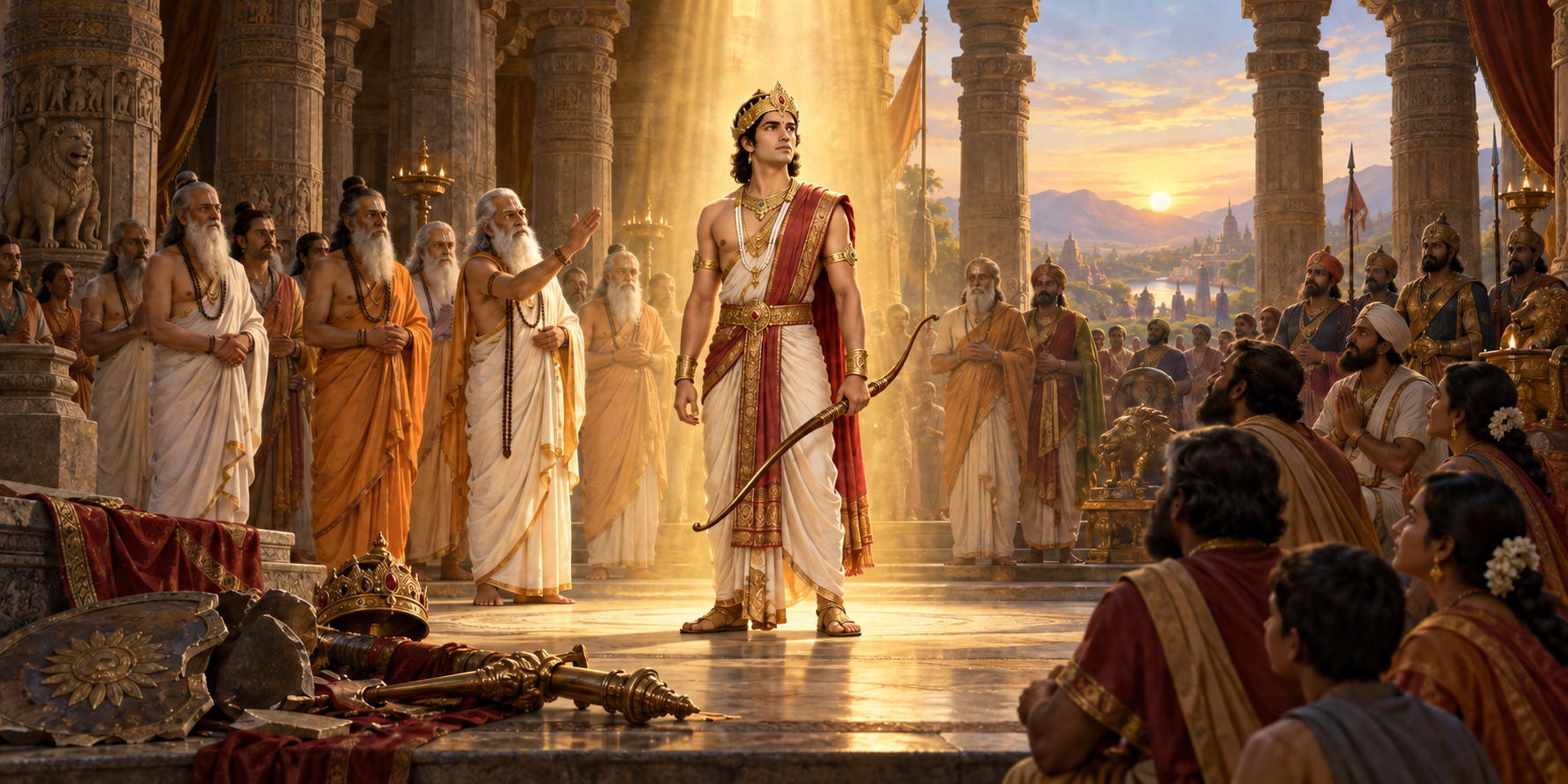
You may come to King Prithu with a practical question: what makes a ruler dharmic rather than merely powerful? His story gives a demanding answer. Authority must arise in response to disorder, submit to a law higher than the ruler, honor qualified counsel, and direct public power toward service.
This makes Prithu useful well beyond a discussion of monarchy. You can apply the same tests when judging an elected leader, a community organization, a temple committee, or your own exercise of responsibility. Do not ask only whether someone can command. Ask where the mandate came from, who may correct it, how it treats different kinds of competence, and what it offers back.
Prithu emerges because inherited power has failed
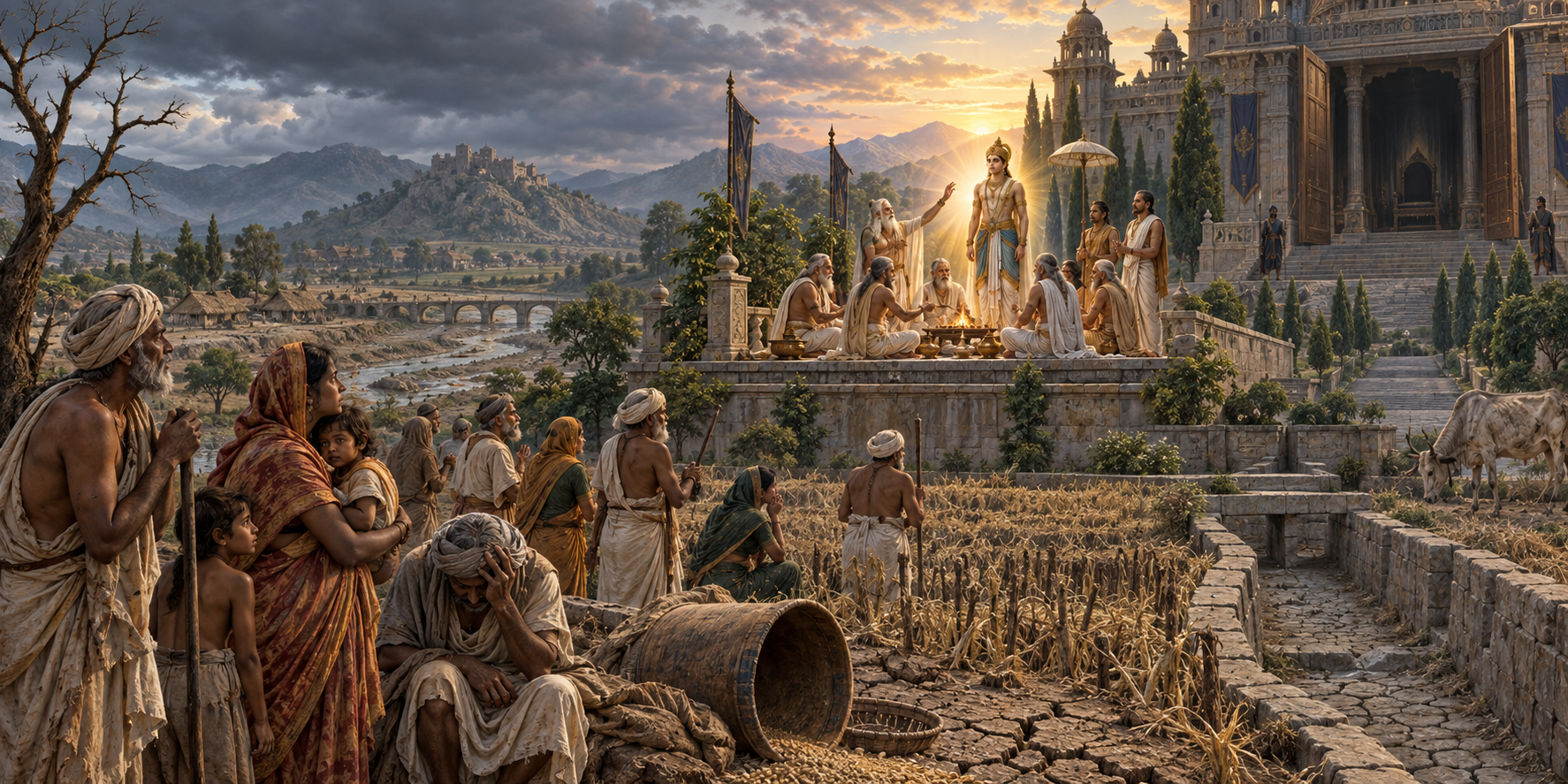
Prithu does not enter the Bhagavata narrative as an ordinary heir enjoying an orderly succession. He appears after King Vena has broken the relationship between royal authority and dharma. The sages intervene, and Prithu emerges from Vena’s arms. The unusual birth makes a precise theological point: a royal line may continue, but its corruption need not continue with it.
That distinction matters. Birth can transmit a claim, a name, or an office; it cannot by itself transmit legitimacy. Vena possesses kingship but turns it away from its proper purpose. Prithu must make royal authority worthy again. His emergence therefore represents restoration, not the automatic vindication of a dynasty.
You should not flatten this Puranic episode into a literal procedure for modern government. Its usable principle is sharper than that: when an institution has failed, replacing its visible head is not enough. The habits that allowed adharma to take hold must also be corrected. Otherwise succession becomes repetition.
When you assess a promised restoration, examine three things. Has the new leader named the previous failure honestly? Has the system recovered a standard outside the leader’s own will? Can the people responsible for preserving that standard intervene before another crisis? If those conditions are absent, a change of personality may leave the old disorder intact.
Prithu’s command is formidable, but it has a boundary

The account presents Prithu as an unrivaled sovereign whose rule extended across the seven islands of its cosmological world. Yet even this extraordinary command was not described as absolute. Saintly persons and brahmanas were not placed under ordinary royal compulsion. Supreme political reach therefore coexists with a meaningful limit.
The seven islands should be read within the sacred cosmology of the narrative, not casually converted into a claim about modern borders. The political teaching does not depend on that conversion. It depends on the contrast between the breadth of the king’s jurisdiction and the existence of persons he may not simply bend to his will.
This is not a license for anyone with a religious title, hereditary identity, or institutional robe to claim immunity. In a dharmic order, exemption from coercion carries an obligation to preserve knowledge, discipline desire, speak truth, and remain oriented toward the sacred. Privilege without qualification would reproduce the very corruption that Prithu’s emergence answers.
For you, the practical question is not whether a modern leader has an ancient class of advisers. It is whether the surrounding system contains anyone able to say, “This is outside your authority,” without being silenced, dismissed, or financially ruined. A leader surrounded only by dependants may receive advice, but not correction.
- Look for an acknowledged limit: the leader should be able to name a law, constitution, vow, tradition, or governing principle that cannot be revised merely for convenience.
- Identify independent counsel: at least some truth-tellers must have standing that does not depend entirely on the ruler’s favor.
- Watch the response to disagreement: correction should produce reasons, reconsideration, or a principled refusal, not retaliation against the person who raised it.
- Distinguish restraint from weakness: power becomes more trustworthy when it accepts legitimate boundaries. Unbounded command is not a higher form of leadership.
Before Prithu speaks, he honors the assembly
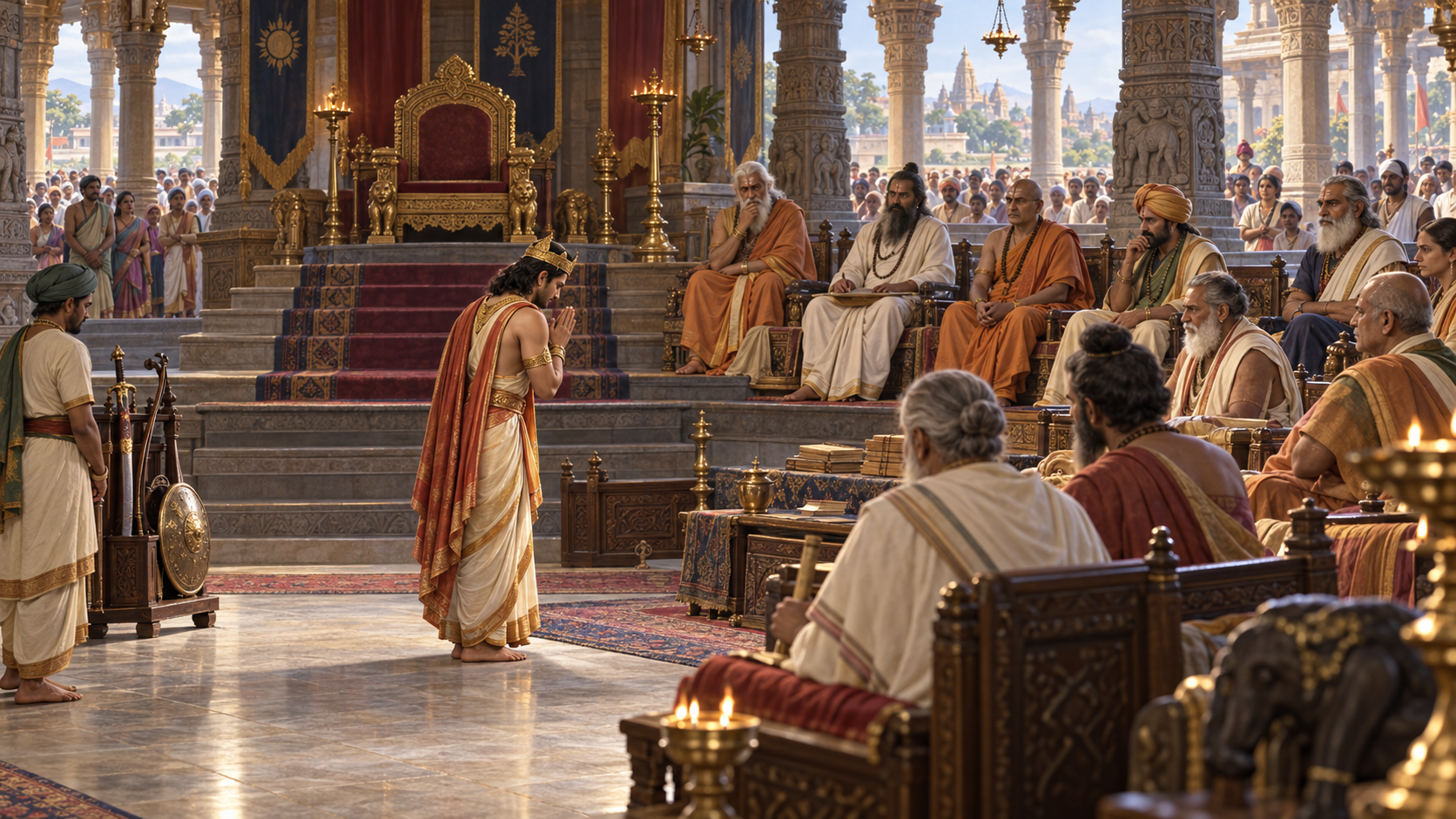
Prithu’s leadership is displayed through sequence as much as through speech. A great yajna brings together sages, brahmanas, devas, and rajarshis. The gathering is not an audience selected to mirror the king back to himself. It contains different forms of authority: spiritual discipline, sacred learning, cosmic responsibility, and rulership shaped by wisdom.
Prithu then honors the assembled guests according to their respective positions before standing among them. Only after recognizing the order represented by the assembly does he occupy its attention. The image of the king appearing like the moon among stars conveys distinction without emptiness: he is conspicuous because he stands within a luminous gathering, not because everyone else has been darkened.
Modern readers may hesitate at language about different positions. That hesitation can be healthy if hierarchy has been used to excuse humiliation. But equal human dignity does not require pretending that every person carries the same knowledge, responsibility, or decision-making role. A surgeon and a patient have equal dignity while bearing different responsibilities in an operating room. A dharmic assembly likewise recognizes meaningful distinctions without treating rank as permission for vanity.
If you chair a meeting, lead a family decision, or hold public responsibility, Prithu’s order of action gives you a workable protocol:
- Convene the people whose knowledge or responsibility bears directly on the decision. Do not fill the room only with those who owe you agreement.
- Name why each kind of counsel is present. This prevents ceremonial inclusion in which people are invited but their actual competence is ignored.
- Clarify roles before debate begins. Say who advises, who decides, which principles constrain the decision, and who will carry its consequences.
- Acknowledge the assembly before asserting your own view. Recognition changes the room from a ruler’s stage into a place of ordered deliberation.
- Speak from within the body you lead. Leadership still requires a distinct voice, but that voice should reveal its relationship to the whole.
Yajna turns royal power into an obligation to give

The setting of Prithu’s assembly is a yajna. In its broad dharmic sense, yajna establishes an order of offering, reciprocity, and responsibility. The king does not gather the realm solely to display possession. Wealth, labor, learning, and authority are placed into a sacred action directed beyond his private appetite.
This corrects a common misunderstanding of strong leadership. The opposite of selfish rule is not passive rule. Prithu’s model joins decisive command to sacrifice. The ruler may act vigorously, but the purpose of that vigor must be larger than personal prestige, dynastic security, or the pleasure of domination.
The presence of rajarshis sharpens the standard. A rajarshi combines the responsibilities of a king with the discipline associated with a rishi. Political skill is not discarded, and spiritual language is not used to evade administration. Outer capacity and inner restraint are expected to meet in one vocation.
You can test the sacrificial character of leadership by following resources rather than slogans. Examine the budget, appointments, time, protection, and public attention under the leader’s control. Then ask:
- What is the leader or institution actually giving up for the stated purpose?
- Who receives lasting benefit, and who carries the cost?
- Does the public act strengthen a shared order, or mainly enlarge the leader’s image?
- Can qualified people examine the use of resources and require an account?
A ceremony can express yajna, but ceremony alone cannot prove sacrificial leadership. If honor flows upward while every cost flows downward, the form of offering has been separated from its moral substance.
Key takeaways: four tests for dharmic leadership
- The emergence test: does the leader correct the disorder that produced the crisis, or merely inherit its machinery?
- The boundary test: who can legitimately say no, and what protects that person from retaliation?
- The assembly test: does the leader recognize different kinds of qualified counsel before claiming the center?
- The yajna test: are power and resources offered toward a shared good, with visible responsibility for their use?
Use these questions the next time a leader asks for trust. Begin with the boundary test: identify the person, institution, or principle that the leader cannot punish into silence. If you cannot find one, the problem is already visible. Prithu’s example does not ask you to romanticize a crown. It asks you to recognize that the strongest authority is the authority disciplined by dharma.
References
