
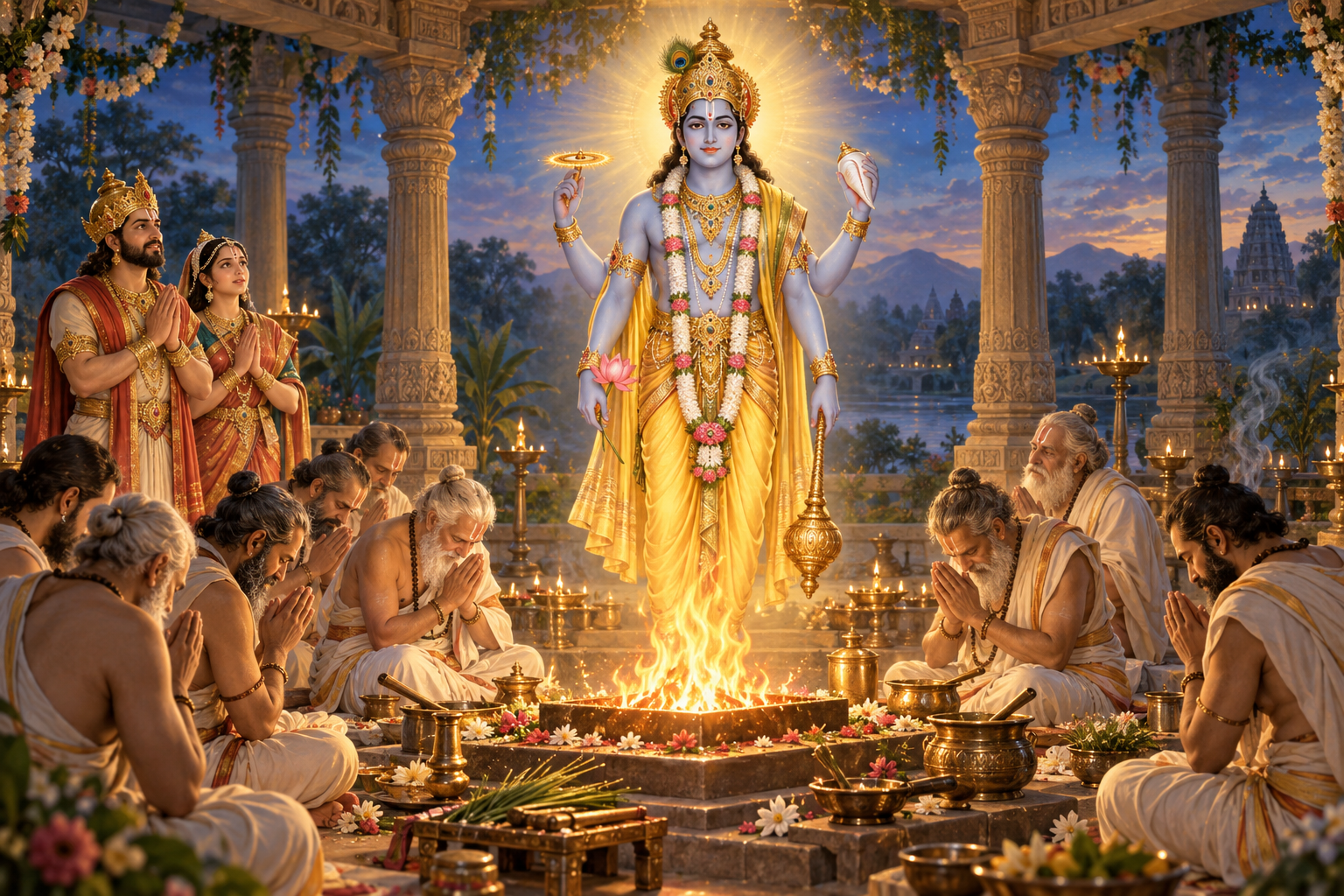
You may come to King Nābhi’s sacrifice expecting a lesson about Vedic ritual. The more immediate lesson is about what happens when ritual succeeds. Bhagavān appears, the priests stand before the very Lord they invoked, and their carefully ordered ceremony gives way to humility.
Their response can help you examine your own worship. Are you offering something to Bhagavān, or trying to purchase an outcome from Him? Can you state your desire honestly without making devotion depend on its fulfilment? And what remains of your practice when concentration, comfort and control disappear?
Why the priests do not celebrate their own success
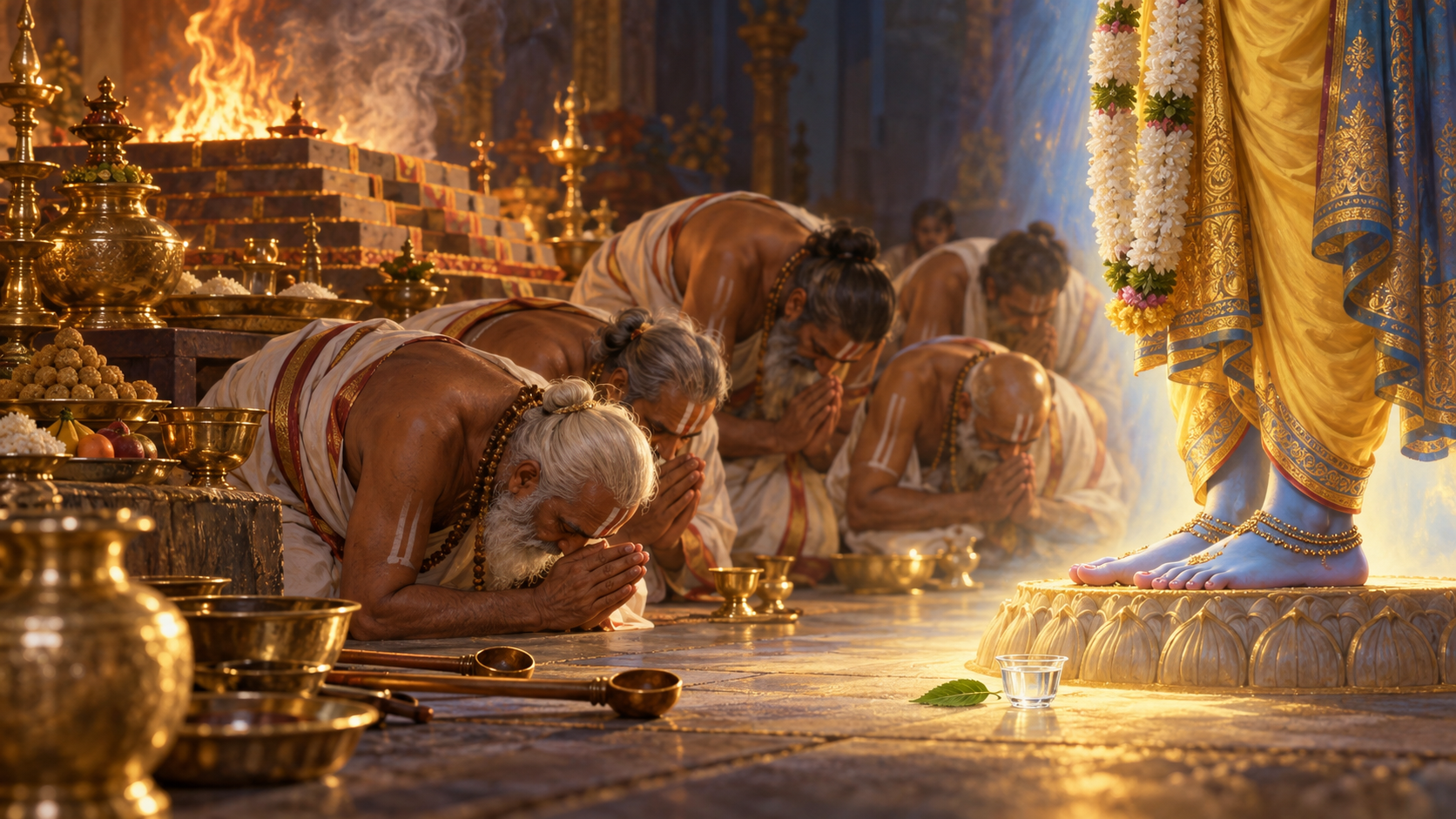
King Nābhi desired a worthy son, and qualified priests conducted a sacrifice through which Lord Viṣṇu became manifest. Yet the priests did not treat His appearance as proof of their power. In the prayers associated with Śrīmad Bhāgavatam 5.3.12-20, they immediately acknowledged that the unlimited Lord could not be contained by their speech, learning or ritual competence.
That admission is not ornamental modesty. It corrects a danger built into every disciplined spiritual practice: the means can become a source of self-importance. Accurate recitation, a well-prepared altar, generous offerings and familiarity with śāstra are valuable. None of them turns Bhagavān into an object under the worshipper’s control.
The distinction is precise. Ritual has an order, and a practitioner should not use inward sincerity as an excuse for carelessness. But technical correctness is the vessel, not the sovereign cause of divine grace. The priests had done what was required and still bowed as dependants. If your competence makes you less teachable, the outer practice may be improving while its inner purpose is being lost.
When you finish pūjā, japa or a vrata, therefore, resist the impulse to audit only the external performance. Also ask: Did this make entitlement stronger or gratitude stronger? Did it sharpen comparison with other devotees, or make service easier? Those questions reveal what the ritual is actually doing to you.
Key takeaways
- The appearance of Bhagavān does not become an achievement that the officiants can claim as their own.
- Elaborate offerings cannot supply a need in the self-sufficient Lord; worship changes and purifies the worshipper.
- A simple offering made with devotion can carry more spiritual meaning than abundance offered as a transaction.
- You do not have to hide a worldly desire, but you should not disguise bargaining as surrender.
- The durable fruit of practice is remembrance of the divine name when ordinary control fails, especially at life’s final boundary.
The prayer moves through four necessary corrections
First, speech yields to the reality it addresses
The priests speak, but they begin by admitting the limits of speech. This prevents prayer from becoming a performance in which eloquence matters more than attention. A polished hymn may guide the mind, but verbal beauty does not measure the depth of devotion.
You can apply this correction before reciting anything. Pause long enough to recognise that the mantra is not merely sound produced by you. It addresses a reality greater than your present comprehension. That pause changes recitation from display into approach.
It also frees you from a common anxiety: the fear that an imperfect personal prayer is worthless. Within the devotional logic of these prayers, honest dependence is not a defect that eloquence must conceal. Speak carefully, but do not wait until you possess perfect words before turning toward Bhagavān.
Second, offering is separated from payment
The priests recognise that Bhagavān is complete in Himself. He does not lack food, wealth, praise or ritual ingredients. The idea that a large sacrifice supplies something He needs therefore collapses. A leaf, flower, fruit or water offered through devotion can be accepted because the decisive element is the relationship expressed through the offering, not its market value.
This does not make beauty or generosity irrelevant. Give the best you can without turning the offering into leverage. An expensive arrangement can express gratitude; it can also conceal a demand. A cup of water can express love; it can also be mechanical. The material scale alone settles nothing.
Use a simple diagnostic: if the desired result does not arrive, do you regard the offering as wasted? If so, a commercial expectation has entered the relationship. Devotion may include petitions, but it cannot be reduced to an exchange rate between ritual effort and divine reward.
Third, the hidden bargain is confessed
The priests do not pretend that the sacrifice was free of worldly purpose. King Nābhi wanted a son like the Lord. They then face the disproportion between that request and the One standing before them: no finite royal benefit can equal Bhagavān, and no second being can be exactly His equal. Their prayer consequently includes the humility of people who recognise how small their request looks in the presence of the giver.
This is a more useful response to mixed motives than denial. You may pray for employment, family wellbeing, success in an examination, relief from conflict or another legitimate human need. Name it plainly. Then place it inside a larger request: may pursuing this outcome not make you forget dharma, and may receiving or losing it not become the condition on which you remember Bhagavān.
Honesty keeps petition from masquerading as surrender. You are no longer telling yourself that you want only the divine when your attention is fixed on a particular result. Once the smaller desire is visible, it can be offered, examined and gradually reordered.
Fourth, remembrance becomes the real request
The deepest petition is not for a flawless ceremony or permanent worldly ease. The priests ask for remembrance of the Lord’s name when human composure breaks down, including at death. That request shifts the centre of worship from controlling circumstances to preserving relationship through circumstances.
This is why nāma-smaraṇa cannot sensibly be postponed until a crisis. Under pressure, the mind usually follows its established grooves. If the divine name is absent from ordinary transitions, it is unrealistic to assume that it will arise automatically at the most disorienting moment of life. Daily repetition creates familiarity; repeated return creates refuge.
Use the same sequence in your own prayer
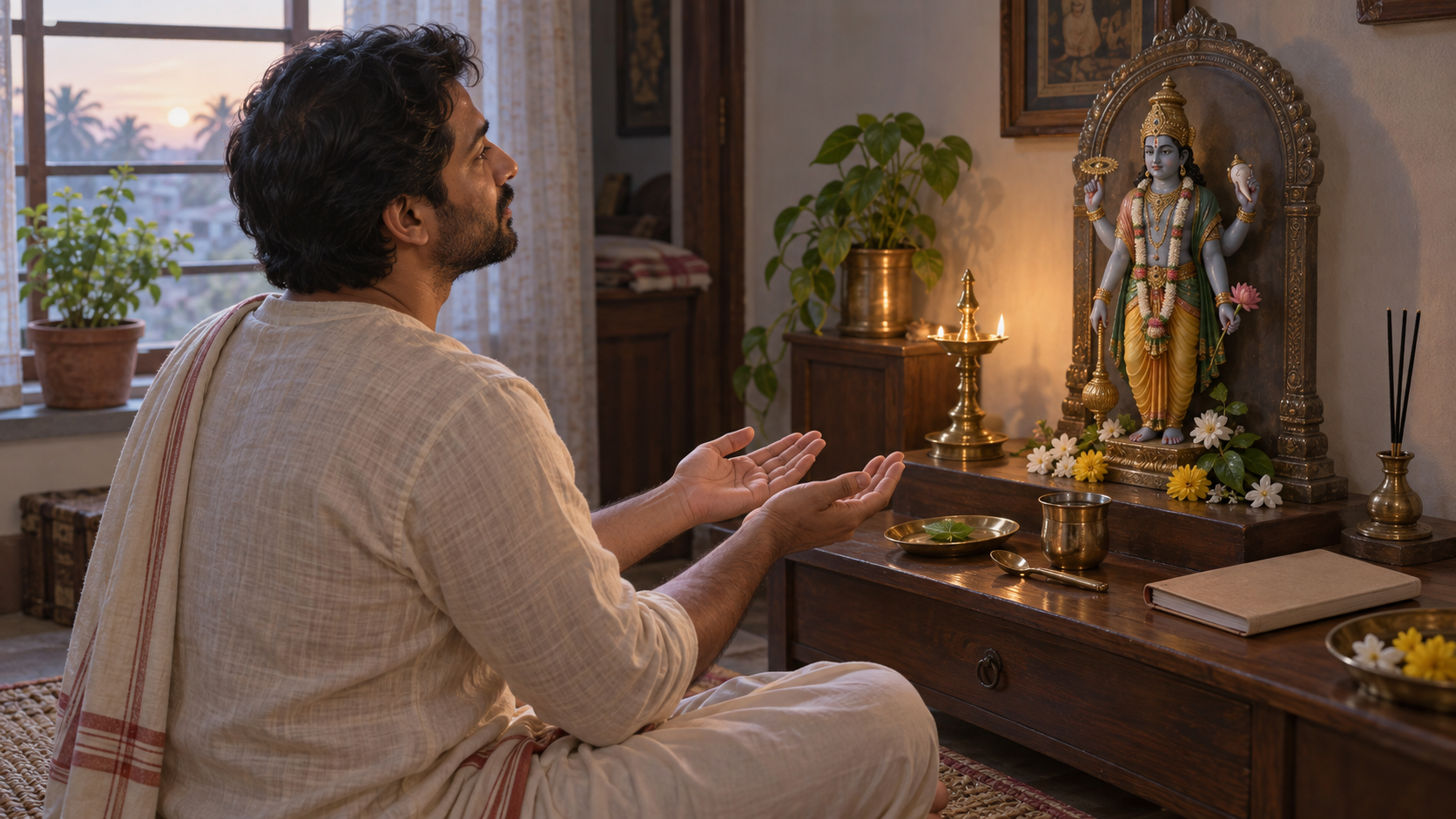
You do not need to imitate the external scale of a royal sacrifice to work with its inner sequence. After your regular mantra, pūjā or scriptural reading, add five plain movements:
- Name the immediate desire. Say what you actually want without inflating it into a grand spiritual claim.
- Acknowledge Bhagavān’s completeness. Remind yourself that your offering does not fill a deficiency in Him.
- Offer what is genuinely available. A flower, fruit, leaf or water may accompany the prayer, but attention and willingness to serve must accompany the object.
- Release the bargain. Ask that the result support dharma, while admitting that devotion cannot depend on getting your preferred outcome.
- Choose one moment for remembrance. Connect the divine name with a predictable point of strain, such as receiving difficult news, losing patience or waking in anxiety.
A concise personal prayer could follow this pattern: Bhagavān, this is what I desire. You are complete and cannot be purchased by what I offer. Please accept this act of devotion, correct what is selfish in my motive, and let me remember Your name whether the result comes or not.
Keep the wording natural. The value lies in the sequence: desire is disclosed, transaction is renounced, the offering is made, the motive is surrendered and remembrance is requested. Each movement closes a particular escape route for the ego.
Within the Vaiṣṇava setting of King Nābhi’s sacrifice, Bhagavān’s response also matters. Because no one else could be equal to Him, the Lord accepted the devotees’ appeal by becoming Nābhi’s son, Ṛṣabhadeva. Grace answered the request, but it did so from divine freedom rather than ritual compulsion. That distinction should govern how you understand every fulfilled prayer.
Test worship where control disappears

A serene altar can support attention, but it cannot by itself prove that remembrance has entered daily life. The sharper test arrives during interruption. Notice the first inner movement when someone insults you, a plan fails, the body becomes uncomfortable or fear rises. Do you reach first for resentment and control, or is there enough space to remember the name?
Do not turn this observation into another contest of spiritual achievement. Use it diagnostically. If remembrance disappears under mild pressure, reduce the distance between formal worship and ordinary action. Repeat the name before answering an upsetting message. Pause with it before entering a difficult conversation. Return to it after making a mistake instead of waiting to feel pure enough to pray.
The priests at King Nābhi’s sacrifice redirect attention from an extraordinary manifestation to the capacity they will need when every ordinary support is gone. You can make the same turn today. Bring one real desire into prayer, offer one simple thing without bargaining, and attach the divine name to one moment in which you usually forget it.
References
