
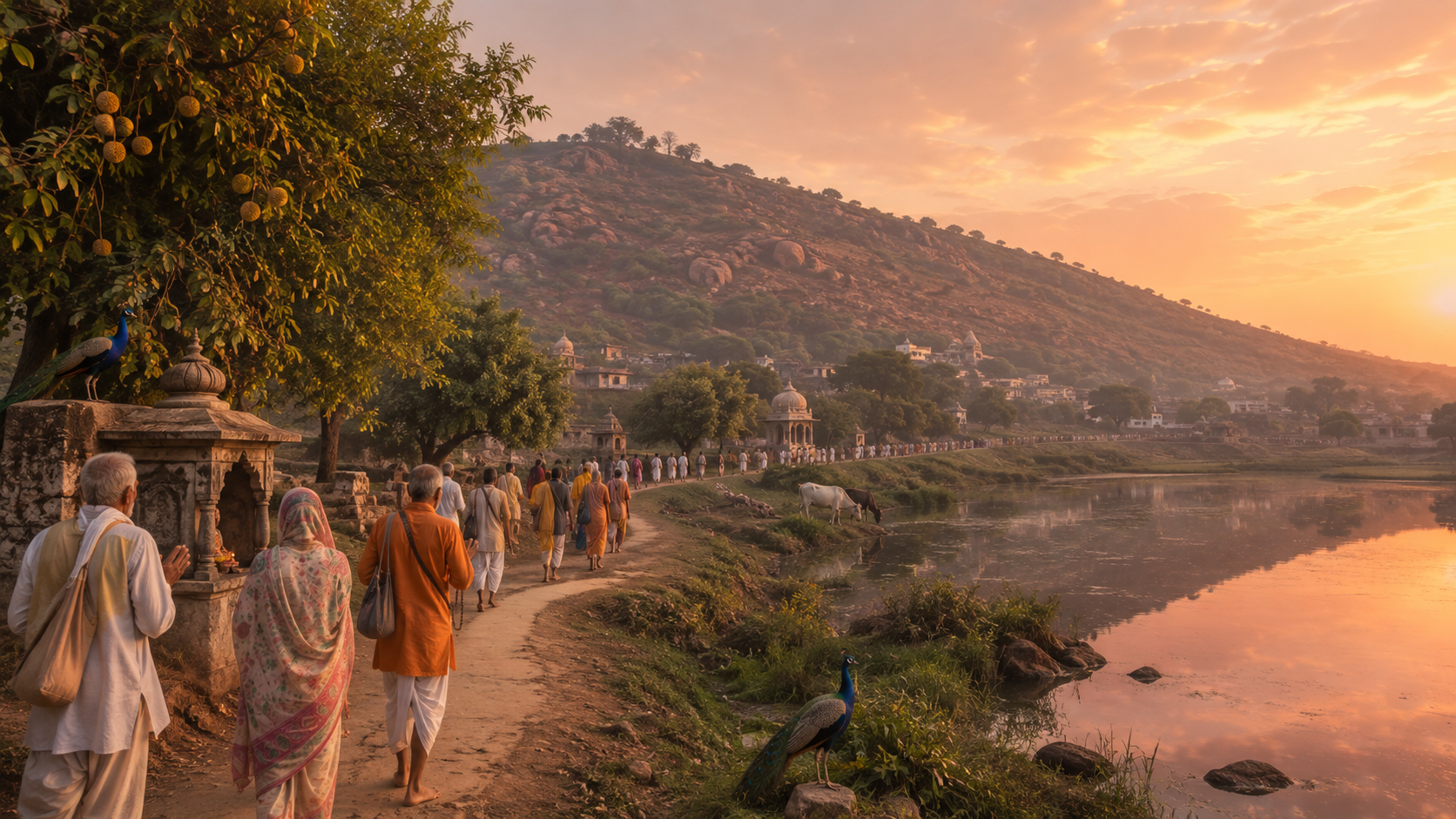
You want to include Govardhan Parikrama in a Divya Desam yatra, but the map seems untidy. Instead of one clearly identified ancient temple for each Divya Desam, Mathura and Vraja present you with numerous shrines, ghats, kunds, towns and lila-sthalas.
That is not a defect in the pilgrimage. Thiru Vada Mathura and Thiru Ayarpadi are best approached as sacred regions whose present form preserves Krishna’s presence across Mathura, Gokul, Govardhan and Vrindavan. Read the geography correctly, and Govardhan ceases to be a side trip: it becomes one of the clearest ways to enter the meaning of these two Divya Desams.
First, read the Divya Desams as sacred geography
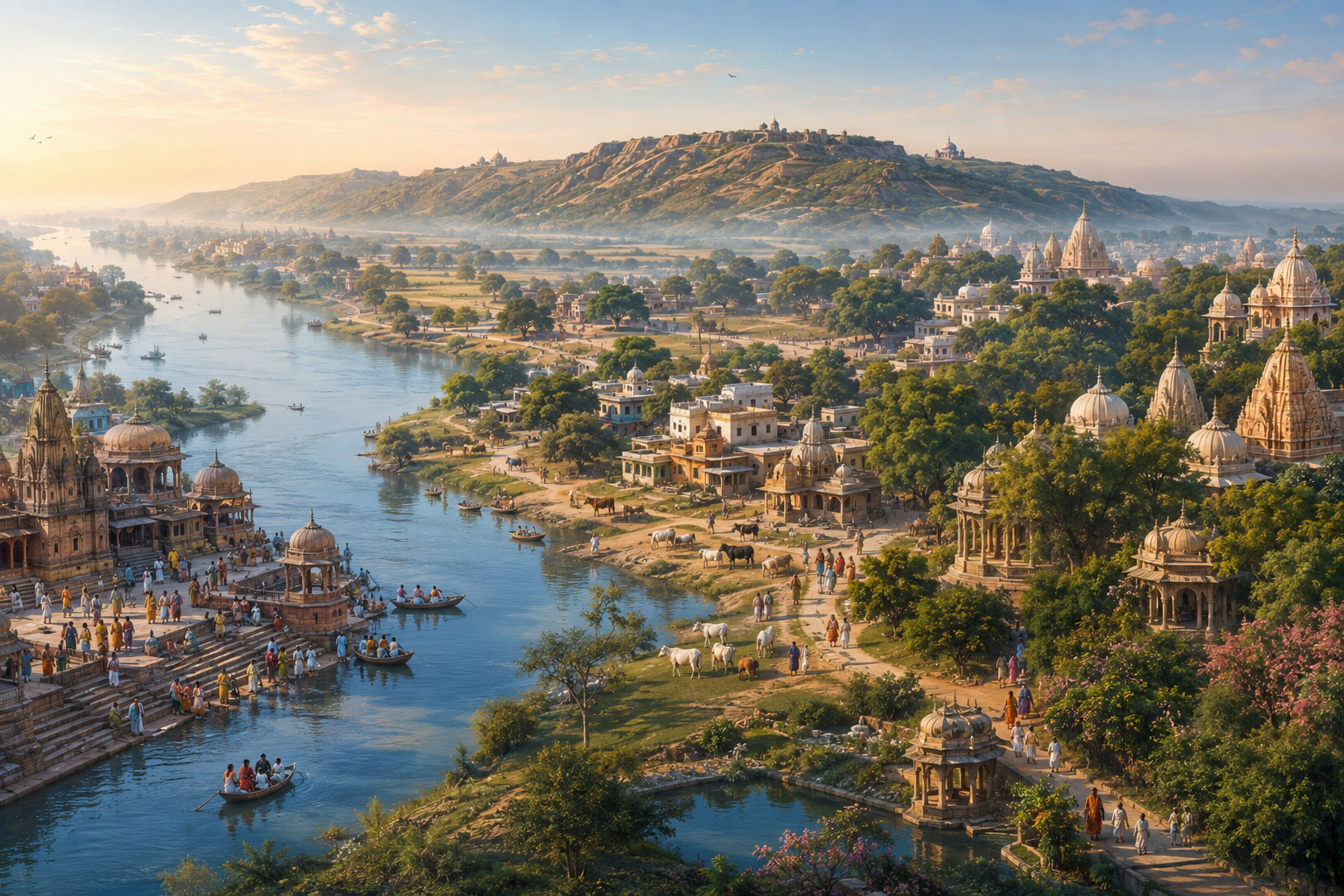
The 108 Divya Desams are Vishnu kshetras praised by the Alwars in the Divya Prabandham. Krishna is revered as the eighth avatara of Shri Maha Vishnu, so the places of his birth and childhood belong naturally within this Vaishnava pilgrimage world. In Vraja, however, the sacred unit is larger than a single surviving structure.
Thiru Vada Mathura, meaning the divine Northern Mathura, and Thiru Ayarpadi encompass multiple sacred places in the present-day cities and towns of the region. The earlier Govardhanesa Perumal temple associated with Thiru Vada Mathura and Navamohana Krishna temple associated with Thiru Ayarpadi are no longer extant; their loss is connected with successive Mohammedan invasions. You should therefore not expect to find two untouched ancient buildings that correspond neatly to two entries on a list.
| Divya Desam | Present pilgrimage field | How to approach it |
|---|---|---|
| Thiru Vada Mathura | Mathura and its associated temples, ghats and Krishna lila-sthalas | Worship across a cluster that can include Krishna Janmabhoomi, Keshavji Mandir, Potra Kund, Rangabhoomi, Vishram Ghat, Adi Varaha Perumal temple, Dwarkadish temple and Akrur Ghat |
| Thiru Ayarpadi | Gokul, Govardhan and Vrindavan | Encounter the landscape of Krishna’s childhood lilas, with Govardhan Parikrama as a central act of worship |
This distinction prevents two opposite errors. The first is declaring the Divya Desams inaccessible because their earlier temples have disappeared. The second is treating any one modern shrine as though it exhausts the ancient kshetra. Built forms can be broken or replaced; sacred memory can remain attached to an entire landscape.
You also do not need to turn every listed place into a mechanical attendance requirement. The names above give you a field of pilgrimage, not a compulsory order. Select a coherent route, understand what each place remembers, and give yourself enough attention for darshan rather than racing between markers.
Why the circuit is worship rather than measured distance
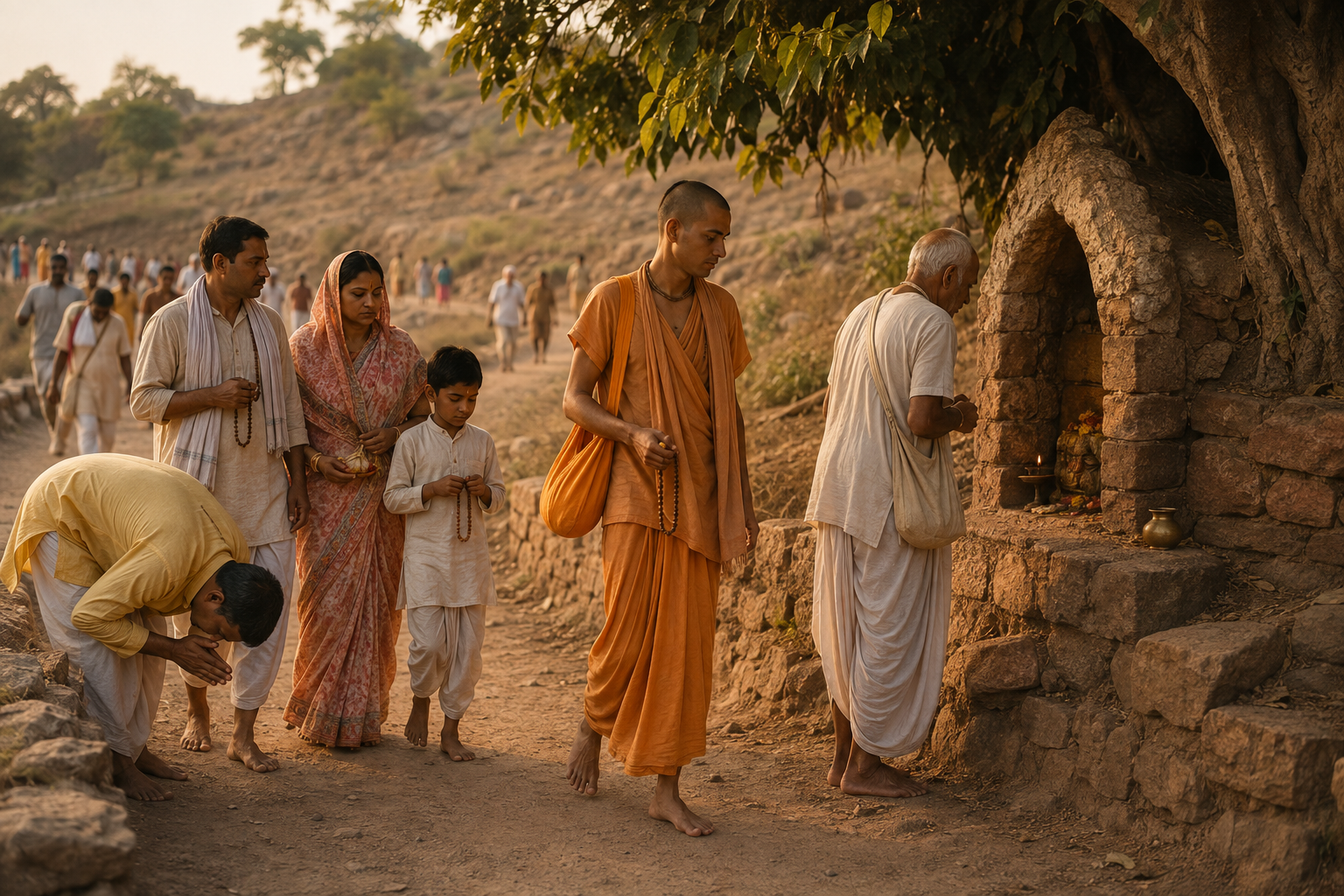
Parikrama joins two ideas: pari, around, and krama, a step or progression. The body moves around what the heart accepts as its centre. Instead of placing your wishes, plans or anxieties at the centre and asking Bhagavan to orbit them, you physically reverse the arrangement.
A completed circuit can also be contemplated as a small image of the cosmic rhythm. The beginning evokes creation, the continuing steps evoke preservation, and the return evokes dissolution into the divine. This is why the middle of a parikrama matters as much as its dramatic beginning or relieving end. Sustained attention is part of the offering.
Govardhan gives that practice unusual force because Giriraj Parvat is worshipped as a divine embodiment. In the Govardhan lila, Krishna redirects the people of Vraja toward honouring the hill that sustains them through its grass, trees, animals and streams. Indra, angered by the departure from his customary worship, sends a destructive storm. Krishna protects the community beneath Govardhan.
The act of protection has received more than one interpretation. The familiar devotional telling sees Krishna balancing the hill upon his little finger. Another understanding speaks of the mountain itself rising, while a more naturalistic reading emphasises Krishna’s leadership in guiding the people into protective caverns and caring for the weak until the storm passed. A pilgrim need not flatten these readings into one claim. They converge on the same dharmic centre: gratitude for what sustains life, courage in crisis and special care for those least able to protect themselves.
You can carry that meaning through the circuit with a simple discipline. It is not a claim about a universally prescribed liturgy; it is a practical way to keep the walk from becoming religious tourism.
- Before beginning, state one short sankalpa. Name what you are offering or seeking without trying to dictate the answer.
- During the first part, remember that Giriraj is the centre. Let your pace, speech and conduct reflect that fact.
- When effort begins to dominate your attention, recall preservation: continue steadily, but do not ignore the needs of children, elders or anyone struggling beside you.
- At the end, release the demand for a particular outcome. Completion means returning the matter to Bhagavan, not forcing an omen from the journey.
The lila also makes your treatment of the place part of your worship. A hill honoured for sustaining cattle, vegetation, water and human life cannot sensibly be revered through conduct that harms its surroundings. Restraint, cleanliness and consideration for animals and fellow pilgrims are not decorative additions to bhakti; they follow from the very reason Govardhan is honoured.
Choose your circuit by sankalpa, not prestige
Route terminology can confuse a first-time pilgrim. The full Govardhan Parikrama is 21 kilometres and covers the complete circuit of sacred places, while the Badi Parikrama is a 12-kilometre route through the outer or more remote places. The word Badi should not lead you to assume that the 12-kilometre route is identical to the full 21-kilometre circuit.
Do not choose a distance because it sounds more impressive when retold. Choose it because you can undertake it attentively and truthfully. A long circuit completed in resentment, family conflict or reckless exhaustion misses the inner rearrangement that parikrama is meant to enact.
- Clarify what you are promising. Decide whether your sankalpa is for the full 21-kilometre circuit or a defined portion. If you complete only part, describe it honestly rather than calling it the full parikrama.
- Plan around the slowest person. When travelling with family, the group vow includes responsibility for one another. Krishna’s protection of the vulnerable is a poor story to remember while leaving a struggling companion behind.
- Separate travel from circumambulation. Govardhan Hill is about 20 kilometres from central Mathura. Reaching the hill and walking around it are distinct demands, so do not treat arrival as though the main physical undertaking were already complete.
- Confirm the route at Govardhan. Establish the current starting point, path and endpoint before beginning. Sacred intention does not remove the need for accurate local directions.
- Respect genuine physical limits. If you cannot safely complete the longer circuit, select a route you can undertake with attention. Devotion does not require you to misrepresent what you completed or prove it through injury.
A useful test is simple: can you retain enough attention to remember whom you are circling? If the distance turns the entire act into survival or competition, revise the plan before taking the vow. The more modest commitment you actually keep is spiritually clearer than the grand commitment you abandon or disguise.
Build the pilgrimage in three movements
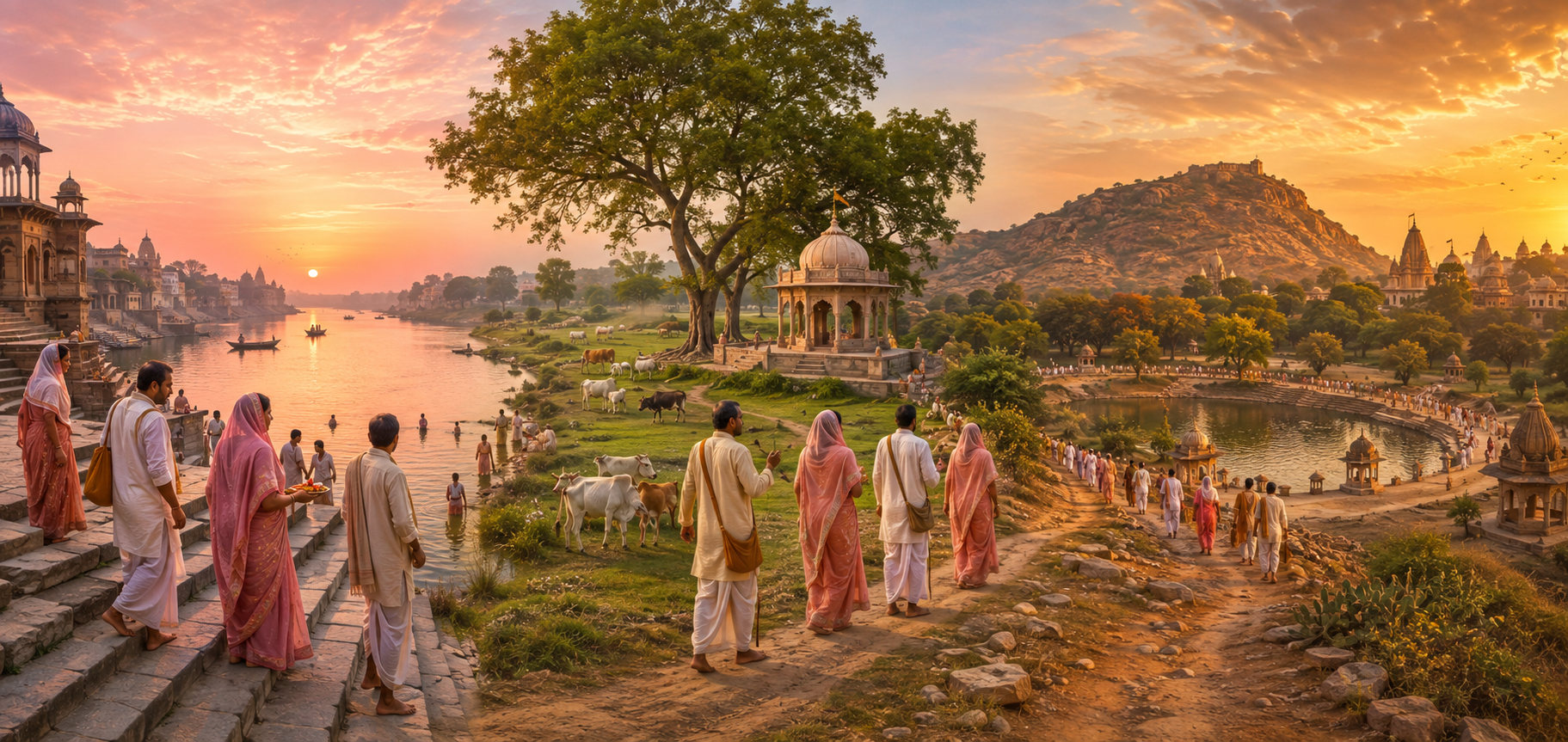
A practical itinerary should follow the devotional logic of the kshetra, not merely the shortest driving sequence. The three movements below are a framework rather than a mandatory ritual order. Local access, family needs and the time available may change the sequence.
- Begin by entering Thiru Vada Mathura. Let Mathura establish the reality of Krishna’s appearance within history and place. The Krishna Janmabhoomi complex includes the prison-cell site associated with his birth. Other recognised points in the wider pilgrimage include Keshavji Mandir, Potra Kund, Rangabhoomi, Vishram Ghat, Adi Varaha Perumal temple, Dwarkadish temple and Akrur Ghat. These places form a constellation; they need not be forced into the role of a single replacement temple.
- Place Govardhan at the centre of the journey. Travel from Mathura to Giriraj with the circuit already chosen, but confirm its practical details when you arrive. Begin with your sankalpa, undertake the parikrama without turning every pause into a photo stop, and end by offering the result rather than evaluating whether the walk produced a sufficiently dramatic feeling.
- Complete the Thiru Ayarpadi frame. Govardhan belongs with Gokul and Vrindavan in the wider landscape of Krishna’s childhood lilas. Continue to those towns in the order your circumstances permit. The point is not to collect three place names; it is to recognise how birth, childhood intimacy, nourishment and protection inhabit one living sacred region.
After each movement, make a three-line note: the place you visited, the lila or divine quality it brought forward, and one dharmic response it asks of you. At Mathura, that response may concern fidelity amid disruption. At Govardhan, it may be gratitude, courage or protection of dependants. In Gokul and Vrindavan, it may be the recovery of trust and loving attention. The note turns memory into conduct without pretending that every passing impression is a divine command.
If you have come with a difficult decision, distinguish surrender from avoidance. Place the outcome at Bhagavan’s feet, but still gather the facts, meet your obligations and seek competent advice where the decision requires it. A pilgrimage can reorder the person making the choice. It should not be used to escape the work that dharma already makes clear.
Key takeaways
- Govardhan Parikrama is not an unrelated excursion from a Divya Desam yatra; it sits within the sacred geography of Thiru Ayarpadi.
- Thiru Vada Mathura and Thiru Ayarpadi should be approached as regional kshetras because the earlier temples associated with them no longer survive.
- The full Govardhan circuit is 21 kilometres. The 12-kilometre Badi Parikrama covers outer or remote places and should not be confused with the full route.
- Mathura, Govardhan, Gokul and Vrindavan form a coherent pilgrimage through Krishna’s birth and childhood landscapes.
- The purpose of parikrama is to place Bhagavan at the centre. Distance, photographs and checklist completion should remain subordinate to that act.
- If you bring a life decision, surrender the outcome while continuing to perform the practical duties the decision requires.
Before you leave home, write one sentence naming your sankalpa, list the towns you intend to visit, and mark the circuit you hope to complete. Confirm the route when you reach Govardhan. Then walk without demanding spectacle. When the journey ends, choose the next dharmic action that is genuinely yours to perform and leave what is not yours at the feet of Giriraj.
References
