
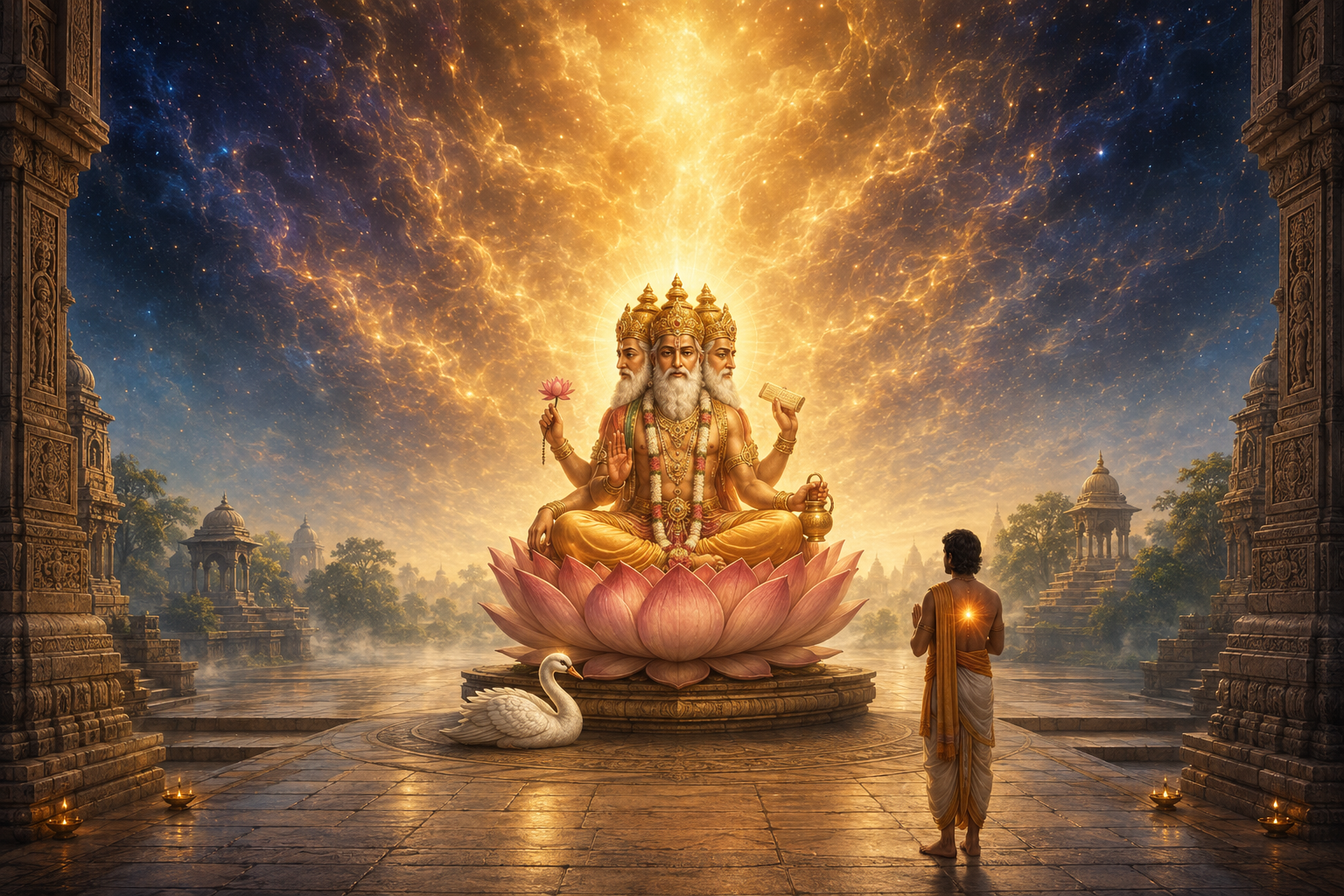
You may have learned that Brahma is the creator and then wondered why the creator has so little visible presence in Hindu temple life. If creation is a divine function, shouldn’t Brahma temples stand beside temples of Vishnu and Shiva across Bharat?
The apparent contradiction disappears once you separate three ideas that are often collapsed: Brahma, Brahman, and jiva atma. The rarity of Brahma worship can then be approached as a philosophical teaching rather than as evidence that Hindus rejected, feared, or forgot the creator.
Begin by separating Brahma, Brahman, and jiva atma
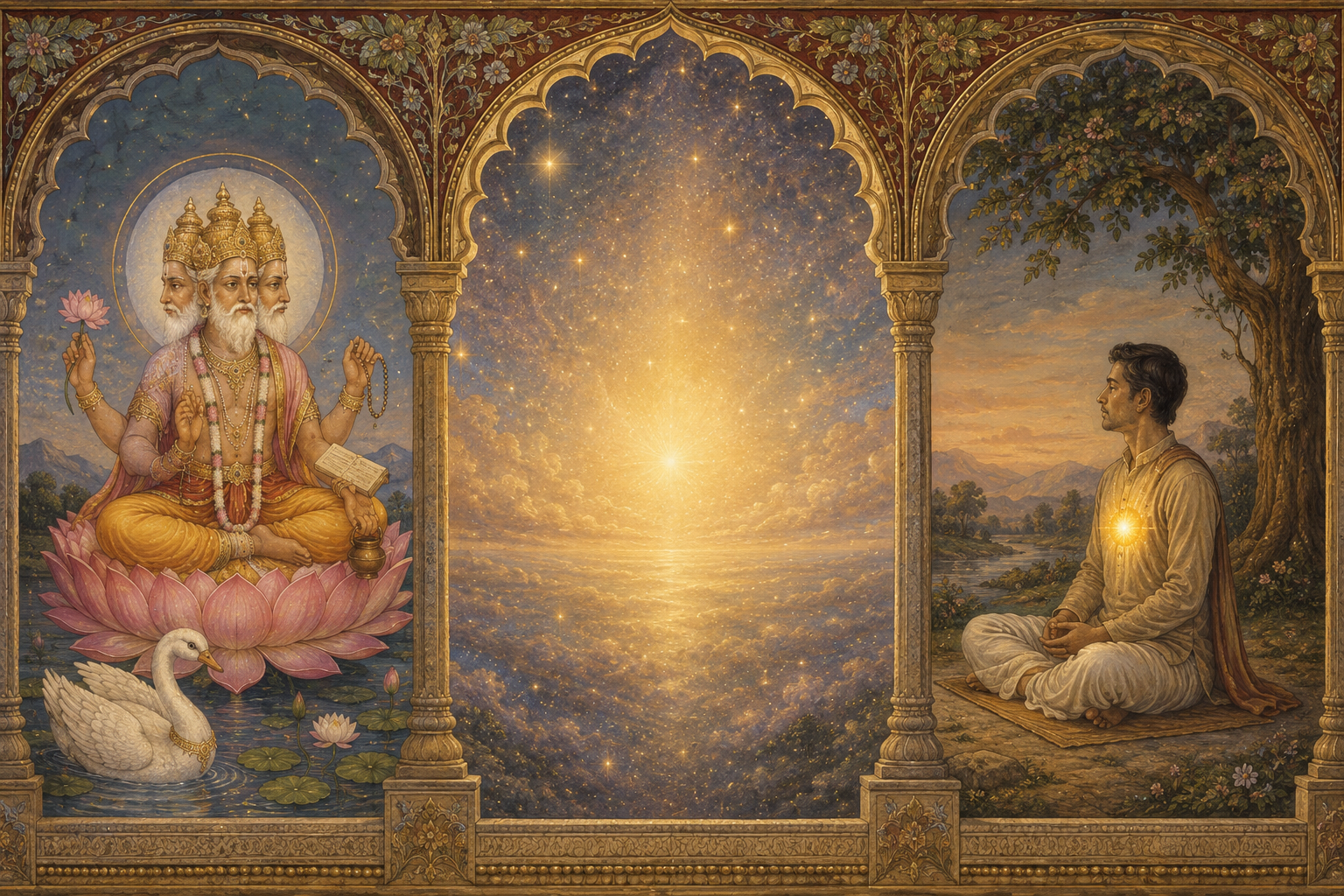
The spelling difference between Brahma and Brahman is not a minor technicality. It changes the question you are asking.
- Brahma is the divine creator associated with the coming forth and ordering of the manifested universe.
- Brahman is the term used in Vedantic thought for ultimate reality. Brahman is not simply Brahma with a longer name.
- Jiva atma, or jivatman, refers to the individual living self as it experiences conditioned existence. Hindu philosophical schools differ sharply over the jiva’s final relationship with ultimate reality.
This means that a cosmic creator need not be identical with the unconditioned ground of existence. Brahma can hold an exalted cosmic function while still belonging to the order of manifestation. Creation is a role within the cosmos; Brahman concerns the reality because of which any role, creator, or cosmos can be known at all.
That distinction also prevents a second mistake. Calling Brahma a jiva atma in a particular theological interpretation does not mean that Brahma is merely an ordinary human personality. It places the creator on the side of conscious agency within manifestation: knowing, acting, producing, and yet still oriented toward a reality beyond created things.
When you encounter a claim about Brahma, check which term is actually intended. Ask whether the discussion concerns the deity who creates, the ultimate ground of reality, or the individual self seeking liberation. Much confusion survives only because those three questions are answered as though they were one.
What the rarity of Brahma temples does and does not prove
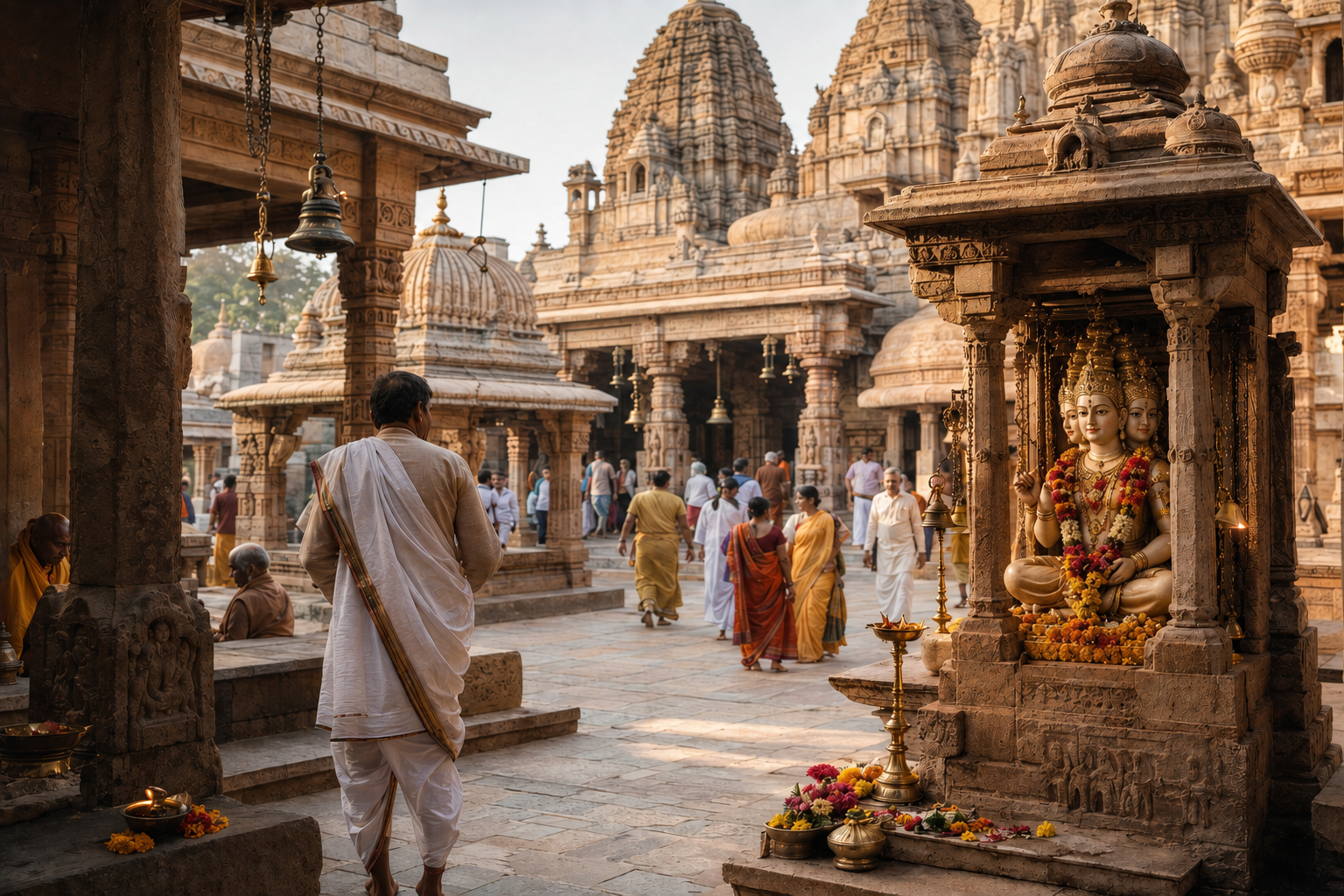
The physical pattern is real: temples devoted to Vishnu and Shiva are widespread, while dedicated Brahma temples are exceptionally rare, with Pushkar in Rajasthan the best-known example. The careful conclusion is that public, dedicated Brahma worship developed on a much smaller institutional scale. The pattern does not, by itself, explain why.
In particular, temple scarcity does not establish any of the following claims:
- Brahma is unreal or absent from Hindu sacred life.
- Every Hindu tradition forbids worship of Brahma.
- Brahma and Brahman are the same, so a temple would be unnecessary.
- One popular sacred narrative supplies the complete historical explanation for every region and sampradaya.
- The number of temples is a simple ranking of divine worth.
A temple landscape is not an organizational chart of the cosmos. It reflects living sampradayas, inherited ritual systems, pilgrimage networks, regional histories, royal and community patronage, and the forms through which devotees have approached refuge and liberation. A deity may be indispensable to the sacred understanding of the universe without becoming the central object of a large temple tradition.
This is why the statement that Hindus do not worship Brahma is too absolute. Dedicated worship is rare, not nonexistent. If someone points to Pushkar, the exception does not destroy the broader observation. It corrects careless wording and reminds you that Hindu practice is rarely captured by a universal negative.
Brahma as jiva atma turns creation into a spiritual question
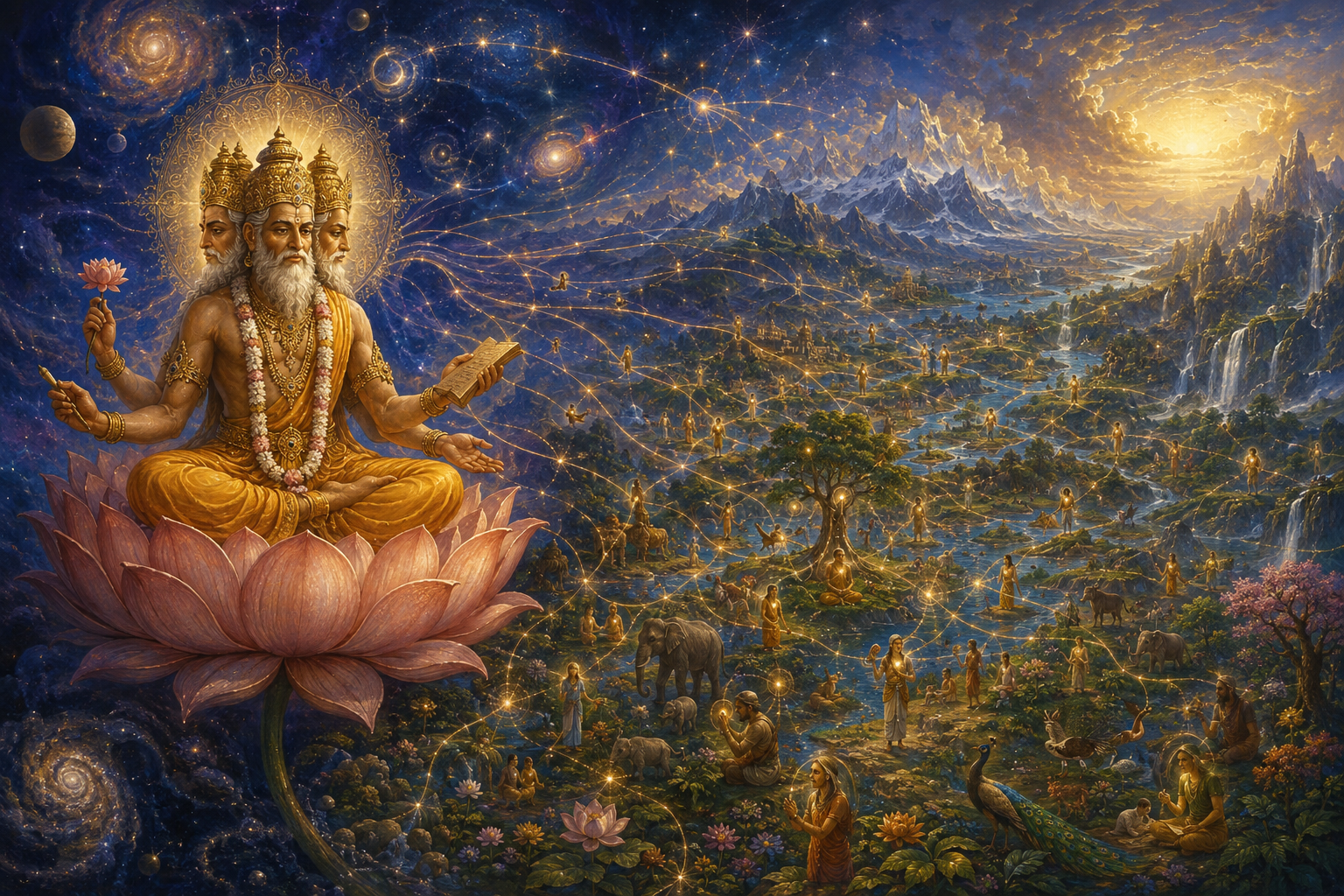
The most fruitful philosophical reading begins with a simple distinction: making something is not the same as knowing the ultimate ground of the maker. Knowledge of created objects, even knowledge vast enough to order a universe, need not end the search for the source of consciousness and being.
Under this reading, Brahma represents the jiva at the greatest imaginable scale. He is not insignificant. He is the cosmic maker. Yet the very structure of creation involves distinction: creator and created, subject and object, before and after, name and form. The jiva likewise encounters life through distinctions and becomes entangled when it treats a role, possession, achievement, or mental identity as the whole self.
The phrase soul still searching should therefore not be heard as ridicule. It identifies the limit of outward mastery. You can organize objects without understanding the subject who knows them. You can build a career, family, institution, argument, or public identity and still be unable to answer what you expect that creation to give you. Greater productivity does not automatically produce greater self-knowledge.
This gives the rarity of Brahma worship a coherent symbolic meaning. Devotional attention tends to gather around the divine as refuge, sustaining presence, transforming power, or liberating reality. Brahma’s function brings forth the field in which embodied experience unfolds. The seeker, however, wants more than entry into that field. The seeker wants freedom from ignorance within it.
Creation remains sacred in this interpretation. The error is not to create, work, think, raise a family, produce art, or build institutions. The error is to ask a created result to settle the identity of the creator. No achievement can permanently answer the question of who you are, because every achievement becomes another object you can observe, remember, defend, lose, or outgrow.
Different Hindu schools will not describe the end of the search in identical terms. Some emphasize realization of nonduality. Others preserve an enduring distinction between the individual self and the Supreme while emphasizing dependence, devotion, grace, or loving service. The Brahma-as-jiva reading should therefore be presented as a theological lens, not as a creed binding every Hindu. Its durable insight is narrower: even cosmic authorship is not identical with liberation.
You can test any explanation of Brahma’s place by asking three questions. Does it distinguish Brahma from Brahman? Does it preserve Brahma’s dignity instead of turning theology into an insult? Does it leave room for actual Brahma worship and for disagreement among sampradayas? If it fails any of these tests, it is probably too crude to carry the weight placed upon it.
Turn the temple puzzle into a practice of self-inquiry
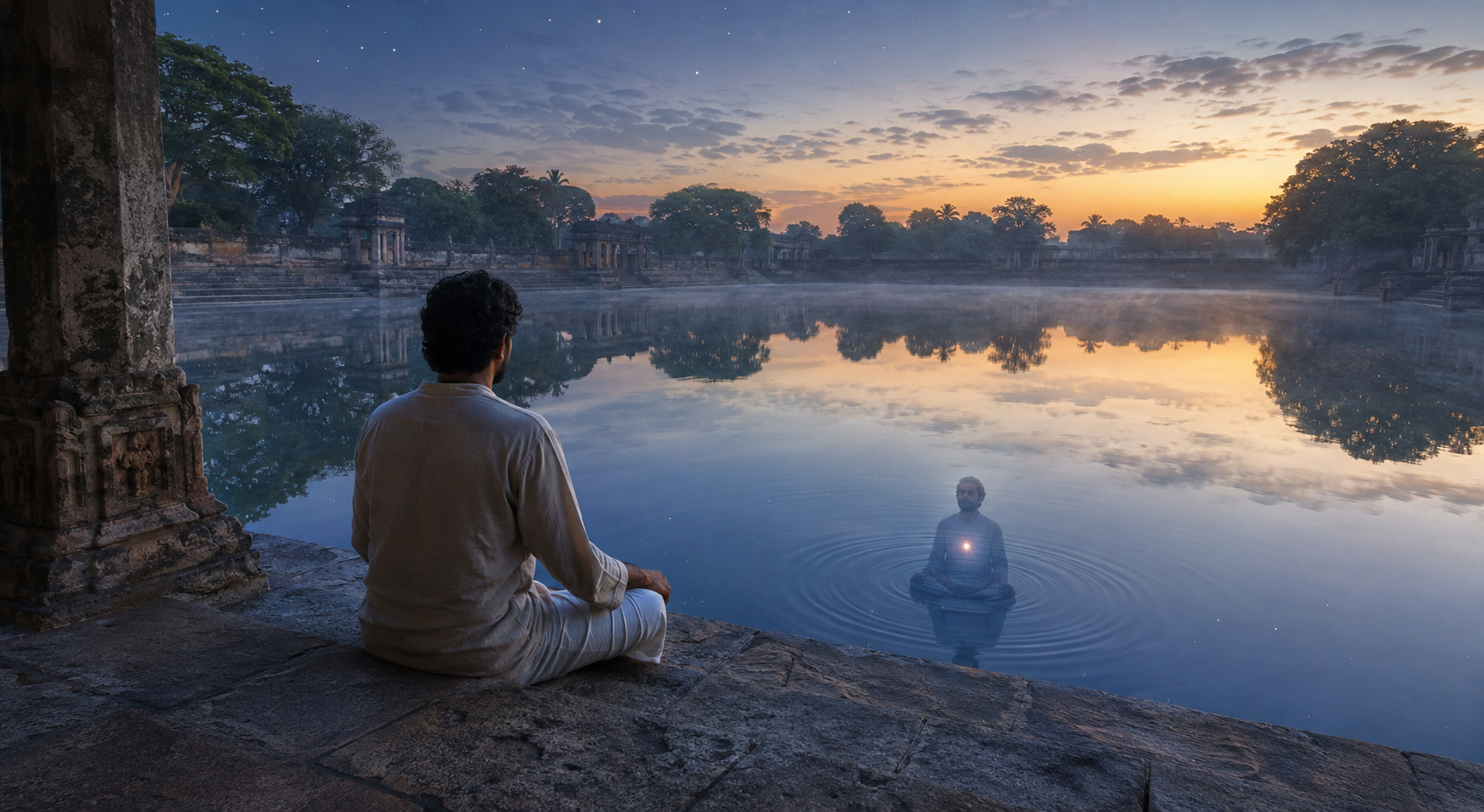
The teaching becomes useful when you apply it to your own habit of creation. You do not need to abandon action. You need to notice when action quietly becomes a demand for identity.
- Name what you are creating. It may be a household, career, reputation, body of knowledge, political position, spiritual identity, or image of yourself as a good person. Use a concrete noun rather than a vague answer.
- Name what you want it to prove. Complete the sentence: If this succeeds, it will prove that I am worthy, secure, intelligent, needed, righteous, or in control. This exposes the burden you have placed on the result.
- Separate the work from the self. Ask what is aware of both the desire to succeed and the fear of failure. Do not rush to supply a memorized philosophical answer. Notice the difference between an experience and the awareness to which it appears.
- Return to dharmic action. Do the next duty carefully, but stop asking its outcome to provide an ultimate identity. Detachment here means clearer action, not negligence toward people or obligations.
- Interpret the inquiry through your sampradaya. If your path is devotional, the practice may culminate in offering both ability and result to the Supreme. If your path emphasizes knowledge, it may deepen investigation into the knower. Do not force every tradition into one metaphysical formula.
This practice reveals why Brahma is such a powerful image for a productive age. The mind can spend its life manufacturing plans, explanations, identities, and worlds. Its capacity to create is real, but its creations cannot tell it what consciousness ultimately is. The maker must eventually become a seeker.
If you feel drawn toward formal Brahma worship, rarity should not be treated as a prohibition. Learn from an established temple, practitioner, or sampradaya that actually maintains the relevant ritual tradition. Philosophical symbolism can guide contemplation, but it is not a license to invent liturgy and present it as inherited practice.
Questions that clarify the teaching
Is Brahma the same as Brahman?
No. Brahma is the creator-deity, while Brahman denotes ultimate reality in Vedantic discourse. Confusing the words turns a question about a divine function into a different question about the nature of reality.
Is Brahma never worshipped?
No. Temples dedicated to Brahma are rare, but they exist, and Pushkar is the most prominent example. Say that Brahma has little dedicated temple worship compared with Vishnu and Shiva, not that worship is completely absent.
Does jiva atma simply mean the ego?
No. Egoic identification concerns the claim that a role, thought, body, possession, or action defines the self. Jiva atma refers more broadly to the individual living self in conditioned existence. Schools disagree about its precise metaphysical status and its relationship with ultimate reality.
Does this philosophy completely explain the lack of temples?
No single philosophical interpretation should be mistaken for a complete institutional history. The seeker-and-sought reading explains what the pattern can mean spiritually. The distribution of temples also belongs to the histories of particular regions, communities, lineages, and forms of worship.
The next time you hear that the creator is not worshipped, pause before repeating an absolute claim or a single-cause legend. Distinguish Brahma from Brahman, recognize the genuine exceptions, and then ask the question the symbolism directs back to you: what are you still asking your creations to prove about the self?
References
