
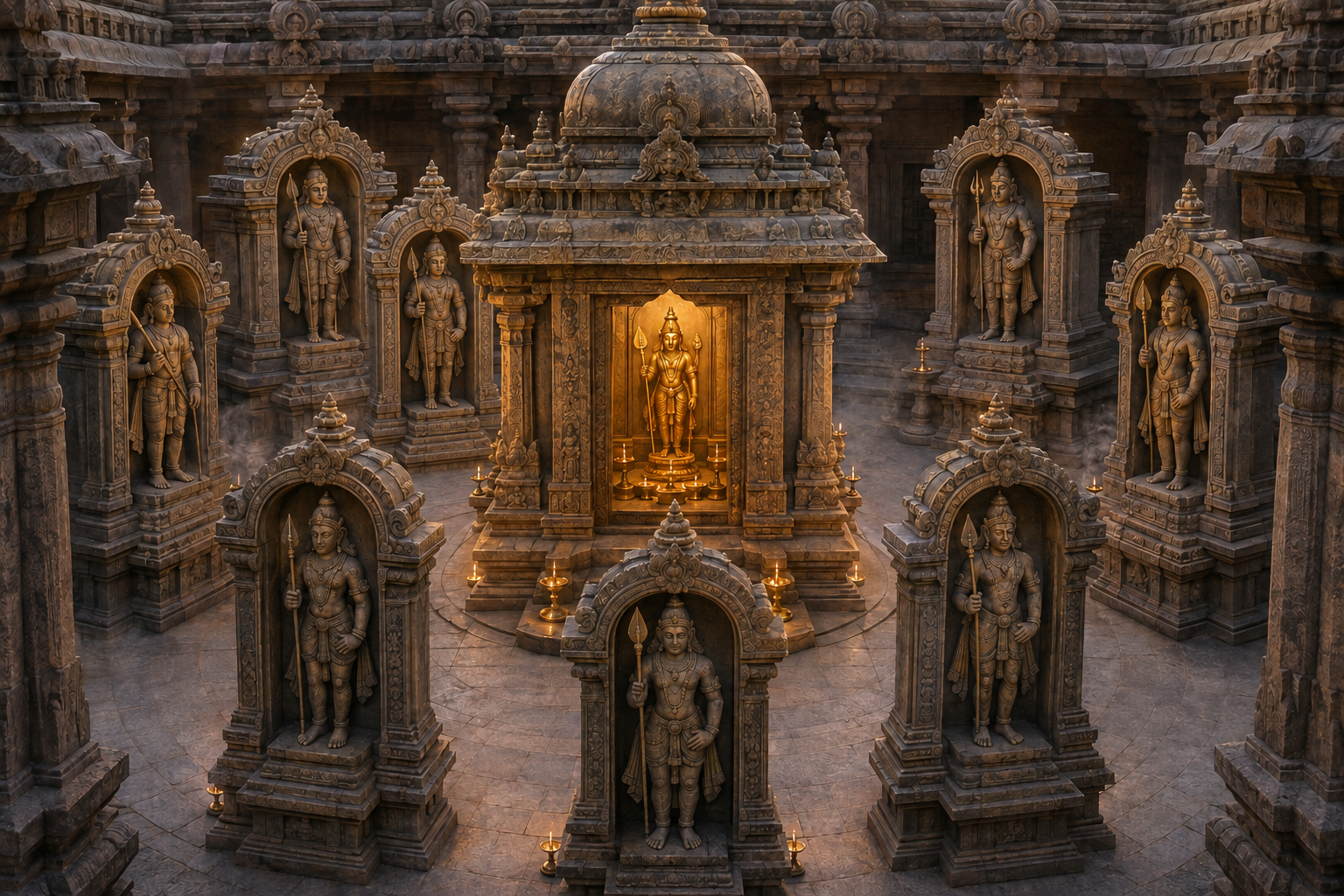
You may have encountered a puzzling detail in a Murugan temple: eight guardians surround the sacred area, yet their names sound like names of Murugan himself. That resemblance is the key to recognizing them, not a copying error or a second list of unrelated deities.
These figures are the Sharira Palakas, the bodyguards attached to Subrahmanya’s temple iconography. Once you know their names, expected forms and directional arrangement, you can distinguish this group from ordinary doorway guardians, the deities of Murugan’s wider retinue and the better-known guardians of the directions.
The eight names, in their prescribed sequence
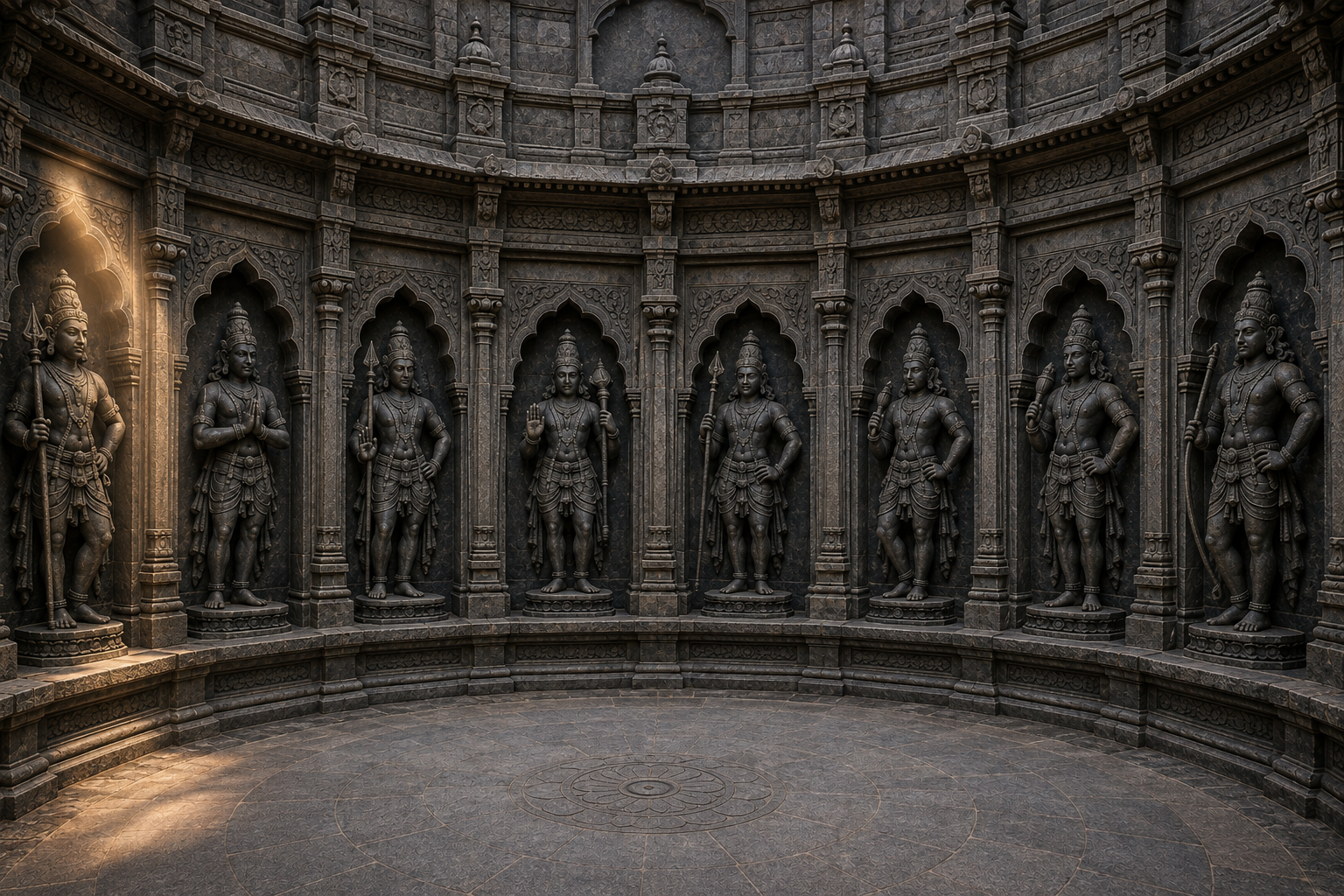
The eight Sharira Palakas associated with Murugan are Shanmukha, Shaktipani, Karttikeya, Guha, Skanda, Mayuravahana, Senani and Shaktihastavan. Diacritical spellings include Shanmukha as Ṣaṇmukha, Shaktipani as Śaktipāṇi, Karttikeya as Kārttikeya, Mayuravahana as Mayūravāhana and Shaktihastavan as Śaktihastavān.
| Order | Guardian | What the name tells you |
|---|---|---|
| 1 | Shanmukha | Murugan as the six-faced one |
| 2 | Shaktipani | The one who holds the shakti in his hand |
| 3 | Karttikeya | One of Murugan’s principal Sanskrit names |
| 4 | Guha | The hidden, secret or inwardly dwelling one |
| 5 | Skanda | Another principal Sanskrit name of Murugan |
| 6 | Mayuravahana | The one whose vehicle is the peacock |
| 7 | Senani | The commander or leader of the army |
| 8 | Shaktihastavan | The one who possesses or bears the shakti in his hand |
Use the meanings as recognition aids, not as a substitute for the actual iconography. Karttikeya and Skanda, for example, are names rather than unique visual instructions. Shaktipani and Shaktihastavan also appear very close in meaning. Preserve both names instead of merging them: the traditional list treats them as separate members of the eightfold group.
Why Murugan’s guardians carry Murugan’s own names
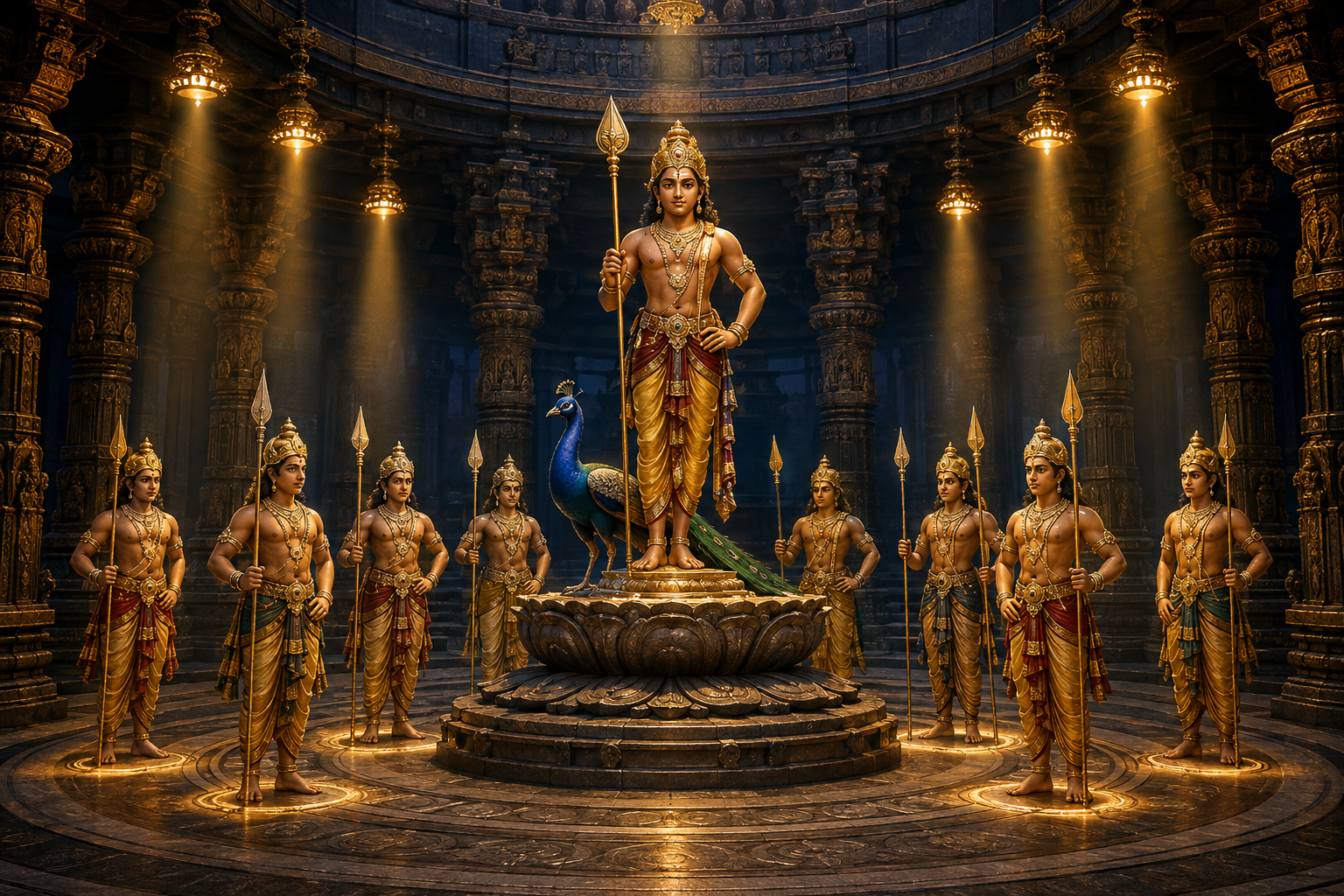
The repeated names can mislead you if you expect every temple guardian to have a separate mythology and biography. The Sharira Palakas are an iconographic bodyguard corps whose identities echo the deity they attend. They are not presented as eight sons of Murugan, eight historical warriors or another version of the Ashta Dikpalakas.
This also explains why the group should not be collapsed into the parivara devatas, the deities belonging to Murugan’s wider retinue. The Sharira Palakas are prescribed in addition to the parivara deities. If a temple plan labels one set as parivara and another as Sharira Palakas, the two labels describe different ritual and architectural offices even when both groups protect the sacred complex.
There is a useful theological insight here, provided we state it as an interpretation rather than a literal translation: Murugan’s presence is guarded by identities that disclose Murugan himself. The boundary around the sanctum does not lead the devotee away from the central deity. It repeats his qualities – six-faced vision, hiddenness, command, the peacock and the shakti – as protection around him.
The English expression “body guardian” or “bodyguard” refers to this iconographic role. It does not by itself establish a system of eight chakras, eight parts of the human anatomy or eight subtle bodies. If someone proposes such a correspondence, ask for the relevant Agamic passage or an explicit local temple tradition before treating it as inherited doctrine.
How to identify the group in a temple
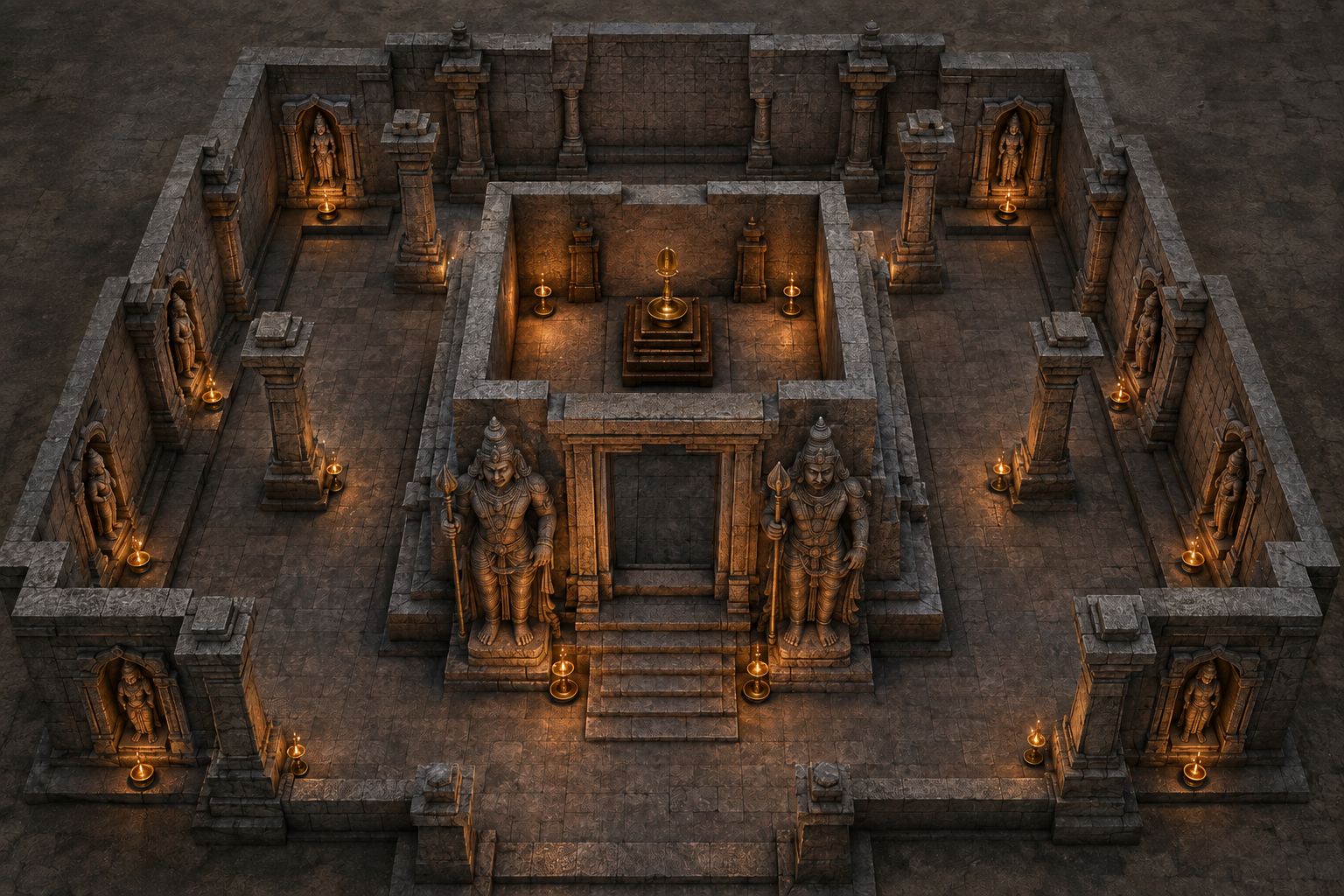
A name alone is rarely enough. Look for a combination of number, placement and form. The prescribed pattern allows variation, so a guardian need not resemble a heavily armed gatekeeper to belong to this group.
- Locate the principal Murugan or Subrahmanya shrine. Establish which enclosure and directional scheme belong to that shrine before counting nearby figures.
- Begin at the east and look for a sequence occupying eight directional points. The arrangement is described as beginning in the east, with the group possibly placed in a second avarana, or surrounding enclosure.
- Count both images and designated pedestals. When full sculptures are not installed, pithas may represent the guardians instead.
- Check the number of arms. A Sharira Palaka may have two arms or four arms, so the two-armed form is not an incomplete version.
- On a four-armed image, look for two hands held at the chest in anjali. The other two hands are prescribed to carry a vajra and a padma, the thunderbolt and lotus.
- Check the faces without demanding uniformity. The guardians may be shown with one face or six faces.
- Where pithas stand in place of sculptures, look for a peacock or elephant positioned before them. This can help confirm that apparently unoccupied pedestals belong to the prescribed scheme.
The combination matters. A peacock proves a connection with Murugan more readily than it proves the presence of a Sharira Palaka. Likewise, a six-faced figure may represent Murugan directly. Identification becomes stronger when the figure belongs to an eight-station arrangement and also matches the permitted arms, gestures or attributes.
Do not reject a figure merely because two hands are joined in reverence. Modern viewers often expect a bodyguard to advertise aggression through weapons and posture. Here, the four-armed form combines anjali with the vajra and lotus. Reverence and protective authority are held together in one image.
Actual temples may preserve, simplify, relocate or omit parts of an ideal iconographic programme. Renovations can also make a directional sequence harder to read. If the visible arrangement is incomplete, ask the archaka or a temple guide for the local names of the stations. Consult a site plan or inscription where one is available, and observe any restrictions on circulation or photography.
Read the architecture before assigning symbolism
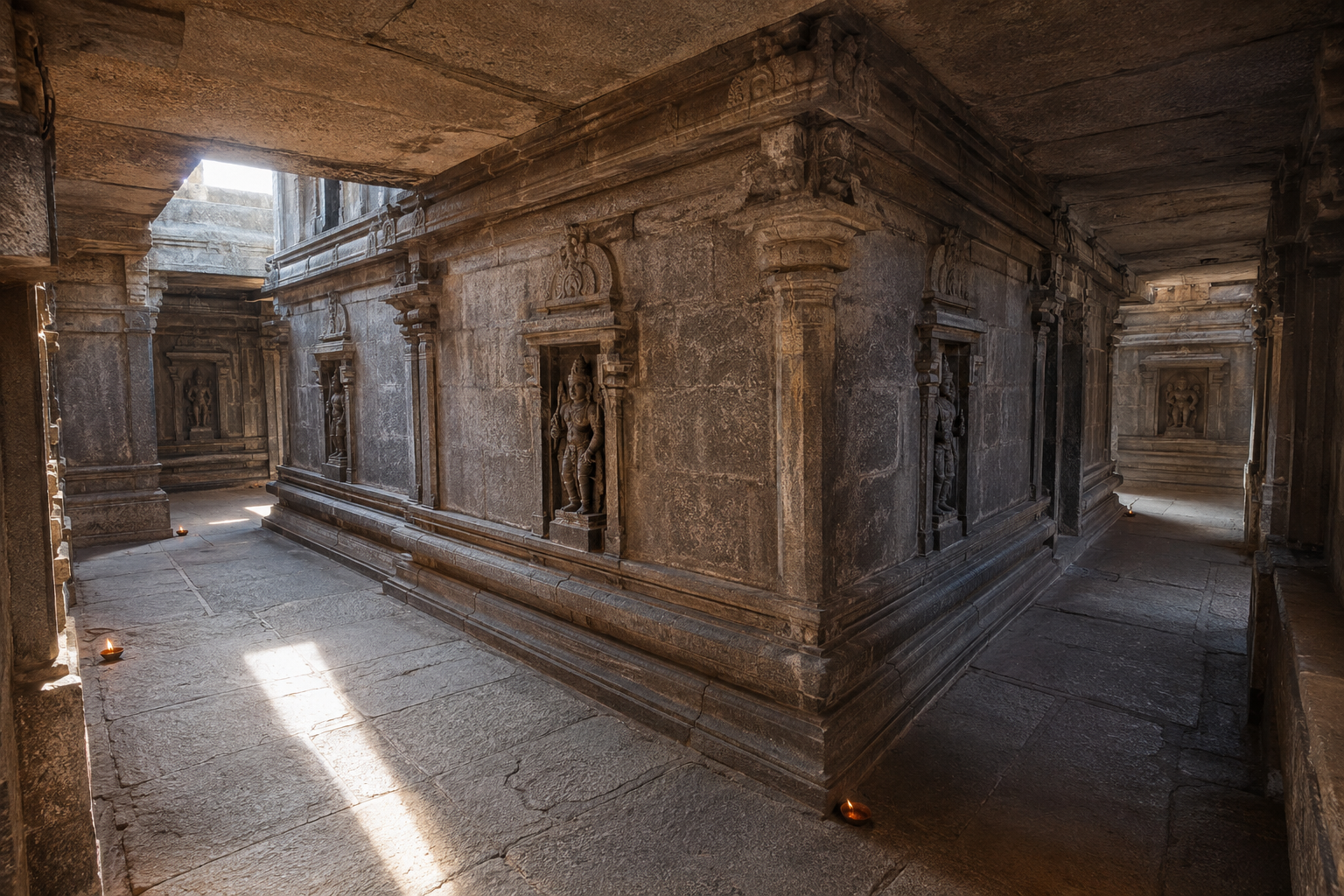
The safest method is to move from structure to interpretation. First establish that there are eight stations associated with the Murugan shrine. Then examine their direction, arms, faces, gestures and emblems. Only after those checks should you identify the group or explore its devotional meaning.
This order prevents three common mistakes. The first is calling any group of eight the Ashta Dikpalakas. The Sharira Palakas do occupy eight directional points, but their names are not the standard names of the directional guardians. The second is treating them as interchangeable with the parivara devatas, despite their separate place in the temple scheme. The third is inventing a one-to-one map between the eight names and a modern psychological or yogic system without textual or local support.
The possible location in a second avarana also deserves care. “Avarana” describes an enclosing circuit or layer around the sacred centre. The available prescription presents the second enclosure cautiously rather than as an absolute placement for every temple. You should therefore use it as a strong clue, not as a reason to dismiss a locally documented arrangement elsewhere in the complex.
Even the absence of statues may carry information. A pitha can function as the assigned seat or marker of a guardian. When eight pedestals form an ordered circuit, record their positions before concluding that the figures have simply been lost. The architecture may retain the conceptual scheme in a reduced form.
These distinctions matter because a temple is not a collection of isolated sculptures. Placement gives an image part of its identity. The same familiar name or emblem can perform a different function at the sanctum, at a gateway or in an outer enclosure. Reading the whole arrangement protects you from turning resemblance into certainty.
Key takeaways for your next temple visit
- The eight Sharira Palakas are Shanmukha, Shaktipani, Karttikeya, Guha, Skanda, Mayuravahana, Senani and Shaktihastavan.
- They are Murugan’s bodyguards in the iconographic programme, distinct from his parivara devatas and from the conventional Ashta Dikpalakas.
- Look for eight directional stations beginning in the east, possibly in a second enclosure around the shrine.
- Accept legitimate variation: each guardian may have two or four arms and one or six faces.
- In the four-armed form, two hands make anjali at the chest while the other two carry a vajra and lotus.
- Pedestals may stand for absent sculptures, with a peacock or elephant placed before them.
On your next visit to a Subrahmanya temple, begin with the eastern side and examine the full circuit before naming any single figure. Count stations as well as sculptures, note the permitted variations, and ask how the temple’s own tradition identifies them. That small discipline turns an obscure list of names into a readable sacred arrangement.
References
