

You may turn to the Devi Aparadha Kshamapana Stotram because you have neglected worship, committed an offence, or begun to wonder whether your failures have placed you beyond the Mother’s grace. Its seventh stanza answers that fear in an unexpected way. It asks you to look first at Shiva, not at yourself.
The stanza appears to say that an ash-smeared, serpent-wearing ascetic occupies the supreme station because he took Bhavani’s hand. That can sound like a claim that Devi promoted an otherwise deficient Shiva. Read more carefully, however, and a richer theology emerges: divine power is relational, grace does not depend on conventional respectability, and union with Shakti reveals the sovereignty already hidden within Shiva’s fearsome form.
The stanza turns an unsettling appearance into sovereignty

The seventh stanza builds its argument through a deliberately severe portrait:
चिताभस्मालेपो गरलमशनं दिक्पटधरो जटाधारी कण्ठे भुजगपतिहारी पशुपतिः। कपाली भूतेशो भजति जगदीशैकपदवीं भवानि त्वत्पाणिग्रहणपरिपाटीफलमिदम्॥ ७॥
Devi Aparadha Kshamapana Stotram, verse 7
A close prose rendering is: Smeared with the ash of the funeral pyre, having poison as his fare, clothed in the directions, bearing matted locks, and wearing the serpent king around his neck, Shiva is Pashupati, Kapali, and Bhutesha. Yet he enjoys the unique station of Jagadisha, Lord of the world. O Bhavani, this is the fruit of taking your hand.
Notice the sequence. The first half names everything that would disqualify a person from ordinary social prestige: cremation-ground ash, poison, nakedness suggested by the directions as clothing, matted hair, a serpent, and a skull. The stanza does not replace those marks with royal garments. Shiva remains exactly as he is. What changes is the level at which you understand him.
This distinction matters. The hymn is not teaching that purity means becoming visually respectable. The funeral ash and serpent are not embarrassing defects that Devi conceals. They belong to Shiva’s transcendence of ordinary fear, possession, and status. The stanza deliberately borrows the gaze of the worldly observer, lets that observer see an alarming outsider, and then overturns the verdict: this very figure holds the singular station of Lord of the world.
The names in the verse make a crude promotion story impossible. Pashupati already means Lord of creatures, while Bhutesha identifies Shiva as Lord of the bhutas, a term that can evoke beings, elements, or spirits depending on context. He is already addressed through names of lordship before Jagadisha appears. Bhavani’s hand therefore does not manufacture divinity out of worthlessness. It discloses the cosmic scope of a lordship that a surface judgement cannot recognise.
Why Bhavani’s hand carries the theological weight

The pivotal expression is tvat-pāṇigrahaṇa: the taking of your hand. Pāṇigrahaṇa carries the sense of taking a hand in marriage. The verse could have described Devi as Shiva’s ornament, companion, or possession. Instead, it identifies a bond with her as the decisive cause of his world-sovereignty.
That reversal is easy to miss. At the grammatical surface, Shiva takes Bhavani’s hand. At the theological level, the fruit of the act comes from her. His action matters because of the one whose hand he receives. Devi is not an accessory added after Shiva has become complete and powerful; the stanza makes relationship with her integral to the manifestation of his power.
This is where the name Shakti becomes more than a synonym for a goddess. Shakti means power, capacity, and the ability through which something becomes effective. Shiva can signify the still, transcendent reality that exceeds all forms, while Shakti signifies its power of manifestation. The two terms need not describe rival beings competing for a throne. They can name distinguishable aspects of a unity: being and power, stillness and expression, transcendence and presence.
The hand is therefore a better image than a crown. A crown can be bestowed upon an isolated ruler. Joined hands signify relation. The stanza places relation at the centre of divine sovereignty: Shiva is known as Jagadisha through union with Bhavani. For you as a worshipper, the implication is immediate. Spiritual dignity is not merely an achievement accumulated by a solitary ego. It arises through right relationship with the divine.
Does the verse make Shiva subordinate to Devi?
You do not have to flatten the stanza into a contest between a superior Goddess and an inferior God. Hymns of devotion speak from a concentrated point of vision. When Devi is being praised, the universe is interpreted through Devi; her grace becomes the key by which even Shiva’s majesty is understood. That devotional focus is intentional, not an error requiring correction.
A strongly Shakta reading can take the causal claim at full force: Devi is supreme Shakti, and Shiva’s capacity to exercise cosmic lordship depends upon her. A nondual reading can place the emphasis on inseparability: Shiva apart from Shakti and Shakti apart from Shiva are abstractions, while their union is the living reality. A bhakti reading can hear an exaltation of sacred companionship, in which the divine couple manifests a fullness not expressed through either figure in isolation.
Those readings place the emphasis differently, but the stanza itself gives you a boundary. It does not ridicule Shiva. Every unsettling description is followed by a title of majesty, and the conclusion honours the union rather than narrating a defeat. To use the verse as ammunition in a sectarian argument would reproduce the superficial judgement that its poetic reversal asks you to leave behind.
Nor should you weaken its Shakta force in the name of harmony. The verse really does credit Bhavani. It does not merely say that Shiva happened to marry her after attaining sovereignty on his own. Its final clause calls his station the fruit of taking her hand. A balanced reading preserves both truths: Shiva is no ordinary dependent being, and Devi’s power is not decorative.
What Divine Motherhood means after you have failed
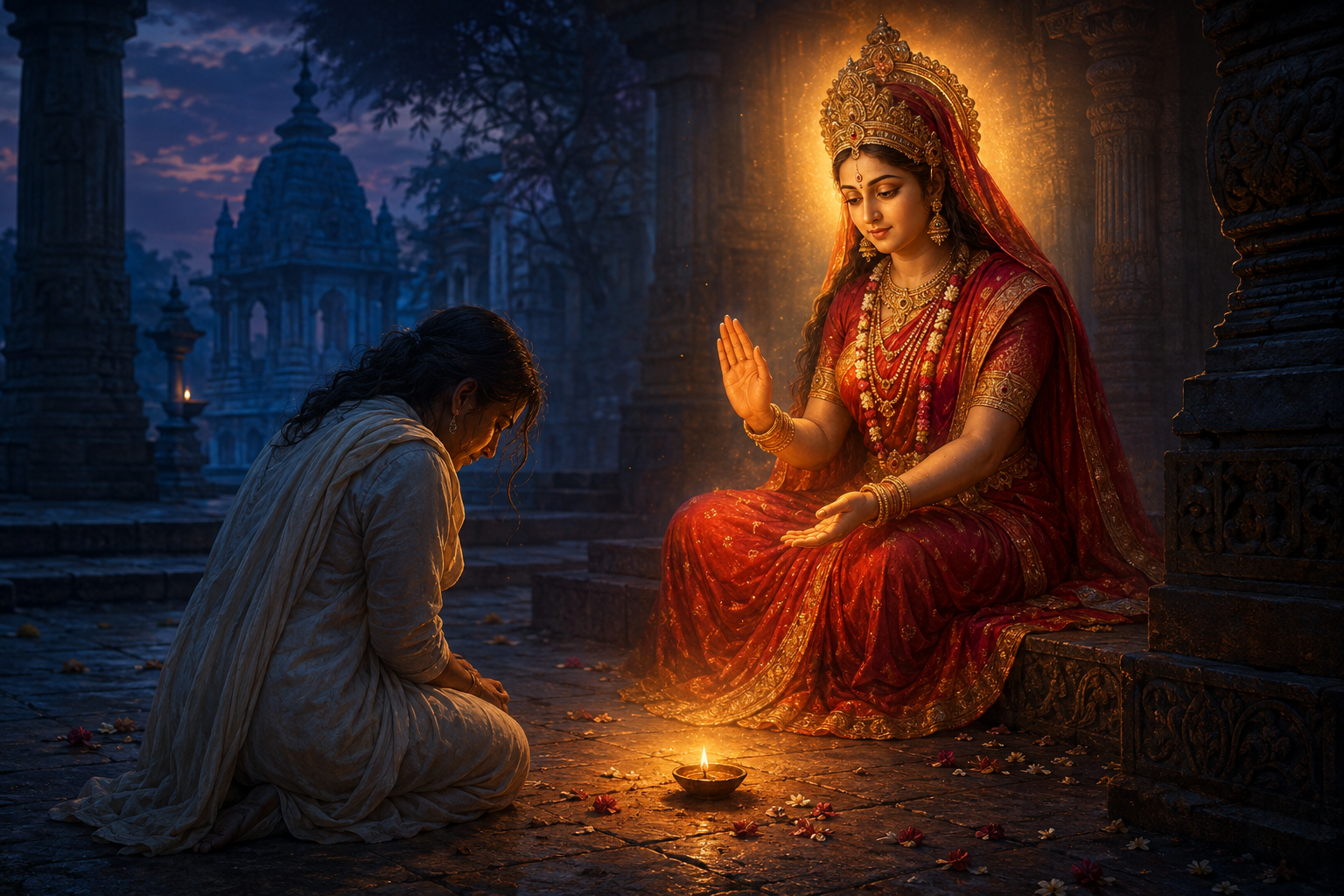
The title Devi Aparadha Kshamapana Stotram tells you how to hear this praise. Aparadha is an offence or transgression; kshamapana is the act of asking pardon. This is not the speech of someone displaying spiritual credentials. It is the speech of a person who knows that something has gone wrong and nevertheless turns toward Devi.
Within that setting, calling the divine Mother is not sentimental language. It defines a relationship in which failure need not have the final word. The worshipper does not claim innocence, bargain with merit, or wait to become flawless before returning. The worshipper approaches because the relationship itself makes return possible.
Verse seven intensifies that assurance without trivialising wrongdoing. If Bhavani’s relationship can make the ash-smeared, skull-bearing, convention-defying Shiva intelligible as Jagadisha, then outward disqualification cannot by itself exhaust divine judgement. The Mother’s sight penetrates beneath the categories by which the world sorts the respectable from the unworthy.
Do not turn that assurance into permission to repeat harm. Forgiveness and evasion are opposites. A sincere kshamapana names the offence, seeks mercy, and changes the conduct that produced it. If your mistake injured another person, prayer does not replace an apology, restitution, or a necessary correction. The Mother to whom you return is a source of moral power, not a hiding place from responsibility.
The practical shift is from self-condemnation to accountable dependence. Self-condemnation says, “Because I failed, I cannot approach.” Entitlement says, “Because Devi is Mother, my conduct does not matter.” The hymn permits neither conclusion. You approach precisely as one who has failed, and you ask for the grace needed to live differently.
How to pray verse seven: key takeaways
- Read the inventory slowly. Pause after the funeral ash, poison, directions as clothing, matted locks, serpent, and skull. Notice which feature makes you instinctively judge Shiva by ordinary standards.
- Mark the turn from appearance to identity. Pashupati, Kapali, Bhutesha, and Jagadisha tell you that the frightening form is not the whole truth. Apply the same discipline to your own guilt: name what happened, but do not mistake an offence for your entire identity.
- Pause at “Bhavani.” The direct address matters. Forgiveness is not an impersonal cancellation of a record; it is sought within a relationship with the Mother.
- Rest on the image of the hand. Pāṇigrahaṇa makes union, not self-sufficiency, the source of manifested greatness. Ask where pride has made you treat spiritual life as a private achievement.
- Pair recitation with one repair. Correct a neglected duty, apologise for a specific injury, resume a practice you abandoned, or remove the condition that keeps producing the same offence. Let the prayer acquire a visible consequence.
You do not need to settle every metaphysical question before praying this stanza. Begin with its movement: see clearly, approach Bhavani, receive relationship as grace, and make one concrete correction. The verse does not ask you to pretend that failure never occurred. It teaches you that failure need not prevent the hand from being extended again.
References
