
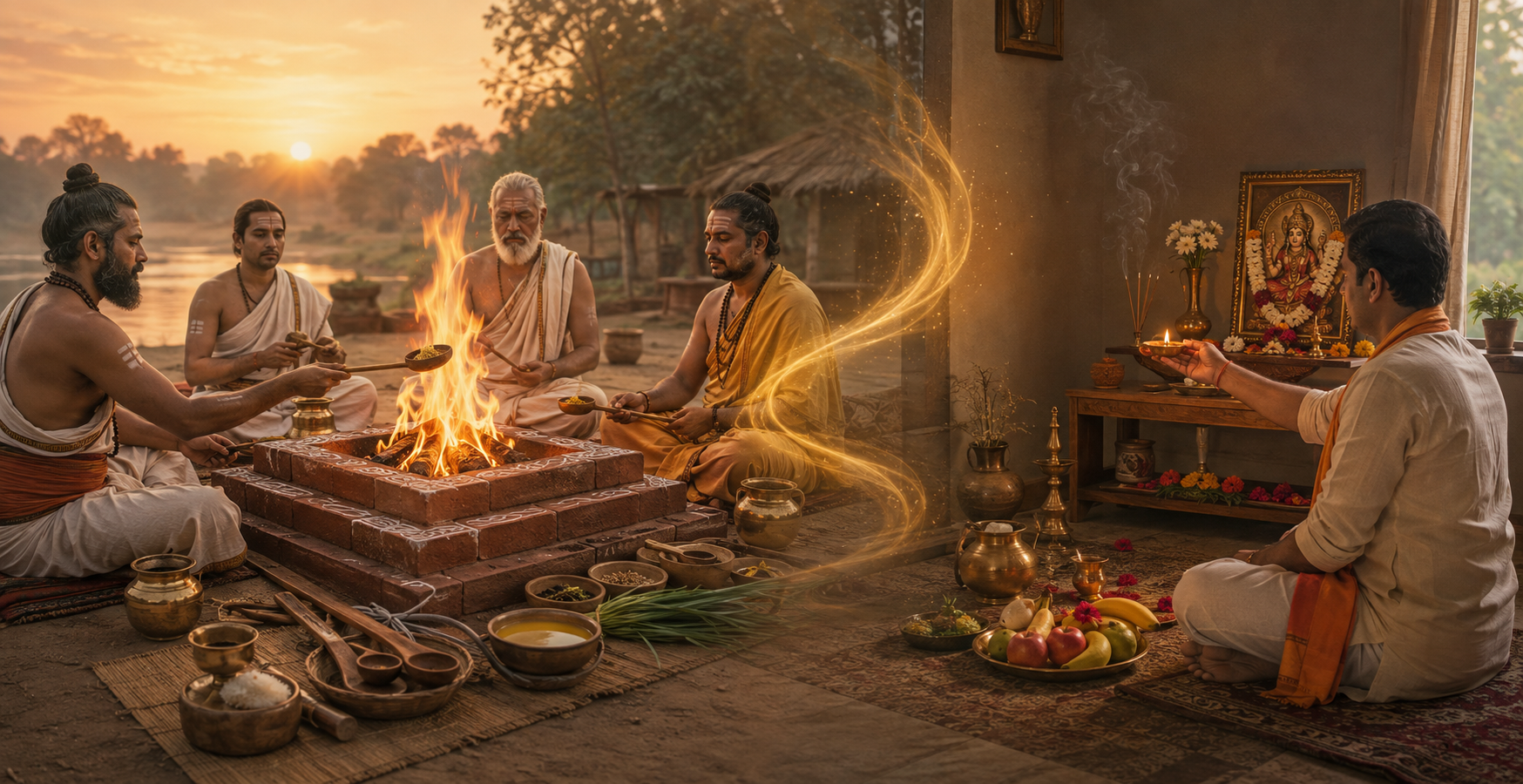
If the puja at your home altar lasts a few minutes while the Vedic rituals you have seen appear elaborate and highly formal, you may wonder whether personal worship is only a reduced version of something older. That conclusion misses the most important part of the history.
Personal puja did not simply miniaturize yajna. It preserved the central act of offering while changing where the encounter with the divine takes place, who can sustain it, and how devotion enters everyday life. Once you see that distinction, you can value a simple puja without mislabeling every sacred offering as a Vedic fire ritual.
The centre of worship changed, but yajna did not disappear
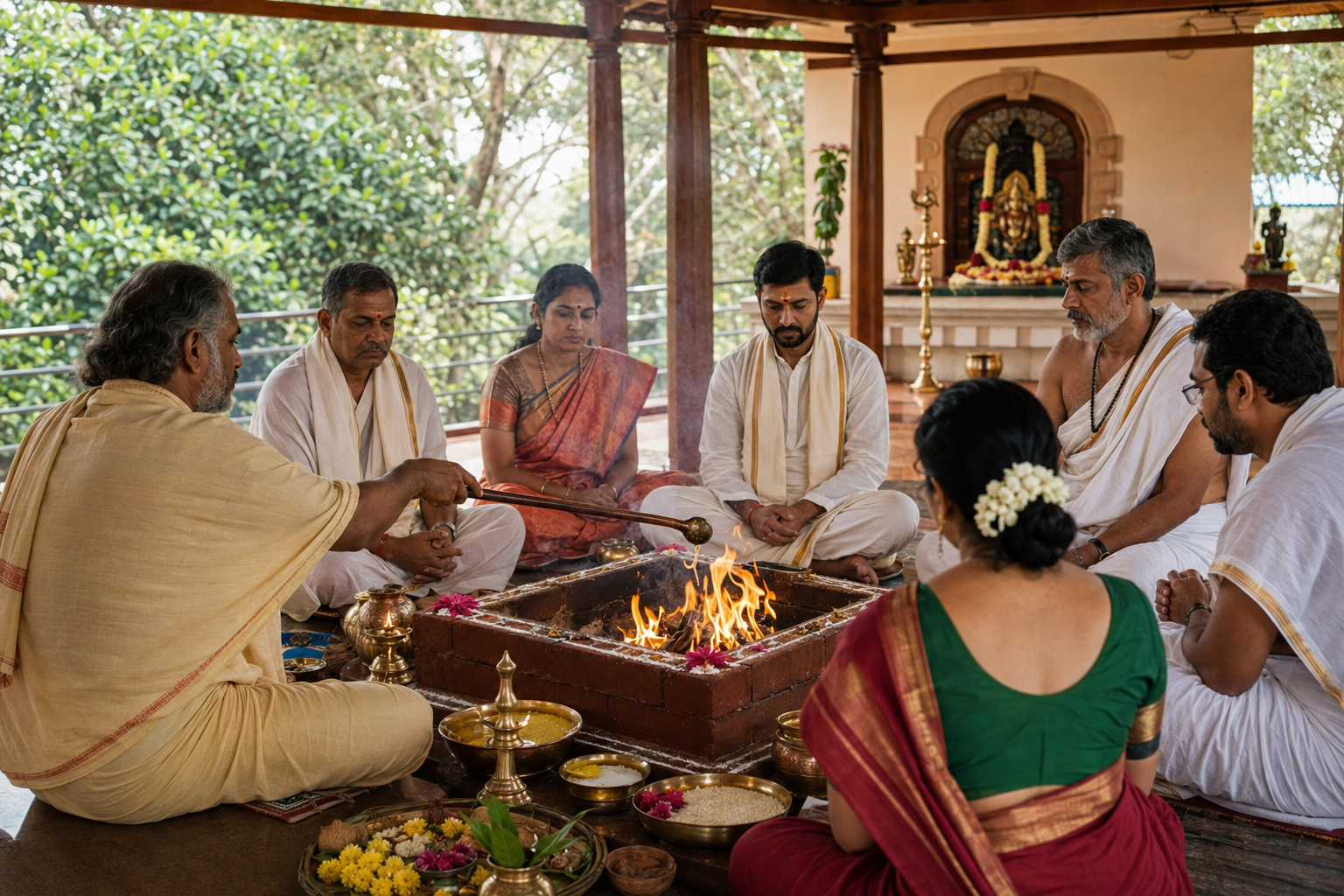
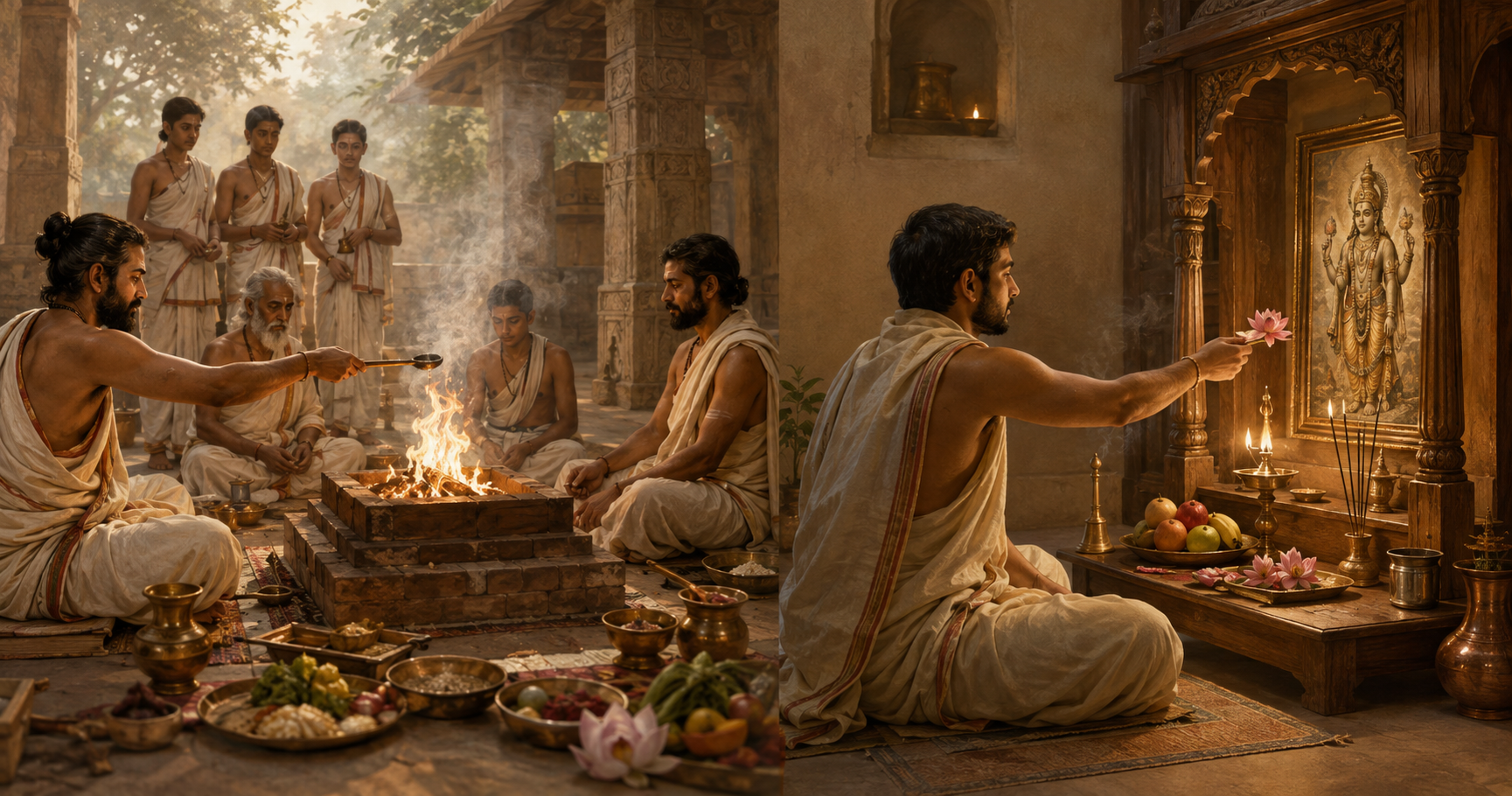
In the earliest Vedic setting, yajna stood near the centre of religious and social life, with Agni carrying human offerings to the devas. The fire was not decorative. It was the ritual medium through which a consecrated offering passed from the visible world toward its divine recipient.
This helps explain why a Vedic yajna depends on more than lighting a flame. The offering, fire, spoken formula, ritual order, intention, and competence of the participants belong together. Some rites can be maintained in a household, while more elaborate ceremonies call for trained ritualists and carefully coordinated actions.
Puja places the emphasis elsewhere. The deity is approached as present before the worshipper through a murti, sacred symbol, image, lamp, or another focus recognized by the tradition. Water, flowers, light, fragrance, food, praise, and attention are offered directly in an atmosphere resembling reverent hospitality.
There was no single day on which Hindus stopped performing yajna and began performing puja. The better picture is a long change in ritual emphasis. Fire offerings continued, while temple worship, household devotion, pilgrimage, festival observance, and inward forms of offering became major ways of living the dharma. Yajna and puja therefore belong to an expanding ritual world, not to two sealed historical periods.
Nor is the change adequately described as public worship becoming private worship. Vedic practice could be domestic as well as collective, and puja can fill a temple or animate a public festival. What changed most was the form of divine encounter: from an offering mediated principally through consecrated fire to a devotional relationship enacted through presence, service, remembrance, and repeated personal attention.
Yajna and puja organize the sacred act differently
| Ritual question | Vedic yajna | Personal puja |
|---|---|---|
| What forms the ritual centre? | A consecrated fire | A deity approached through a recognized image, symbol, lamp, or other sacred focus |
| What is the defining action? | An oblation is offered into fire according to an ordered rite | Offerings and acts of reverent attendance are presented before the deity |
| What carries the offering? | Agni serves as the divine messenger | The offering is made in the immediate devotional presence of the deity |
| What knowledge is required? | Correct sequence and recitation are especially important; elaborate rites may require trained officiants | Practice ranges from a simple household observance to detailed temple liturgy |
| What relationship is emphasized? | Reciprocity sustained through a properly ordered sacred offering | Welcome, service, contemplation, affection, surrender, and remembrance |
These are differences of emphasis, not absolute walls. A yajna can be intensely devotional, and a puja can be governed by exact ritual rules. A lamp in puja also preserves the religious language of luminosity and transformation without turning the entire observance into a fire sacrifice.
The most durable continuity is the movement from possession to offering. Something drawn from ordinary life is selected, purified by intention, presented, and no longer treated as merely private property. In yajna it enters the sacred fire. In puja it is placed before the deity; food may then be received as prasada. The material can be modest, but the act changes the worshipper’s relationship to it.
- Ordinary time is interrupted. You stop other work and give the sacred act a definite beginning.
- Attention is gathered. The offering is not casual disposal; it is joined to intention, remembrance, and appropriate words.
- A relationship is acknowledged. The worshipper does not behave as an isolated owner but as one who receives, owes, gives, and belongs.
- Something is released. Food, fragrance, light, effort, breath, or praise is surrendered rather than merely displayed.
- The worshipper returns changed. The rite closes, but its discipline should continue as gratitude, restraint, generosity, and responsible action.
This shared grammar matters more than superficial resemblance. A puja does not need a large fire to inherit the logic of sacred offering, and a flame by itself does not make an observance a Vedic yajna.
Personal worship means accessible, not arbitrary
A home altar changes the practical threshold of worship. You do not need to assemble the people, materials, and specialized knowledge required for an elaborate yajna whenever you wish to pray. You can establish a regular rhythm of devotion through a lamp, water, a flower, food, recitation, silence, or another offering accepted in your tradition.
That accessibility is one reason puja can accompany daily life so closely. The worshipper can greet the deity, make an offering before eating, mark a family observance, seek clarity before a difficult duty, or end the day in remembrance. Repetition turns devotion from an occasional event into a cultivated relationship.
Personal, however, does not mean invented according to momentary preference. Hindu traditions differ over theology, images, mantras, ritual sequence, and the role of a teacher. A family custom, temple tradition, or sampradaya gives a puja its particular shape. Two sincere households may therefore worship differently without either practice being a defective copy of the other.
This also prevents a common mistake: ranking rituals only by their visible scale. A lengthy ceremony can be performed inattentively, while a small daily offering can train patience and gratitude. Simplicity is not proof of shallowness. At the same time, sincerity is not an excuse to disregard a rite whose integrity depends on learned procedure or precise recitation. When you undertake such a rite, learn it from someone competent in that tradition.
The use of a murti or sacred symbol should not be reduced to decoration. It gives attention a stable focus and permits acts of welcome, care, adornment, contemplation, and farewell. Different Hindu schools explain divine presence differently, so you need not force every form of puja into one philosophical account. Follow the understanding of the tradition whose practice you are adopting.
How to make a simple home puja coherent
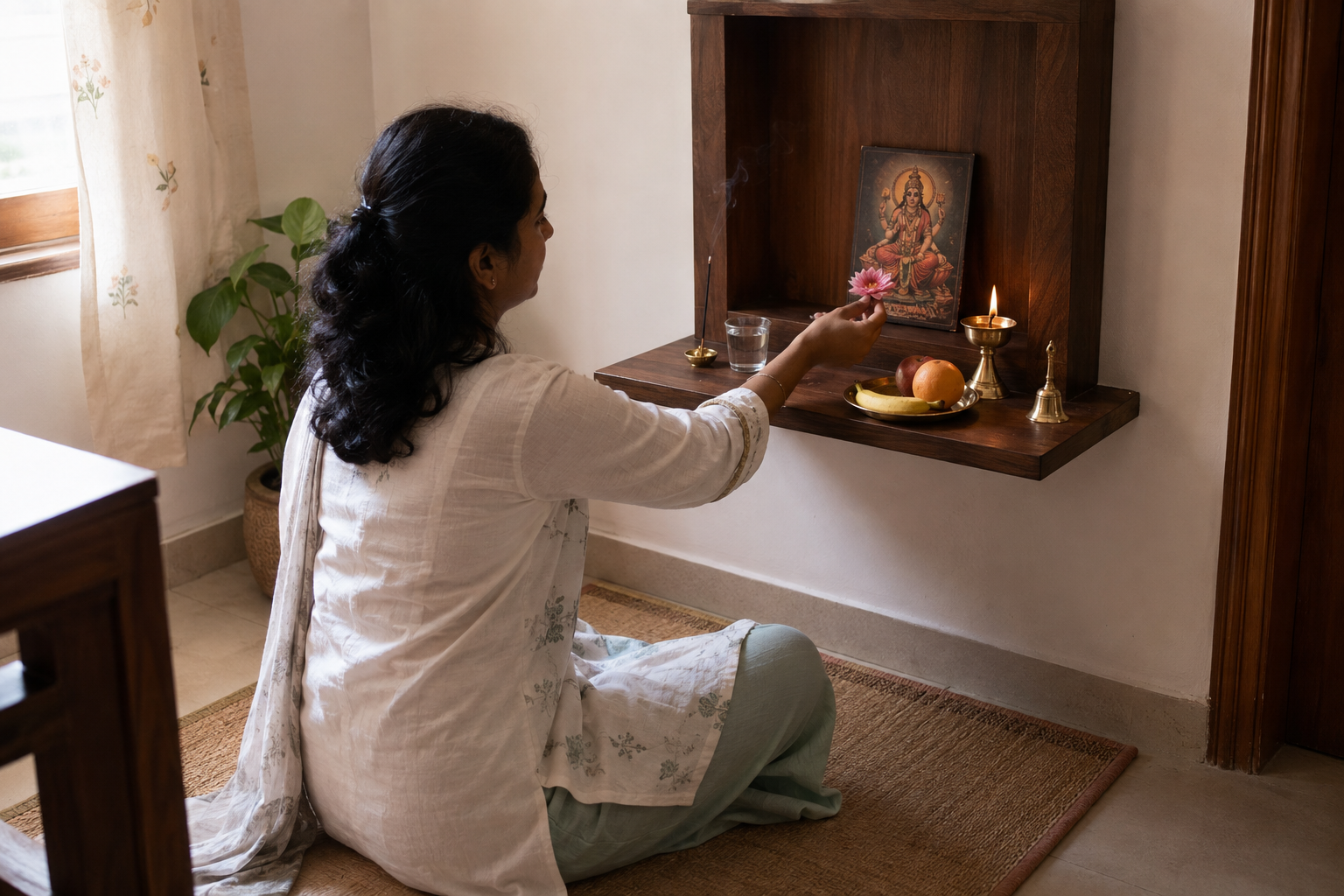
If your concern is whether a short personal puja can be meaningful, begin with coherence rather than complexity. Each action should have a reason, and the sequence should move clearly from preparation to offering to closure.
- Identify the tradition you are following. Start with your family’s practice, an established temple custom, or instruction from a trusted teacher. Do not assemble unrelated ritual fragments merely because they look ancient.
- Prepare one clean place. Remove clutter, wash your hands, arrange the image or symbol respectfully, and gather the required items before beginning. This prevents the puja from dissolving into repeated interruptions.
- Choose modest offerings you can sustain. Water, a suitable flower, a small amount of food, or a lamp may be enough where your tradition accepts them. An offering should express care, not waste or competition.
- Begin with conscious address. Settle your attention and approach the deity using a familiar prayer, name, or form of remembrance. If a specific recitation requires instruction, learn it properly instead of relying on an uncertain phonetic copy.
- Offer each item deliberately. Pause long enough to know what you are giving and why. If your hands continue the sequence while your attention is elsewhere, reduce the number of actions rather than rushing through them.
- Include stillness. After spoken prayer or offerings, leave a brief space for contemplation. Puja is not only a series of objects placed on a tray.
- Close the observance respectfully. Complete the customary closing actions, receive or share offered food appropriately, and restore the space. A defined ending keeps the rite from becoming casual.
If you use a lamp, incense, or any other open flame, keep it on a stable fire-resistant surface and never leave it unattended. Where an open flame is unsafe, omit it and follow a safe form of worship accepted in your circumstances. The sacred meaning of attention does not justify a preventable fire risk.
After the puja, test its effect in conduct. Did the offering make you less possessive, more truthful, more patient, or more attentive to duty? Ritual precision has its proper place, but worship becomes disconnected from dharma when nothing in the worshipper’s choices is open to transformation.
Key takeaways
- Vedic yajna centres on consecrated fire, with Agni carrying offerings to the devas.
- Personal puja centres on approaching and attending to the deity through a recognized sacred focus.
- Puja did not erase yajna; the two forms continue with different purposes, structures, and degrees of specialization.
- The deepest continuity is the discipline of offering: something is received, set apart, surrendered, and returned to life with changed meaning.
- An accessible home practice can remain traditional, but personal freedom does not remove the need for guidance when a rite requires learned procedure.
At your next puja, make one concrete improvement rather than adding more objects. Learn why one action belongs in the sequence, slow down one offering, or ask a knowledgeable elder or teacher about one inherited custom. That is how a personal flame remains connected to the larger sacrificial vision: not by imitating the scale of a Vedic yajna, but by making the act of offering truthful in the life you actually lead.
References
