
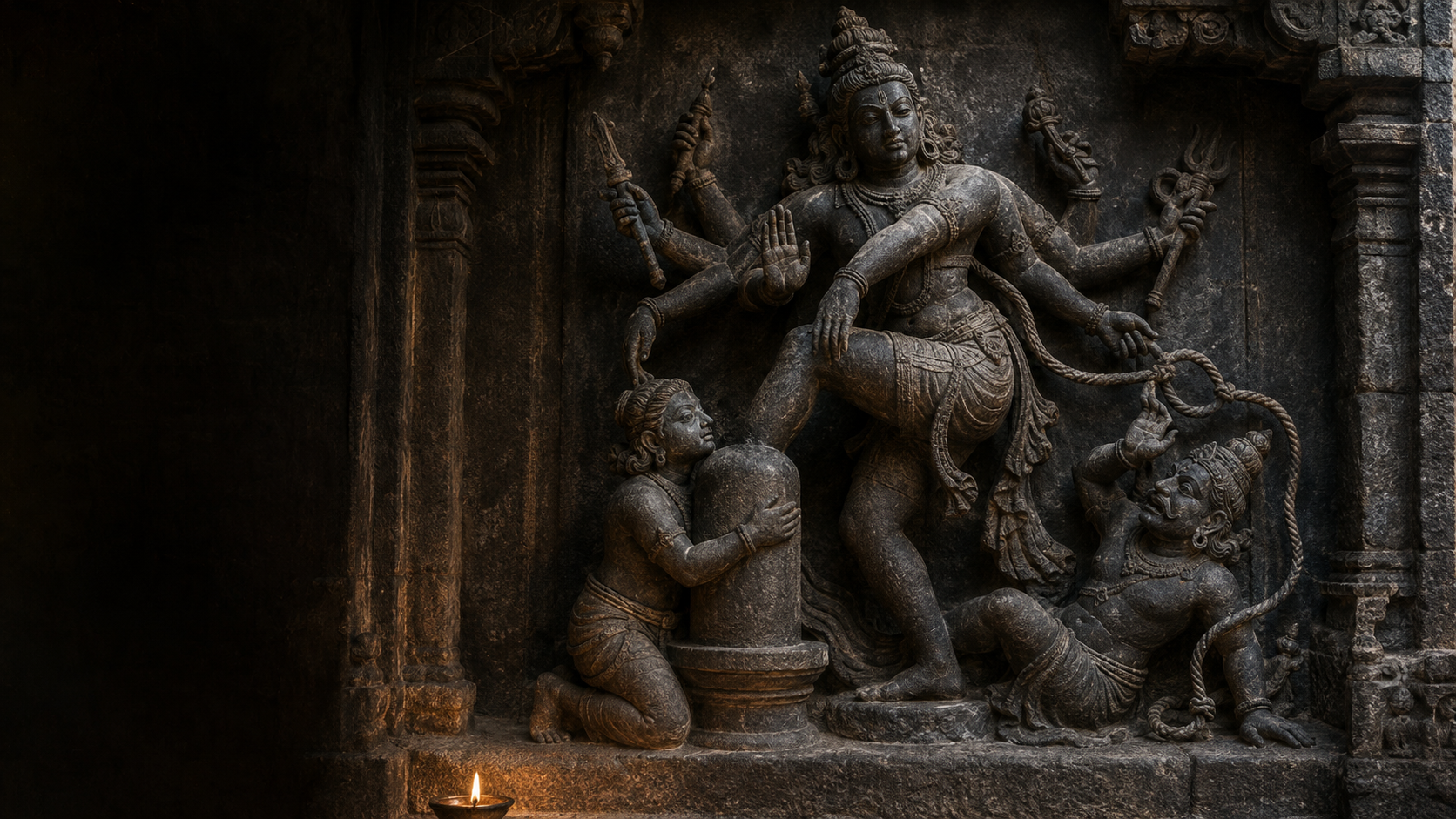
You are standing before a fierce image of Shiva. One leg is lifted, another figure lies or recoils below, and a small devotee may be almost lost among the larger forms. Is this Kalasamhara, Nataraja, Bhairava, or another powerful manifestation?
Start with the relationships, not the number of arms. Kalasamhara is most securely identified as a narrative composition: mortality approaches a devotee, the devotee takes refuge in Shiva, and Shiva places death itself under a higher authority. Once you can see that sequence, the image becomes far easier to recognize and far harder to misunderstand.
Identify the narrative triangle before studying the ornaments
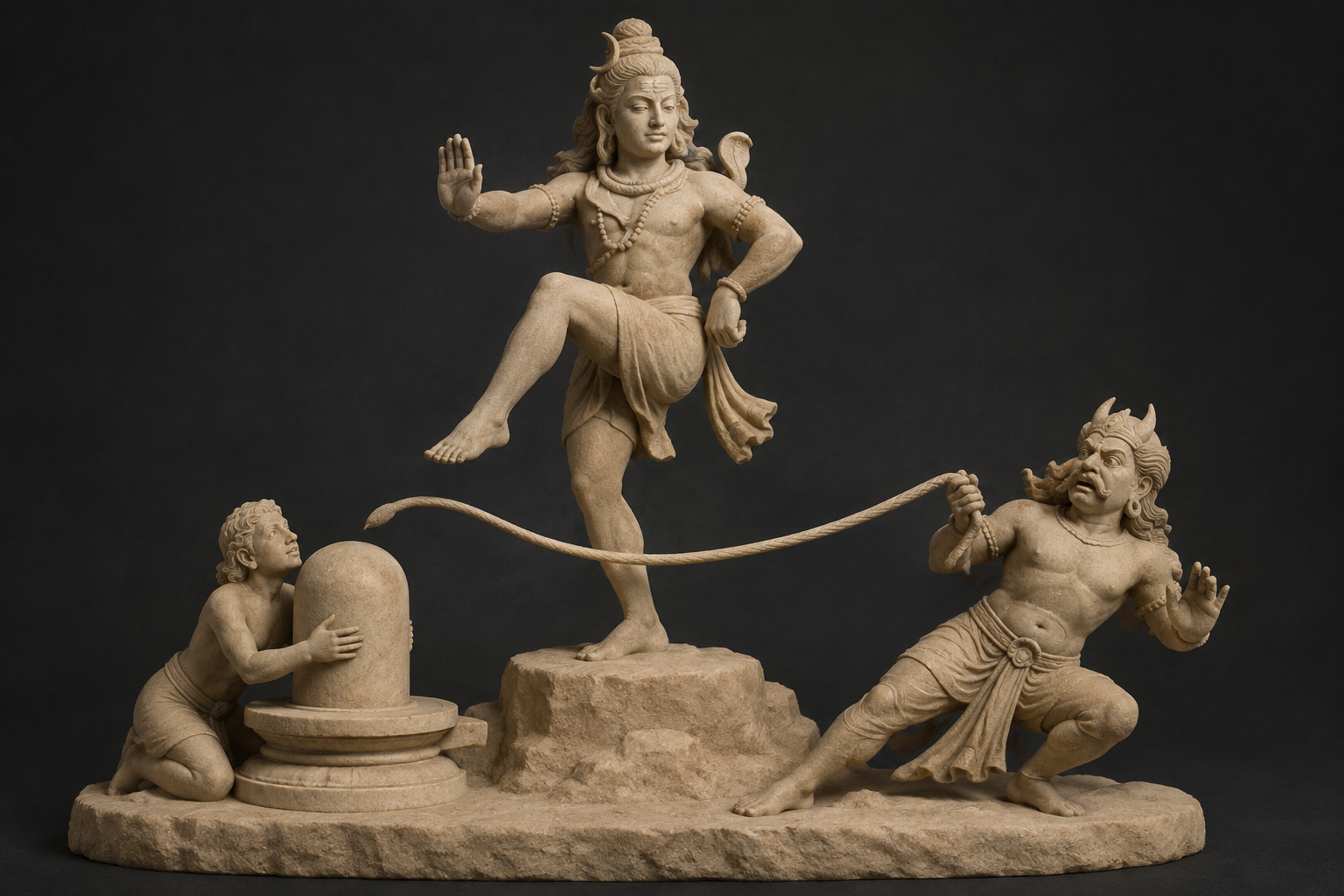
The name gives you the first clue. Kala can mean both time and death, while samhara means destruction or annihilation. Kalasamhara therefore presents Shiva as the one who overcomes Kala. The visual form is not simply “angry Shiva”; it is a statement about the limits of mortality and temporal power.
The familiar narrative setting is the deliverance of Markandeya. The young devotee remains absorbed in worship of Shiva as Yama, the lord associated with death, comes to claim him. Shiva intervenes from or in connection with the linga and subdues the power that appeared inescapable. Sculptures do not always preserve every part of this scene, but its essential relationships remain the best identification test.
- Look for the object of refuge. A linga is a much stronger clue than a weapon or crown. Markandeya may be shown beside it, embracing it, kneeling near it, or reduced in scale to preserve Shiva as the visual centre.
- Find the approaching or defeated power. Yama or Kala usually occupies the lower or more vulnerable part of the composition. The figure may be falling, recoiling, restrained, or placed beneath Shiva’s commanding movement.
- Trace Shiva’s action. A raised or extended leg, forceful gesture, or weapon directed toward the subordinate figure shows intervention. The precise pose can vary; its direction and purpose matter more than its isolated shape.
- Check whether the figures form one story. The devotee, linga, Shiva, and Yama should make sense together as danger, refuge, intervention, and defeat. If those roles cannot be established, treat the identification as provisional.
This method also works when an image is weathered. A missing hand can erase a weapon, and a broken projection can make an arm count uncertain. The underlying composition is more durable evidence than any single attribute.
Read the composition as a movement from fear to refuge
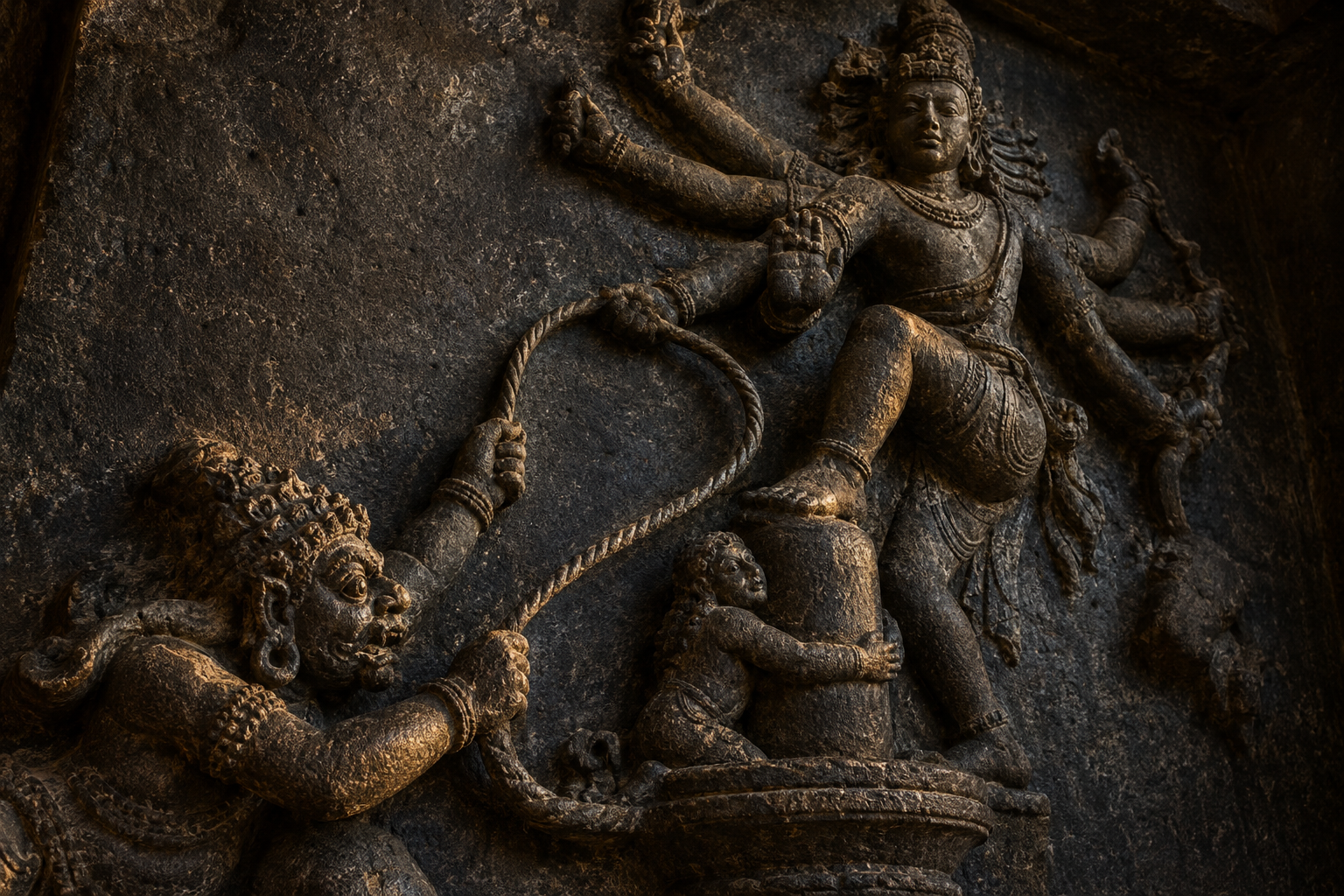
Kalasamhara does not present four unrelated sacred characters. It arranges them as a sequence. Markandeya represents embodied vulnerability. The linga marks refuge in Shiva. Yama or Kala embodies the limit confronting embodied life. Shiva breaks into that apparent inevitability and changes the hierarchy of the scene.
Begin at the smallest figure and follow the implied movement. Mortality advances toward the devotee. The devotee does not defeat it through physical strength; he remains oriented toward Shiva. Shiva’s energy then moves against Kala. This visual path explains why Markandeya’s scale should not be mistaken for insignificance. His smallness expresses human limitation, while his placement at the linga reveals the decisive act of devotion.
Shiva’s dynamic posture carries theological meaning. Multiple limbs, weapons, emphatic gestures, flying locks, or a forceful stance can intensify the moment, but regional, period, and medium-specific treatments need not reproduce every feature in the same way. Do not reject a plausible Kalasamhara merely because it differs from one photograph you know. Conversely, do not identify every aggressive Shiva by a raised foot alone.
Yama should not be reduced to a demonic villain. Within the scene, he represents a law that ordinarily governs embodied beings: what is born in time reaches an end. Kalasamhara places that law beneath Shiva without asking you to pretend that ordinary bodies never die. Its claim is about ultimate authority, not a promise that devotion functions as a technique for avoiding physical mortality.
Kala means death and time, so Shiva’s victory has two levels
If you read Kala only as the figure of death, you see a divine rescue. That is correct but incomplete. Kala is also time: the sequence in which things arise, change, decay, and disappear. Shiva’s conquest therefore reaches beyond one threatened life. It declares that time does not contain or exhaust the deepest reality represented by Shiva.
Read the image on two levels at once:
- The narrative level: a devotee facing death takes refuge in Shiva and is protected from Yama’s immediate claim.
- The philosophical level: every conditioned form belongs to time, but Shiva is represented as sovereign over the process that limits those forms.
This double meaning prevents two opposite mistakes. The first is to flatten Kalasamhara into a dramatic tale about one supernatural combat. The second is to dissolve the story into an abstraction and overlook Markandeya’s bhakti. The icon holds both together: devotion is the human movement toward Shiva, and transcendence of Kala is the cosmic truth revealed through that movement.
A tantric reading can take the composition as a map of spiritual orientation. Consciousness ordinarily measures itself through before and after, gain and loss, youth and age, arrival and departure. Kala appears invincible within that measured field. The linga establishes an unmoving sacred centre, while Shiva’s intervention shows that the centre is not subordinate to the movement surrounding it. This is an interpretive lens, not a substitute for the particular Agamic, sectarian, or temple tradition in which an image was consecrated.
During darshan, you can make this distinction practical. Do not ask only, “Will Shiva remove what I fear?” Also notice how much of the fear comes from treating change, delay, ageing, or an ending as the whole truth of who you are. Kalasamhara does not tell you to ignore time. It asks you to place time in its proper order: powerful within embodied existence, but not supreme over Shiva.
Rule out look-alikes before naming the form
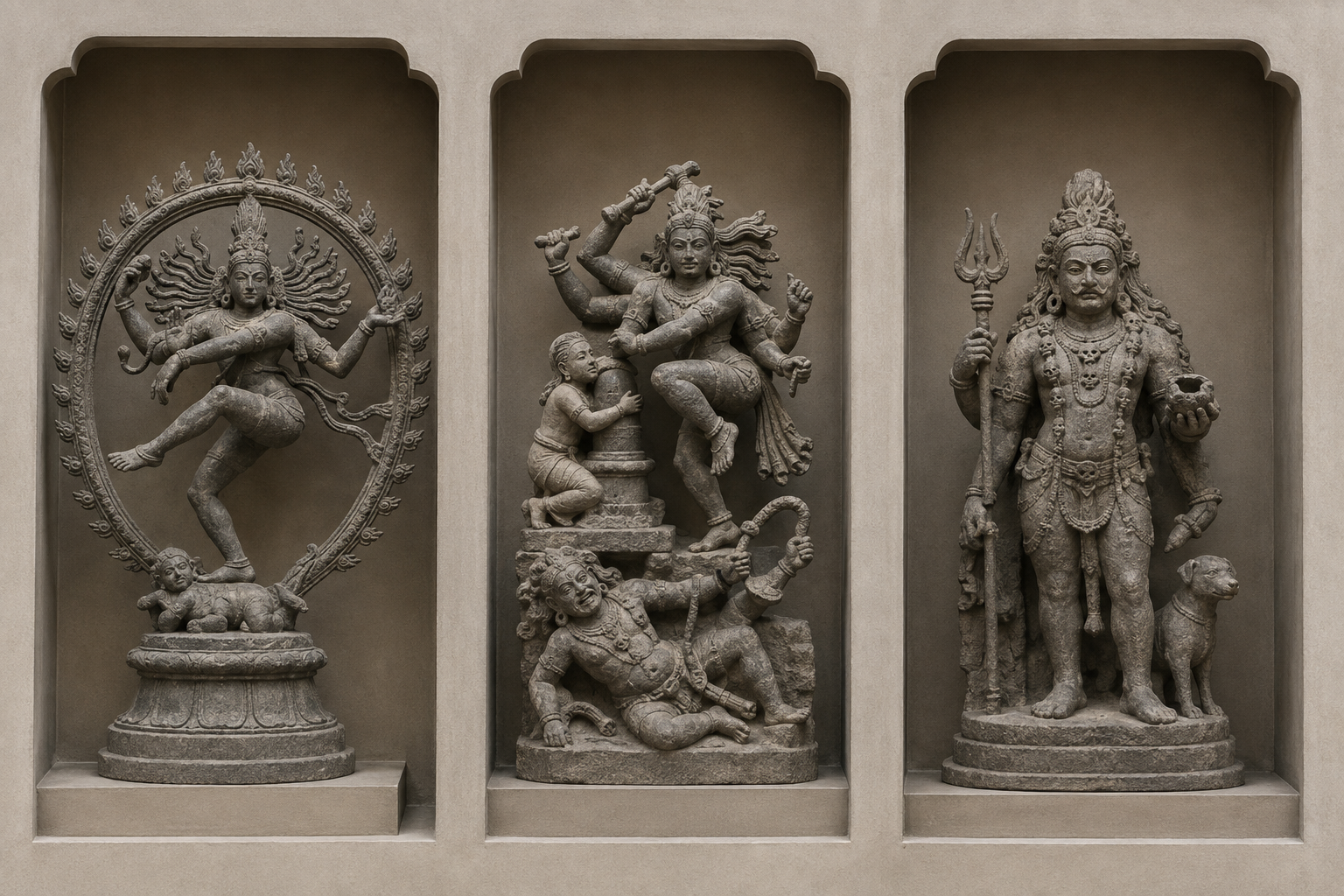
Fierce movement occurs in several forms of Shiva. A confident identification therefore needs positive evidence for Kalasamhara, not merely an intense face, a weapon, or a subordinate figure.
- Nataraja: the primary subject is Shiva’s dance, commonly organized through the dancing posture, the dwarf Apasmara, and often a surrounding aureole or ring of flames. A figure underfoot does not by itself turn Nataraja into Kalasamhara.
- Gajasamhara: the conspicuous elephant hide is the defining narrative clue. The scene concerns Shiva’s victory over the elephant demon, not Markandeya’s refuge from Kala.
- Bhairava: fierceness, skull imagery, or a formidable standing form may point toward Bhairava. Without the Markandeya-linga-Yama relationship, ferocity alone is insufficient evidence for Kalasamhara.
- An unidentified heroic or destructive form: damaged figures sometimes preserve action but lose the narrative markers needed for a responsible name. In that case, “a fierce form of Shiva” is better than an overconfident label.
Museum labels, temple traditions, and regional names may use Kalasamhara, Kala Samhara, Kalantaka, or a related designation. Terminology can overlap because Kala may be treated as the principle of time and death as well as associated with Yama in the narrative. When names differ, return to the depicted relationships. They tell you what the image is doing.
Arm count is a supporting observation, not a universal password. The same applies to a particular weapon, headdress, or direction of a lifted leg. Record those details after identifying the narrative structure. If you are documenting a temple image, note which figures are present, which are damaged, where the linga stands, and toward whom Shiva’s movement is directed. That description remains useful even if specialists later refine the name.
Key takeaways
- Kalasamhara is best recognized through a narrative cluster: Shiva, Kala or Yama, Markandeya, and the linga.
- The linga and devotee are stronger identifying evidence than a particular weapon or number of arms.
- The scene moves from mortal danger to refuge and then to Shiva’s intervention; follow that movement when reading the sculpture.
- Kala means both death and time, so the form expresses more than rescue from one moment of death.
- The image affirms Shiva’s supremacy over temporal limitation; it should not be treated as a literal promise of bodily immortality.
- When decisive figures are missing or damaged, keep the identification provisional rather than relying on fierceness alone.
The next time you meet this form, give the whole composition one quiet minute before focusing on ornaments. Locate the devotee, the linga, the power of death, and the direction of Shiva’s response. Then read the scene twice: first as Markandeya’s deliverance, and again as the declaration that even Kala has a boundary.
References
- Hindu Blog — Kalasamhara Shiva Idol Form – Iconography – Kala Samhara – Who Conquered Death and Time
