
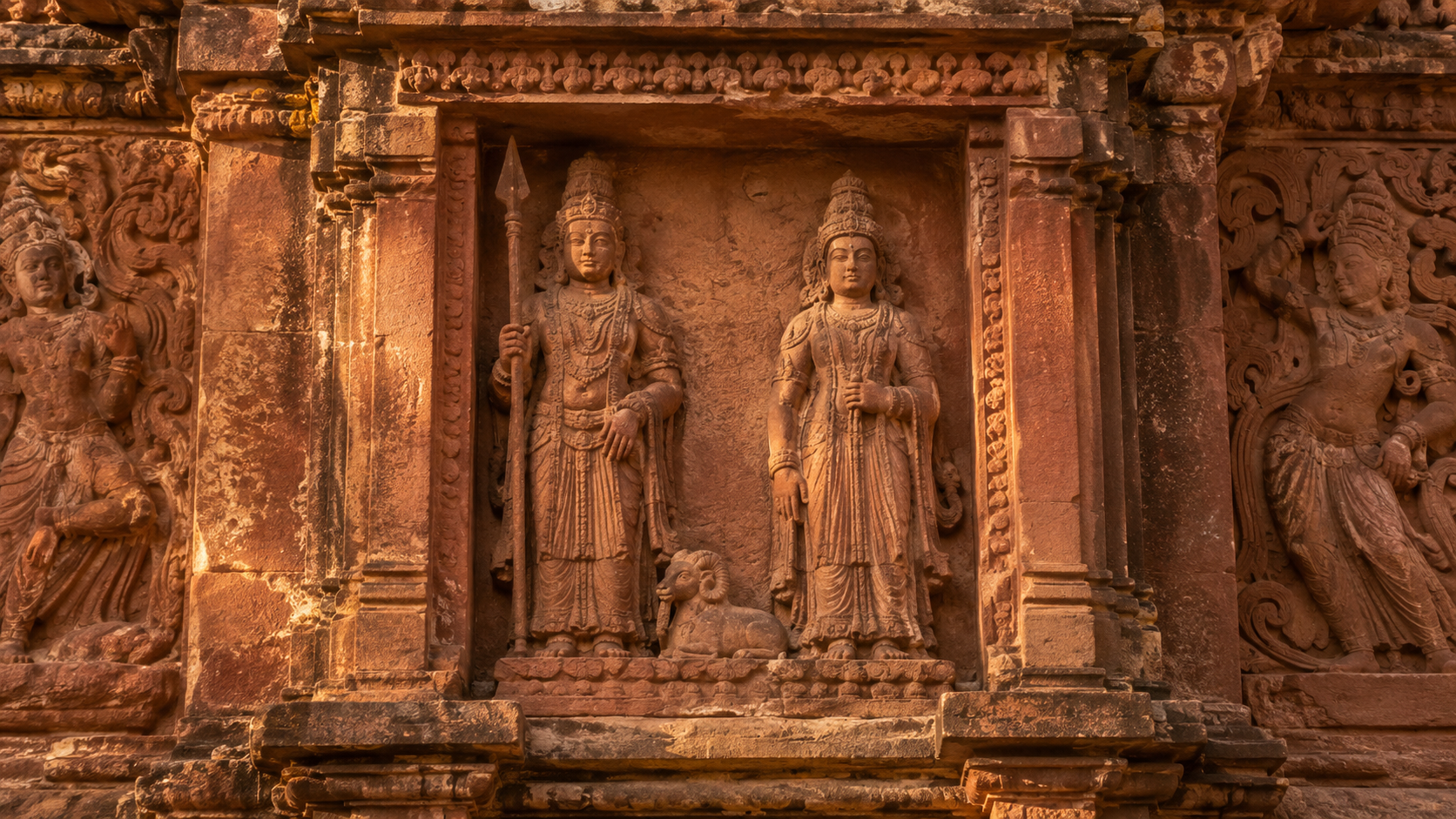
You are looking at a temple panel in which a male planetary deity appears beside a feminine figure. The label is missing, the sculpture is weathered, or the only description says Mangal and Shakti Devi without explaining how that identification was reached. How much can you safely conclude from what you see?
The reliable approach is to read the image in a fixed order: establish the temple context, identify Mangal, examine how the two figures are related, and only then interpret their union. That sequence keeps a meaningful encounter with sacred art from turning into confident guesswork.
Establish Mangal’s identity before interpreting the pair
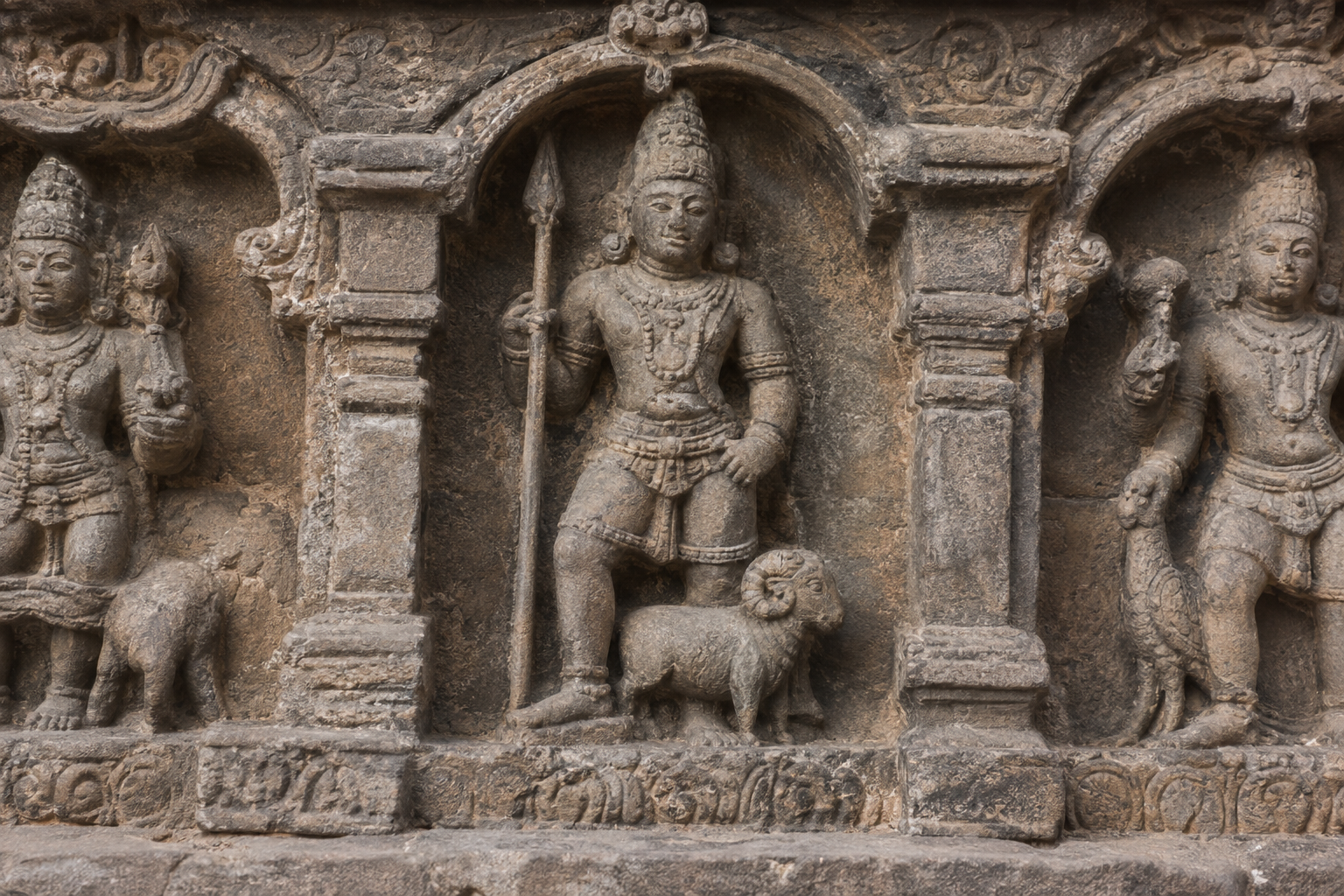
Mangal belongs to the Navagrahas, the nine planetary deities. He is associated with Mars and is also known as Angaraka, Kuja, and Chowwa. These names are especially useful when a temple notice, catalogue, inscription, or local account uses a term other than Mangal.
Begin with the ensemble rather than the isolated figure. A sculpture located within a documented Navagraha group has a much stronger claim to planetary identity than a detached image that merely looks forceful. If you are viewing a photograph online, find the uncropped panel, shrine, or architectural setting before accepting the caption.
Next, keep identity and interpretation separate. Hindu tradition associates Mangal with courage, energy, warfare, physical strength, and the vital force of life. Those associations explain why his presence matters, but they do not identify every vigorous or martial-looking temple figure as Mangal. Symbolic resemblance supports an identification; it cannot replace contextual evidence.
The feminine figure requires the same care. In this particular iconographic relationship, Shakti Devi is presented as Mangal’s consort. Her proximity to him is relevant, but proximity alone is not proof. Temple panels can place deities, attendants, donors, and other figures close together. Look for a deliberately paired composition and confirm it through a local label or record whenever one is available.
Use a repeatable five-step reading method
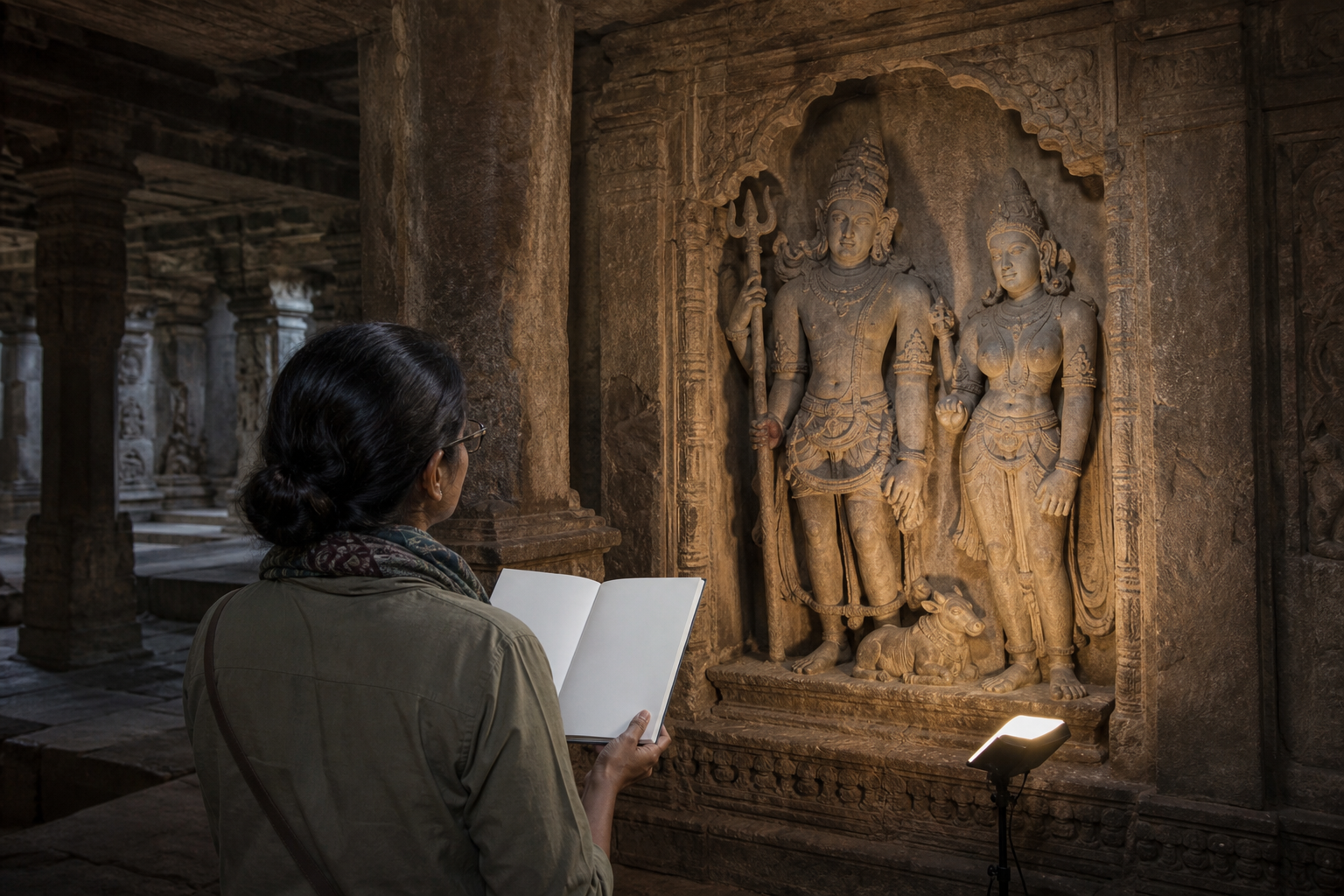
You do not need to be an art historian to make a disciplined first reading. You do need to record what is present before filling gaps with what you expected to find.
- Locate the image. Record the temple, shrine, wall, niche, panel, and position within any larger group. Context is often more informative than a close-up of the face or hands.
- Check every available name. Look for Mangal, Angaraka, Kuja, or Chowwa in labels and descriptions. Transcribe the wording as it appears instead of silently replacing a local name with the one you know.
- Describe each figure independently. Note posture, number of arms, hand gestures, held objects, ornaments, relative scale, orientation, seat or pedestal, and any surviving attendant or vehicle. Observation should come before identification.
- Describe the relationship. Ask whether the figures share a base, face one another, mirror one another, occupy equal or unequal visual space, or simply happen to be adjacent. These features show how the sculptor organized the pair even when individual attributes are damaged.
- Mark uncertainty. Distinguish an original feature from a break, later repair, repainting, replacement, or unclear area. If you cannot see an object clearly, write that it is indistinct rather than supplying the expected object from memory.
Our practical rule is to seek two independent clues before publishing a definite identification. A documented Navagraha setting plus a name is strong evidence. A name plus unmistakably paired treatment can also be persuasive. Visual resemblance and a modern caption copied across several websites may look like two clues, but they can originate from the same unsupported assumption.
A useful field note has four parts: proposed identity, basis for that identity, description of the paired figure, and condition of the image. For example, you might record Mangal, also locally named Kuja, within a labelled Navagraha ensemble; feminine figure paired on the same sculptural unit and identified locally as Shakti Devi; right-hand details damaged. That wording preserves both knowledge and uncertainty.
The union depicts power becoming effective
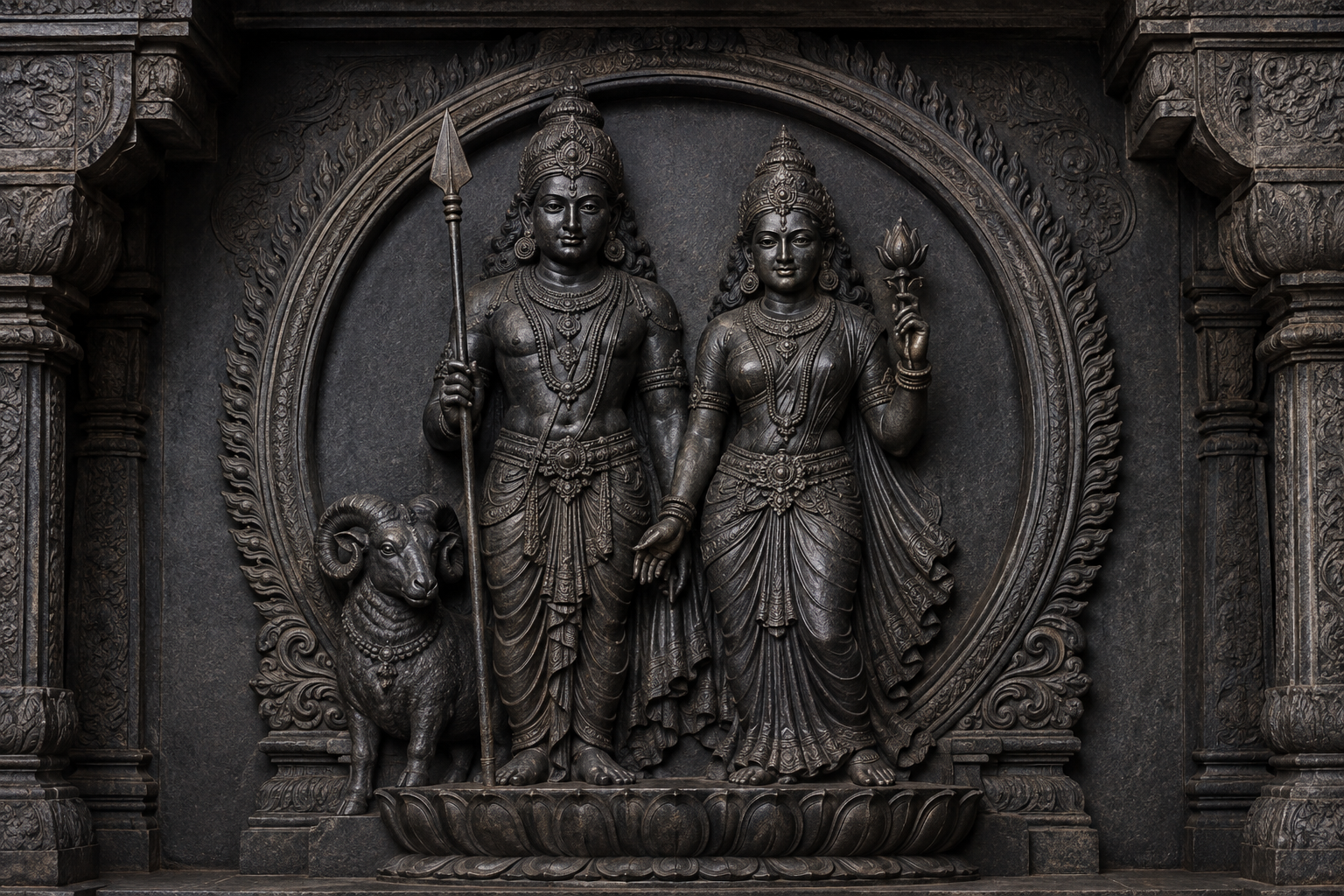
Once the identification is secure, the pair becomes more than a catalogue entry. Mangal embodies a concentrated field of force: courage that meets danger, energy that initiates action, strength that sustains effort, and martial capacity that can confront conflict. Shakti signifies power or operative capacity. Their union can therefore be read as force joined to the power through which force becomes active.
This reading prevents two shallow reductions. Mangal is not merely anger or aggression, because his symbolism also includes courage, physical strength, energy, and vital force. Shakti Devi is not decorative company added to a male deity. Calling her a consort names a sacred relationship; it does not, by itself, establish inferiority. Her presence makes the pair’s dynamic capacity visible.
The ethical question is not whether energy is good or bad in the abstract. It is where that energy is directed. Courage can protect or intimidate. Strength can uphold dharma or serve domination. Martial capacity can defend a community or become uncontrolled hostility. The icon does not require you to glorify aggression. It invites you to ask whether power has purpose, discipline, and right direction.
- Where in your life is courage required rather than anger?
- What useful action needs sustained energy rather than a sudden burst of impulse?
- Which strength must be governed so that it protects instead of harms?
- What capacity is present in potential but has not yet been put into dharmic action?
These questions are a devotional application, not a claim that every temple, sect, or sculptural programme gives the pair one exhaustive meaning. A public sacred image also is not a personal horoscope. Keep the iconographic meaning of Mangal distinct from any individualized astrological judgement.
Avoid four common iconographic misreadings
- Do not identify Mangal from temperament alone. A fierce expression, strong body, or martial impression is not sufficient without planetary context or naming evidence.
- Do not call every adjacent goddess Shakti Devi. First establish that the composition presents a pair, then look for a label, inscription, temple record, or dependable catalogue identification.
- Do not import every detail from a modern printed image into an older sculpture. Regional conventions, artistic choices, material limits, weathering, and restoration can affect what survives. Describe the object in front of you.
- Do not turn symbolic complementarity into a literal claim about the social roles of men and women. The image concerns divine powers in relationship; a gender hierarchy does not follow automatically from the word consort.
Be equally cautious with missing features. A broken hand does not prove that a particular attribute was once present. An empty space might result from damage, but it might also belong to the original composition. When the physical evidence stops, your certainty should stop with it.
Key takeaways
- Mangal is the Navagraha deity associated with Mars and may be named Angaraka, Kuja, or Chowwa.
- His symbolism includes courage, energy, war, physical strength, and vital force; it should not be reduced to aggression.
- Shakti Devi is represented as Mangal’s consort in this iconographic setting, making their relationship central to the sculpture’s meaning.
- Temple context, names, paired composition, and physical condition should be recorded before philosophical interpretation begins.
- A sound reading sees directed and effective power in the union while clearly separating documented features from devotional interpretation.
The next time you encounter this pair, begin with the widest view of the shrine and work inward. Record the setting, search all four names of Mangal, describe both figures without filling damaged areas, and preserve any uncertainty in your notes. Only after that should you ask what the union says to you about courage, disciplined energy, and power placed in the service of dharma.
References
