
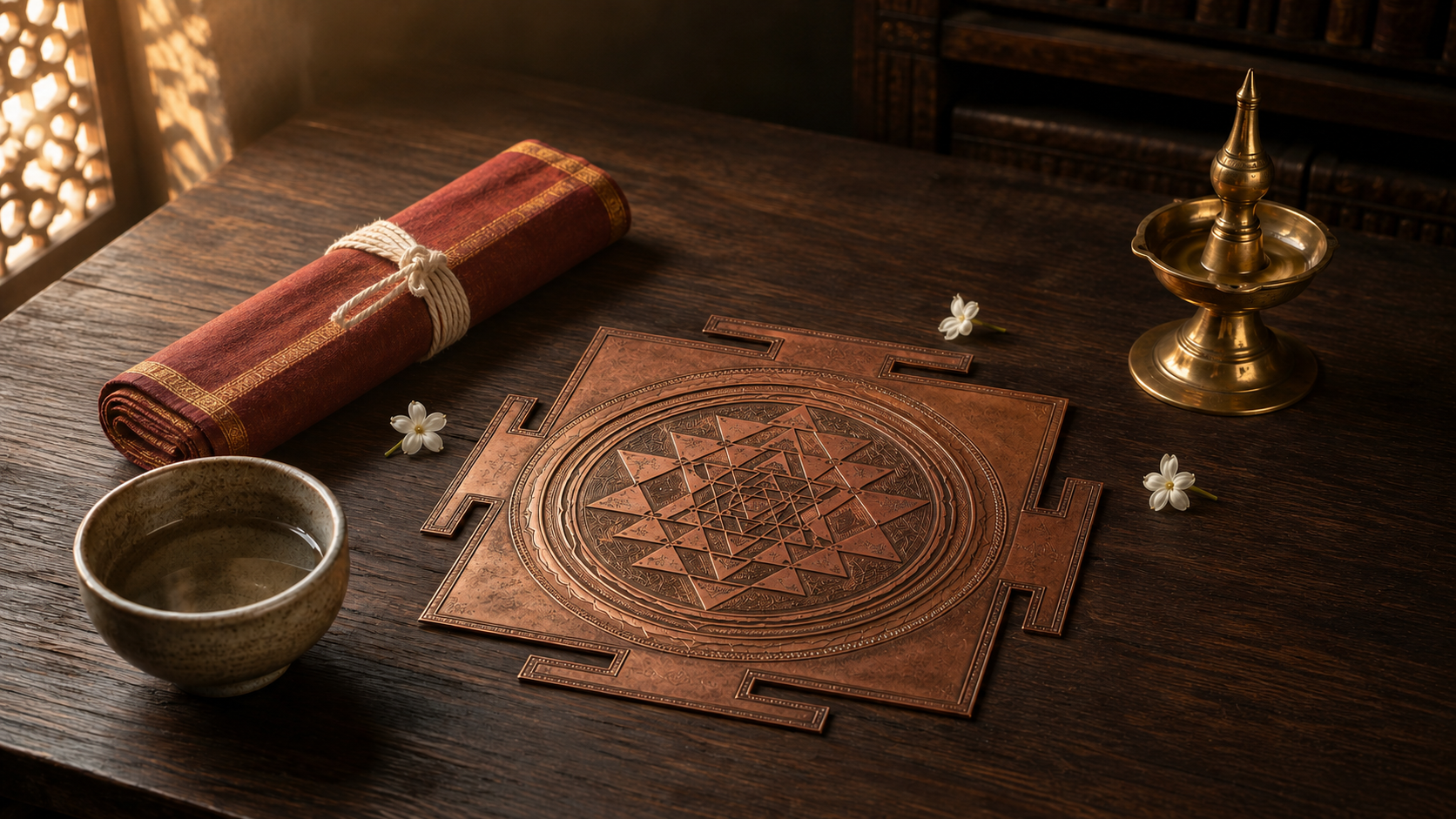
If you opened the Parashurama Kalpasutra hoping to learn Navavarana Puja, the first decision is not which mantra to recite or which offering to place. It is whether you are studying the ritual, preparing to observe it, or practising it under initiation. Confusing those three aims is how a sacred liturgy gets reduced to a collection of disconnected instructions.
With the right boundary in place, you can read Chapter Five fruitfully. You begin to see how Sri Chakra worship orders sacred space, divine presence and the worshipper’s attention into one movement. You also learn why a complete ritual cannot be reconstructed safely by collecting mantras and diagrams from unrelated traditions.
Nine enclosures form one ritual argument
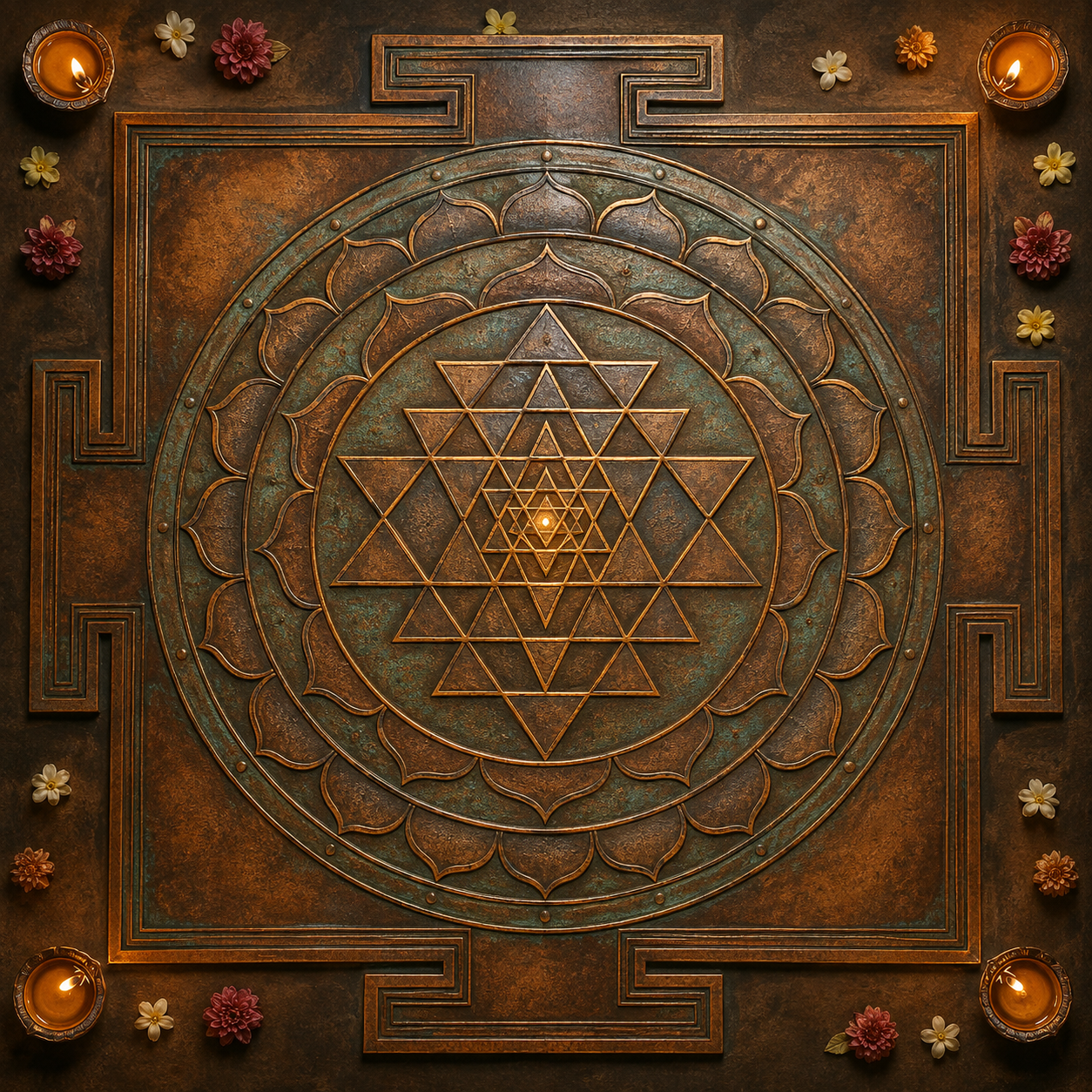
Within the fifth of the Parashurama Kalpasutra’s ten chapters, Lalita Navavarana Puja receives sustained treatment. The name supplies the basic map: nava means nine, while avarana means an enclosure, circuit or covering. The nine avaranas are the interrelated circuits of the Sri Chakra, approached from the exterior toward the central bindu.
Do not picture them as nine rooms through which the worshipper merely passes. Each avarana is a field of relationship. Geometry identifies the locus of worship. Deity reveals that the locus is alive with Shakti. Mantra, gesture, offering and contemplation establish the worshipper’s participation in that field. Remove any one of these dimensions and the puja becomes harder to understand.
A practical reading therefore follows three layers at once:
- Spatial: Where is this avarana situated within the complete Sri Chakra?
- Theological: Which manifestation or power of Lalita is being approached here?
- Participatory: What change in attention, identification or relationship is required of the worshipper?
This three-layer method prevents two opposite mistakes. One is to treat the Sri Chakra as decorative geometry. The other is to treat every line and intersection as a code that can be mastered intellectually. In Navavarana Puja, the diagram is neither ornament nor puzzle. It is a ritual body through which Lalita Tripurasundari is approached and worshipped.
The outer-to-inner movement is also easy to misread. It does not mean that the outer world is impure and must be discarded before something spiritual can begin. The complete Sri Chakra includes every avarana. Arrival at the bindu does not invalidate the circuits through which the worshipper approached it. The centre gathers the whole form; it is not a shortcut around the whole.
Where reading ends and initiated practice begins
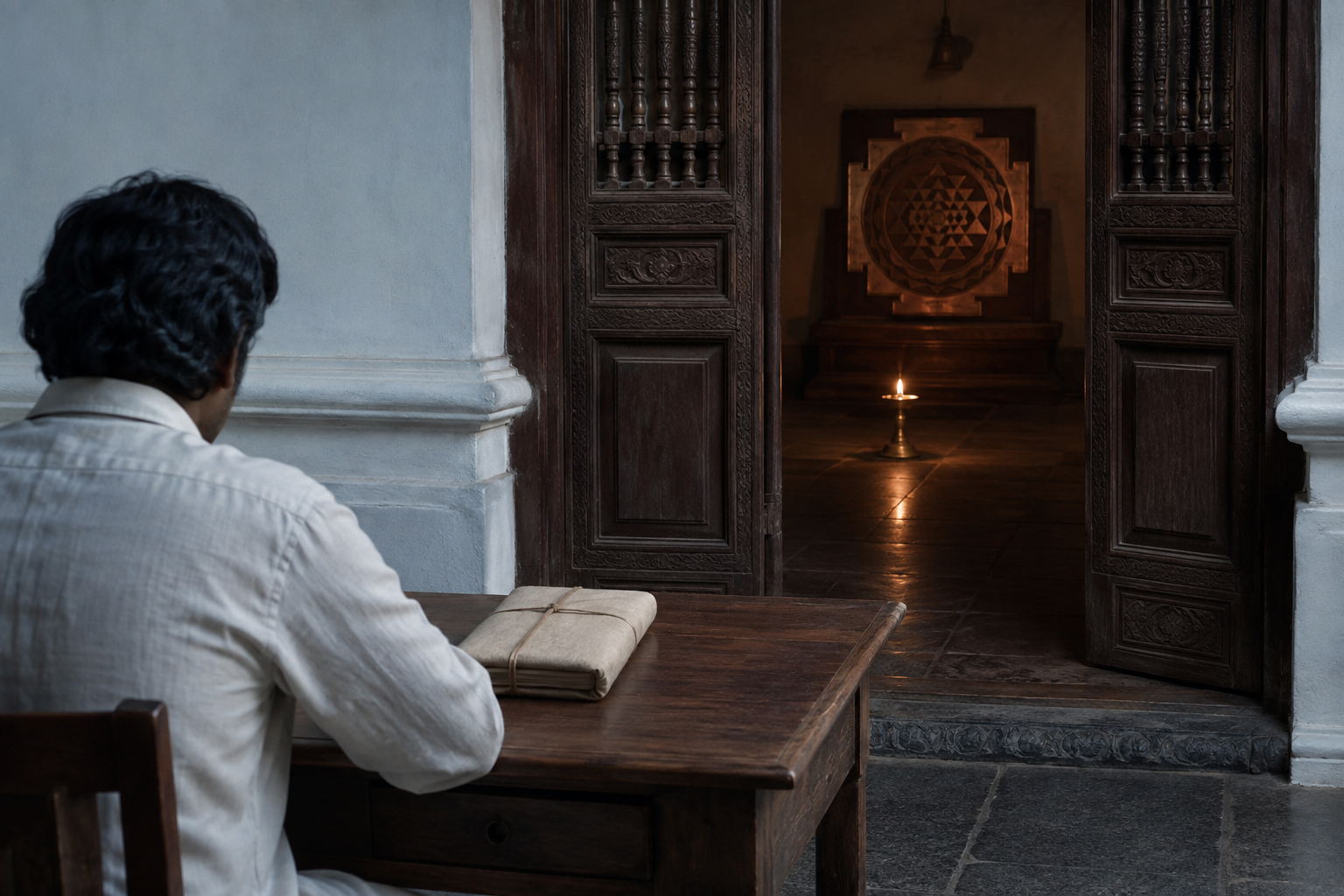
Full Navavarana Puja belongs to the living practice of Srividya. In such a practice, mantra, nyasa, mudra, visualization, offerings and the order of worship form a connected discipline. A mantra is not simply a divine name that can be inserted anywhere. Nyasa is not a stage direction. A mudra is not decorative hand movement. Each element receives its meaning from the initiation, transmission and paddhati in which it is used.
This matters because two sequences may look similar on the page while depending on different oral instructions. Names, mantra forms, preliminary rites, authorized substitutions and methods of internalization can vary among lineages. Combining fragments from several systems may produce something that resembles a puja externally while belonging coherently to none of them.
Initiation is therefore not a bureaucratic permission slip placed in front of otherwise complete information. It transmits the relationships that make the information usable: how a mantra is received, how the Sri Chakra is contemplated, how ritual actions fit together, what must be corrected and what the practitioner is actually being trained to notice.
If you have not received the relevant initiation, you can still do serious work without pretending to perform the complete rite. You can study the architecture of the Sri Chakra, learn the function of an avarana, identify the major transitions in the ritual and observe a public puja where that is permitted. For personal worship, remain with public prayers and forms of devotion approved in your family or by a qualified teacher. Do not extract restricted mantras and improvise a private sequence from isolated pages.
If you are initiated, use the procedure given by your own guru and lineage as the operational standard. Chapter Five can then deepen your understanding of that procedure, but it should not become a catalogue from which you replace inherited instructions whenever another wording appears attractive.
A six-step method for studying Chapter Five

You do not need to begin by memorizing every technical term. Begin by building a dependable map. The following method works whether you are reading in Sanskrit, through a translation or alongside oral instruction.
- Define your purpose. Write down whether you are studying doctrine, learning ritual structure, preparing to observe worship or reviewing a practice already transmitted to you. This one sentence determines which questions are appropriate and which actions remain outside your scope.
- Record the textual basis. Note the edition, language, translator or commentary you are using. Preserve important Sanskrit terms beside any translation. Words such as avarana, nyasa and bindu carry more ritual meaning than a single English equivalent can hold.
- Establish the whole Sri Chakra before examining a part. Use a diagram accepted within the tradition you are studying. Mark the nine circuits from the exterior toward the bindu, but resist filling the page immediately with every name and mantra. First learn where each circuit stands in relation to the whole.
- Build an avarana matrix. For each circuit, make separate notes under five prompts: locus, divine presence, ritual action, mantra or formula, and contemplative meaning. If your material does not answer one of them, leave the space blank. A visible gap is safer than an invented connection.
- Mark transmission-dependent material. Use a clear symbol beside mantras, nyasas, mudras, visualizations or procedures that require confirmation from your teacher. This stops study notes from quietly turning into an unauthorized practice manual.
- Paraphrase the movement. After studying a section, explain in plain language why the worshipper moves from that avarana to the next. If you can list actions but cannot explain their relationship, you have memorized a sequence without yet understanding its ritual logic.
Your notes should distinguish description from instruction. For example, knowing that a particular class of divine powers belongs to an avarana is descriptive knowledge. Knowing the authorized mantra, pronunciation, nyasa and manner of worship is practical instruction. The first can orient a student; the second may depend on transmission.
When you can consult a teacher, take precise questions rather than asking for a general explanation of Navavarana Puja. Useful questions include:
- Which edition or commentary best matches our paddhati?
- Is this instruction for external worship, internal worship or a combination of both?
- Which preliminaries are assumed rather than stated in full?
- Which mantras, nyasas and mudras are authorized at my present stage?
- Are any substitutions permitted when prescribed materials are unavailable?
- Which closing acts are essential to completing the sequence properly?
These questions expose the hidden dependencies of a ritual. They also give a teacher something concrete to correct. That is far more useful than accumulating additional terminology while the basic sequence remains unclear.
Five mistakes that distort Navavarana Puja
- Reducing navavarana to nine offerings or nine generic stages. The term refers to the nine circuits of the Sri Chakra and the worship organized through them. Count alone does not define the rite.
- Treating the bindu as the only sacred part. The centre is approached through the complete mandalic order. Ignoring the surrounding avaranas removes the very structure that makes the movement to the centre meaningful.
- Mixing paddhatis without noticing. A diagram from one lineage, mantras from another and ritual actions from a third do not automatically form a valid synthesis. Keep the provenance of each instruction visible in your notes.
- Choosing between an entirely external and an entirely psychological interpretation. A purely mechanical reading turns worship into procedure, while a purely psychological reading can erase deity, mantra and sacred presence. Hold the ritual, theological and contemplative dimensions together unless your lineage explicitly directs a particular emphasis.
- Treating translation as authorization. Understanding the literal meaning of an instruction does not supply pronunciation, ritual competency, lineage context or permission to use a restricted mantra. Comprehension is valuable, but it is not identical to transmission.
There is another, subtler error: judging the puja by whether it produces an unusual feeling. Concentration, emotion and visual clarity naturally vary. The more dependable test is whether your attention, accuracy, humility and fidelity to the received method are becoming steadier. In a disciplined ritual tradition, consistency matters more than chasing a dramatic inner event.
Key takeaways
- Navavarana Puja is worship through the nine interrelated circuits of the Sri Chakra, not a generic nine-step ceremony.
- Read each avarana spatially, theologically and participatively: locate it, recognize the divine presence and ask what it requires of the worshipper.
- The movement toward the bindu gathers the whole Sri Chakra; it does not dismiss the outer circuits as spiritually irrelevant.
- Study can clarify architecture and vocabulary, but lineage guidance governs restricted mantra, nyasa, mudra and operative ritual sequence.
- Keep one paddhati coherent. Record where every instruction comes from instead of blending attractive fragments.
- If you are uninitiated, study the map, attend authorized public worship and use public devotional forms rather than reconstructing the full puja alone.
Your next step should match your actual position. If you are a student, make the nine-part study sheet and identify what you do not yet know. If you are preparing for initiation, bring the six practical questions to a qualified Srividya teacher. If you already practise, compare your notes with the paddhati you received and correct gaps there before adding anything new. Navavarana Puja rewards ordered attention; begin by giving your study the same order.
References
