

You may finish a Bhagavatam class moved by Krishna-lila and still not know what to carry into the rest of your day. Retelling the plot rarely closes that gap. You need a way to notice what the lila reveals, test what you think it means, and turn that understanding into a specific devotional response.
The method below is designed for personal reading, temple classes, and recorded katha. It keeps Krishna at the centre without reducing His lila to a moral fable, and it keeps your application grounded in the passage rather than in a feeling loosely associated with it.
Start with the relationship, not the moral
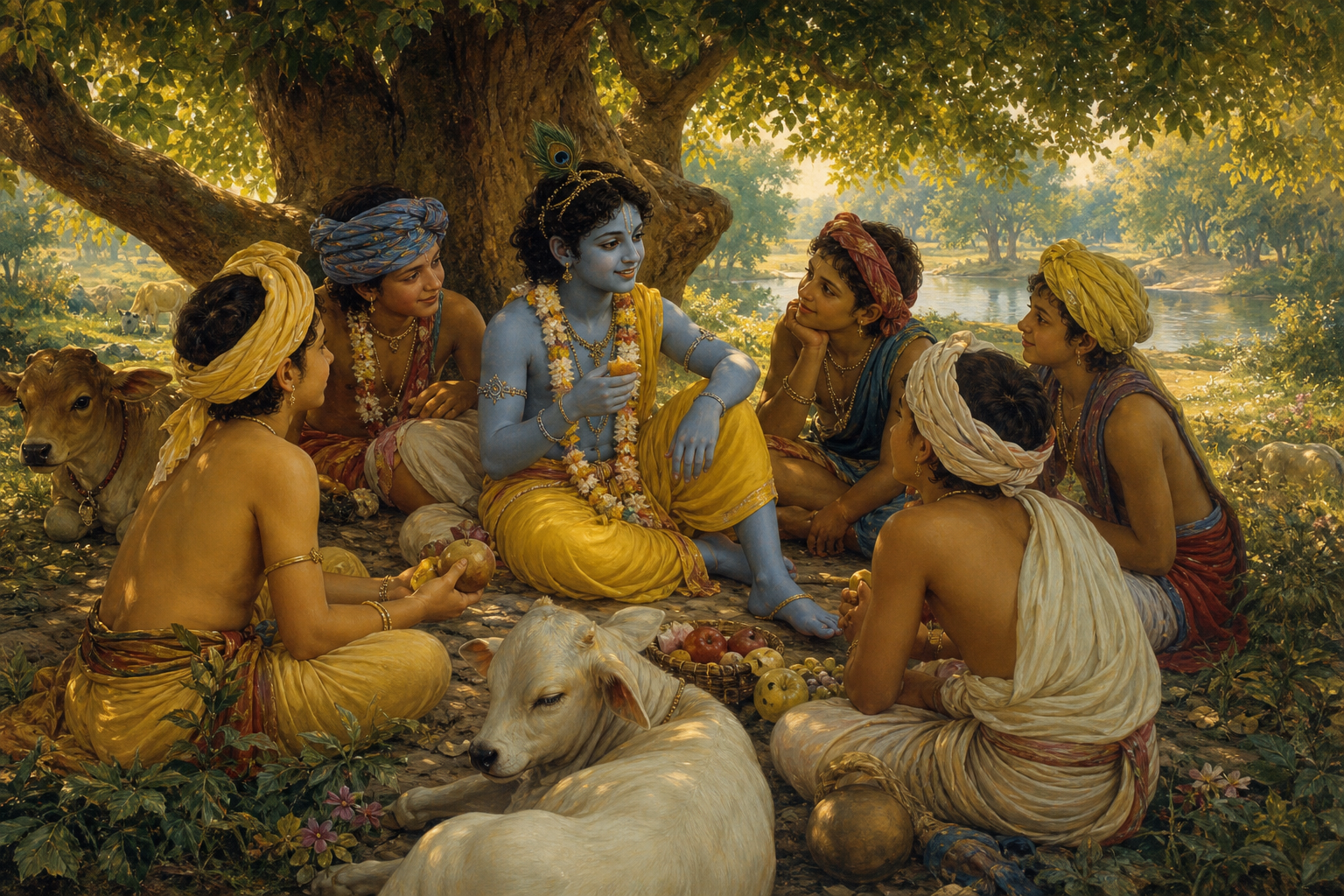
When you encounter a sacred narrative, the quickest question is often: What lesson can I use? That question is reasonable, but it comes too early. Krishna-lila first asks you to attend to Krishna and to the relationships unfolding around Him. Only then can you make a responsible application.
Lila means divine activity or sacred pastime. In a bhakti reading, its purpose is not exhausted by plot, symbolism, or ethical instruction. Hearing is itself a devotional practice, traditionally called shravana, because attentive hearing nourishes remembrance, or smarana. The immediate question is therefore not merely what happened, but what you are being shown about Krishna, His devotees, and the orientation of loving service.
- Who is speaking, who is hearing, and what relationship joins them?
- What does each person desire, fear, offer, resist, or surrender?
- Which word, action, prayer, or reversal changes the relationship?
- What does the passage explicitly praise, correct, accept, or reject?
- What does Krishna reveal through His response, including any response that challenges your expectation?
Read with the discipline of assuming that the wording deserves careful attention. That does not mean inventing a hidden symbol behind every detail. It means resisting the urge to skip directly to a familiar slogan.
A useful test is simple: if your supposed lesson could have been written without reading anything distinctive in the passage, it is probably generic. Return to the actual speech, action, and relationship. A sound application should preserve something particular about the lila that produced it.
Separate observation, interpretation, and response

Many weak readings collapse several mental moves into a single conclusion. A person notices an event, assigns a meaning to it, and announces a life lesson without showing how those stages connect. You can avoid that problem by giving each stage its own place in your notes.
- Observation: Record what the passage actually presents. Name the speaker, hearer, action, important wording, and narrative change. Do not add motives that the text has not supplied.
- Interpretation: State what the observation may reveal about Krishna, the devotee, bhakti, dharma, attachment, surrender, remembrance, or service. Mark an inference as an inference.
- Response: Choose a practice that follows from that interpretation. It might concern prayer, speech, attention, restraint, service, gratitude, or the way you approach another person.
Suppose a class leaves you with the thought that devotion requires humility. That may be true, but it is still too broad to guide your day. Ask what humility looked like in that passage. Was it honest confession, patient hearing, accepting correction, giving up control, or recognising dependence on Krishna? Your response should correspond to the form actually present in the text.
This distinction also protects you from confusing a teacher’s useful application with the literal wording of a verse. Keep both, but label them honestly. The verse is the verse; commentary explains it; an application carries its teaching into a particular circumstance. Bhakti does not require those categories to be blurred.
Read Krishna-lila within the wider Bhagavatam

Krishna-lila should not become an isolated collection of favourite scenes. The wider Srimad-Bhagavatam forms the listener through prayers, teachings, choices, failures, transformations, and the lives of devotees. That broader education supplies the humility and discernment needed to hear intimate lila responsibly.
Context matters even within a single passage. A prayer spoken in distress, a teacher’s instruction, a devotee’s confession, and a narrator’s explanation do not perform the same function. Before turning a line into a universal rule, identify what kind of speech it is and why it appears at that point in the narrative.
When you need passages on which to practise this method, begin with Srimad-Bhagavatam 3.29.6-16, Srimad-Bhagavatam 4.9.20, or Srimad-Bhagavatam 4.24.76. Read the surrounding passage rather than treating the numbered verse as a detachable quotation. Apply the same questions to each selection and let their different settings test whether your method follows the text or merely repeats your preferred theme.
Keep Krishna-lila and the wider Bhagavatam in conversation. The broader teachings can discipline how you hear the lila, while the lila prevents philosophy from becoming impersonal abstraction. One supplies formation; the other draws the heart toward the person at the centre of bhakti.
Turn hearing into a repeatable sadhana
Sadhana is disciplined spiritual practice. For Bhagavatam study, discipline does not mean racing through verses or producing impressive notes. It means returning to a dependable sequence that moves from attention to remembrance and from remembrance to service.
- Set your intention before beginning. Ask to hear Krishna rather than merely consume religious content. Put aside the urge to collect clever points for later display.
- Locate the passage. Identify the speaker, hearer, immediate situation, and narrative movement. If you do not know one of these, mark it as an open question instead of guessing.
- Read before reaching for an explanation. Note what you can genuinely observe. This gives you a basis for recognising what the commentary clarifies or adds.
- Hear the explanation attentively. Record the textual connection behind an interpretation. If you cannot find the connection, preserve the interpretation as a question to investigate.
- Restate the movement from memory. Close the book or pause the recording and say what changed in the passage. If you can recall only a general theme, return to the wording.
- Choose a concrete response. Connect the teaching to an action you can recognise in ordinary conduct. Avoid dramatic vows prompted by a passing mood.
- Return before moving on. Ask whether the passage affected your attention, speech, prayer, restraint, or service. If it did not, do not manufacture a success; carry the question back into your next hearing.
With a recorded Krishna-lila katha, pause at a natural change of scene or speaker. State what changed before continuing. This prevents a long stream of sacred narration from becoming devotional background noise.
Your final note should be smaller than the class, not a transcript of it. Preserve the passage reference, the relationship you noticed, the teaching you can defend from the text, and the response you intend to practise. That is enough to make the next hearing cumulative rather than disconnected.
Handle difficult lila without dismissal or forced certainty

Some Bhagavatam passages will resist your first reading. You may face unfamiliar social assumptions, extraordinary divine behaviour, intense devotional emotions, or a translation whose implications are unclear. Immediate dismissal is not careful reading, but neither is a hurried defence built from facts you have not established.
- Verify which words belong to the verse, translation, commentary, and speaker’s application.
- Read what comes before and after the difficult line. Look for a question being answered, a condition being stated, or a transformation taking place.
- Determine whether the passage describes an event, prescribes conduct, offers praise, voices distress, or uses poetic language.
- Distinguish Krishna’s divine action from conduct that a human being has been instructed to imitate.
- Consult a recognised commentary within the tradition in which you are studying, then bring unresolved questions to a qualified teacher.
- State what remains uncertain. Honest incompleteness is better than an interpretation made certain by tone alone.
Two errors deserve special attention. The first dissolves the lila into metaphor until Krishna becomes an interchangeable symbol for an idea. The second imitates an extraordinary act while ignoring one’s actual duties, qualifications, and instructions. A devotional reading receives the lila as sacred while still asking what kind of response the passage authorises.
Commentarial traditions can also differ in emphasis. Do not manufacture unanimity where you encounter a real distinction. Name the interpretation you are following, learn its reasoning, and avoid presenting a sectarian emphasis as though no other Dharmic reading exists. Conviction becomes clearer, not weaker, when its lineage and limits are honestly stated.
Key takeaways
- Approach Krishna-lila first as an encounter with Krishna and His devotees, not as raw material for a generic moral.
- Identify the speaker, hearer, setting, kind of speech, and narrative change before forming an application.
- Keep observation, interpretation, commentary, and personal response distinct in your notes.
- Read Krishna-lila together with the wider Bhagavatam so that affection remains joined to philosophical and ethical formation.
- Do not imitate extraordinary divine behaviour on the strength of a private feeling or an isolated quotation.
- Let each hearing produce a modest, text-grounded change in remembrance, speech, restraint, prayer, or service.
At your next reading or katha, choose a single passage and write down its speaker, hearer, decisive movement, revealed relationship, and practical response. Revisit that response before choosing another passage. This is how Krishna-lila moves from content you admire to remembrance that steadily shapes the way you live.
References
- Dandavats — Not One Word Wasted – Bhakti On – 2026-08-31
- Dandavats — HG Nrsimha Kavaca Prabhu – Srimad-Bhagavatam 4.24.76
- Dandavats — Krishna Lila Katha Day 4 Speaker – H.G Padmamukha Nimai Das
- Dandavats — Bhagavatam Class 3.29 6–16
- Dandavats — Bhrgupati Prabhu – SB 4-9-20 – 8-31-26
