

If you saw the news from Amravati and wondered whether Shri Bhagwanpuri Sansthan has actually recovered its land, the careful answer is yes in the formal land record: the Additional District Collector quashed disputed mutation entries and restored the property to the Sansthan.
That is a consequential victory, but a corrective order is not the last administrative task. If you help manage a temple, donate to one, or simply want Dharmic institutions protected, the practical lesson is clear: verify the land record, preserve the chain of documents, and monitor implementation after the order.
What was restored in the Shri Bhagwanpuri case
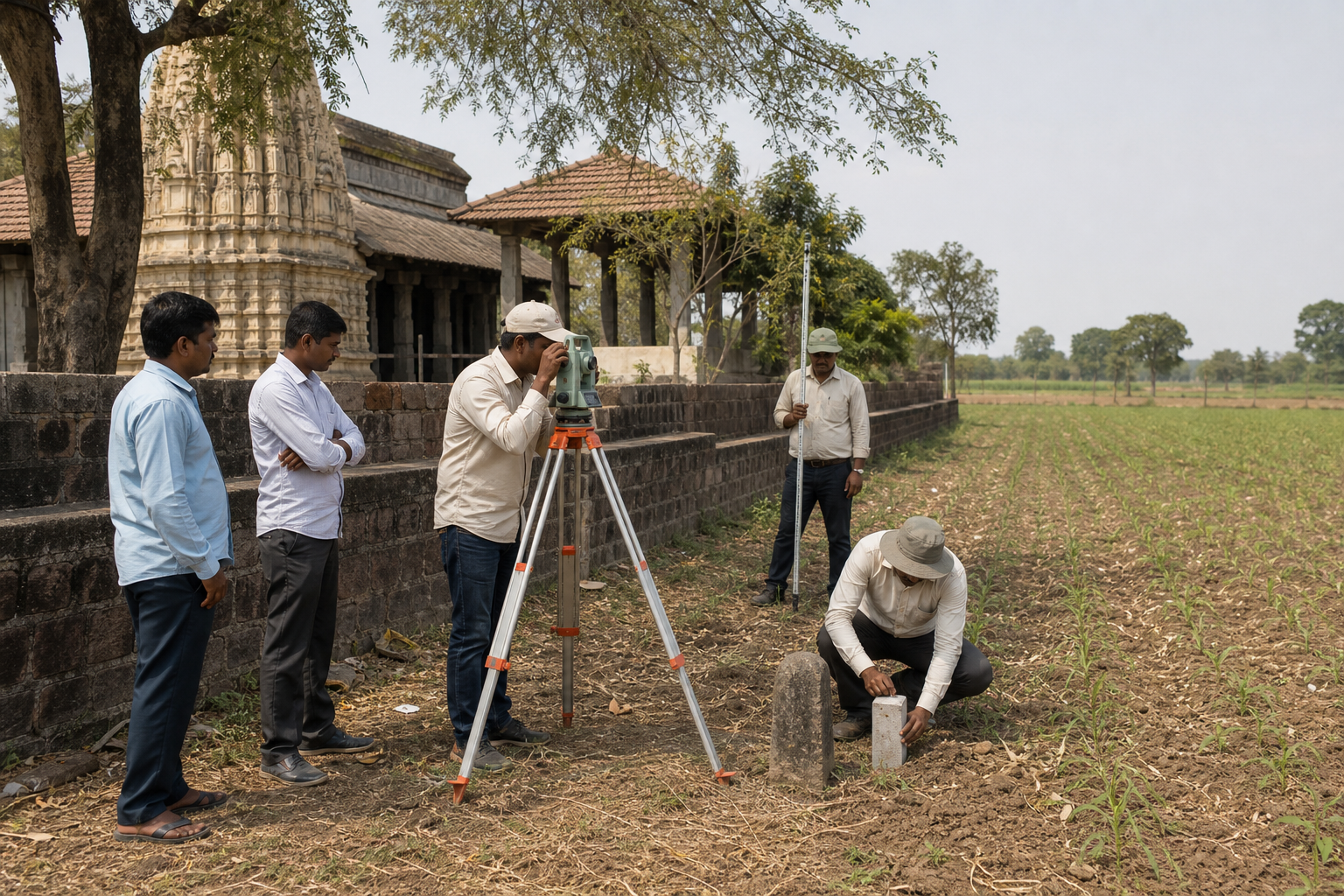
The case concerned mutation records described as fraudulent and about 50 years old. Sustained legal intervention by the Maharashtra Mandir Mahasangh led the Amravati Additional District Collector to cancel those entries and formally restore land described as worth multiple crores to Shri Bhagwanpuri Sansthan.
The wording matters. A mutation entry is an entry in the land-revenue record. Cancelling a defective entry corrects the government’s administrative record and removes a document that could otherwise be used to project a claim over the property. In this case, the named beneficiary of the restoration is Shri Bhagwanpuri Sansthan.
You should also distinguish what has been established from what has not been made public. Without the text of the order, parcel identifiers, valuation method, details of possession, or any response from the opposing side, it would be unsafe to infer that every related legal question has ended. The responsible description is narrower: an administrative authority quashed the old mutation entries and formally restored the temple land to the Sansthan.
That distinction protects the credibility of temple advocacy. It allows you to celebrate a real result without turning an administrative victory into claims about criminal liability, physical possession, or further proceedings that the available facts do not establish.
Why a decades-old mutation entry still matters

A mutation entry is generally maintained for land-revenue administration. It is not necessarily a conclusive title document by itself, and the legal status of a property can depend on several records, instruments, and orders. Yet an incorrect mutation entry is not harmless. Officials, prospective occupants, managers, and later proceedings may all look to the current revenue record when deciding who appears to hold rights over the land.
Age creates procedural inertia. An old entry may be copied into later extracts, treated as routine by successive officeholders, or escape attention when a temple’s management changes. A wrong entry does not become right merely because it is old, but the passage of time can make the underlying documents harder to locate and the institutional memory harder to reconstruct.
The 50-year history of the Shri Bhagwanpuri entries therefore carries a warning for every temple institution: reverence does not maintain a revenue record. A temple may have continuous worship, committed devotees, and a strong local memory of its property while its paperwork tells a different story. The gap is often discovered only when construction begins, a notice arrives, boundaries are disturbed, or another party asserts control.
If you are responsible for temple affairs, do not begin with the assumption that the institution owns only the land it visibly occupies. Begin with its complete property inventory. Agricultural land, vacant parcels, access paths, donated property, leased premises, and land used by others all need to be matched against current official records.
Build a temple-land record that survives changes in management

The strongest protection is a repeatable control system rather than a folder that only one trustee understands. The exact documents and procedure will vary by property, so a live dispute should be reviewed by a Maharashtra advocate experienced in land and revenue matters. As an institutional baseline, use the following workflow.
- Create a property register. Give every parcel its own entry. Record the village or locality, the applicable survey, gat, city-survey, or other identifier, stated area, boundaries, present use, known occupants, the name appearing in the current record, and the date on which that record was last checked.
- Preserve the documentary chain. Keep certified or otherwise legally usable copies of acquisition documents, donations, grants, historic extracts, mutation applications and orders, maps, tax or revenue receipts, leases, licences, and relevant court or administrative orders. Store an indexed digital copy under institutional control as well as the required physical records.
- Separate ownership, possession, and use. These are not interchangeable. A parcel may stand in the institution’s name while another person uses it, or the temple may occupy land whose record requires correction. Mark each status separately so that everyday use is not mistaken for complete legal security.
- Assign responsibility to an office, not an individual memory. The governing body should identify who obtains updated records, who receives notices, who may instruct counsel, and who reports changes to the trustees or managing committee. Preserve handover notes whenever the officeholder changes.
- Review records on a fixed recurring date and after any trigger. A government notice, neighbouring transaction, proposed development, boundary disturbance, lease request, management transition, or new claim should prompt an immediate comparison between the institution’s file and the current official entry.
- Use a written escalation protocol. Date-stamp every notice, preserve the envelope or electronic delivery record, note the response deadline, and send the complete file to authorized counsel. Do not rely on a verbal assurance that an official or community member will handle it.
- Track implementation after a favourable order. Obtain the legally usable copy, confirm that the operative directions match the institution’s understanding, apply for any consequential record changes through the proper channel, and then obtain a fresh record showing the result. Keep the old entry, the corrective order, and the updated entry together.
The last step is easy to neglect. Winning an order and verifying its implementation are different tasks. An institution that announces victory before checking the updated record may discover later that a clerical step, identification mismatch, or unresolved consequential entry still requires attention.
Do not alter boundaries, remove occupants, destroy structures, or enter disputed land merely because you believe the temple’s claim is strong. Those actions can create legal and safety risks independent of the underlying property claim. Physical possession and enforcement should proceed only through lawful instructions tailored to the actual order and circumstances.
How devotees can support restoration without harming the case

Community vigilance helped keep the Shri Bhagwanpuri matter from disappearing into old paperwork. Devotees can play a valuable role, but useful support is disciplined. Public anger cannot replace an authenticated record, and careless accusations can complicate an institution’s legal position.
Before forwarding a victory claim or donating to a land-protection campaign, ask concrete questions:
- Which temple institution legally holds or claims the property?
- Which parcel identifiers and boundaries are involved?
- Which authority passed the operative order?
- Has the institution obtained a legally usable copy of that order?
- Does the current land record now reflect the correction?
- Is any further proceeding, implementation step, or possession issue still pending?
- Who is authorized by the institution to receive money, documents, or legal information?
If you possess old receipts, maps, photographs, correspondence, or family records connected to temple property, preserve the originals and give copies through an authorized channel. Note where the material came from and when it was created. Do not crop away identifying context, rewrite dates, annotate an original, or circulate sensitive material indiscriminately. Evidence is most useful when its origin and integrity can be explained.
Financial support should go through an accountable institutional mechanism. Ask what the money covers, who approves expenditure, and whether contributors will receive a receipt and a status update. Avoid cash collections controlled by an individual who cannot show authorization from the temple body.
Public communication should identify confirmed actions and leave disputed allegations to the legal process. You can say that an authority cancelled specified entries or restored the Sansthan’s name when the order establishes it. You should not label a named individual a criminal, declare physical possession delivered, or announce that every legal remedy is exhausted unless the relevant record supports that statement.
Key takeaways for protecting temple property
- The Amravati Additional District Collector quashed mutation entries described as fraudulent and formally restored the land to Shri Bhagwanpuri Sansthan.
- The disputed entries were about 50 years old, showing how long a defective land record can survive without sustained scrutiny.
- A corrected mutation entry is important, but it should not be confused automatically with conclusive title, physical possession, or the end of every possible proceeding.
- Every temple institution needs a parcel-by-parcel register, an indexed documentary chain, a designated record custodian, and a recurring verification process.
- After a favourable order, the institution should obtain the operative record, complete consequential steps, and verify the fresh land entry.
- Devotees help most by preserving authentic documents, funding accountable legal work, asking precise questions, and avoiding confrontation or unsupported accusations.
If you are connected to a temple, begin with a single-page inventory of every known parcel and the name currently appearing in its official record. That first comparison may reveal nothing unusual, which is valuable in itself. If it reveals a discrepancy, place the complete file before qualified counsel and the appropriate authority before the entry acquires another generation of institutional inertia.
The Shri Bhagwanpuri restoration demonstrates what sustained, lawful vigilance can achieve. The next responsibility is to make that restoration durable through accurate records, controlled custody of documents, and regular oversight.
References
