
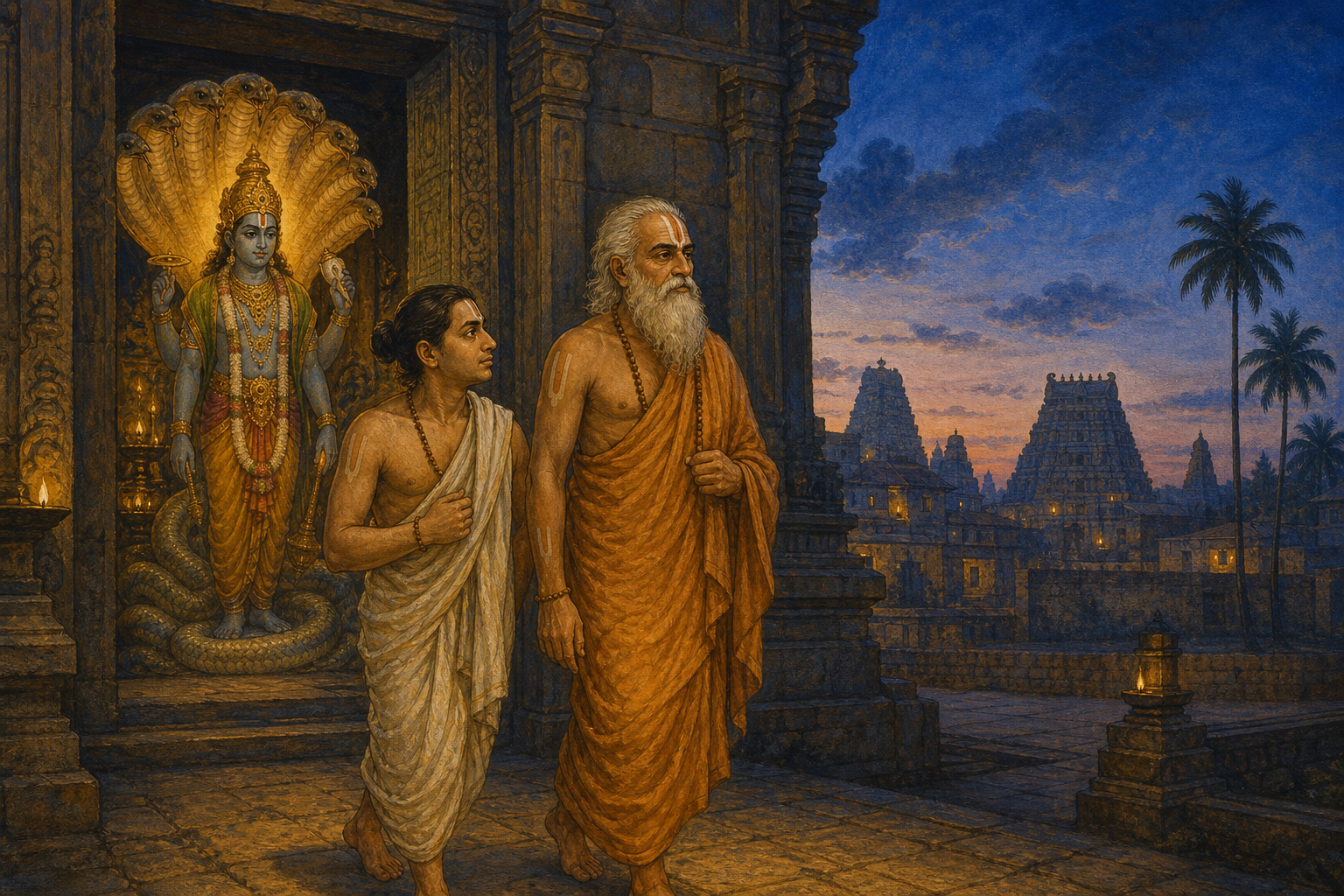
If you have heard that Kanchipuram’s deities left their temples to follow Thirumalisai Alvar, you may wonder how a devotee is meant to understand it. Must you treat it as an ordinary travel report, or reduce it to a moral metaphor?
That choice is too narrow. The tradition works through temple theology: Perumal is a living divine presence, devotion creates obligations between people, and a sacred city cannot take either relationship for granted. Once you see those connections, the extraordinary movement of the deities becomes intelligible rather than merely spectacular.
Begin with the chain of loyalty, not the miracle
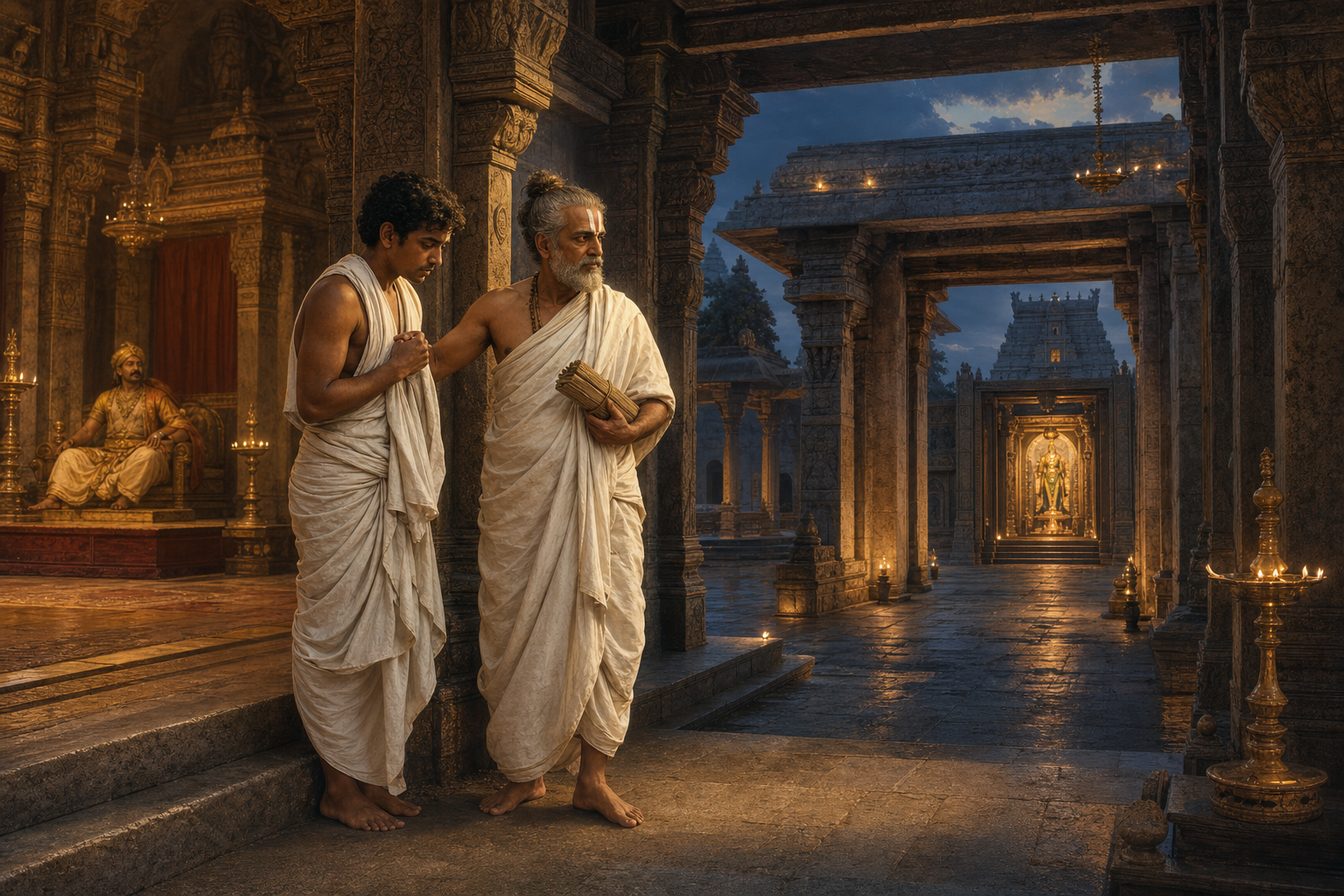
The tradition has three indispensable figures: Thirumalisai Alvar, his disciple Kanikannan, and the presiding deity. Kanikannan is not an incidental companion inserted between a saint and God. His place in the account reveals what kind of devotion the Alvar embodies.
Many retellings naturally emphasize the most astonishing event: the deities of Kanchipuram leave their temples and follow. But if you begin there, the account can sound like a display of supernatural influence. Begin with the relationships instead, and a clearer pattern appears:
- Kanikannan stands in a relationship of discipleship and loyalty to Thirumalisai Alvar.
- The Alvar’s devotion to Perumal does not make his human obligations irrelevant.
- The deity responds to the devotee rather than remaining detached from what happens around him.
- The movement expands from an individual bond into a citywide withdrawal of sacred presence.
This sequence matters. Bhakti is not presented as a private emotion sealed inside the worshipper’s mind. It changes how the devotee treats another person. The deity’s response then gives theological weight to that fidelity.
When you hear the account recited, therefore, do not ask only, “How could the gods walk away?” Ask, “What loyalty set the movement in motion?” That question takes you closer to the tradition’s ethical center.
A moving deity expresses a living temple presence
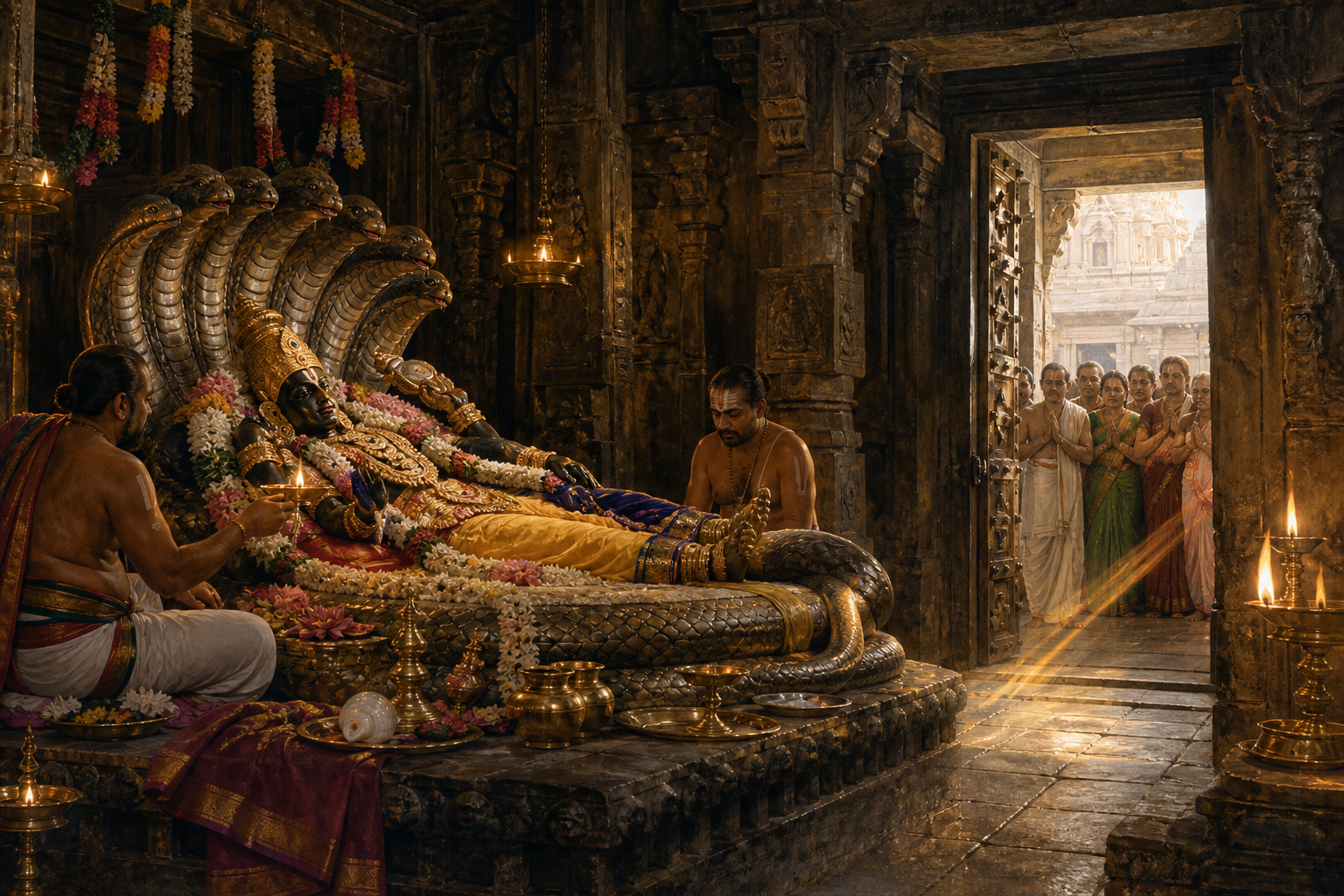
Modern readers sometimes approach a murti through an unhelpful binary. Either it is treated as an ordinary material object, or believers are imagined to be claiming that matter behaves like a human body. Temple worship has a different grammar.
A consecrated deity is approached through darshan, service, offering and reverence. The exact routines differ among temples, but their common premise is relationship: the devotee does not behave as though the divine presence were merely decorative. Perumal receives devotion and can answer it.
The Kanchipuram tradition pushes that premise to its dramatic limit. A temple normally anchors sacred presence to a place. Here, the deity moves. Holiness is shown to be more than architecture, civic prestige or possession of a sanctuary. If the divine presence chooses to depart with a devotee, the city cannot hold it by entitlement.
This does not mean that a powerful saint controls God. The account describes a freely responsive deity, not a mechanical force compelled by a technique. Thirumalisai Alvar’s devotion is not a formula that obliges Perumal to obey. The point is intimacy without reduction: the deity remains sovereign while choosing solidarity with the devotee.
That distinction protects the account from two opposite errors. Calling it meaningless fantasy denies the temple worldview before trying to understand it. Treating it as proof that a devotee can command God turns bhakti into spiritual power-seeking. Neither reading preserves the relationship at the heart of the tradition.
Read the tradition on devotional, ethical and civic levels
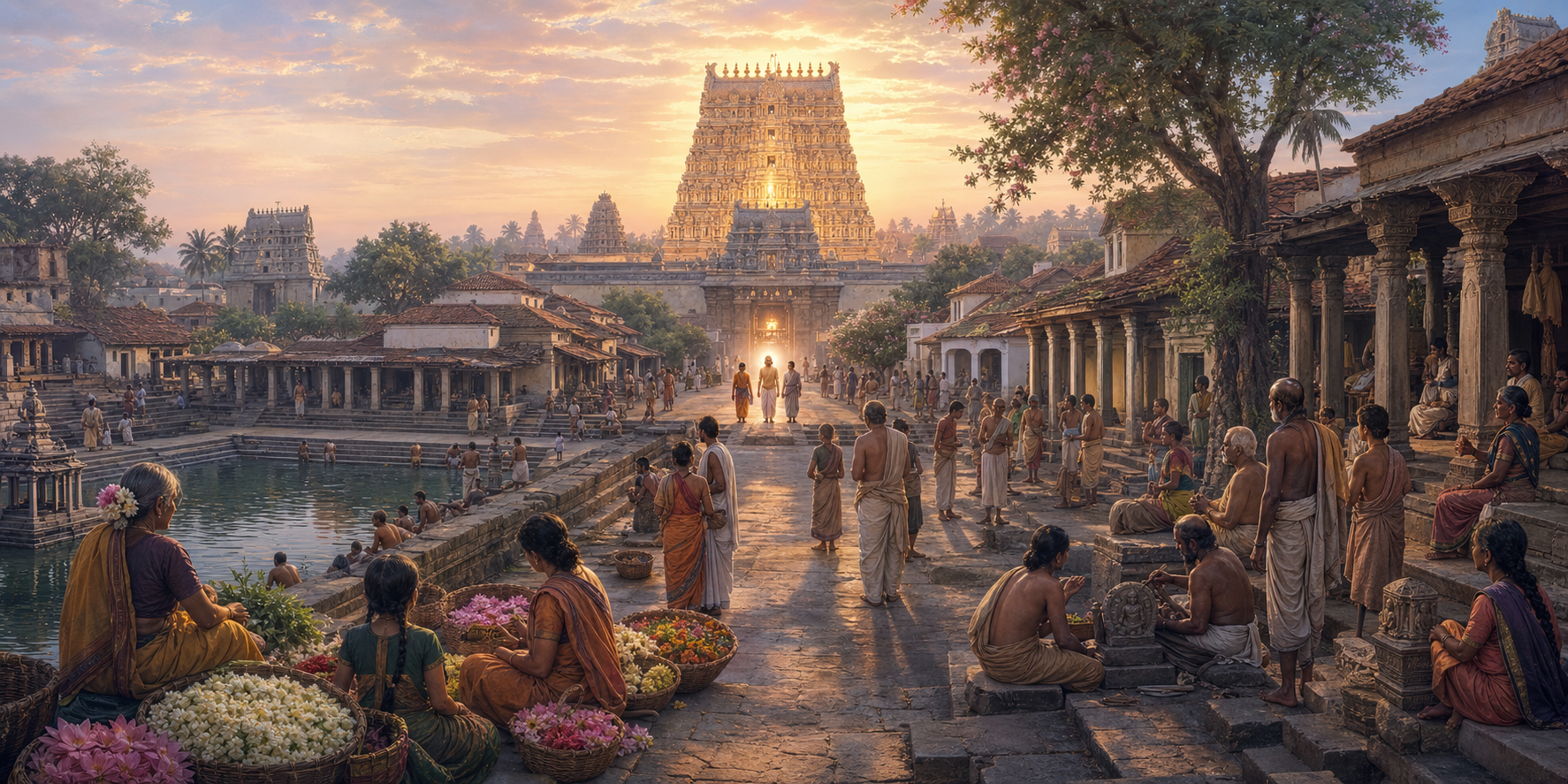
A temple narrative can carry several meanings at once. You do not have to force the Kanchipuram account into a single category. Three levels are especially useful.
The devotional level: God is responsive
Perumal is not portrayed as remote from the devotee’s life. Divine nearness becomes action. The deity’s willingness to follow tells the worshipper that sincere bhakti is a relationship of presence, not merely correct speech about God.
For your own practice, this changes the question you bring to worship. Instead of asking only whether you completed a ritual correctly, ask whether the ritual is making your relationship with the divine more truthful, attentive and humble.
The ethical level: a disciple is not disposable
Kanikannan’s presence prevents the account from becoming a solitary saint’s spiritual triumph. A devotee cannot praise fidelity to God while treating human bonds as expendable whenever they become inconvenient. The Alvar-disciple relationship gives the narrative its moral tension.
This is a practical test you can apply beyond the temple. If a religious commitment makes someone impressive in public but unreliable toward those entrusted to them, the Kanchipuram tradition gives you reason to question that performance. Devotion should deepen dharmic responsibility rather than provide an escape from it.
The civic level: a city cannot own sacredness
The departure is larger than one person changing location. The deities leave their temples, turning a personal bond into a crisis for Kanchipuram itself. Sacred geography is therefore presented as relational. A city may possess shrines, customs and inherited prestige, yet divine presence is not reduced to civic property.
For a community responsible for a temple, the implication is demanding. Preservation cannot stop at maintaining stone, festivals or reputation. It must also preserve the relationships of service, humility and devotion that make the temple a living sacred center.
How to hear, visit and retell the tradition responsibly
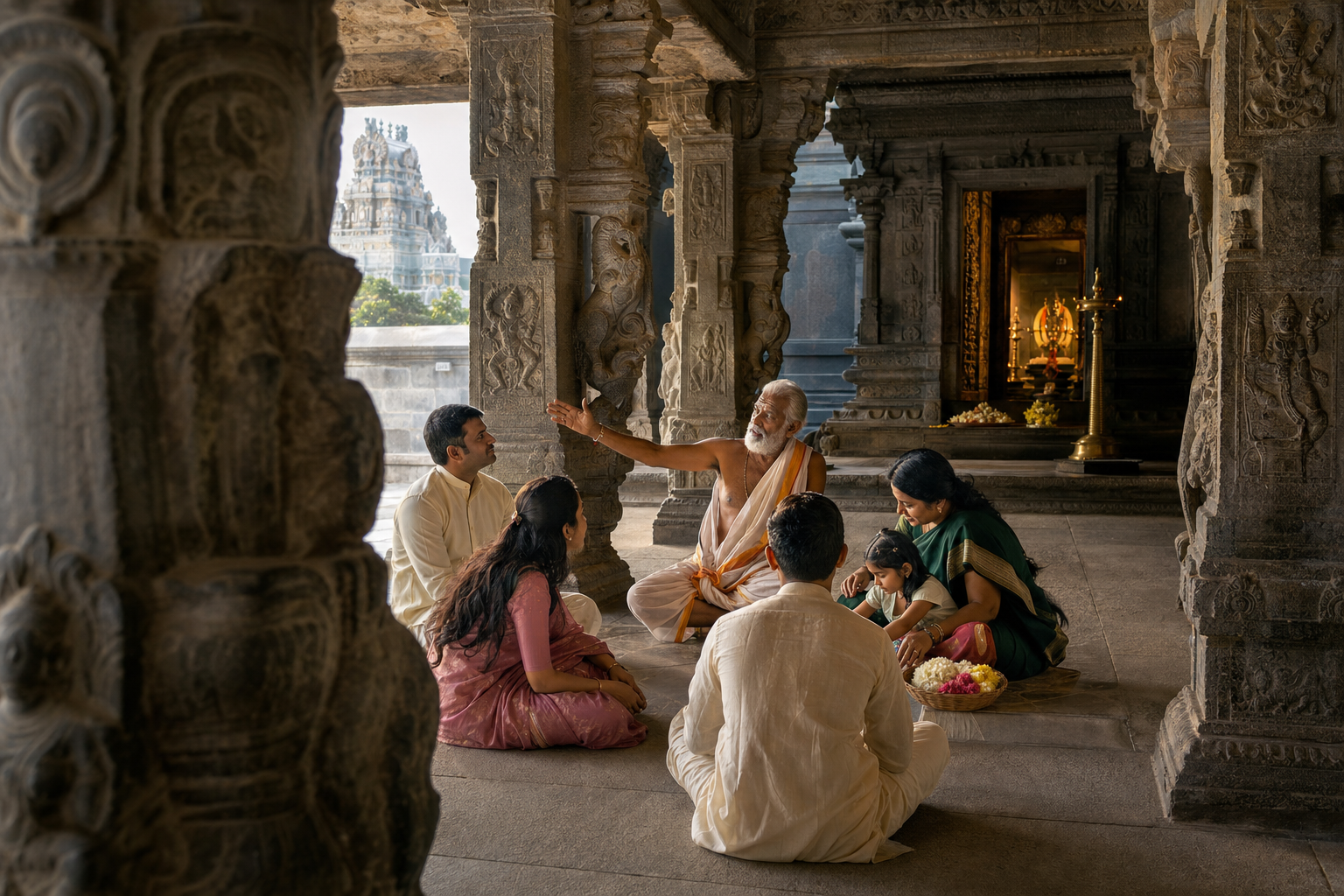
You can respect a sacred account without adding details you cannot support or pretending that every listener must approach it in the same way. Use the following method when you encounter the tradition in a discourse, a temple visit or a family retelling.
- Keep the relationships visible. Name Thirumalisai Alvar, Kanikannan and the deity. If Kanikannan disappears from the retelling, much of the ethical meaning disappears with him.
- Separate inherited tradition from historical verification. A devotional narrative and an independently documented chronology are not the same kind of claim. If you lack a reliable basis for a precise date, ruler, route or speech, do not supply one merely to make the account sound complete.
- Listen for local forms of memory. Temple communities may emphasize different moments or implications. Ask what a particular detail teaches before declaring a variation an error.
- Do not reduce the murti to a prop. The deity’s agency is the theological point. Even a symbolic reading should not erase the temple tradition’s conviction that Perumal is genuinely present and responsive.
- Do not turn the saint into a spiritual celebrity. The event directs attention to fidelity and divine grace, not to personal domination of the deity.
- Carry home one ethical question. Ask where your declared devotion requires loyalty, humility or responsibility toward another person. That makes the tradition a discipline rather than an entertaining marvel.
If you visit Kanchipuram, resist treating the temple merely as the location of a famous supernatural episode. Attend to how sacred presence is enacted through darshan, worship and remembered relationship. The tradition becomes easier to understand when you see that the temple is not only a monument but a meeting place between deity, devotee and community.
Key takeaways
- The tradition joins Kanikannan’s discipleship, Thirumalisai Alvar’s devotion and the deity’s response in one chain of loyalty.
- The departure of the deities expresses a temple worldview in which divine presence is living, sovereign and responsive.
- The account carries devotional, ethical and civic meanings; none requires you to erase the others.
- Respectful retelling preserves the named relationships and does not invent unsupported dates, speeches or circumstances.
- The practical question is not whether you can reproduce the miracle, but whether your bhakti makes you more faithful in the relationships dharma has placed before you.
The next time you hear the Kanchipuram tradition, follow the relationships before following the departing deities. Then choose one obligation in your own life that devotion calls you to honor more faithfully. That is where this temple memory stops being distant legend and begins to shape conduct.
References
