
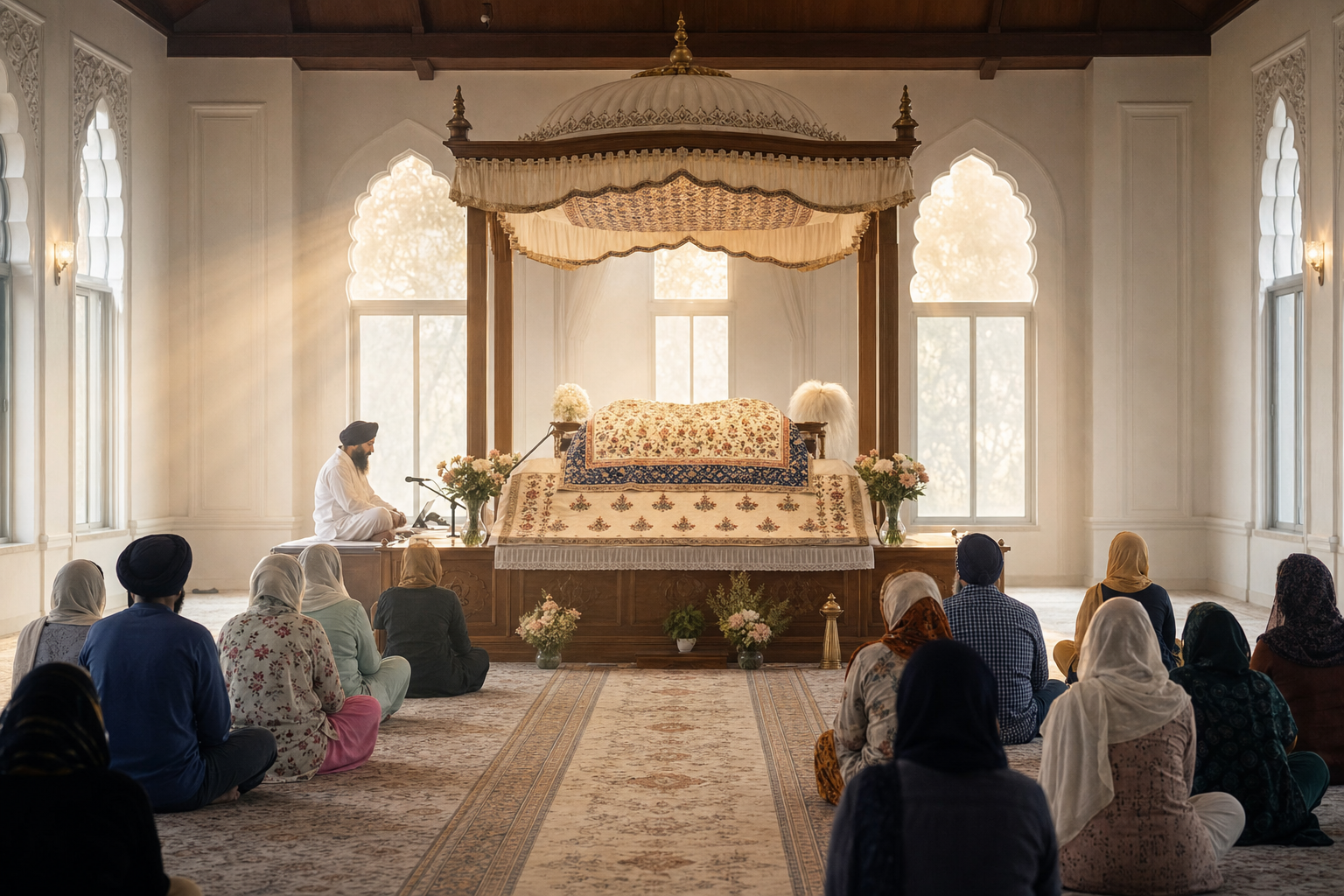
You may have seen First Prakash on a gurdwara calendar and known that it matters, yet still wondered what exactly happened and how to explain it without reducing the day to an anniversary. The essential distinction is simple: Prakash is not the publication of a book. It is the reverent bringing forth of the Guru’s Word into the presence of the sangat.
That distinction gives you a practical way to approach the observance. Learn the history accurately, participate with the discipline expected in a gurdwara, listen for guidance rather than spectacle, and help children understand why Sikhs speak of Guru Granth Sahib as the living Guru.
What the First Prakash actually commemorates
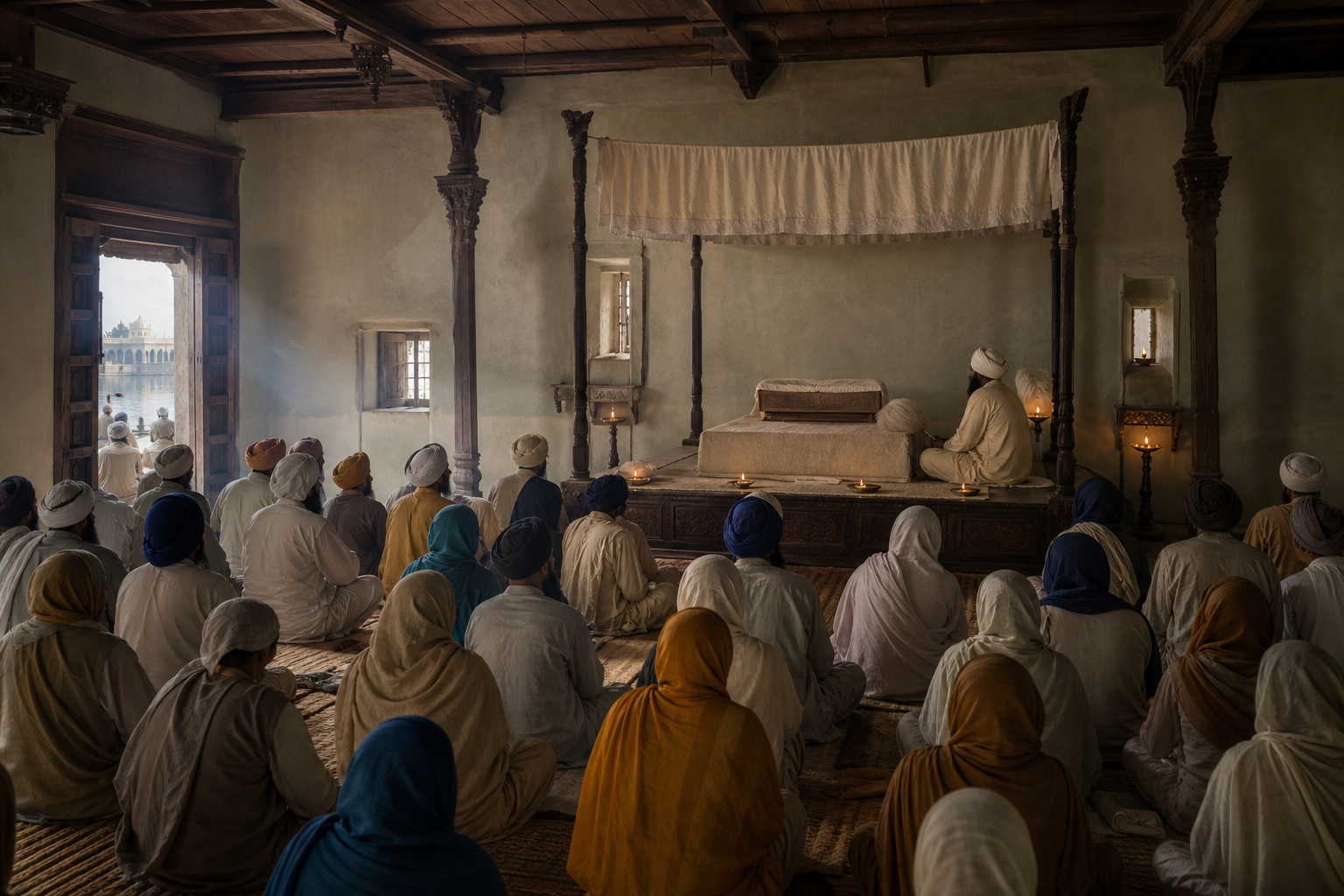
On 1 September 1604, Guru Arjan arranged the first ceremonial Prakash of the Adi Granth at Harmandir Sahib in Amritsar. Guru Arjan had overseen the compilation, while Bhai Gurdas wrote the sacred volume by hand as its scribe. The work brought authenticated Gurbani together so that the Sikh community could receive, sing and preserve the revealed Word in an authoritative form.
The completed volume was taken from Ramsar to Harmandir Sahib in a reverent procession. Baba Buddha carried it upon his head, an act that visibly placed the authority of Gurbani above personal rank. Guru Arjan accompanied the procession, and Baba Buddha became the first granthi at Harmandir Sahib.
The word Prakash carries the sense of bringing into light or manifest presence. In gurdwara practice, it refers to the respectful opening and installation of a saroop of Guru Granth Sahib in the darbar. The corresponding evening observance is Sukhasan, when the saroop is respectfully closed and taken to its resting place. These are not ordinary acts of opening and storing a volume. They express an ongoing relationship between Guru, Shabad and sangat.
One historical distinction prevents a common misunderstanding. The 1604 event was the First Prakash of the Adi Granth during Guru Arjan’s lifetime. Guru Gobind Singh later conferred eternal Guruship upon Guru Granth Sahib in 1708. The First Prakash and the conferral of Guruship are therefore connected, but they are not the same event. If you are teaching the history, use those two dates as a short timeline rather than merging them into one.
Why Prakash means more than placing a scripture on a throne
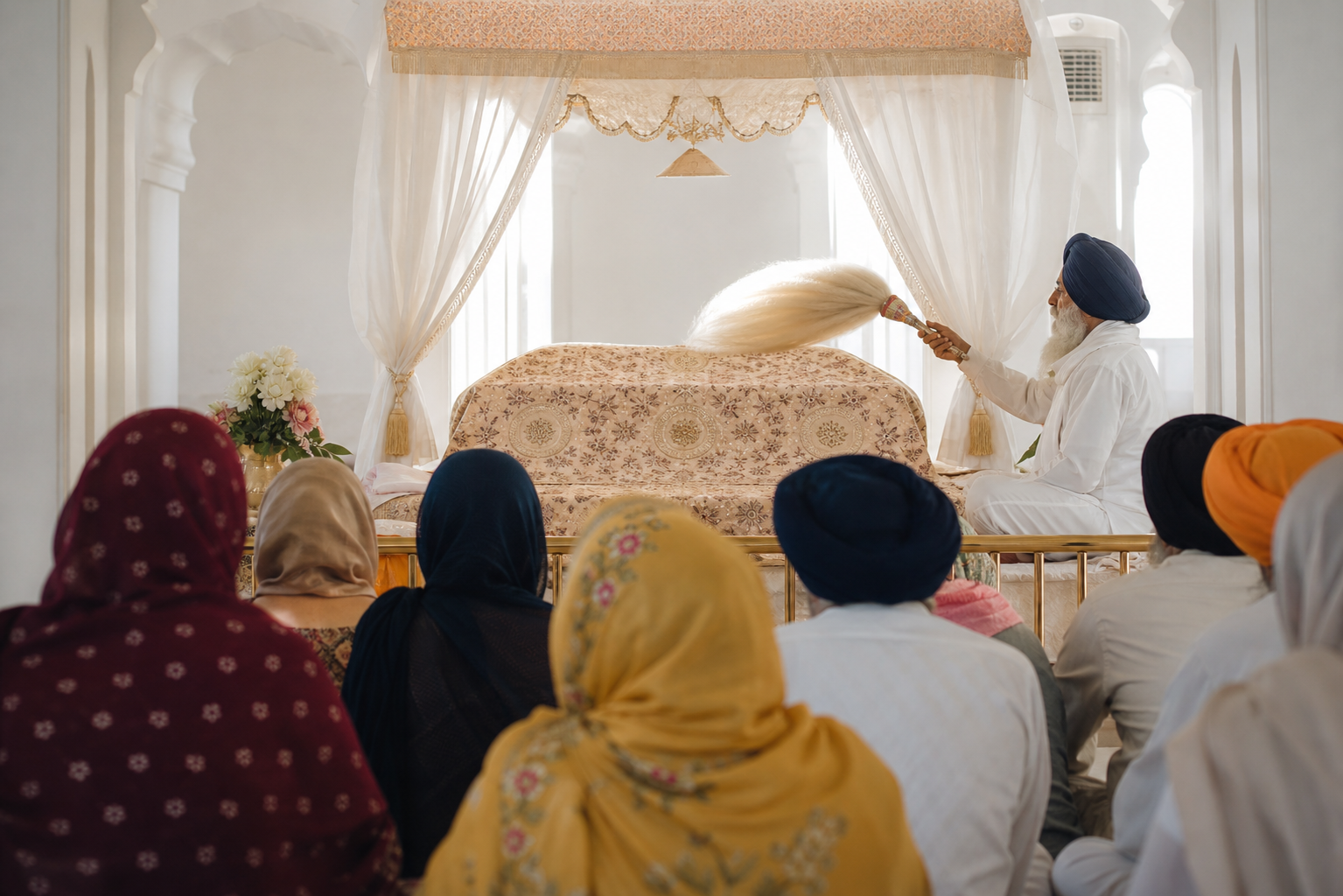
The outward ceremony is striking: the covered head, the elevated place, the chaur sahib, the careful movement of the saroop and the congregation seated before it. Yet the ceremony points beyond itself. Sikh reverence is directed toward the authority of Shabad Guru, the Divine Word encountered through Gurbani. The physical discipline teaches the body not to approach sacred wisdom casually.
First Prakash joins three responsibilities. Gurbani must be preserved accurately. It must be received humbly. It must then be heard and lived. Remove the first responsibility and teachings can be altered. Remove the second and scripture becomes material for ego or argument. Remove the third and even immaculate ritual leaves daily conduct untouched.
This is why describing Guru Granth Sahib merely as the "Sikh Bible" is inadequate. That shorthand may tell an unfamiliar listener that the text is sacred, but it misses the distinct Sikh understanding of living Guruship. A Sikh does not enter the darbar only to inspect a historical manuscript. The sangat gathers in the Guru’s presence, listens to Gurbani, receives a Hukam and submits personal preference to spiritual instruction.
Readers from other Dharmic traditions may recognize the larger intuition that reverence is embodied: you sit differently, speak differently and handle sacred things differently. Still, Sikh practice should be understood on its own terms. First Prakash is not an occasion to force Guru Granth Sahib into the categories of another tradition. It is an opportunity to notice how Sikhi locates authority in Shabad and makes listening a communal discipline.
You can test whether an observance has reached its purpose with one question: what teaching will govern your conduct after you leave? If the answer is only that the ceremony was beautiful, stay with the Gurbani a little longer. Read a reliable translation of the Hukam, identify the instruction rather than merely the comforting phrase, and choose one action through which you will obey it.
How to observe First Prakash with understanding
Gurdwaras may mark the occasion through recitation, kirtan, katha, Ardas, processions, seva and langar. Local programmes differ, so do not build your visit around assumptions. Check the announced time and ask whether the main programme begins with Prakash, concludes a path, or focuses on kirtan and historical reflection.
- Learn the two-minute history before you arrive. Remember Guru Arjan, Bhai Gurdas, Baba Buddha, the Adi Granth, Ramsar and Harmandir Sahib. You do not need a long lecture in the car. You need enough context to recognize what the programme is commemorating.
- Prepare for the gurdwara as a sacred space. Wear clean, modest clothing and bring an appropriate head covering if the gurdwara does not provide one. Remove your shoes, wash your hands, silence your phone and follow the local rules. Tobacco, alcohol and other intoxicants have no place on gurdwara grounds.
- Enter the darbar without treating it as a performance. Follow the sangat’s movement and the guidance of sewadars. Do not block the approach to Guru Granth Sahib, walk around taking photographs, or record people without permission. If you are unfamiliar with a gesture, ask quietly instead of copying it carelessly.
- Listen for meaning. Kirtan is not background music, and katha is not a delay before langar. Notice which Shabad is being sung, what quality or failing it addresses, and what the Hukam asks of the listener. If Punjabi is a barrier, read a translation before or after the programme rather than scrolling through your phone in the darbar.
- Join seva without making yourself the centre. Ask where help is needed. Shoes, dishes, water, cleaning and langar service are all places where reverence becomes work. Accept the task given instead of searching for the most visible role.
- Carry one instruction home. Write down one line or teaching you heard and name the conduct it requires. It might concern truthful speech, humility, remembrance, honest work, sharing or freedom from ego. Return to it during the following week so the observance does not end at the gurdwara door.
If you are attending for the first time or are not Sikh, respectful curiosity is welcome. Arrive a little early and tell a sewadar that you are unfamiliar with the programme. A brief question asked before entering the darbar is better than anxious guessing during it. You do not need to pretend knowledge you do not have; you do need to respect the discipline of the space you have entered.
How to explain the living Guru to a child
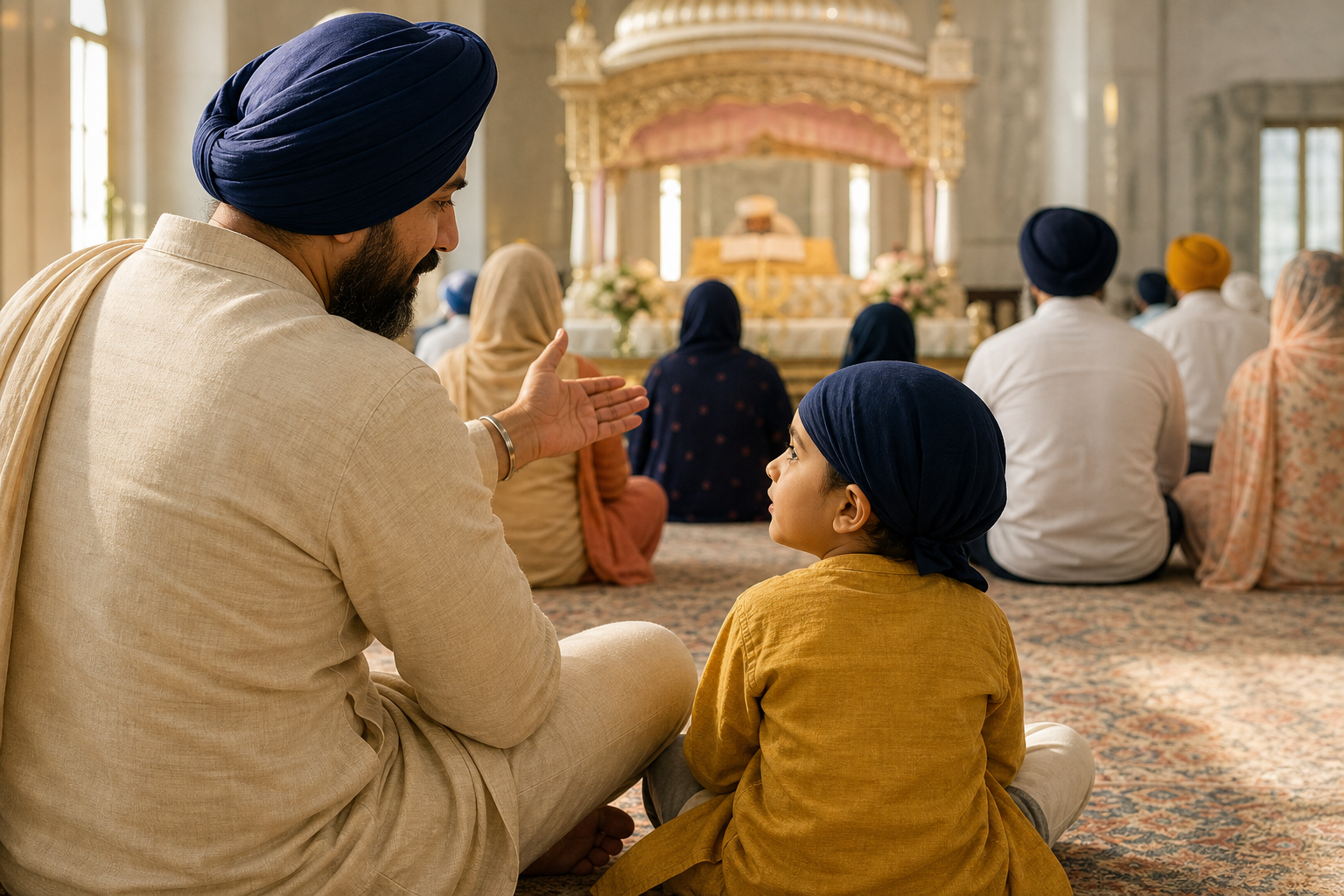
A young child does not need a compressed lecture on canon formation. The image of a living treasure is more useful: the treasure is not kept valuable by locking it away, but by opening Gurbani, listening to it and allowing it to shape life. History then gives the image a real setting rather than leaving it as a vague metaphor.
A three-sentence explanation you can use
Try this: "Guru Arjan gathered the sacred hymns, and Bhai Gurdas carefully wrote them. Baba Buddha carried the Adi Granth with great respect to Harmandir Sahib, where it was opened before the sangat. We remember that First Prakash because Gurbani is not only something Sikhs protect; it is the Guru’s wisdom that Sikhs listen to and follow."
That wording gives the child people, actions and purpose. It also avoids two weak explanations: "It is the birthday of a book," which is historically and spiritually misleading, and "We bow because that is our custom," which gives a rule without its meaning.
Teach listening as relationship, not surveillance
A child can learn that the Guru is always listening, but use that teaching carefully. It should invite honesty, prayer and trust. It should not become a threat such as, "The Guru heard you misbehave." Turning the Guru into an invisible monitor may produce fear or concealment when the intended lesson is that the child can bring every question, mistake and hope into the Guru’s presence.
Complete the teaching by reversing its direction: the Guru listens, and we must learn to listen to the Guru. Ask the child, "If you could say one honest thing before Guru Sahib, what would it be?" Then ask, "What might Gurbani be teaching us to do?" The first question builds relationship. The second prevents relationship from becoming one-sided wish-making.
Use a before, during and after rhythm
- Before the visit: show the child pictures of Harmandir Sahib and name Guru Arjan, Bhai Gurdas and Baba Buddha. Explain only the role of each person: compiler, scribe and bearer or first granthi.
- During the programme: give the child one thing to notice, such as how the sangat sits, how the saroop is approached, or when everyone becomes quiet for the Hukam. One observation is more manageable than a stream of corrections.
- After the visit: ask the child to draw or retell the journey from Ramsar to Harmandir Sahib. End with a conduct question: "What is one way we can show that we listened?"
Do not turn the names and dates into an immediate test. Let the child first remember the moral shape of the event: careful preservation, humble carrying, communal listening and lived guidance. Historical details are more likely to remain when attached to those meaningful actions.
Etiquette corrections also work better when tied to meaning. Instead of saying only, "Do not turn your back," explain that people move carefully because they recognize the Guru’s presence. Instead of demanding silence for its own sake, explain that silence makes listening possible. The goal is not a child who can perform respect while resenting it. The goal is a child who understands what the respectful action is for.
Key takeaways
- First Prakash commemorates the 1604 installation and ceremonial opening of the Adi Granth at Harmandir Sahib under Guru Arjan’s direction.
- Bhai Gurdas served as the scribe, while Baba Buddha carried the sacred volume and became the first granthi at Harmandir Sahib.
- The First Prakash of 1604 is distinct from Guru Gobind Singh’s conferral of eternal Guruship upon Guru Granth Sahib in 1708.
- Prakash is not merely opening a book. It enacts the presence and authority of Shabad Guru before the sangat.
- The most faithful observance joins reverence to listening, seva and a specific change in conduct.
- When teaching children, present the Guru’s listening as a source of trust, and teach that the relationship also asks them to listen and respond.
Before the next First Prakash programme, do three things: confirm your gurdwara’s schedule, tell your family the difference between 1604 and 1708, and decide how you will preserve one teaching after the programme. A calendar entry becomes a Dharmic practice when remembrance changes the way you listen and live.
References
- SikhNet – News – The Living Treasure: A Journey to the First Prakash
- SikhNet – Children Stories – The Living Treasure
