

You may have found the Parashurama Kalpasutra while looking for an authentic way into Srividya and reached the practical question that serious seekers eventually face: should you only study it, or can you begin performing what you read?
The sound answer is to use the text first as a map of a living tradition. Study can begin immediately. Lineage-specific ritual should begin only when its prerequisites are clear and a qualified teacher has authorized it. That distinction protects both your practice and the integrity of Srividya.
Know what kind of text you are holding

Tradition attributes the Parashurama Kalpasutra to Bhagavan Parashurama. It is regarded as an important procedural work associated with Srividya and Divine Mother worship. Its significance lies not merely in praising Devi, but in organizing a disciplined way of approaching her.
The name itself helps you set expectations. Kalpa concerns an ordered method, while sutra indicates compressed formulation. A sutra is designed to preserve a great deal in very few words. It may assume that the reader already knows the technical vocabulary, ritual setting, sequence, exceptions and oral explanations. A translation can render the words into familiar language without supplying all that assumed knowledge.
That is why the Parashurama Kalpasutra should not be treated like a modern beginner’s handbook. A short instruction can sit at the end of an entire chain of eligibility, initiation and training that remains unstated on the page. The brevity is a feature of the form, not permission to improvise.
Srividya itself is more than generalized affection for the Goddess. It brings devotion, sacred knowledge, mantra, yantra, bodily discipline, ritual action and contemplation into a coordinated path. These dimensions support one another, but they are not interchangeable. Understanding a mantra intellectually is not the same as receiving it for practice. Admiring a yantra is not the same as knowing how a lineage installs and worships it.
When you read Chapter 1, therefore, ask four different questions instead of the single question, What do I do?
- What understanding of Devi, the practitioner and worship is being established?
- What qualities or preparation does the instruction appear to assume?
- Which statements explain a principle, and which direct a ritual action?
- Which details would require oral clarification before they could be performed responsibly?
This reading discipline prevents a common mistake: extracting an attractive formula while missing the framework that gives it purpose.
Read Chapter 1 in three deliberate passes
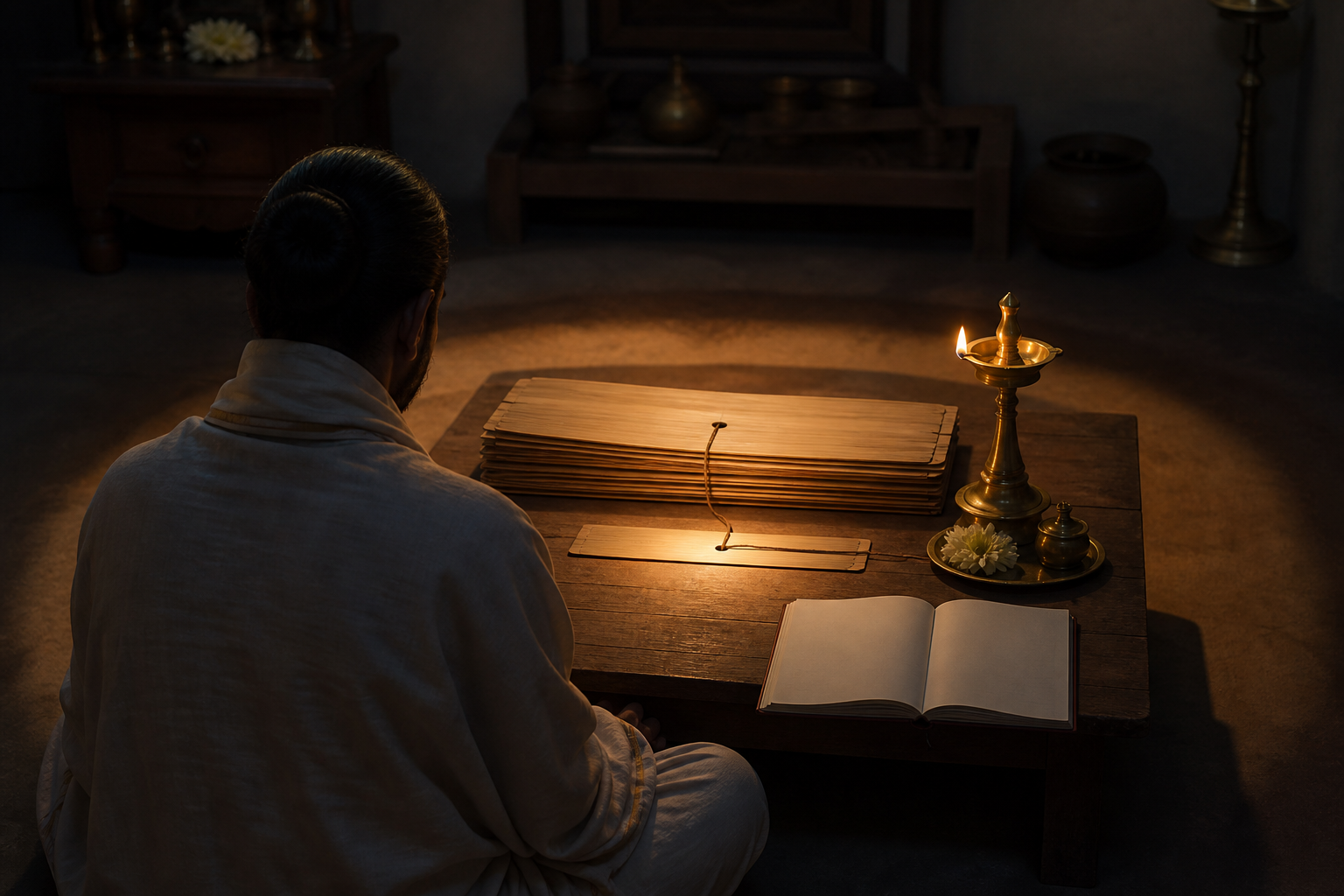
Your first goal is not to collect secret-looking practices. It is to discover the architecture of the teaching. Three passes through a short unit will usually teach you more than repeated, hurried reading.
First pass: establish the plain sequence
Read the whole unit without attempting any ritual instruction. Mark transitions and action words. Note where the concern changes from qualification to preparation, from principle to worship, or from worship to an expected result. Even when the technical meaning is unclear, the order can reveal what the text treats as prior and what it treats as dependent.
- Write each unfamiliar term exactly as it appears in your edition.
- Beside it, record the translator’s rendering without treating that rendering as the final definition.
- Mark every passage that appears to command an action.
- Mark every prerequisite stated before that action.
- Leave a blank beside anything whose pronunciation, sequence or ritual context remains uncertain.
Do not silently fill those blanks from memory or from an unrelated website. In a technical tradition, an unknown is useful information. It tells you what to ask.
Second pass: separate principle from procedure
A principle can often be studied and contemplated before initiation. A procedure may depend on initiation, oral transmission and correction. The same passage can contain both, so classify sentence by sentence.
Teachings about reverence, attention, self-restraint, purity of intention and the place of Devi in worship can shape your understanding now. Directions involving a received mantra, bija syllables, nyasa, mudra, construction or installation of a yantra, a fire rite, technical measurements, fixed ritual counts or a tightly ordered sequence should be treated as dependent instructions until a teacher in the relevant tradition explains their status.
Dependent does not mean forbidden to read. It means that reading and performing are different acts. You can examine the instruction, learn its vocabulary and understand where it belongs without claiming the ritual authority to enact it.
Third pass: turn uncertainty into precise questions
Take your annotations to someone qualified to teach the form of Srividya you intend to follow. Do not ask only, Can I do this? A useful consultation is much more specific:
- Is this passage explanatory, contemplative or performative?
- Does this instruction require diksha in this lineage?
- Is the wording in my edition sufficient, or is an oral explanation essential?
- Does the practice depend on instructions given earlier or elsewhere?
- Which parts may a non-initiated devotee study or observe?
- How would an error be recognized and corrected?
A competent answer should clarify boundaries, not merely increase mystery. If nobody can tell you what preparation an instruction assumes, continue studying it as a textual teaching rather than converting it into a private experiment.
Keep devotion distinct from initiated ritual

The boundary between open devotion and initiated practice is not identical in every Srividya lineage. That variation is a reason to ask, not a reason to assume that every practice is open or that every practice is closed.
General devotion to Devi can include respectful remembrance, prayer in your own words, reading about her, offering a flower, maintaining a clean place of worship and following an established family practice. These acts express bhakti without pretending that you have received a technical mantra or ritual office that you have not received.
Initiated practice has a different character. Diksha is not merely access to hidden information. Within a functioning parampara, it establishes a relationship of teaching, obligation, correction and continuity. The guru does not simply hand over syllables; the teacher explains how a particular practice belongs within a larger discipline and determines what the student is prepared to undertake.
Use this decision test whenever you encounter an appealing instruction:
- Do you know whether your intended lineage treats the practice as public or initiated?
- Have you received the mantra or method from someone authorized to teach it?
- Do you understand every prerequisite and the full sequence, rather than one isolated step?
- Is there a person who can correct your pronunciation, gestures, visualization and ordering?
- Can you explain the practice’s spiritual purpose without reducing it to promised powers or quick results?
If any answer is no, keep the passage in the study category. You lose nothing by waiting. The real danger in careless practice is not the sensational occult story often attached to Tantra. It is the quieter formation of confusion, false confidence and disrespect for a discipline whose parts were meant to work together.
One warning deserves special emphasis: do not assemble a personal ritual by taking a mantra from one teacher, a nyasa from another manual, a diagram from the internet and a sequence from a different lineage. Shared terminology does not guarantee compatible practice. A coherent, modest discipline is better than an impressive collection of disconnected techniques.
Begin with a practice that does not counterfeit initiation
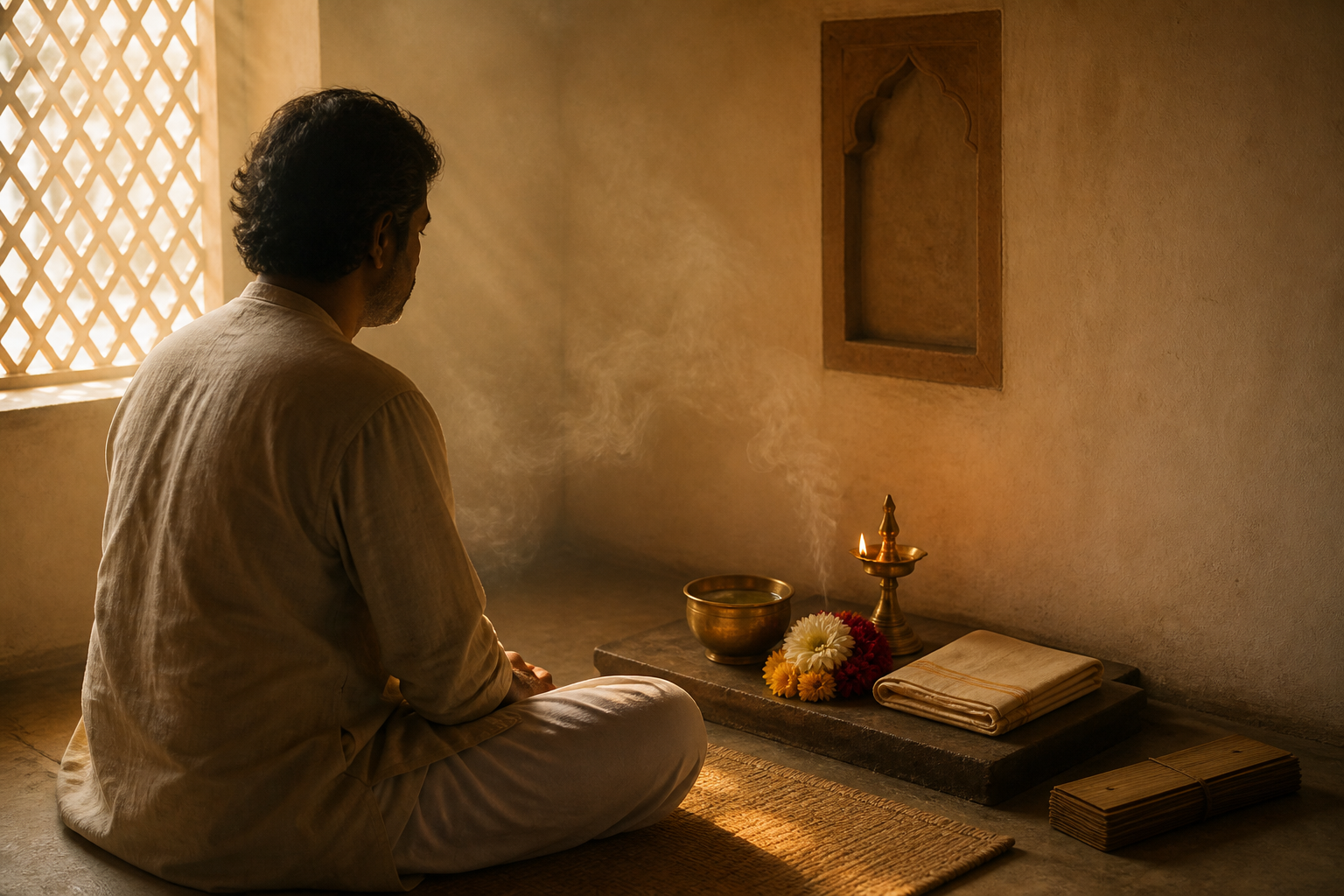
You do not have to remain spiritually inactive while seeking guidance. You can establish a simple rhythm of devotion and study without claiming that it is the technical ritual prescribed by the Parashurama Kalpasutra.
- Set a clear intention. Approach Devi for reverence, understanding and steadiness, not for spectacle, power or a dramatic experience.
- Prepare a clean, quiet place. If it is already part of your household worship and can be done safely, light a lamp or make a simple flower offering. Otherwise, sit respectfully without adding ritual objects.
- Begin with your established family prayer or a plain salutation to the Divine Mother. Do not copy a bija mantra merely because its syllables appear in print.
- Read one small unit of Chapter 1 as scripture. Identify its main principle, the action it appears to govern and any prerequisites you still need to clarify.
- Choose one ethical expression of the reading for the day: greater truthfulness, restraint in speech, attention to duty, cleanliness or reverence toward others.
- Record one precise question for future guidance, then close with gratitude. Stop there rather than filling the silence with invented ritual.
This routine is intentionally modest. Its purpose is to make you a more attentive student and devotee, not to imitate an initiated sadhana. If you already have a guru and received instructions, follow those instructions instead of a generic checklist.
You can also judge whether your approach is maturing by its ordinary effects. Srividya should not become an excuse to neglect family obligations, honest work, self-control or basic courtesy. Fascination with technical vocabulary is not the same as transformation. If your study increases humility, consistency and discernment, it is beginning to serve its proper purpose. If it produces only status claims and an appetite for more secrets, return to the fundamentals.
When seeking a teacher, ask about parampara, what may be taught openly, what requires diksha and how students are prepared and corrected. A trustworthy guide should be able to distinguish textual study from ritual authorization. Charisma, online visibility and possession of rare-looking material do not answer those questions.
Key takeaways for a serious Srividya seeker
- Treat the Parashurama Kalpasutra as a compressed map of an ordered tradition, not a self-executing ritual manual.
- Begin reading now, but classify each passage as principle, contemplation or procedure before acting on it.
- Assume that technical mantra, nyasa, mudra, yantra and tightly sequenced ritual require clarification unless your lineage has explicitly taught otherwise.
- Never combine isolated instructions from different manuals or lineages merely because they use similar terms.
- Continue simple Devi devotion and ethical discipline while you seek qualified guidance.
- Measure progress by steadiness, humility and responsible conduct, not by the quantity of esoteric material collected.
Your next step is concrete: take the first unit of Chapter 1, annotate it in the three passes above and carry the resulting questions to a teacher within a recognizable Srividya parampara. That is already a meaningful beginning because it replaces restless experimentation with attention, order and reverence.
References
