
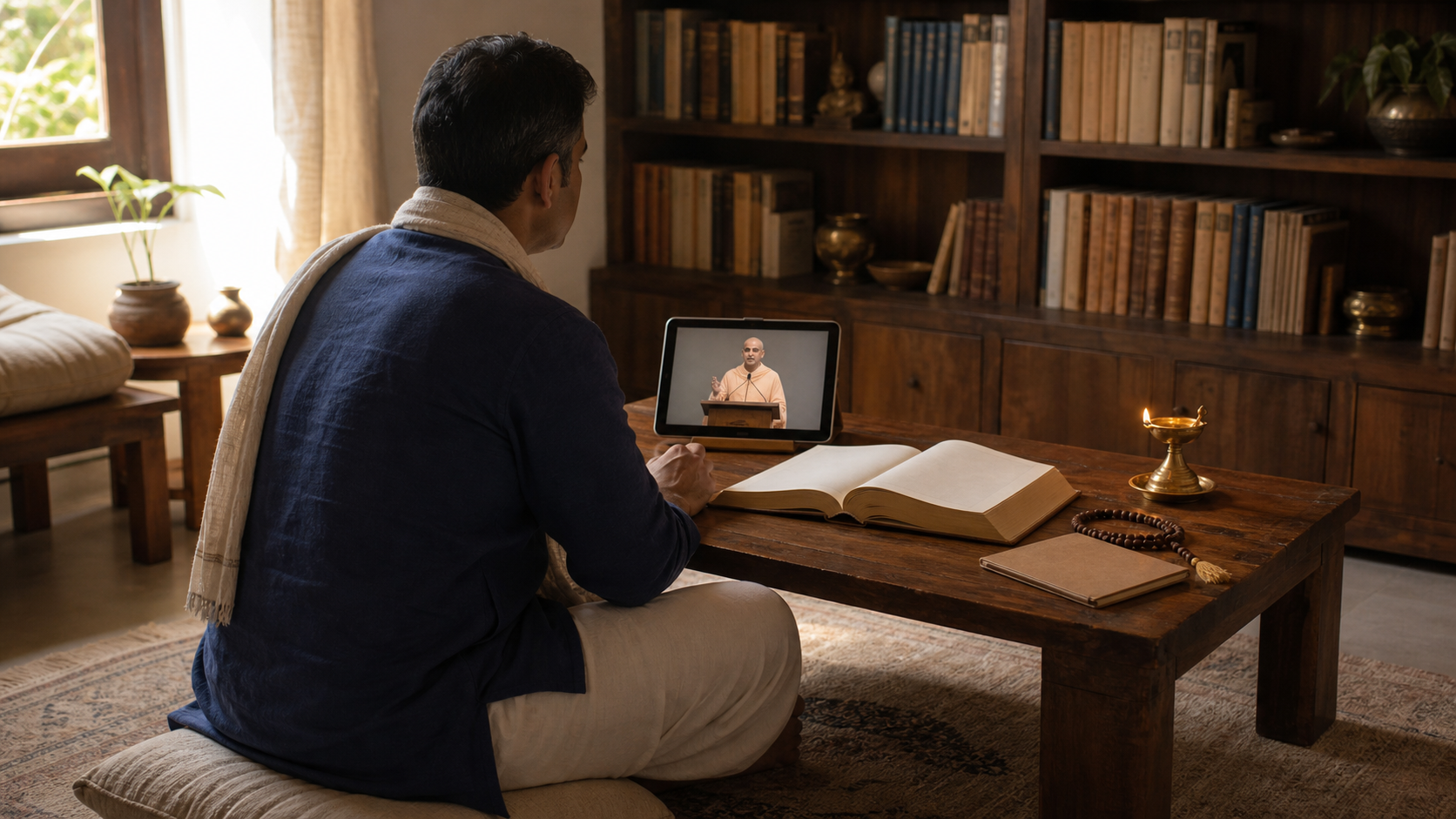
You open a Srimad Bhagavatam discourse because you want more than information. Yet an online queue can quietly turn sravana into passive consumption: one speaker leads to another, the named verse fades from view, and little remains once the talk ends. The useful question is not simply whether a discourse felt inspiring. It is whether you can return to the passage with clearer understanding and a more deliberate practice.
A living teacher can connect scripture, sacred occasion, doctrine, and daily conduct in ways that solitary reading may not. To receive that value without losing the Bhagavatam itself, anchor your listening in the verse address, choose a discourse for a defined purpose, distinguish the layers of what you hear, and carry something definite into your study or sadhana.
Begin with the exact scriptural address

The verse reference is not cataloguing trivia. It is your route back to the primary text. In the usual Canto.chapter.verse notation, 10.8.12 directs you to Canto 10, Chapter 8, Verse 12. A reference such as 11.03.54-55 identifies a consecutive passage in Canto 11, while 3.28.10-11 points to another paired selection. A leading zero is simply a formatting choice; the underlying locator remains the same.
Recent discourse listings show why this precision matters. A Lord Balarama Purnima discourse by HG Akhila Prabhu is anchored in 10.8.12, while Panca Gauda Prabhu addresses 11.03.54-55. A separate 3.28.10-11 discourse with H.G. Nitai Chandra Nimai Das offers another passage-level entry point. Speaker, occasion, and verse may all matter, but the verse is the stable coordinate you can verify and revisit.
Before listening, make a short preparation pass:
- Locate the named passage in the translation or edition being used. If the edition is not identified, choose a trusted edition and record which one you consulted.
- Read the selected verse or verses together with the immediately surrounding text. This reveals whether the passage begins a thought, continues one, or completes it.
- Mark the words of the verse, its translation, and any supplied commentary as distinct layers. You are not ranking them; you are learning what kind of statement you are reading.
- Write a brief paraphrase limited to what the selected passage explicitly communicates. Do not import the discourse into your paraphrase before you have heard it.
- Carry a live question into the session. It may concern a term, a transition between verses, the relevance of the sacred occasion, or the practical force of the passage.
This preparation prevents a common confusion. A speaker may begin with a verse and then range through wider theology, narratives, commentarial insights, analogies, or practical counsel. Such range can illuminate the text. Your open Bhagavatam gives you a return path, allowing you to notice what the verse states directly and what the teacher is bringing into conversation with it.
Choose a discourse for the need in front of you
Not every Bhagavatam discourse is trying to do the same work. On 27 August 2026, both the Balarama Purnima session on 10.8.12 and the session on 11.03.54-55 were presented. The shared date does not make them interchangeable. One explicitly joins a sacred observance to a named verse; the other identifies a different passage as its center.
Complete this sentence before you press play: “I am listening to understand…” Your ending should name a passage, an occasion, a question, or a part of your practice. If you can name only the speaker, you have not yet chosen a purpose.
- For textual continuity: follow discourses through the same chapter or narrative sequence. Stay with the sequence until you can see how one passage leads into the next.
- For a sacred occasion: choose a festival-centered discourse, then keep both the observance and the cited verse in view. Notice whether the occasion clarifies the passage rather than replacing it.
- For close study: select a tightly defined verse or verse pair. Read both parts of a paired selection and ask why they have been treated together.
- For a practical question: begin with the relevant passage, not a promising title alone. This gives you a basis for deciding whether the eventual application actually grows from the text.
A healthy listening practice can include all these forms, but it should have a spine. Continuous reading supplies that spine. Festival teachings, topical discussions, and individual speakers can then deepen the journey instead of fragmenting it into unrelated moments.
Separate the text, exposition, and application

Sravana is receptive, but it is not inattentive. Devotional openness does not require you to place every sentence in the same category. A verse, a translation, a traditional interpretation, an illustrative story, and a speaker’s practical recommendation can all be valuable while doing different kinds of work.
Use a simple note structure while listening:
- Text: record the precise verse reference and a faithful statement of what the selected passage says.
- Exposition: note the concepts, connections, and interpretive moves used to explain the passage.
- Illustration: identify analogies, stories, or contemporary examples. Treat them as aids to understanding, not as additional verses.
- Application: write the counsel being offered for conduct, remembrance, service, study, or another aspect of practice.
- Open question: preserve anything that needs checking in the surrounding chapter, a recognised commentary, or conversation with a qualified teacher.
This separation guards against two opposite mistakes. The first is reducing a living discourse to a transcript, as though interpretation and application were intrusions. The second is allowing an appealing analogy or forceful application to become indistinguishable from the words of the Bhagavatam. The better habit is to honour each layer and retain the relationship among them.
You can then assess a discourse without turning devotional hearing into a hostile fact-checking exercise. After the session, ask:
- Can you identify the named passage and explain why it mattered to the discourse?
- Was it clear when the speaker was quoting, paraphrasing, interpreting, or illustrating?
- Did the larger exposition eventually return to the verse?
- Did the practical counsel follow from the explanation, or was the scripture used merely as a launching point?
- If the discourse concerned a festival, did the occasion reveal something about the passage and the passage reveal something about the observance?
- Were unfamiliar or lineage-specific claims identified clearly enough for you to investigate them further?
Charisma can help a teacher hold attention, but it cannot by itself establish textual fidelity. Conversely, a restrained delivery is not evidence of greater depth. Judge the relationship among passage, explanation, and application rather than treating presentation style as the measure of authority.
When different speakers appear to disagree, first determine whether you have found a contradiction or simply a difference of emphasis. Write each claim plainly, locate its textual basis, and identify the interpretive tradition being invoked. If the difference remains substantial, bring the exact wording and verse to a teacher you trust. Do not flatten genuine distinctions, but do not manufacture conflict from isolated clips or paraphrases either.
Give every discourse an afterlife in your sadhana

The decisive part of a discourse often begins after the audio stops. If you immediately select another talk, the first teaching must compete with a fresh stream of ideas. A smaller sequence, revisited carefully, usually serves scriptural formation better than an expanding queue that you never digest.
Use this listening cycle:
- Before: open the passage, read its immediate context, and state the question you are bringing.
- During: take sparse notes under the distinct headings of text, exposition, illustration, application, and open question. Constant transcription can prevent actual hearing.
- After: close your notes and restate the passage and central teaching from memory. Reopen the Bhagavatam and correct what you blurred or omitted.
- Apply: translate relevant counsel into a definite change in attention, speech, service, study, remembrance, or conduct. Keep the application proportionate to what was actually taught.
- Return: revisit the named passage before choosing the next discourse. Record what became clearer and what still requires guidance.
Not every class needs to produce a new vow. Sometimes the honest result is a corrected misunderstanding, a term to investigate, a verse to memorise, or a question to carry to a teacher. Forced application can be as shallow as passive listening. The aim is faithful assimilation, not the appearance of constant spiritual novelty.
Over time, organise your listening around the Bhagavatam rather than around a feed. Let continuous reading determine your main route. Add festival discourses when the sacred calendar makes their setting meaningful. Compare teachers on the same passage only after you understand the passage well enough to recognise what each teacher is emphasising. This turns variety into depth instead of distraction.
Key takeaways
- Start from the exact Canto.chapter.verse address and read the surrounding context before listening.
- Choose the discourse for a stated purpose: continuity, sacred occasion, close study, or a practical question.
- Keep the scriptural text, the speaker’s exposition, illustrative material, and practical counsel distinct in your notes.
- Evaluate the connection between passage and application rather than relying on charisma, familiarity, or an attractive title.
- Return to the verse after the session and carry forward a concrete insight, practice, or unresolved question.
For your next discourse, choose the verse before you choose the voice. Open the Bhagavatam first, listen with the passage in view, and do not move on until you have named what the hearing clarified. That small discipline can turn an endless stream of spiritual content into sustained sravana.
References
- Dandavats – Srimad Bhagavatam
- Dandavats – HG Akhila Prabhu – Lord Balarama Purnima – Srimad-Bhagavatam 10.8.12 – 27/08/2026
- Dandavats – His Grace Panca Gauda Prabhu – SB 11.03.54-55 – 27-08-2026
- Dandavats – Srimad Bhagavatam Text 3.28.10-11 – Speaker H.G. Nitai Chandra Nimai Das
