
If you are planning Panch Dwarka, the first risk is surprisingly basic: visiting five Krishna temples is not enough unless they are the five destinations that belong to this named circuit. Dwarka and Bet Dwarka are separate stops, while two temples with nearly identical English names stand in different towns. A loose Krishna itinerary can therefore look complete on paper and still omit a destination.
You need two plans. The first is a fixed shrine checklist that preserves the scope of the yatra. The second is a live logistics sheet for current darshan hours, access arrangements, transport and the needs of your travelling party. Build them separately, and you can change the route without accidentally changing the pilgrimage.
Start with the five-shrine checklist, not a route map

Panch Dwarka comprises five Krishna destinations in Gujarat and Rajasthan: Dwarkadish Temple at Dwarka, Bet Dwarka, Ranchhodraiji Temple at Dakor, Shrinathji Temple at Nathdwara and Dwarikadhish Temple at Kankroli. Enter all five name-and-place pairs in your master plan before comparing routes or booking rooms.
| Planning cluster | Sacred destination | Town or place to record |
|---|---|---|
| Gujarat | Dwarkadish Temple | Dwarka |
| Gujarat | Bet Dwarka | Bet Dwarka |
| Gujarat | Ranchhodraiji Temple | Dakor |
| Rajasthan | Shrinathji Temple | Nathdwara |
| Rajasthan | Dwarikadhish Temple | Kankroli |
The town names are not optional labels. Dwarkadish Temple in Dwarka and Dwarikadhish Temple in Kankroli are distinct entries. If a booking note, family message or driver instruction says only “Dwarkadhish,” the similar names can create avoidable confusion. Use “Dwarkadish Temple, Dwarka” and “Dwarikadhish Temple, Kankroli” every time.
Keep Bet Dwarka separate as well. Reaching Dwarka does not, by itself, check Bet Dwarka off your list. Give it its own line for access, darshan arrangements and onward travel. This one habit prevents the most consequential kind of itinerary error: treating a nearby or similarly named destination as though it were already included.
Build the circuit in clusters, then choose your direction
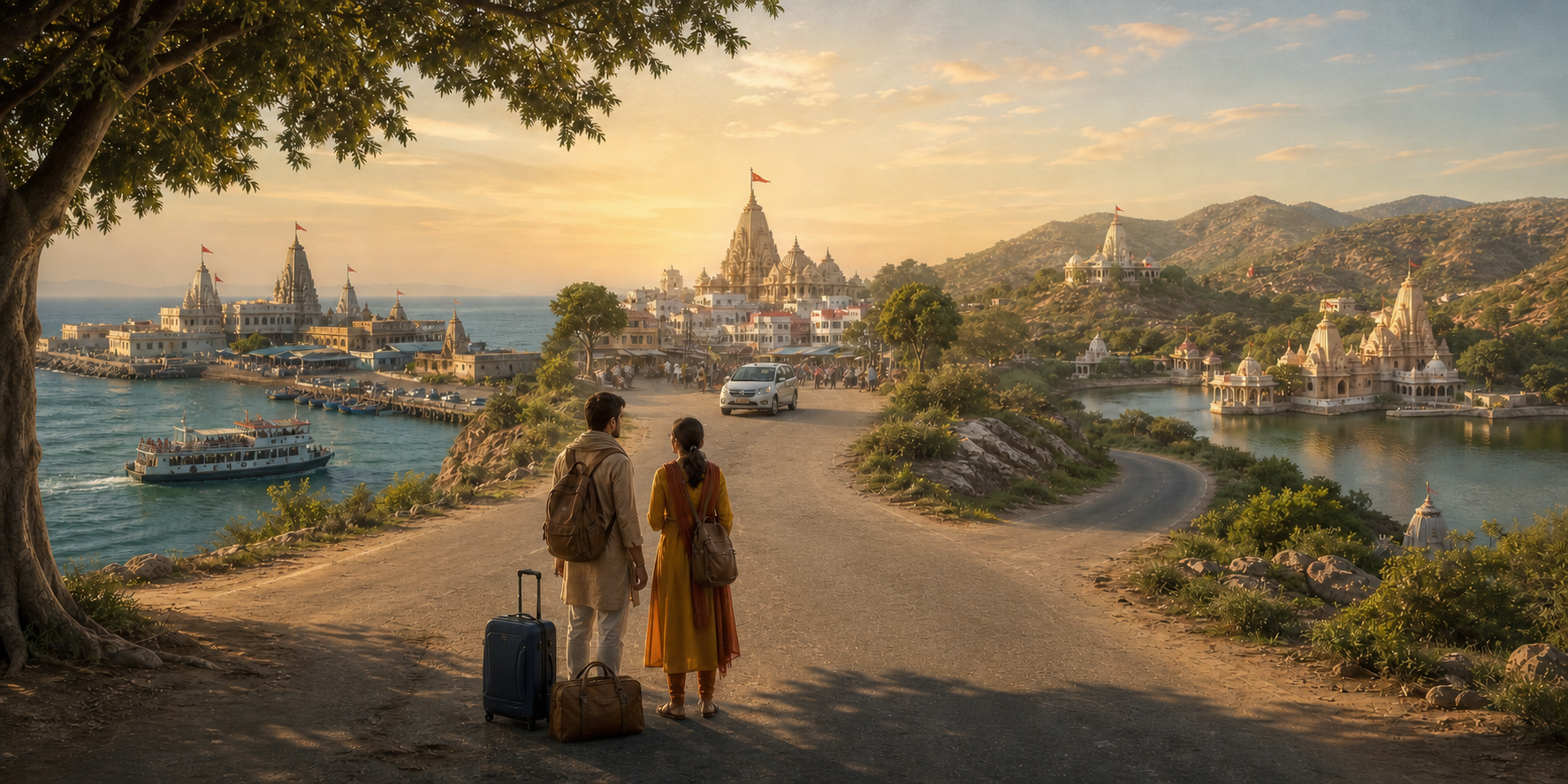
A numbered list of temples is not automatically an efficient travel order. Begin with two geographic planning blocks: the Gujarat destinations of Dwarka, Bet Dwarka and Dakor, and the Rajasthan destinations of Nathdwara and Kankroli. Then test a Gujarat-first plan against a Rajasthan-first plan.
- Mark your actual arrival point, departure point and any fixed family commitments.
- Place the three Gujarat destinations in one planning block and the two Rajasthan destinations in another.
- Check current point-to-point travel options for the mode you will really use. Do not build a road plan from rail timings or a rail plan from driving estimates.
- Verify the last-mile access to every shrine, especially Bet Dwarka, independently of the journey to its broader area.
- Compare the two directions for backtracking, forced late arrivals and dependence on a single fragile connection.
- Choose the direction that leaves the cleanest recovery window if a darshan or transfer takes longer than expected.
Do not place a non-refundable intercity departure immediately after the earliest possible end of darshan. A temple queue is not a scheduled appointment, and rushing through worship to protect a ticket defeats the purpose of the journey. Where the cost or schedule makes a missed connection serious, leave a later alternative rather than relying on a perfect exit time.
If you are travelling with an older person, a child or someone with limited mobility, “How far is it?” is not enough. Ask separately about the distance from the vehicle drop-off, standing time, stairs, seating, shade, toilets, permitted mobility aids and the possibility of leaving the queue safely. If those answers are uncertain, anchor the day around one principal shrine instead of stacking darshan against a demanding transfer.
Protect the yatra with a live darshan worksheet
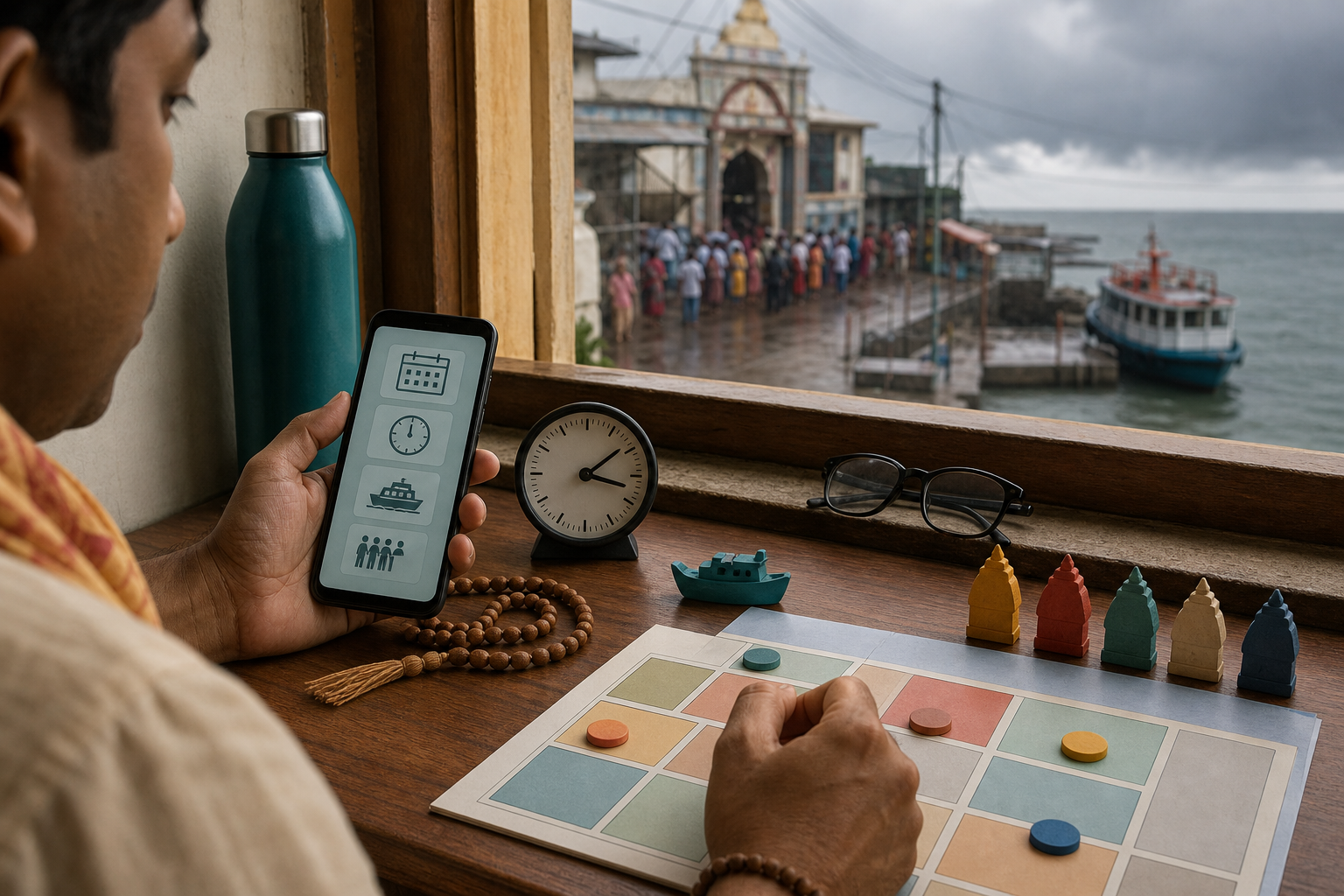
Temple hours and entry arrangements can change with the day, observance and local conditions. Treat any copied schedule as a lead to verify, not as a promise. Your fixed list tells you where you must go; your live worksheet tells you what is currently possible.
Create one row for each of the five destinations and add these fields:
- Planned date and an alternative date or time window.
- The darshan window you intend to use, plus any closure or break that affects it.
- Current entry and queue arrangements for the members of your party.
- Dress expectations and locally applicable temple etiquette.
- Rules for bags, phones, cameras, footwear and other items you may be carrying.
- Whether offerings should be brought, obtained locally or arranged through the temple.
- Vehicle drop-off, walking, stairs and accessibility information.
- The contact or person who confirmed the details, with the date of confirmation.
Verify twice when the journey involves costly or difficult connections: once before committing to transport and accommodation, and again close to the day of darshan. If your visit overlaps a major observance, ask about that date specifically. An answer for an ordinary day may not describe the arrangements you will encounter.
Keep the worksheet usable offline. Put the five temple-and-town pairs, accommodation details, essential confirmations and emergency contacts on one printed page or in a saved document that does not depend on mobile data. Each adult should know the next meeting point in case the group is separated.
Pack for attention rather than accumulation. Carry necessary identification, medicines and only the items permitted at the destination. Keep prescriptions and essential medication with the person who needs them, not in luggage that may be deposited elsewhere. Obtain offerings only after confirming the local practice; one temple’s customary arrangement should not be assumed at another.
Make five darshans feel like one pilgrimage
Logistics can keep the circuit intact, but they cannot supply its inner thread. Before leaving, write your sankalpa in one plain sentence: why are you undertaking Panch Dwarka, and what do you hope to offer, understand or carry home? This need not be elaborate. It needs to be clear enough to recall when delays begin to dominate the day.
- Name the intention. Keep one sentence in your travel notebook and read it before the first darshan of each day.
- Approach each destination on its own terms. Do not reduce Ranchhodraiji, Shrinathji, Dwarkadish and Dwarikadhish to interchangeable stops. Attend to the name and form of Krishna before you begin comparing buildings, queues or photographs.
- Respect local maryada. Ask before taking photographs, carrying an offering or entering an area when the practice is unclear. The correct response to uncertainty is a quiet question, not an assumption imported from the previous temple.
- Leave space after darshan. Record the destination, the prayer you brought and one thought or duty you are taking away. Even a few unhurried lines can prevent the journey from collapsing into transport memories.
- Close the circuit deliberately. After whichever destination completes your five-shrine plan, check the list once, offer gratitude and decide on one concrete act of remembrance, study, seva or personal discipline to continue at home.
If you are travelling as a family, agree on the purpose before departure. One person may seek prayer, another historical connection and another simply the chance to accompany an elder. Those motives can coexist. What causes friction is leaving them unspoken while one person treats every pause as sacred and another treats it as a delay.
Assign practical roles without turning the yatra into an operation: one person keeps current confirmations and tickets, one watches the needs of elders or children, and every adult knows the next destination by its full name and town. Shared clarity frees the group to be present during darshan.
Key takeaways
- Panch Dwarka means five specific destinations: Dwarka, Bet Dwarka, Dakor, Nathdwara and Kankroli.
- Keep Dwarkadish Temple at Dwarka distinct from Dwarikadhish Temple at Kankroli in every note and booking.
- Plan Gujarat and Rajasthan as geographic clusters, but choose your direction from current connections and your real arrival and departure points.
- Give Bet Dwarka its own access and darshan line; do not treat arrival in Dwarka as completion of both destinations.
- Verify temple arrangements directly and close to the visit, especially when a missed connection would be costly.
- Carry one sankalpa through all five darshans so the circuit remains a pilgrimage rather than a collection of check marks.
Open a blank sheet now and enter the five name-and-town pairs exactly as listed above. Add current access and darshan confirmation beside each one before you buy transport. That small discipline gives you a Panch Dwarka plan that can absorb changes without losing either a shrine or the attention you meant to bring to it.
References
