
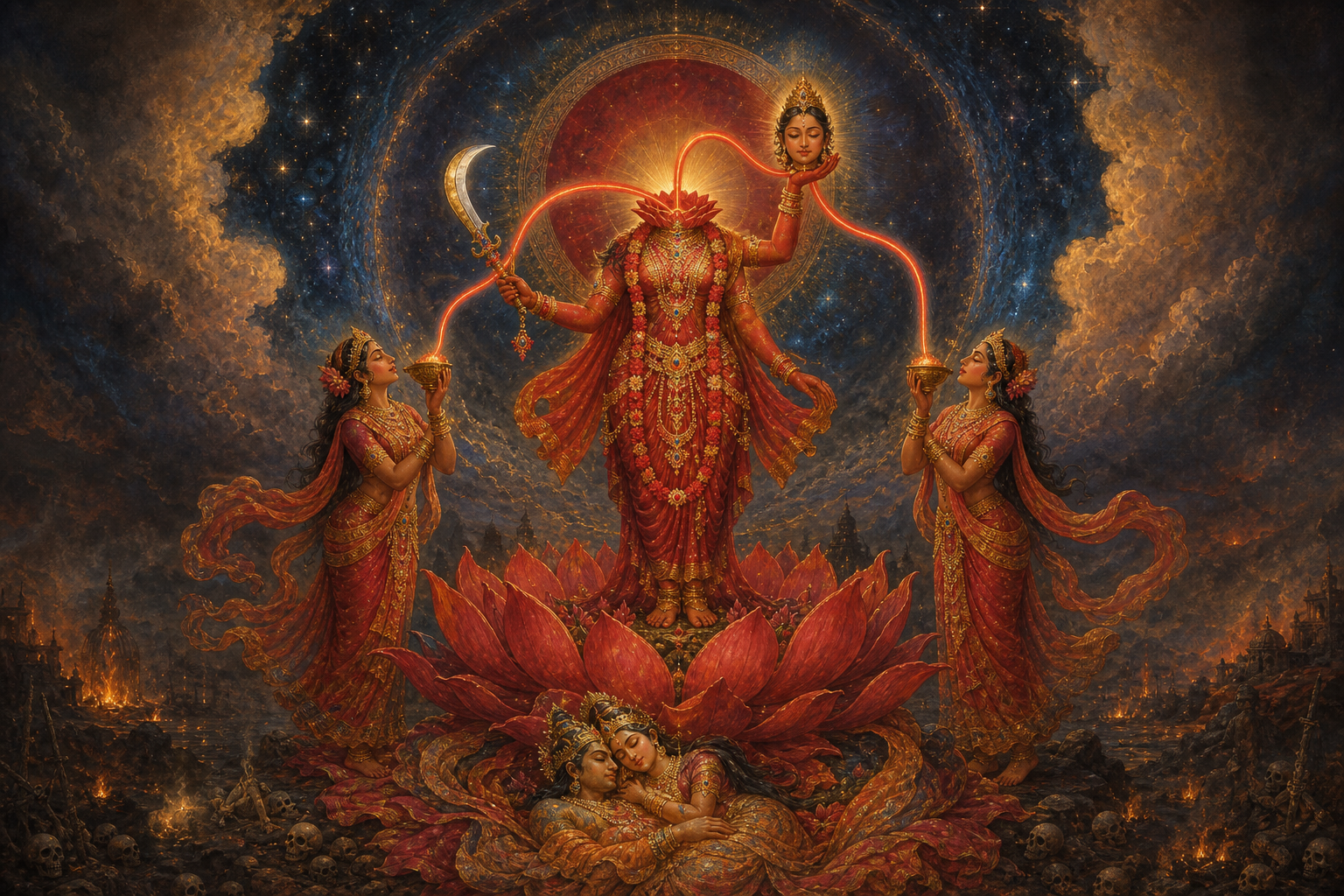
If Chinnamasta’s image leaves you unsure whether you are looking at terror, sacrifice, sexuality, or spiritual liberation, don’t resolve that discomfort too quickly. The apparent contradictions are not obstacles placed between you and the meaning. They are the means by which the meaning is communicated.
The most useful question is therefore not, “What does this one disturbing feature mean?” Ask instead: “Why must these opposing forces appear together?” That shift lets you read the image as a Tantric composition rather than as an isolated scene of violence or eroticism.
Read the whole composition before interpreting its shock
Chinnamasta is self-decapitated, yet she is not presented as a simple image of defeat. She joins sexual generation to dissolution and sacrifice to nourishment. Her imagery therefore refuses the ordinary habit of placing life on one side and death on the other. It presents them as mutually implicated processes.
This is the first rule for reading her symbolism: do not detach one element from the visual argument made by the whole. A severed head viewed alone may seem to signify only death. A copulating couple viewed alone may seem to signify only fertility or desire. Chinnamasta’s composition brings maithuna and pralaya into the same field, making creation and dissolution answer one another.
Use this four-part reading method whenever you encounter the image:
- Name what the image shows without immediately judging it: self-decapitation, sexual union, life, death, nourishment, and sacrifice.
- Pair the apparent opposites: generation with dissolution, nourishment with self-offering, vitality with mortality.
- Ask what is lost when either side is removed. Creation without dissolution becomes endless accumulation; dissolution without creation becomes sterile negation.
- Interpret the relationship among the symbols before assigning a fixed meaning to any one of them.
This method protects you from two common errors. The first is sensationalism, which treats Chinnamasta as little more than a frightening spectacle. The second is domestication, which softens the image until its severity disappears. A serious reading does neither. It allows the symbols to remain difficult while asking what their arrangement reveals.
Self-decapitation makes sacrifice an active principle
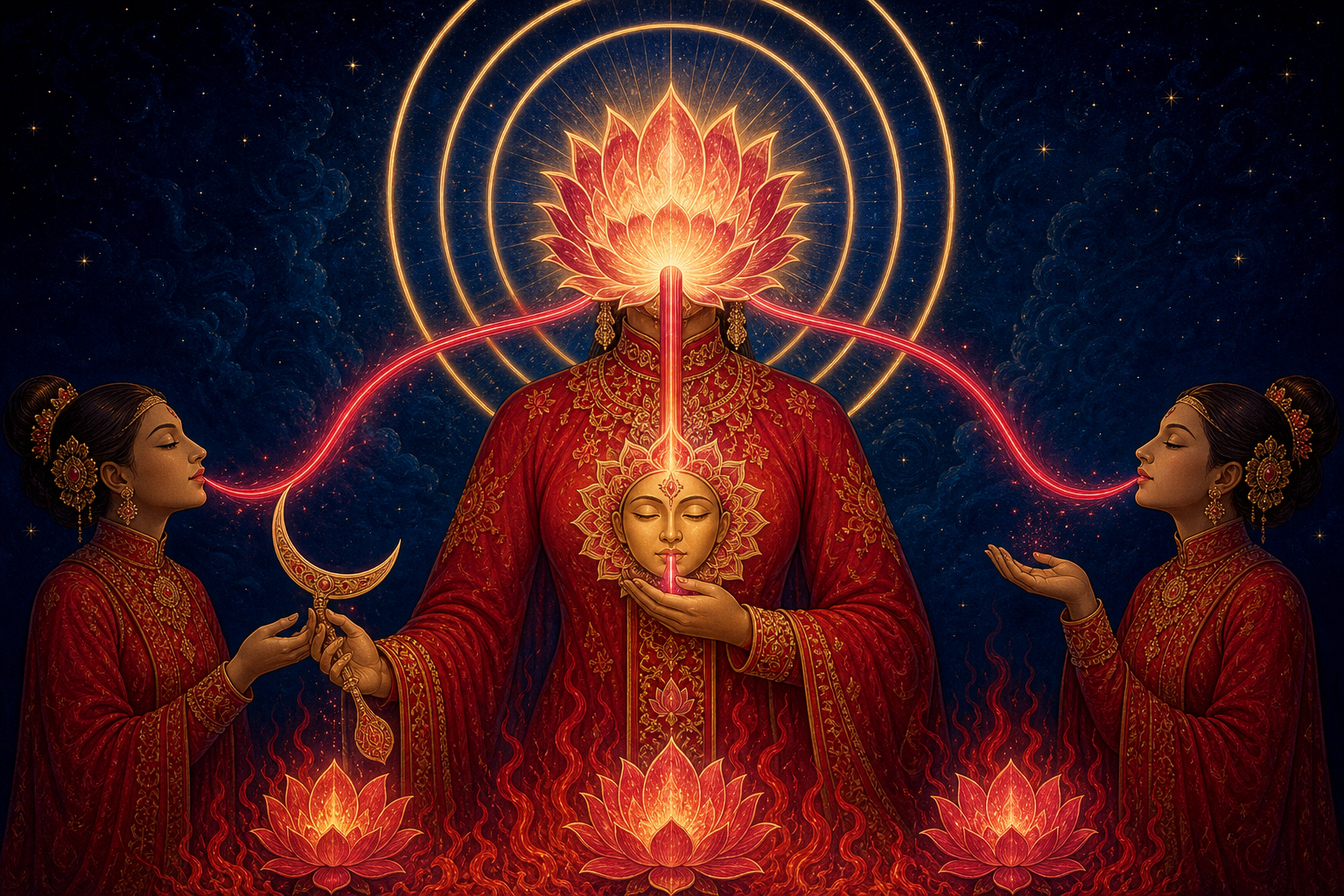
The decisive feature is that Chinnamasta is self-decapitated. The action is not represented as something merely inflicted upon a helpless figure. That distinction changes the symbolic question from “Who destroyed her?” to “What does deliberate self-offering make possible?”
It would still be a mistake to reduce the act to a slogan about “destroying the ego.” That phrase can become so broad that it explains almost nothing. Chinnamasta’s symbolism is sharper. Her sacrifice remains connected to vitality and nourishment. The image does not allow self-offering to mean passive collapse, self-hatred, or the glorification of harm.
A useful distinction is between sacrifice and mere loss. Mere loss leaves only deprivation. Sacrifice relinquishes something within a larger movement of life. Chinnamasta forces you to ask whether what is surrendered actually nourishes anything worthy, or whether “sacrifice” is being used to dignify needless suffering.
You can apply that distinction to ordinary decisions without imitating the physical imagery. When a duty, attachment, ambition, or habit demands a cost, ask three precise questions:
- What is being relinquished? Name the time, status, comfort, possession, or attachment rather than calling it vaguely “the ego.”
- What is being nourished? Identify the person, responsibility, practice, or principle that genuinely receives life from the offering.
- Does the offering sustain dharma or merely enable harm? An act does not become sacred simply because it hurts.
This last question matters. Tantric symbolism is not a command to reproduce every represented act literally. Self-decapitation belongs to the icon’s symbolic grammar; it is not a model for bodily harm. Its practical demand is discernment about attachment, expenditure, and transformation.
Maithuna and pralaya must be understood together
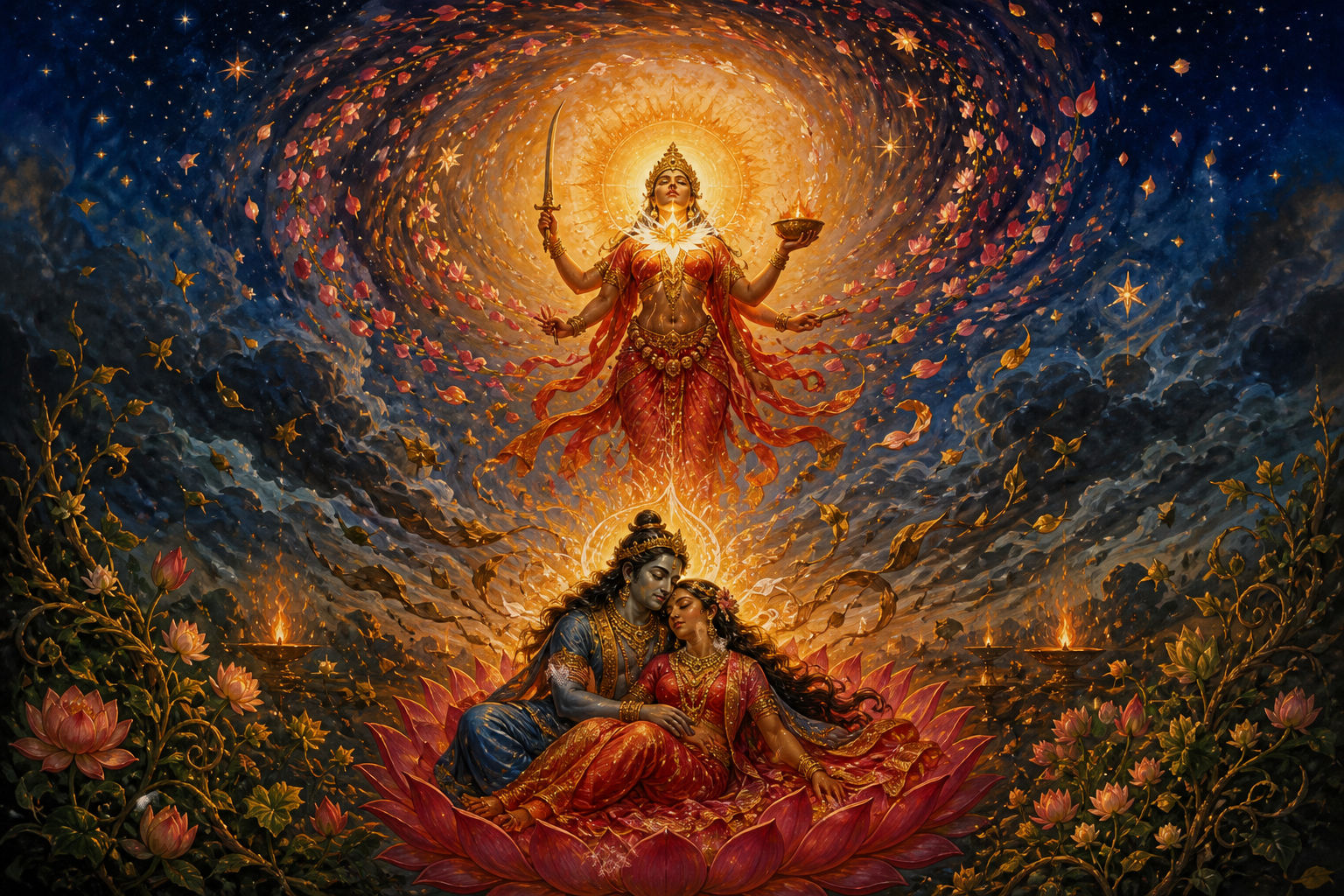
Chinnamasta is commonly shown standing upon a copulating couple. In this composition, maithuna carries the force of sexual energy and life-creation. Pralaya carries destruction or dissolution. Their conjunction prevents a one-sided reading of either.
If you see only maithuna, the image can be misread as an endorsement of desire for its own sake. If you see only pralaya, it can be misread as a rejection of embodied life. The composition holds both: the same existence that generates forms also dissolves them. Chinnamasta does not stand outside this movement as though spirituality required disgust toward life. She reveals its total pattern.
This also clarifies what Tantric paradox is doing. It is not placing random opposites side by side to seem mysterious. It confronts a mental division that ordinary thinking prefers to preserve: pleasure here, death there; birth here, destruction there; receiving here, sacrifice there. Chinnamasta makes that division difficult to maintain.
When you look at the couple beneath the goddess, notice the level at which you react. Prudish rejection and voyeuristic fascination are opposite reactions, but both can stop at the sexual surface. Move past that surface by asking what maithuna contributes to the entire composition: generative power, continuity, and the arising of life. Then ask why the goddess of self-decapitation must appear in immediate relation to it. The answer lies in impermanence: whatever arises participates in the conditions of its own eventual dissolution.
That insight need not produce pessimism. Dissolution is not presented as an external accident that renders creation meaningless. It belongs to the same field. The symbol asks you to value life without pretending that any form can be possessed permanently.
Key takeaways for reading Chinnamasta’s image
- Begin with relationships among the symbols, not with the most shocking detail in isolation.
- Read self-decapitation as deliberate self-offering within a larger movement of vitality, not as a celebration of injury or defeat.
- Understand maithuna as generative sexual energy and life-creation within this symbolic setting.
- Understand pralaya as dissolution, not merely as violence detached from creation.
- Keep nourishment and sacrifice together: a meaningful offering must sustain something, not merely cause deprivation.
- Reject both sensationalism and sanitisation. The disturbing features carry meaning and should neither be exploited nor erased.
- Do not turn symbolic imagery into improvised ritual or literal conduct.
Bring the paradox into practice through one real decision

Chinnamasta becomes practically useful when her paradox sharpens your judgement. Choose one situation in which you are trying to preserve something that cannot remain unchanged: a role, an expectation, a possession, a relationship pattern, or an idea of yourself. Do not begin with a grand declaration of renunciation. Begin by identifying the actual movement of creation and dissolution already present.
- Write one sentence naming what is coming into being.
- Write one sentence naming what must end, loosen, or change for that emergence to continue.
- Name who or what will be nourished by the change.
- Name the cost, including any cost being imposed on someone else.
- Choose one bounded action that honours both realities, such as ending an unsustainable commitment, redirecting time toward a duty, or releasing an expectation that obstructs necessary change.
The fourth step keeps the exercise honest. People sometimes romanticise their own sacrifice while leaving others to bear its consequences. Chinnamasta’s union of sacrifice and nourishment gives you a stricter test: the offering should participate in life rather than make suffering appear spiritually impressive.
If you want to move beyond contemplation into formal Tantric worship, seek instruction within a competent living tradition. An icon can guide reflection, but it cannot by itself provide the safeguards, context, or discipline of an initiated practice.
The next time you encounter Chinnamasta, resist the urge to decide immediately whether the image is erotic, terrifying, life-affirming, or destructive. Hold the categories together long enough to see what the goddess demands of your attention: life is nourished through expenditure, creation does not escape dissolution, and spiritual clarity begins when you stop protecting yourself from that relationship.
References
