
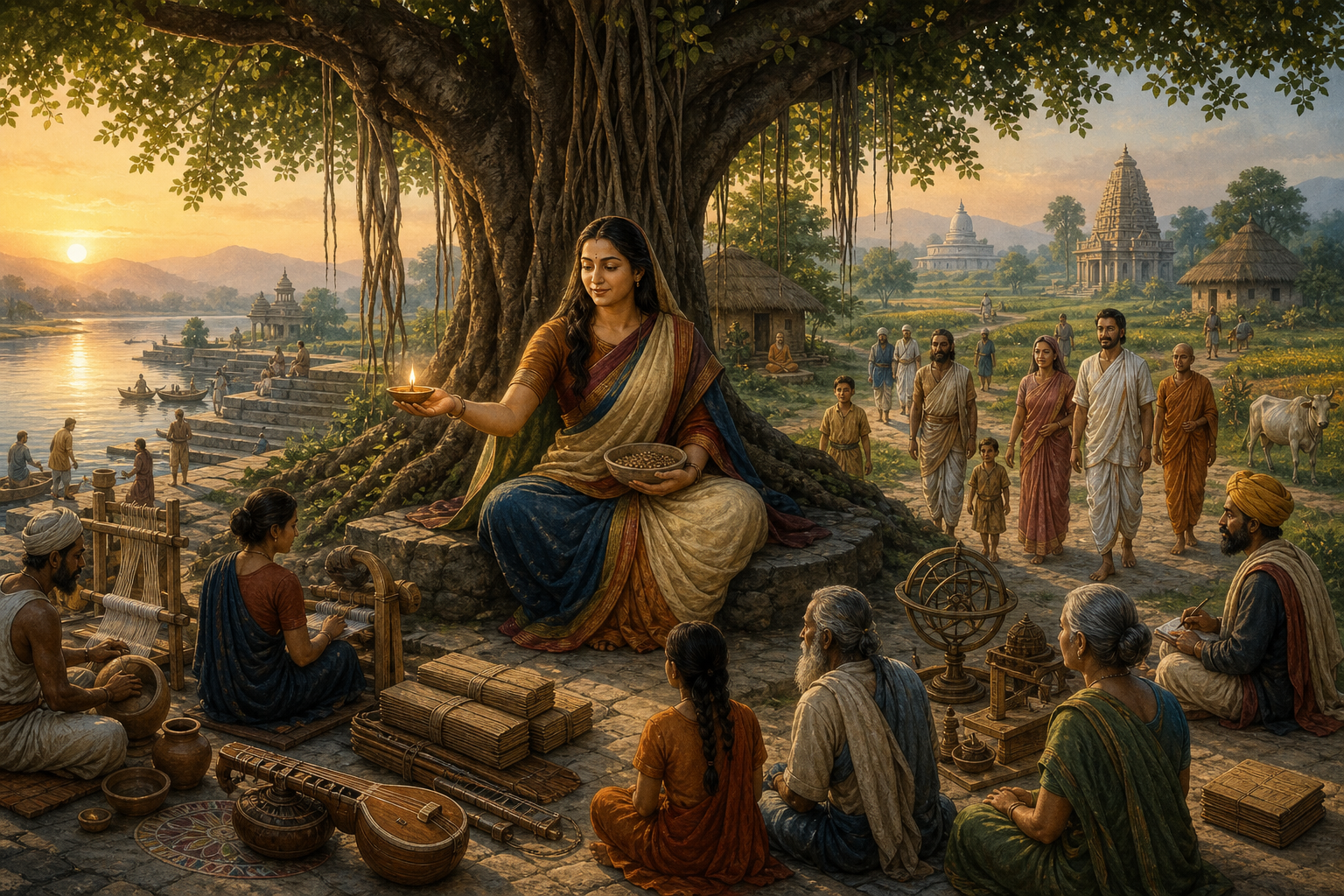
You may already feel the truth of Bharat Mata, yet still hesitate when someone asks what the phrase actually means. Is it another name for patriotism? Does it refer to territory, culture, or a spiritual presence? And what does calling Bharat a mother require from you?
A useful answer must go beyond emotion. To call Bharat a civilizational mother is to say that generations have been nourished by her accumulated ways of seeking truth, ordering life, forming character, and transmitting wisdom. It also places a duty on the recipient: receive that inheritance carefully, practise it honestly, protect its living institutions, and pass it on without distortion.
Begin with the distinction modern politics blurs

A state is a structure of law, administration, borders, and political authority. A nation is a people conscious of a shared public life. A civilization is deeper and longer: it carries memories, sacred geographies, languages, arts, disciplines, institutions, moral vocabularies, and enduring questions about human existence.
Bharat can be understood at all three levels, but they aren’t interchangeable. Governments change. Policies can be supported, opposed, or corrected. Civilizational memory survives across such changes because it lives in families, lineages, places of worship, schools, festivals, philosophical debates, artistic forms, and daily conduct.
In the spiritual vision associated with Sri Aurobindo and the Mother, Bharat is a living spiritual reality rather than only a territorial, political, or economic unit. This is a spiritual interpretation of civilization, not a category that can be established through a census or reduced to a government programme. Its value lies in the relationship it asks you to form with the civilization.
That distinction prevents two serious errors. The first is treating every action of the state as sacred merely because the civilization is sacred. The second is measuring civilizational loyalty only through conformity to a political party or policy. You can revere Bharat while criticizing a government, correcting a false historical claim, or demanding better institutions. In fact, care without correction is usually sentimentality rather than responsibility.
Complete this sentence as precisely as you can: I call Bharat a mother because she has transmitted… If your answer stops at birthplace, ancestry, or political pride, you have described attachment but not yet civilizational motherhood. Name what was transmitted: a discipline, a philosophical question, a language, a form of worship, an ethical commitment, an artistic tradition, or a way of relating material life to spiritual purpose.
This also explains why political independence cannot be the final measure of civilizational renewal. Within this vision, independence is the beginning of Bharat’s work, not its completion. A sovereign state may still neglect its knowledge traditions, imitate unsuitable models, abandon civilizational confidence, or use inherited symbols without embodying their disciplines.
Motherhood means transmission, not possession
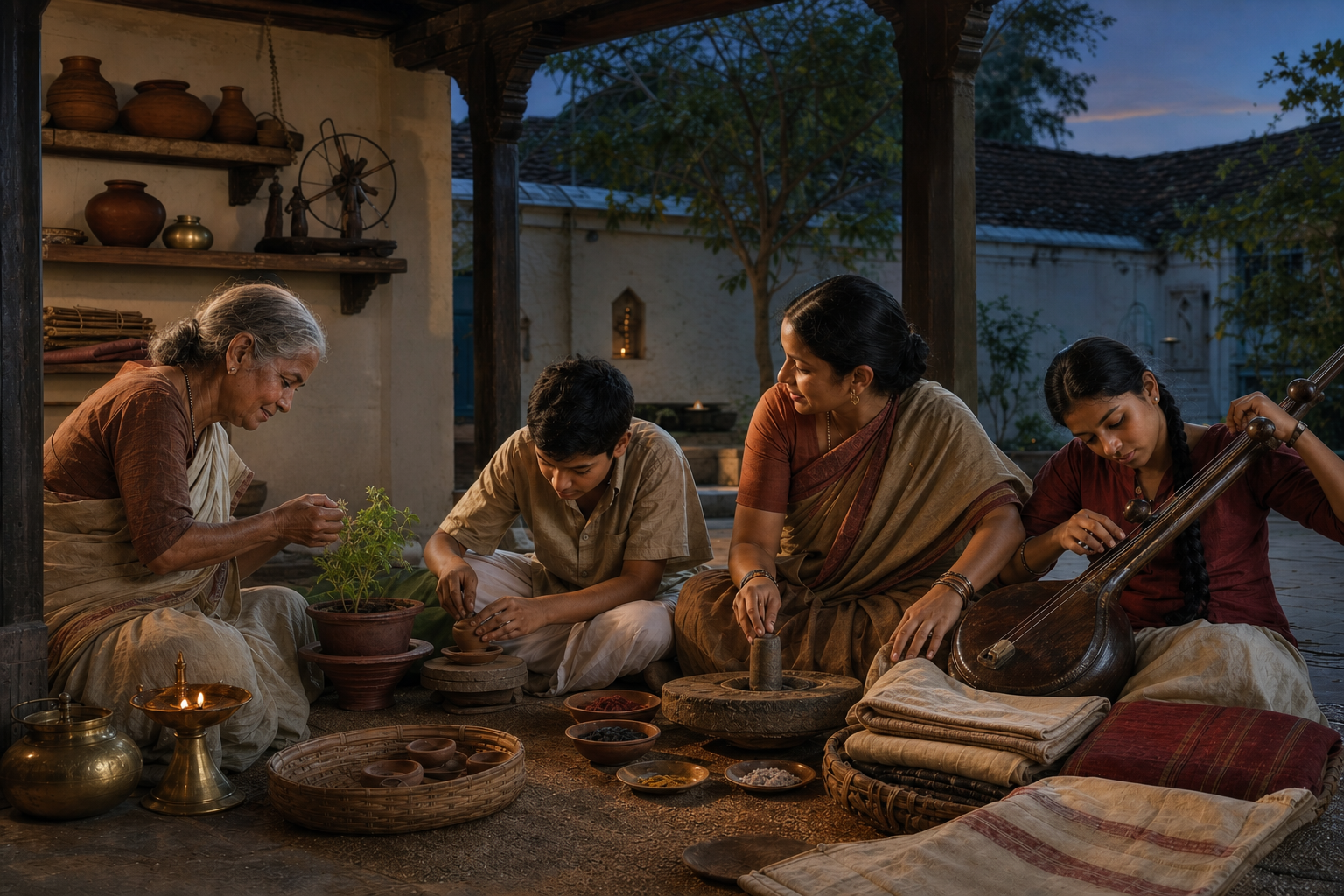
The maternal image is powerful because a mother does more than mark an origin. She nourishes, forms, teaches, restrains, and prepares the next generation to act independently. Applied to civilization, motherhood names a process of transmission. It doesn’t turn the land into property owned by whichever group can shout the loudest.
Bharat’s civilizational distinctiveness, in this understanding, lies in a sustained search for truth carried by generations of rishis, yogis, thinkers, and seekers. The inheritance is therefore not merely a collection of conclusions. It includes methods: disciplined inquiry, debate, contemplation, ethical restraint, devotion, self-observation, service, and the testing of teachings in life.
This point matters because civilizational pride can become strangely passive. People defend a scripture they haven’t opened, praise a language they make no effort to learn, invoke a guru whose discipline they don’t follow, or celebrate a sacred site while ignoring the institution that maintains it. The symbol remains visible while the transmission underneath it weakens.
To reverse that pattern, examine one inheritance through three questions:
- What did you receive? Name the teaching, practice, text, language, art, institution, family observance, or moral habit. Avoid answering with a vague word such as culture.
- What does it ask you to do? Identify its discipline, not just its symbolism. A living inheritance places some demand on attention, conduct, study, restraint, worship, or service.
- How will it pass through you? Decide whether you will practise it, support a carrier of the tradition, teach it accurately, preserve a record, or create the conditions for someone more qualified to transmit it.
Shared civilizational origin does not mean shared creed. Hindu, Buddhist, Jain, and Sikh traditions retain their own teachings, authorities, practices, and accounts of the highest human aim. Even within Hindu traditions, metaphysical conclusions and paths differ. The mother image is strongest when it can hold such distinctions without denying kinship.
So don’t defend Dharmic unity by claiming that every path says the same thing. That erases the very traditions you mean to honour. State the kinship, name the difference, and let each tradition describe itself in its own vocabulary.
Belonging is measured by relationship, not blood alone

The language of mother and children can easily be misread as a claim about biological descent. Civilization doesn’t work so narrowly. Birth may give you early access to a language, ritual, community, or family memory, but it gives no automatic understanding of them. Conversely, birth outside a Dharmic family doesn’t prevent serious study, reverence, service, or disciplined participation.
It is more useful to notice three ways a person can stand in relation to a civilization:
- Inherited participation: You received a tradition through family or community. Your task is to move from familiarity to understanding rather than assuming that custom explains itself.
- Chosen participation: You approached a tradition through study, practice, or a teacher. Your task is to honour its origin, accept its discipline, and resist extracting attractive techniques from their ethical setting.
- Civic stewardship: You may not practise a particular Dharmic path, yet you can protect the freedom, institutions, heritage, and truthful representation of the civilization in which you live.
These relationships can overlap. What matters is reciprocity. If you receive language, meaning, community, beauty, or spiritual direction from a civilization, ask what you return to the people and institutions carrying it.
If you live in the diaspora, start with what remains alive rather than manufacturing a grand identity from slogans. Ask an elder or practitioner about one observance. Learn its proper name and purpose. Record a family explanation with permission. Find out which details are local custom and which belong to a wider tradition. A small piece of accurate transmission is worth more than a large performance of certainty.
If you came to a Dharmic tradition by choice, use its own teachers and categories before translating everything into a more familiar framework. Credit where a practice comes from. Don’t rename it to make it appear detached from Bharat. At the same time, don’t claim authority that your study or initiation doesn’t give you.
If your relationship is primarily political, keep civilization and regime separate. Defending Hindus from misrepresentation, protecting Dharmic institutions, or arguing for Bharat’s interests doesn’t require pretending that every leader, policy, or popular historical claim is correct. A civilizational advocate gains credibility by being exact about both achievement and failure.
Five tests keep reverence honest
A sacred metaphor should sharpen judgment, not suspend it. Use these tests whenever you encounter a speech, campaign, institution, educational programme, or personal habit presented as service to Bharat.
- The truth test: Does the claim distinguish documented history, theological belief, philosophical interpretation, and future aspiration? Each has value, but they are not the same kind of statement. If a historical assertion is weak, sacred language cannot make it strong.
- The distinctiveness test: Are Hindu, Buddhist, Jain, and Sikh voices allowed to describe themselves accurately? Civilizational kinship becomes careless when it flattens genuine differences or recruits every tradition into one modern political formula.
- The duty test: What concrete obligation follows from the reverence being expressed? Look for study, ethical conduct, institutional support, conservation, teaching, service, or protection. If nothing changes beyond vocabulary, the claim is decorative.
- The integration test: Does the proposal join inner development with material competence? Bharat’s civilizational vocation has been framed as a harmony of spiritual aspiration and worldly achievement, not a choice between poverty with piety and prosperity without purpose. A school still needs sound teaching; a temple still needs honest administration; a cultural institution still needs competent preservation.
- The transmission test: Can a younger or less informed person actually receive what is being protected? A locked archive, unexplained ritual, inaccessible lecture, or untranslated memory may possess value but remain unable to reproduce itself. Preservation is complete only when someone can learn.
When something fails one of these tests, the answer isn’t necessarily to reject it. Correct the history, restore the distinction, name the missing duty, improve the institution, or build a path of transmission. The tests turn criticism into repair.
Practise the idea for four weeks
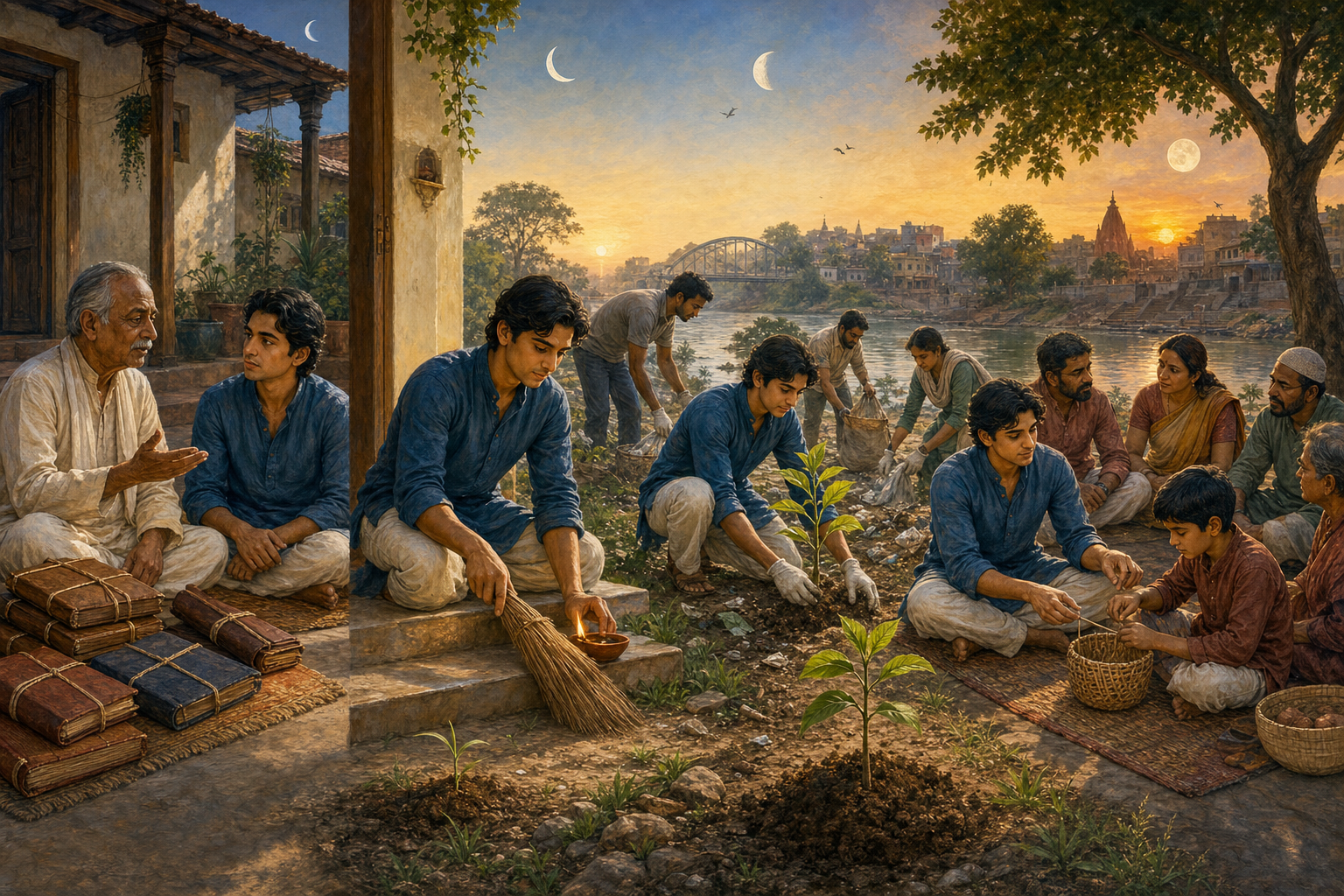
If Bharat as mother matters to you, give the phrase one month of disciplined attention. Keep the scope narrow enough to finish.
- Week one: define the relationship. Write one sentence naming what Bharat has transmitted to you. Then label each part as inherited memory, established fact, spiritual conviction, or aspiration. This immediately shows where you need study.
- Week two: deepen one inheritance. Choose a single practice, teaching, text, language form, artistic tradition, or historical institution. Find its originating tradition and learn from a reliable carrier of that tradition. Focus on the question it addresses and the discipline it requires.
- Week three: serve a carrier. Support one place where transmission actually happens: a family archive, library, temple, ashram, vihara, Jain centre, gurdwara, language class, heritage project, teacher, or community group. Offer the kind of help it needs rather than the kind that displays you.
- Week four: transmit accurately. Explain what you learned to one other person, or preserve it in a short written or recorded form. Name the tradition it belongs to, separate fact from interpretation, and invite correction from someone more knowledgeable.
At the end of the month, ask what changed in your conduct. Did you become more accurate, more disciplined, more useful to a living institution, or more capable of explaining a tradition without flattening it? If not, adjust the practice before expanding the claim.
Key takeaways
- Bharat as civilizational mother names a spiritual and moral relationship, not merely a political identity.
- Civilization, state, and government overlap, but none should be mistaken for the others.
- Dharmic kinship does not require Hindu, Buddhist, Jain, and Sikh traditions to become the same.
- Birth can provide access to an inheritance; practice, service, and truthful transmission show what you have done with it.
- Reverence becomes credible when it produces accuracy, self-discipline, competent institutions, and something the next generation can receive.
Begin with the unfinished sentence: Bharat has mothered me by… Fill it with one precise inheritance. Then choose one act of study and one act of service that will keep that inheritance alive. A civilizational mother is honoured most clearly when what she gave you becomes more truthful, more practised, and more available to those who come after you.
References
