
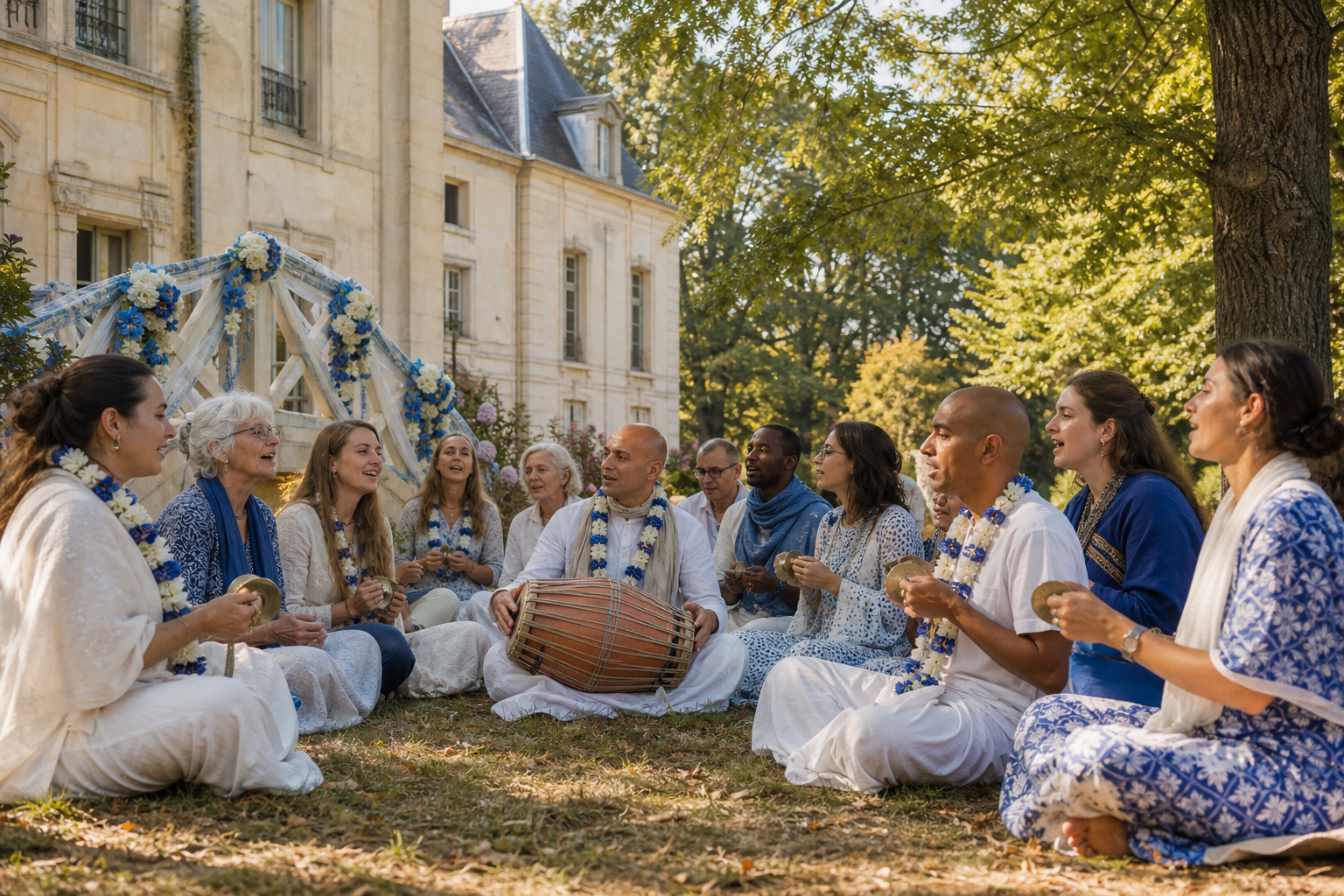
If you came looking for a schedule, a recording, or a reliable account of Balarama Festival 2026 at New Mayapur, the firm answer is narrower than a complete festival programme. You can verify an afternoon kirtan dated 24 August 2026 and a lecture dated 25 August 2026 by Sruta Kirti Prabhu, presented through ISKCON New Mayapur in France.
That gives you a useful path into the festival, but it does not establish every session, its exact timing, or the practical arrangements for attending. Here is how to separate what is confirmed from what still needs checking, and how to engage with the kirtan and lecture as devotional practice rather than background media.
What is confirmed, and what you should not assume

The dated festival material identifies two distinct forms of participation. The 24 August entry is an afternoon kirtan. The 25 August entry is a lecture by Sruta Kirti Prabhu. Those labels confirm festival moments on both dates; they do not prove that the entire festival began on the former date or ended on the latter.
A date and the word afternoon are not a travel itinerary. They do not tell you the local start time, duration, admission arrangements, language, accommodation, transport, accessibility, meal arrangements, or whether the available media represents the complete programme. If you are reconstructing the event or using it to plan a future visit, confirm those matters directly with the temple before booking transport or lodging.
If your aim is to find the festival media, keep the date, format, festival name, and speaker together when searching within the ISKCON New Mayapur channel. The most useful combinations are:
- 24 August 2026, afternoon kirtan, Balarama Festival, New Mayapur
- 25 August 2026, Sruta Kirti Prabhu lecture, Balarama Festival, New Mayapur
This matters because event channels often contain many devotional recordings with similar titles. Searching only for Balarama or kirtan may bury the relevant entry among unrelated results. The date-and-format combination is the better identifier.
Key takeaways
- You can firmly identify an afternoon kirtan on 24 August 2026 and a lecture by Sruta Kirti Prabhu on 25 August 2026.
- Both are associated with Balarama Festival 2026 at ISKCON New Mayapur in France.
- The labels are enough to locate and follow the festival media, but not enough to infer a complete programme or visitor arrangements.
- If you have time for both, approach the kirtan as preparation of attention and the lecture as direction for that attention.
- Complete the experience by turning something you hear into a definite act of seva.
Use the kirtan and lecture as complementary practices
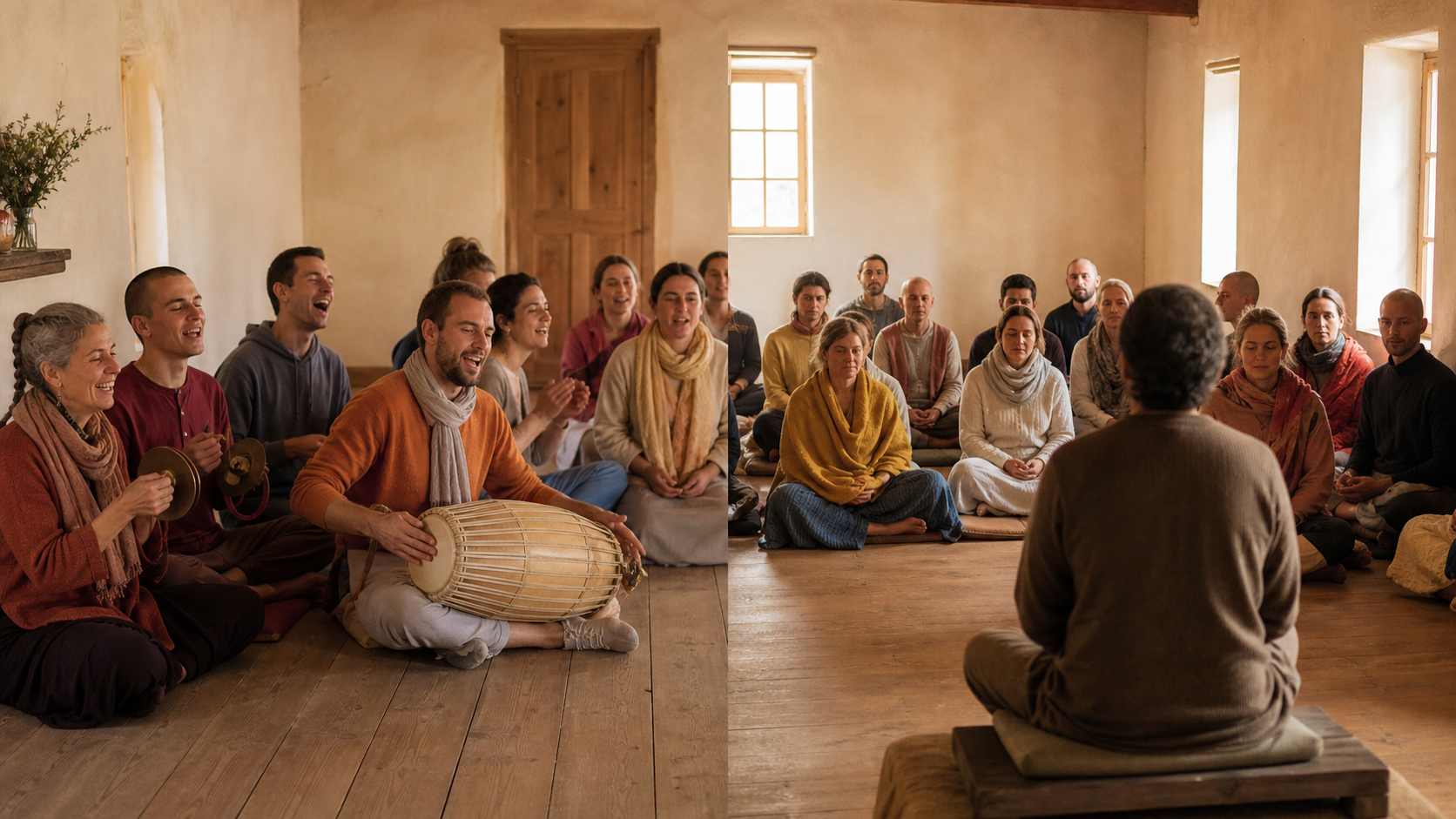
Kirtan and a lecture ask different things of you. Kirtan is participatory: repetition gathers a scattered mind and places sacred sound at the centre of attention. A lecture is reflective: it gives language, distinctions, and instruction to the devotional mood. Consuming either casually can flatten its purpose. Engaging with them in sequence lets each do its own work.
If you have enough time for both, follow the dated order. Begin with the 24 August afternoon kirtan, then hear the 25 August lecture. You are not merely reproducing chronology. You are moving from gathered attention to considered understanding.
- Set aside a distraction-free period. Do not make the kirtan incidental sound while scrolling, messaging, or doing unrelated work.
- Join the repeated sacred names if they are familiar to you. If they are not, listen respectfully and notice how repetition changes the quality of your attention.
- Approach the lecture with a narrow question: what does devotion to Balarama require in conduct, not merely in sentiment?
- Write down the teaching that most clearly touches a present duty, weakness, or relationship. Avoid collecting every appealing phrase.
- Before seeking more festival content, decide how that teaching will alter something you actually do.
If your immediate need is information rather than immersion, reverse the order without guilt: hear the lecture first, note its central instruction, and then return to the kirtan with that instruction in mind. The right order is the one that keeps you attentive. The wrong order is endless browsing without sustained hearing.
Read Balarama’s strength through service

A Balarama festival becomes shallow if strength is understood only as force, status, or victory over another person. A more demanding devotional reading asks whether strength has made you dependable. Can you bear responsibility without resentment, support sacred work without demanding recognition, and restrain the ego when it wants control?
This turns the festival from an occasion into an examination. As you hear the lecture, test your life against questions that produce a concrete answer:
- Responsibility: Which duty have you been avoiding because no one is forcing you to complete it?
- Restraint: Where are you confusing spiritual conviction with the desire to dominate a conversation or relationship?
- Support: Who depends on your steadiness, and what practical help have you left vague?
- Discipline: Which devotional commitment disappears as soon as your mood changes?
- Seva: What necessary work can you do without turning it into a performance of your own virtue?
Choose the question that creates the most resistance. That resistance often marks the distance between admiring a virtue and practising it. Write a direct answer after the lecture, while the instruction is still close enough to challenge your habits.
This approach also protects against a common religious mistake: treating emotion as the completion of devotion. A moving kirtan may open the heart, but the lasting test is whether that opening makes you more truthful, reliable, restrained, and useful in service.
Make the festival continue after the media ends

The devotional effect of a festival often weakens at the handoff from inspiration to ordinary life. Kirtan creates concentration, the lecture names a principle, and then routine resumes before either reaches conduct. Close that gap deliberately.
- Name the change in plain language. Write what you understood without devotional ornament or vague promises.
- Choose an act of service that can be completed under your present circumstances. It might involve finishing a neglected duty, supporting someone who relies on you, restoring attention to daily practice, or correcting a lapse in reliability.
- Attach the action to an existing routine so it does not depend on a future mood. Decide when and where you will do it.
- Return to the lecture after acting. On the second hearing, notice whether the instruction sounds different once it has met resistance in real life.
Keep the action proportionate. Grand declarations are easy to make while devotional emotion is high; a quiet duty completed faithfully is harder and more revealing. Balarama’s strength is better honoured by sustained service than by an impressive intention that never becomes visible.
If all you have is the dated festival media, that is enough to begin. Locate it with the exact channel, dates, format, and speaker; listen with full attention; then leave the festival with a definite act of seva. That is how an event in New Mayapur can continue to shape your practice wherever you are.
References
