
You may have encountered Tvarita as the goddess of Ashtami and wondered whether that label tells you anything beyond a calendar association. It does, but only when you place her within the complete vision of the Nitya Devis.
Tvarita belongs to a Srividya understanding in which time is not spiritually empty. The lunar cycle can disclose the presence and activity of the Divine Mother. That gives you a more useful starting point than treating Tvarita as an isolated deity of speed or as a source of instant results.
Place Tvarita within the Nitya map first

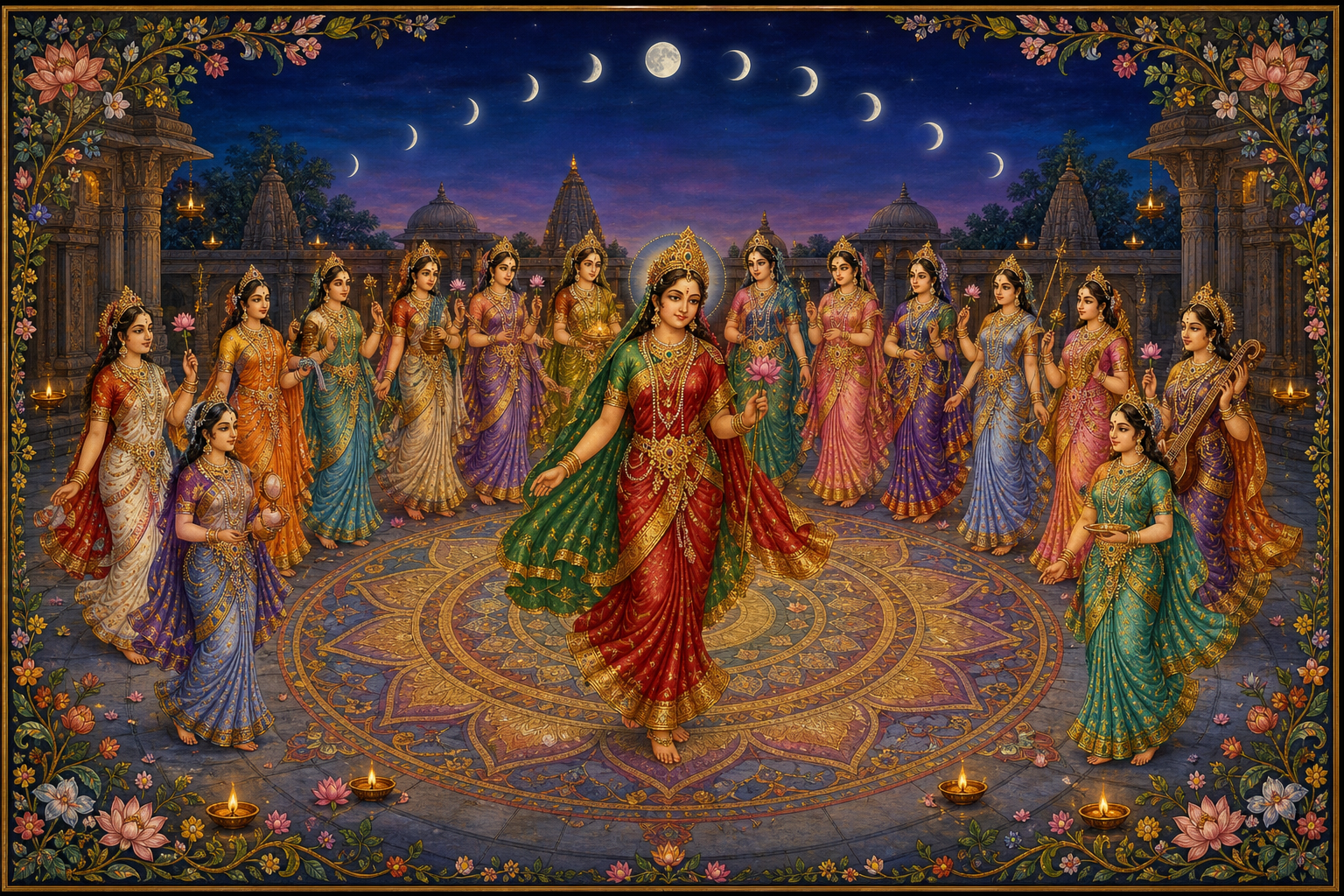
The Nitya Devis are sixteen goddesses embodying the sixteen phases of the lunar cycle. Tvarita is the Nitya associated with Ashtami, the eighth lunar tithi. Her identity therefore belongs to a larger sacred pattern rather than to a disconnected festival date.
Nitya means eternal or ever-present. Tithi refers to a changing division of lunar time. Holding those two ideas together is important: the lunar phase changes, yet each change can reveal an aspect of an abiding divine reality. The Nityas invite you to notice time as Shakti rather than regard it as an empty container through which religious events happen.
This distinction prevents a common misreading. The sixteen Nityas are not simply sixteen labels pasted onto a calendar. Their arrangement expresses a theology of time. A tithi is the visible or calculable occasion; the Devi is the sacred reality contemplated through it.
When studying Tvarita, keep three levels separate:
- The calendrical level: Tvarita is connected with Ashtami.
- The theological level: lunar time is understood as an expression of the Divine Mother.
- The contemplative level: Tvarita’s swiftness gives you a way to examine timely, directed action.
Start with those established points. Add ritual details only when you have instructions from a trustworthy Srividya lineage. This keeps a clear explanation from turning into an invented practice.
Key takeaways
- Tvarita is one of the sixteen Nitya Devis and is associated with Ashtami tithi.
- The Nitya system presents lunar time as sacred manifestation, not merely chronological measurement.
- Tvarita’s swiftness should not be confused with impatience, recklessness, or a promise of instant results.
- If a practice depends on Ashtami, verify the local tithi rather than relying only on a civil date.
- Conceptual study can begin openly; mantra, nyasa, yantra, mudra, and formal worship should follow qualified lineage instruction.
Read swiftness as right movement, not mere speed

Tvarita’s name points to swiftness. It is tempting to turn that into a slogan: faster success, quicker relief, or immediate fulfilment. The name alone does not justify any such promise. A sound contemplative reading begins with a more demanding question: what makes an action timely rather than merely hurried?
Haste is often driven by agitation. Timely action comes from seeing what the moment requires and moving without avoidable delay. The difference matters in dharmic life. An impulsive act may be fast but poorly aligned; a deliberate act may be swift because indecision no longer obstructs it.
You can use Tvarita’s name as a mirror through three questions:
- Where are you postponing a necessary dharmic action while waiting for perfect conditions?
- Where are you calling restlessness or impatience a form of decisiveness?
- What is the smallest timely action you can take without abandoning discernment?
These are reflection prompts, not claims about a canonical Tvarita ritual. That boundary is useful. It lets the theology change how you examine conduct without pretending that a modern exercise is an inherited liturgy.
Swiftness also has meaning because Tvarita stands within a cycle. A cycle gives every phase a place; it does not demand that every phase do the same work. Her association with one tithi therefore points toward a particular quality within ordered time. It does not make speed the sole measure of spiritual maturity.
Use Ashtami as a doorway, not a superstition

Ashtami means the eighth tithi, but a tithi is not interchangeable with a numbered Gregorian date. Lunar timing and the civil calendar do not divide the day in the same way. If you are identifying Ashtami for an observance, consult a reliable panchanga calculated for your location instead of assuming that a date printed for another region applies unchanged to you.
Accuracy in timing is only the first step. The deeper point is that time itself is approached as a living sacred reality and an expression of the Divine Mother. The panchanga tells you which tithi is operating. The Nitya framework asks how that phase of time is being perceived spiritually.
This protects you from two opposite errors. The first is to ignore the lunar context and reduce Tvarita to a generic deity of rapid outcomes. The second is to treat Ashtami mechanically, as though noticing the correct tithi automatically produces a spiritual result. Calendar precision supports practice; it does not replace attention, discipline, or lineage.
If your immediate purpose is study rather than ritual observance, record three facts in your notes: the name Tvarita, the Ashtami association, and her position within the collective of sixteen Nityas. Then place any new claim you encounter under one of three headings: theology, iconography, or ritual procedure. This simple sorting method exposes unsupported mixtures. A symbolic interpretation should not quietly become a ritual instruction, and a lineage-specific procedure should not be presented as universal.
Study Tvarita without crossing ritual boundaries

Srividya is not helped by collecting isolated names, seed syllables, diagrams, and procedures from unrelated pages. Even when individual fragments are authentic somewhere, combining them does not create a coherent practice. Context includes the lineage, the form of worship, the practitioner’s preparation, and the sequence in which instructions are given.
A careful approach has five steps:
- Learn the system before the fragment. Understand that Tvarita belongs to a mandala of sixteen Nitya Devis associated with lunar phases.
- Fix the basic association. Tvarita is connected with Ashtami, the eighth lunar tithi.
- Distinguish explanation from interpretation. Her name establishes an association with swiftness; broader reflections on decisive action should be identified as reflections.
- Distinguish study from ritual performance. Reading about a deity does not confer initiation or establish the correct use of a mantra, yantra, nyasa, or mudra.
- For formal practice, ask a qualified teacher for instructions belonging to one identifiable Srividya lineage, then follow that method without assembling additions from scattered material.
When evaluating a teacher or teaching, ask concrete questions. Which lineage is being taught? Is the material intended for general study or initiated practice? Which instructions are preparatory, and which require diksha? Are differences from other Srividya methods being acknowledged? Clear answers matter more than a large collection of esoteric terminology.
If you do not have lineage instruction, you can still study the public theological structure and contemplate the ethical difference between timeliness and haste. Do not silently promote that contemplation into a self-authorized ritual. Restraint here is not exclusion from knowledge; it is respect for the form in which specialized knowledge is transmitted.
Your next useful step is small: place Tvarita back among the sixteen Nityas, check Ashtami through a local panchanga when timing matters, and write down exactly which part of your interest is calendrical, theological, contemplative, or ritual. Once that distinction is clear, you will know whether you need a calendar, a careful explanation, or guidance from a lineage teacher.
References
