
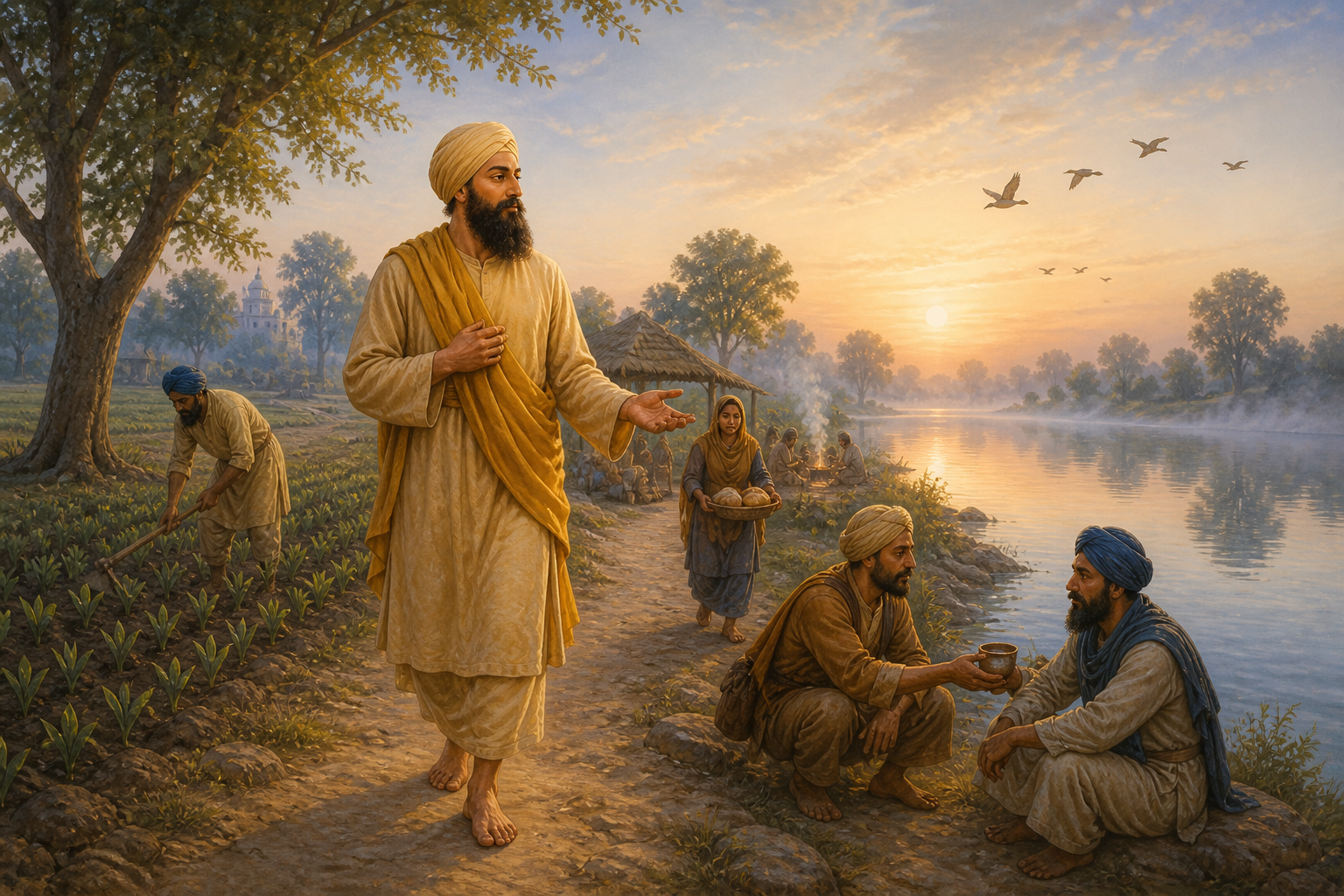
You may be trying to hold two commitments together: fidelity to your own dharmic path and honest respect for people whose worship looks different. If inclusion asks you to treat every tradition as identical, it feels shallow. If fidelity requires contempt for others, it becomes spiritually corrosive.
Guru Nanak offers a more demanding standard. Keep the discipline that roots you, widen your awareness of where the Divine can be encountered, and let remembrance appear in your speech, conduct, care for nature, and seva. Universal devotion is not merely an opinion about religions. It is a way of praying and acting.
Universal does not mean interchangeable

Universal devotion begins with a distinction that religious conversations often miss: shared spiritual values do not make different traditions interchangeable. Sikh remembrance through Gurbani and Naam Simran, Hindu japa and bhajan, Buddhist meditation and maitri, and Jain commitments to ahimsa and inner discipline can all move a practitioner from self-absorption toward ethical conduct. Their terms, doctrines, and disciplines nevertheless retain their own meanings.
Respect therefore asks more of you than saying that every path is the same. You must be able to notice a genuine resonance without taking possession of another community’s language. You can honour a Buddhist practice of compassion without renaming it Sikh, appreciate Sikh seva without detaching it from Sikh life, and recognise ahimsa across traditions without pretending that every tradition explains it identically.
The remembered encounter at Jagannath in Puri makes this balance visible. During an Udasi in Odisha, Guru Nanak is said to have answered the anticipated temple aarti with a hymn of cosmic worship. The gesture need not be read as a dismissal of the lamp-lit rite. It places the lamp, the shrine, and the worshipper within a sacred horizon far larger than any single human ceremony.
- If your attachment to a form makes you contemptuous of another sincere practitioner, possessiveness has displaced devotion.
- If your language of universality makes you careless about your own discipline, vagueness has displaced devotion.
- If you can remain rooted while meeting another path without fear or ridicule, universality has begun to become a practice.
A useful rule is simple: keep the form that trains you, but release the urge to make the Infinite the property of that form.
The cosmic aarti changes where you notice worship

Gagan mai thaal, ravi chand deepak bane; tarika mandal janak moti.
Guru Nanak’s cosmic aarti
The hymn pictures the sky as the ceremonial platter, the sun and moon as lamps, and the stars as pearls. This is more than beautiful celestial imagery. It changes the scale of worship. Aarti is no longer confined to the moment when human hands lift a lamp; the worshipper discovers that the cosmos has never stopped offering its light.
You can use that image as a practical contemplation rather than leaving it as poetry. When you first notice the open sky, sunlight, moonlight, or stars, interrupt your ordinary habit of treating them as background. Recall the cosmic offering. Then ask what kind of conduct belongs inside such a sanctuary.
<!– wp:list {