
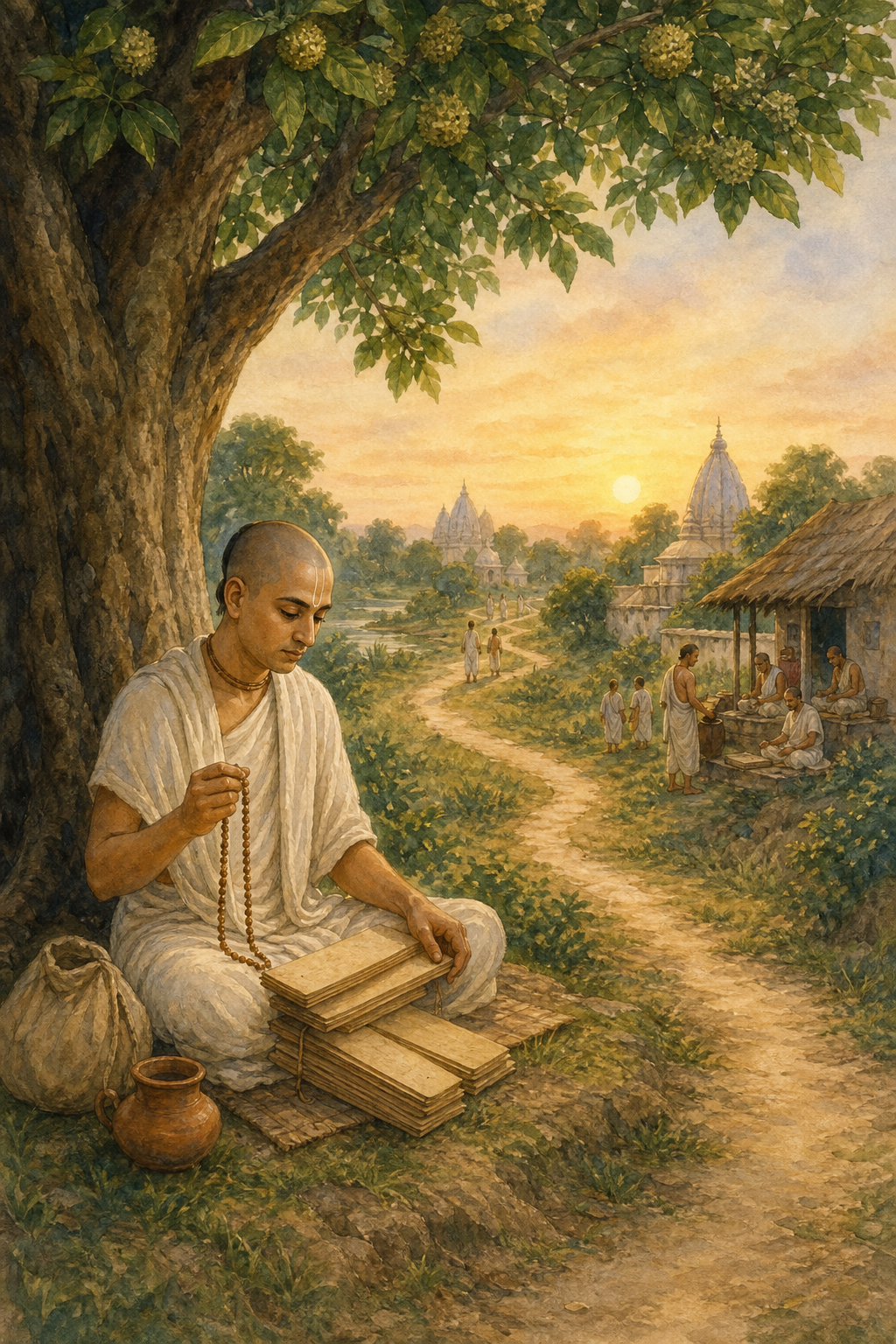
You may already revere Rupa Goswami, observe his disappearance day, or recognize Sri Upadesamrita as an essential Gaudiya text. The harder question is personal: what should his legacy change in the way you speak, chant, serve, associate with devotees, and approach the sacred places of Vraja?
The practical answer is a sequence. Restrain what scatters consciousness. Build habits that support remembrance. Let your dealings with Vaishnavas expose the actual condition of your heart. Then approach rasa and the intimate geography of Vraja as fields of service, never as religious status. This is a specifically Gaudiya Vaishnava frame; honoring it also means not flattening the distinct teachings of other Vaishnava sampradayas.
Key takeaways
- Rupa Goswami’s path does not begin with discussing the highest rasa. It begins with governing speech, mind, anger, appetite, and sexual conduct.
- A sustainable practice is better than an impressive burst. Choose a rule you can keep when enthusiasm is low, not only when inspiration is high.
- Your relationships are a diagnostic instrument. If chanting is not making your speech, service, and disagreement more honest and respectful, something needs correction.
- Sacred geography marks increasing intimacy with Krishna, but physical proximity does not by itself produce spiritual qualification.
- An acharya’s disappearance day becomes meaningful when hearing leads to one identifiable change in conduct.
Practice Sri Upadesamrita at the points of friction
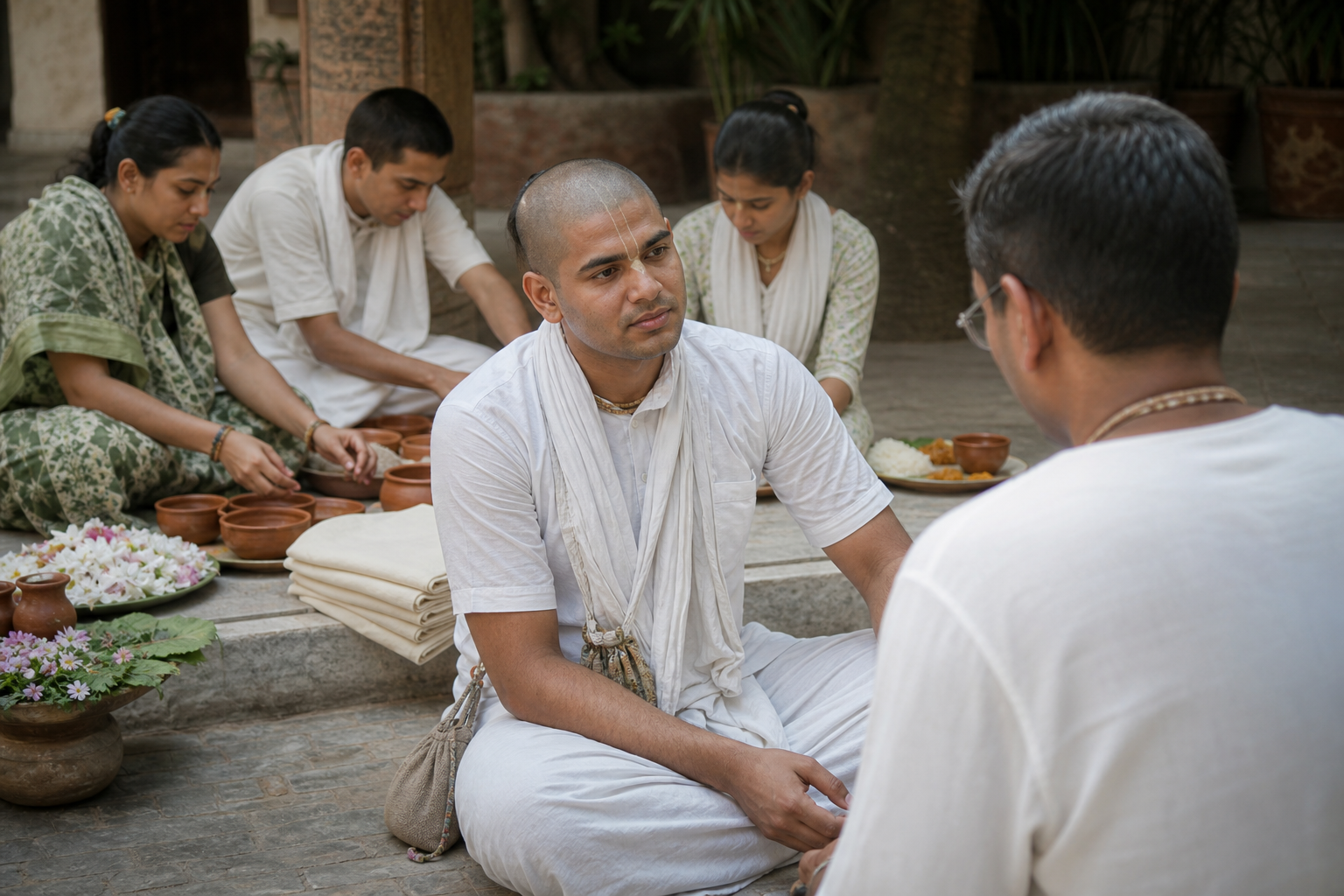
Sri Upadesamrita opens where devotional life usually becomes difficult: not in theory, but in the unruly movements of speech, mind, anger, tongue, belly, and sexuality. Control here does not mean hatred of the body or the denial of legitimate duties. It means refusing to let an impulse decide what kind of person you will be.
Work with each faculty concretely:
- Speech: Before repeating a criticism, ask whether the person concerned needs to hear it, whether you have verified it, and whether speaking will repair anything. Devotional vocabulary does not turn gossip into seva.
- Mind: Give japa a protected place in your routine. When attention wanders, return to the holy name without turning distraction into a second drama of self-condemnation.
- Anger: Do not compose accusations while agitated. Pause, identify the actual wrong, and address that wrong without assigning motives you cannot know.
- Tongue and belly: Honor prasada with gratitude, but notice when the search for taste, abundance, or novelty begins directing the day. Simplicity protects attention.
- Sexual conduct: Keep the vows and boundaries appropriate to your ashrama consistently. Private exceptions gradually weaken public integrity.
Restraint alone can become dry, so pair every removal with a support. Replace idle talk with Krishna-katha. Replace spiritual busyness with service that has a clear purpose. Replace restless comparison with steady association. Replace the hunger for a new technique with patient attention to the practice already entrusted to you.
Do not attempt a total renovation of your devotional life in one surge. Find the point where you most predictably lose steadiness. Establish one corrective rule there, keep it until it becomes reliable, and only then widen the discipline. This turns Upadesamrita from a text you admire into a text that governs decisions.
Let Vaishnava relationships verify your inner life
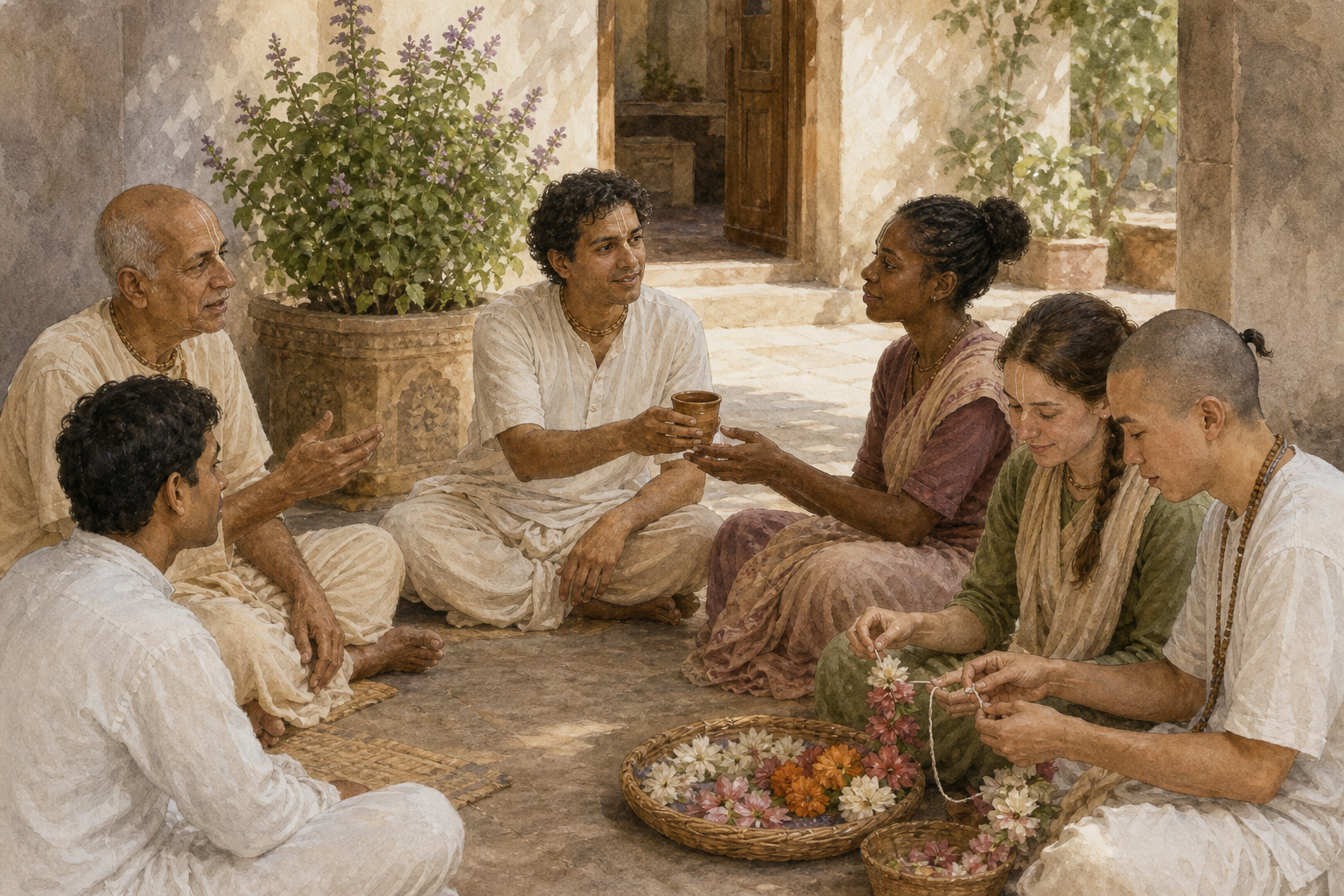
Rupa Goswami places loving exchange among devotees inside the practice itself: giving and receiving gifts, revealing the mind and hearing another in confidence, and offering and honoring prasada. These are not ornaments added after solitary realization. They are ways the heart learns trust, gratitude, receptivity, and service.
This is why being a true Vaishnava cannot be reduced to dress, vocabulary, institutional position, or the ability to defeat another person in argument. Identity must become conduct.
You can test that conduct with ordinary situations:
- When another devotee receives recognition, can you appreciate the service without immediately measuring it against your own?
- When correction comes, can you separate its useful content from the discomfort of receiving it?
- When you disagree on a practical matter, can you describe the disagreement accurately without questioning the other person’s devotion?
- When someone confides in you, do you protect the confidence, or turn privileged knowledge into social influence?
- When you serve, do you remain steady if nobody notices?
Respect does not require pretending that every devotee has the same maturity, responsibility, or authority. Nor does humility require concealing serious misconduct. Mature association combines reverence with discernment: offer respect broadly, place trust carefully, and seek guidance from practitioners whose conduct supports their words.
Use one question as a regular examination: is your sadhana making you safer to speak with, easier to correct, and more dependable in service? If not, the answer is not necessarily more religious activity. You may need more honest association and more careful attention to the activity you already perform.
Read the sacred geography as a map of deepening service

Sri Upadesamrita, verse 9, presents a map of rasa through Vaikuntha, Mathura, Vrindavan, Govardhan, and Radha-kunda. The movement is toward increasingly intimate manifestations of Krishna’s pastimes and loving service. It is not a tourist league table or a way to claim superiority because you visited a particular place.
Govardhan is especially instructive because sacred place and seva cannot be separated. If you approach Vraja mainly to collect images, locations, or stories about yourself, the geography remains external. If you approach under guidance, hear attentively, respect residents and pilgrims, avoid needless disturbance, and carry an instruction home, the journey begins to shape practice.
Before visiting a sacred place, decide how you will protect the purpose of the visit. Read the relevant passage before arrival. Keep the phone away during hearing, japa, and darshan unless it is genuinely needed. Ask what service is appropriate rather than inventing a conspicuous one. Record an instruction you can continue after leaving.
If you cannot travel, do not treat geography as inaccessible spirituality. You can study the map with a trusted commentary, hear hari-katha from qualified teachers, maintain a clean place for chanting and worship, and serve the Vaishnavas available to you. This does not make your room identical to Govardhan. It does prevent distance from becoming an excuse for inattention.
Rasa should likewise be approached as a vocabulary of relationship and service, not as a demand for unusual emotion. Emotional intensity can come from temperament, music, group atmosphere, memory, or fatigue. The safer sign of assimilation is durable: more eagerness to serve, less appetite for prestige, greater fidelity to the holy name, and more care in dealing with devotees.
Turn remembrance of Rupa Goswami into an accountable practice
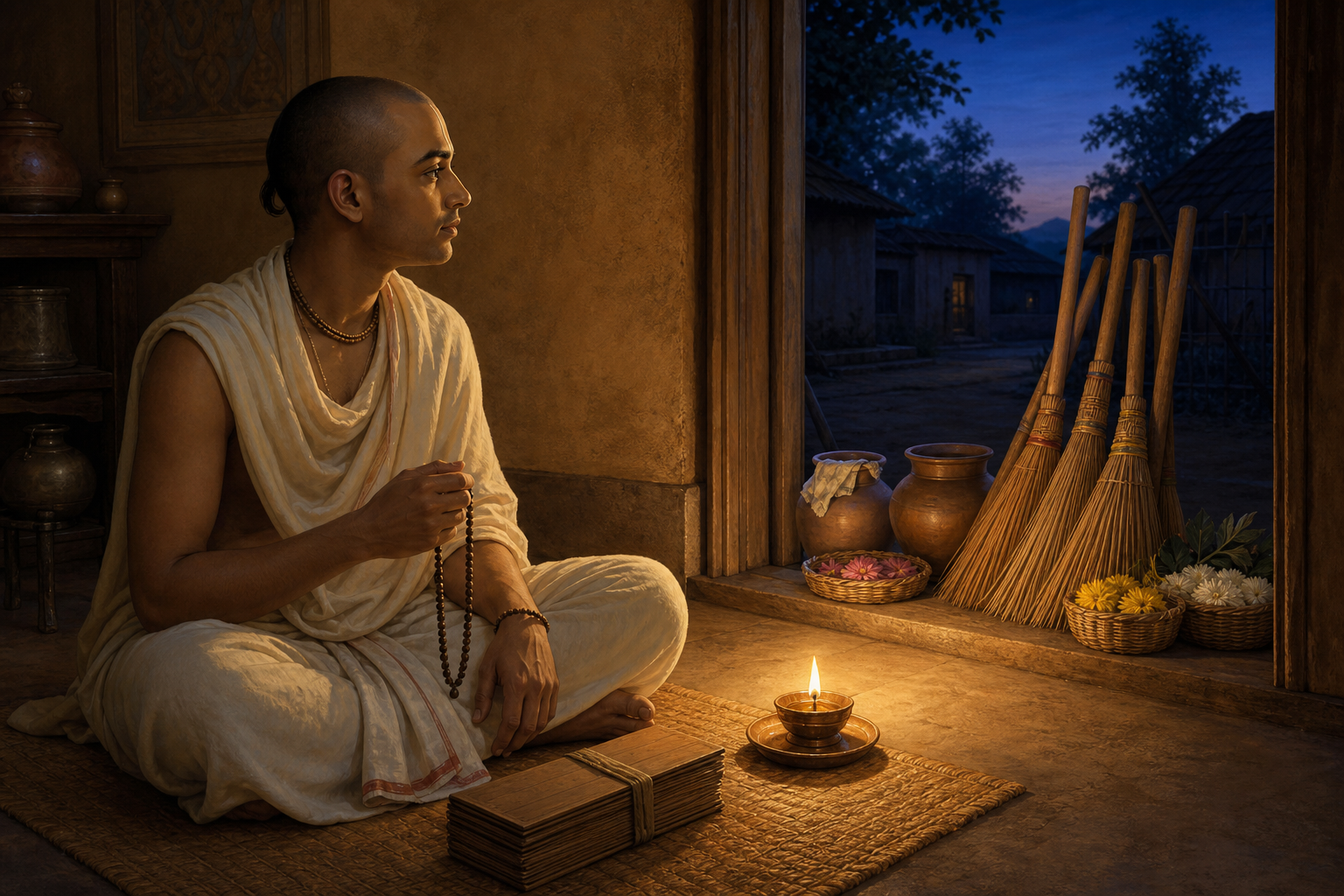
A disappearance day is not merely an anniversary of absence. It is an occasion to recover the acharya’s instruction and place yourself under it again. Morning hearing centered on Rupa Goswami’s disappearance and mangala arati and darshan in Krishna Balaram Mandir show the natural setting for that remembrance: worship, hearing, community, and renewed service.
You can make the observance practical with this sequence:
- Hear before you speak about him. Read Sri Upadesamrita with a commentary accepted in your lineage, or hear from a teacher whose life and teaching you trust.
- Select the instruction that meets your present weakness. Do not choose the most elevated-sounding passage. Choose the one that corrects something you actually do.
- Name the evidence. Write down where the weakness appears: criticism, irregular japa, appetite, resentment, competition, careless association, or another repeatable situation.
- Choose a visible correction. Examples include refusing to forward unverified criticism, protecting the time of japa, apologizing for harsh speech, or restoring a neglected service.
- Make the commitment accountable. Tell a trusted devotee what you intend to change and invite a direct question about whether you kept it.
- Offer service without display. Let gratitude take a form that benefits the temple, the devotees, the sacred place, or the transmission of genuine teaching.
The next time you honor Rupa Goswami, do not measure the observance only by how much you heard or how strongly you felt. Look for the instruction that survived the occasion. Begin with the one restraint, exchange, or service you can practice today, and let consistency prepare the heart for the deeper truths you hope to understand.
References
- Dandavats – Disappearance Day of Srila Rupa Goswami | Morning Class with HG Urmila Devi Dasi
- Dandavats – Shrila Rupa Gosvami disappearance || HH Prabodhananda Saraswati Swami || 25-08-2026
- Dandavats – 2026.08.22 – The map of rasa (Sri Upadesamrita, 9) (Govardhan) – Bhakti Vijnana Goswami
- Dandavats – What Makes Someone a True Vaishnava? | Gauranga Darshan Das
