
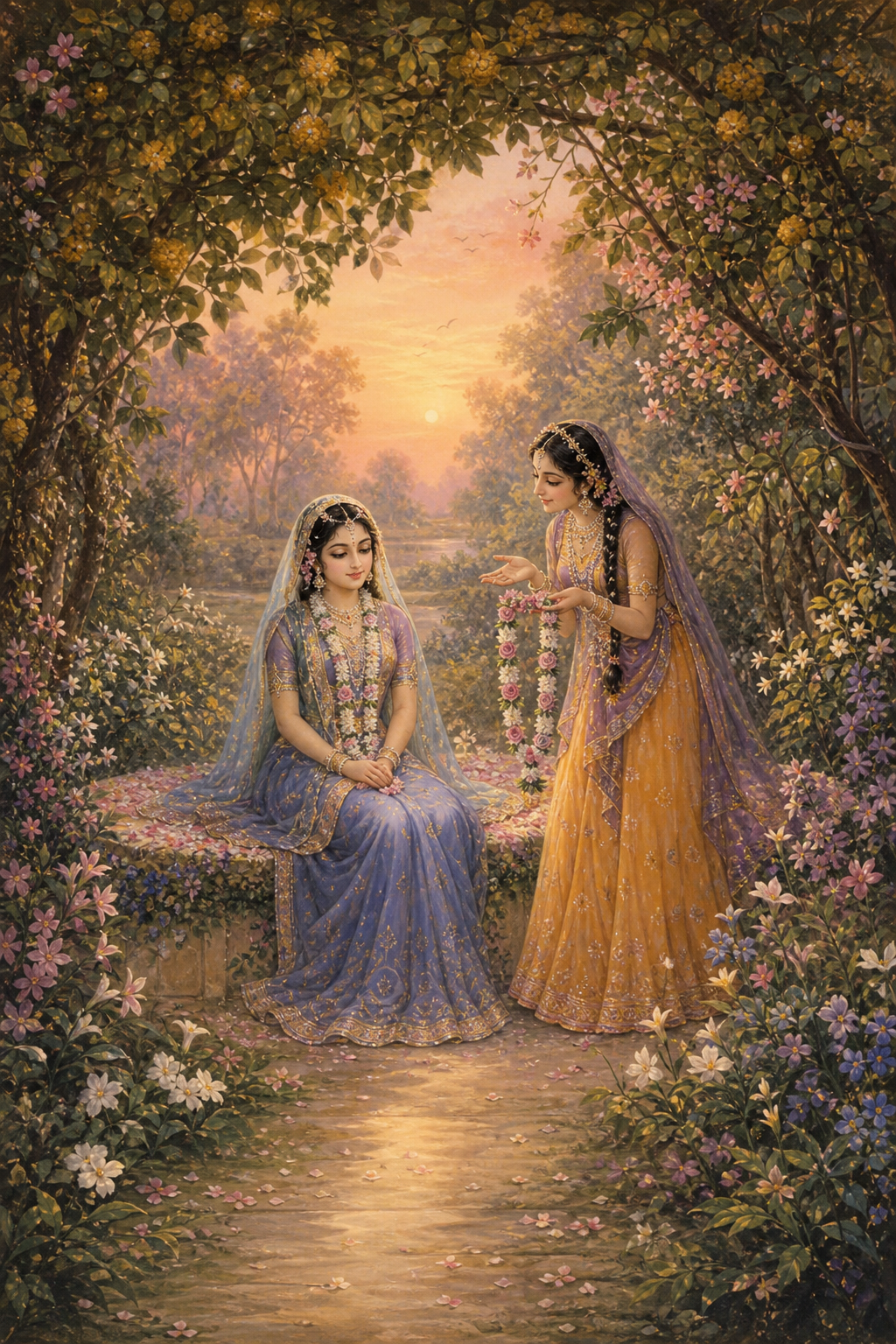
You may know that Radha stands at the heart of Gaudiya devotion and that Lalita is Her intimate sakhi, yet still not know what to do when you sit down to meditate. Should you picture Them, repeat Their names, follow a narrated lila, or wait for a devotional feeling to appear? A dependable starting point is simpler: let sacred sound establish your attention, let a received description give that attention shape, and let Lalita teach you the posture of service.
This distinction matters because imagination can support remembrance, but it can also turn a sacred relationship into private theatre. The measure of a sound Gaudiya meditation is not how vivid it becomes. Look instead at whether it returns you to nama, seva, humility, and greater care for other devotees.
Radha is the center; Lalita teaches the approach
In Gaudiya devotion, Radha is contemplated as Krishna’s supreme beloved and the fullest embodiment of devotion to Him. Lalita belongs to Radha’s intimate circle. Her significance for your meditation is therefore relational: she does not become a second, competing center of attention. She shows how love for Radha becomes alert, intelligent, practical service.
This gives you a clear way to hold Radha and Lalita together. Do not meditate on two disconnected sacred portraits. Attend to the relationship. Radha is to be served; Lalita represents the servant who understands Radha’s needs, protects the atmosphere of devotion, and directs attention away from herself.
That changes the questions you bring into meditation. Instead of asking, “What extraordinary scene can I see?” ask, “What does Lalita notice because she is concerned for Radha? What would service require here? What self-interest would have to become quiet?” These questions keep contemplation within the grammar of seva.
You should also resist turning Lalita into a shortcut for making claims about your own eternal identity. Curiosity about a sakhi’s service is not the same as realization of your personal spiritual form. A preferred image, an intense emotion, or a recurring thought does not settle that question. Where your lineage gives specific instruction on advanced internal practice, follow that instruction. Where it does not, remain with the names, descriptions, and service attitudes you have actually received.
Use one sacred detail instead of constructing a spectacle
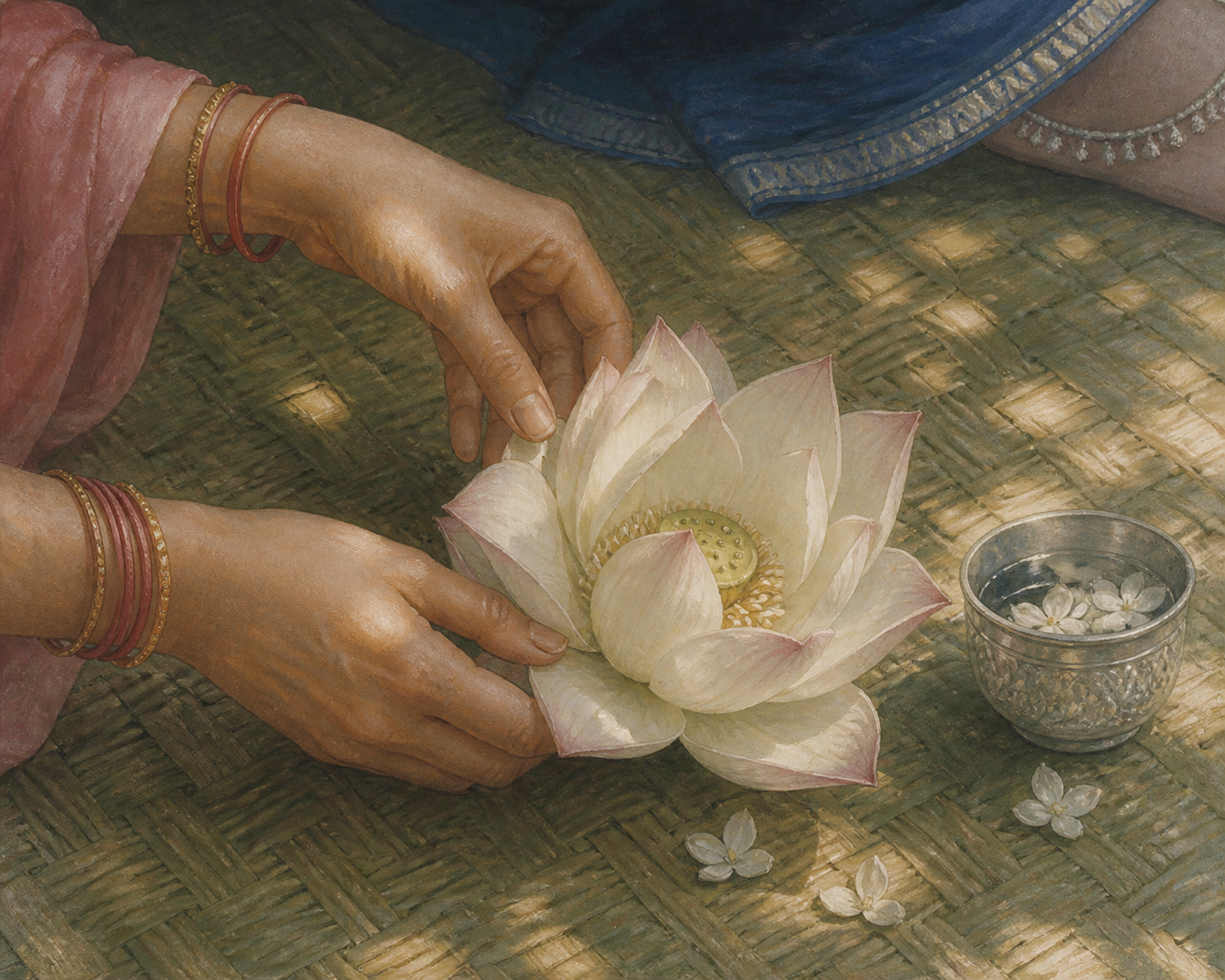
Gaudiya contemplation can become so concentrated that even Sri Radha’s eyebrows serve as a stimulus for ecstatic love. That narrowness is instructive. You do not need to manufacture a complete landscape, invent dialogue, or keep adding visual decoration. One faithfully heard detail can hold the mind more honestly than an elaborate scene assembled from preference.
Take that detail as a doorway into relationship, not as an aesthetic object to collect. A feature of Radha’s form matters devotionally because of what it expresses and how it affects those who love and serve Her. The aim is not anatomical precision. The aim is attentive remembrance shaped by affection and service.
When you work with a detail, make three movements. First, recall only what you have heard. Second, place it within the relationship between Radha and Her servants. Third, release the image when the mantra or spoken name again calls for your full attention. You do not have to keep an image continuously visible for the meditation to be meaningful.
Before accepting an inner image as useful, test it:
- Can you trace it to a teaching, recitation, song, or description received within your tradition?
- Does it make Radha’s service more important than your own role in the scene?
- Can you set it aside without anxiety and return to the holy name?
- Would you allow a trusted teacher to correct your interpretation?
- Does its effect continue as patience, discipline, and respect after the meditation ends?
If the answer to several of these is no, you do not need to condemn the experience or wrestle with it. Simply set it aside. Return to sound, prayer, and teachings you can verify. That response protects reverence without treating every mental event as revelation.
A repeatable service-first meditation sequence
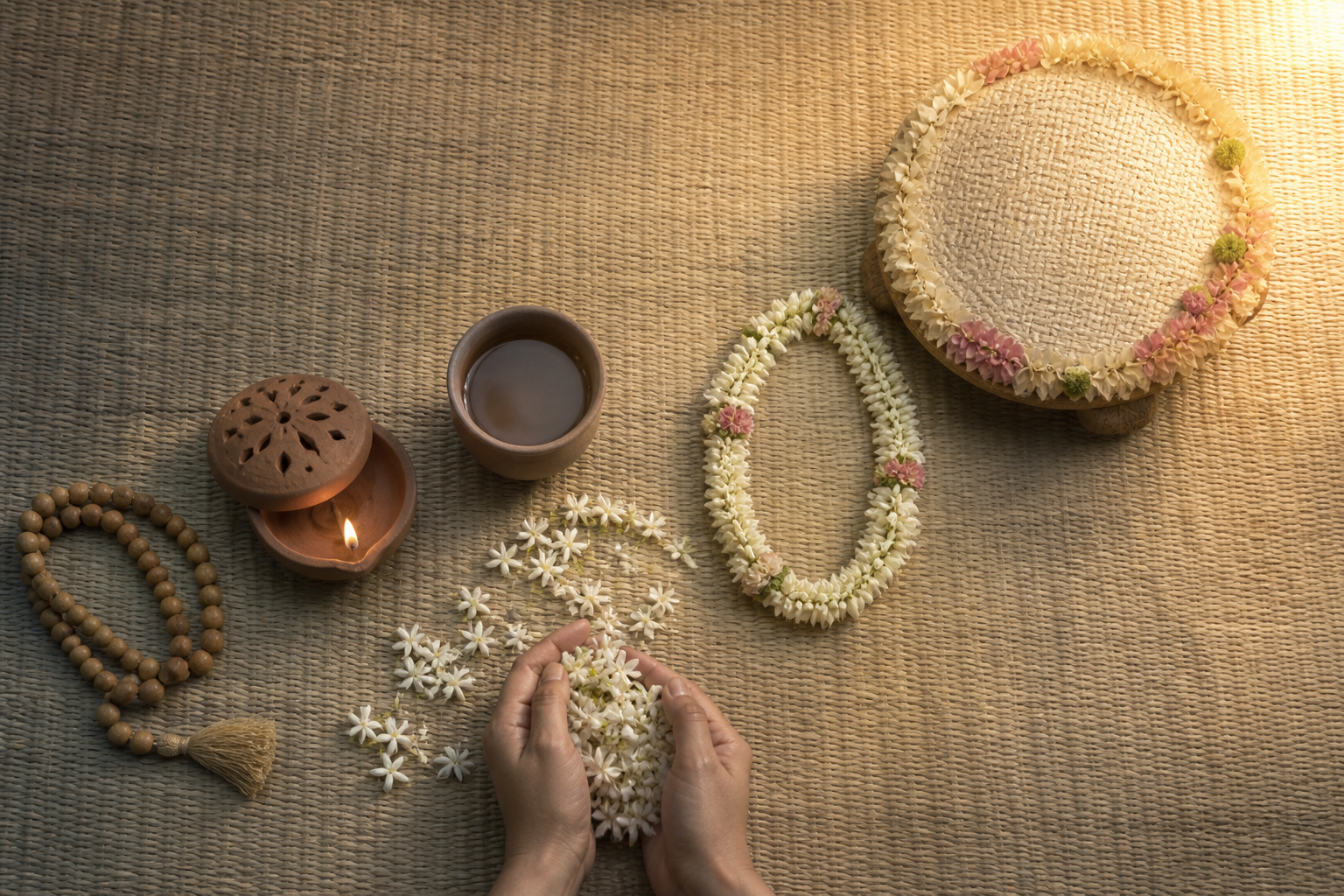
You can use the following sequence during an ordinary chanting or remembrance period. It does not require advanced visualization, and it leaves room for the particular instructions of your guru and lineage.
- Choose a received description. Select one name, feature, gesture, or service relationship that you have genuinely heard. Do not combine several unfamiliar accounts in the same sitting.
- State your intention plainly. Ask that the remembrance make you more fit for service. This prevents the search for unusual feeling from quietly becoming the purpose.
- Begin with sacred sound. Chant the mantra or divine names already established in your practice. Let hearing come before visualization. If no image appears, continue hearing; the absence of a picture is not a devotional failure.
- Hold one detail lightly. Recall the chosen feature without forcing sharpness. Do not add colors, dialogue, scenery, or a personal role merely to keep the mind entertained.
- Bring in Lalita’s service orientation. Ask how an intimate servant of Radha would attend, protect, arrange, or respond. Keep Lalita facing Radha rather than turning her into an object detached from Her service.
- Return and close. Come back fully to the mantra or name. End by identifying one ordinary form of service that should change because of the meditation: better attention, less harsh speech, more reliability, or more respect for devotees.
The final step is essential. A meditation that remains sealed inside an attractive inner world has not yet shown its practical fruit. You do not need to claim an elevated mood. Look for a modest but observable change in conduct. If you become easier to instruct and more dependable in service, the practice is moving in a healthy direction.
Do not use tears, bodily sensations, visual clarity, or emotional intensity as a ranking system. Such experiences may arise or may not. Chasing them divides your attention: one part remembers Radha while another watches yourself to see whether you are becoming advanced. Return the observing mind to service.
Let Gaura remembrance keep the inner practice grounded
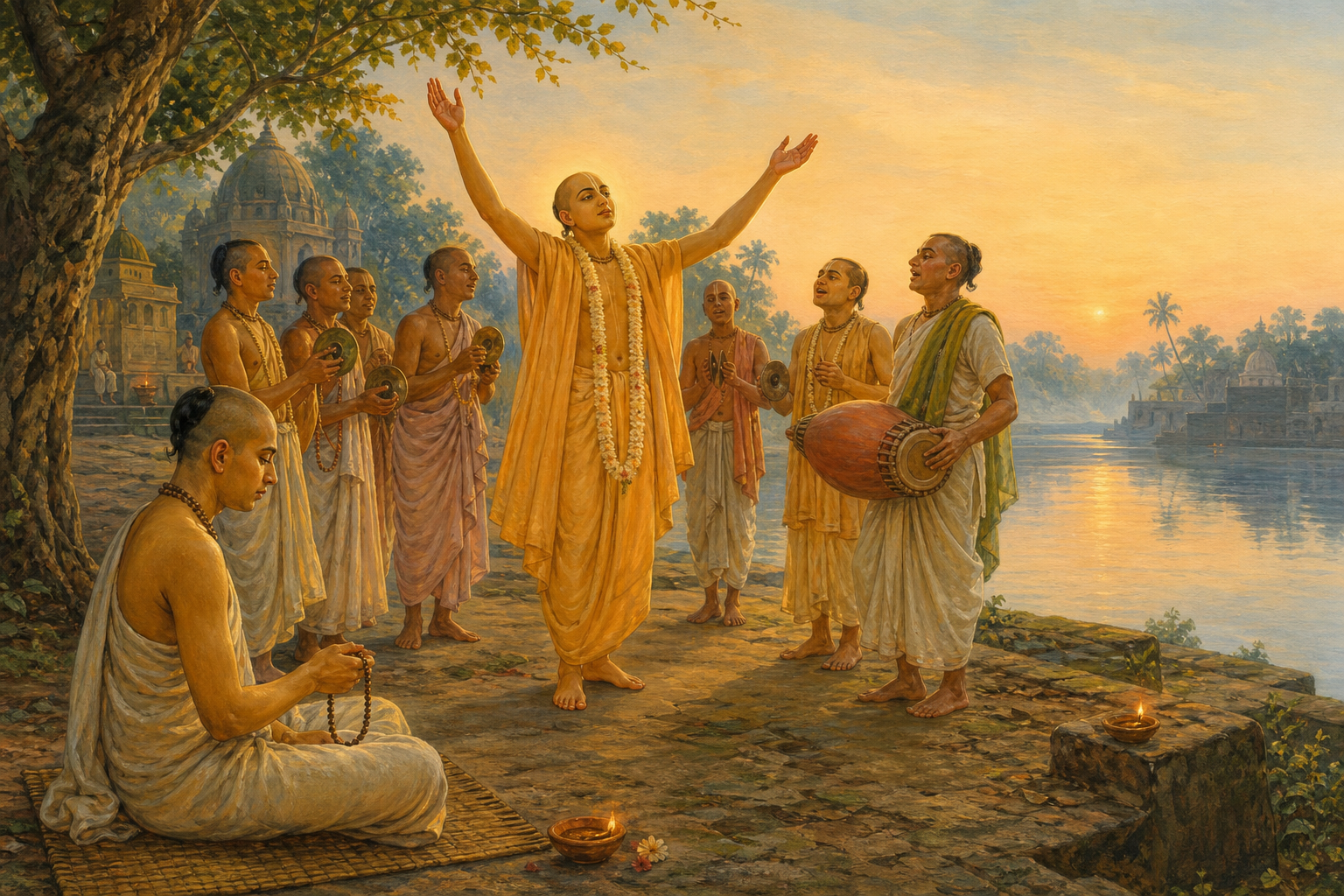
You do not need to treat Gaura meditation and Radha-Lalita contemplation as rival practices. Gaura remembrance gives the practitioner an accessible ground in mercy, the holy name, and shared devotional life. Lalita-centered contemplation supplies an intimate grammar of Radha’s service. The theme of Lalita Sakhi in two worlds helps you notice continuity of service without flattening distinct manifestations of divine lila into one private construction.
This connection also gives you a practical method of correction. If inward contemplation makes you neglect chanting, community responsibilities, or kindness toward devotees, strengthen the Gaura-centered foundations of your practice. If external observance has become mechanical, a brief remembrance of Lalita’s wholehearted attention to Radha can restore the reason for what you are doing.
Be especially careful with correspondences between personalities in different lilas. They may carry theological meaning within a lineage, but they are not an invitation to make rapid claims about yourself. Contemplate continuity of devotion first. Questions of identity and esoteric detail belong under qualified guidance, not under the pressure to turn every meditation into a discovery.
If a practice repeatedly produces agitation, spiritual entitlement, contempt for simpler devotional acts, or certainty that ordinary guidance no longer applies to you, simplify it. Return to the holy name and seek counsel from a teacher who knows both the theology and your actual practice. Restraint here is not a rejection of intimate devotion. It protects intimacy from self-projection.
Key takeaways
- Keep Radha at the center and approach Lalita as a model and guide of Radha-centered service.
- Let sacred sound establish the meditation before asking the mind to hold an image.
- Use one received detail rather than inventing an elaborate scene; even a small feature can carry concentrated devotional meaning.
- Treat vividness and emotion as experiences, not as proof of realization or spiritual identity.
- Judge the practice by its fruit in nama, seva, humility, teachability, and conduct toward devotees.
- Use Gaura remembrance and communal devotion to ground intimate contemplation rather than separating inner practice from lived responsibility.
In your next session, change only one thing: choose one faithful detail and hold it just long enough to ask what service to Radha requires. Then return to the divine name. If that rhythm makes you more attentive and teachable, continue it. If it makes you preoccupied with novelty or status, simplify the practice and ask for guidance.
References
- Dandavats – Gaura Meditation / Lalita Sakhi in Two Worlds
- Dandavats – Today’s Featured Video: Stimulation for Ecstatic Love Part 192 – Sri Radha’s Eyebrows

Leave a Reply
You must be logged in to post a comment.