

You may already know what you oppose. A policy feels unjust, a campus argument misrepresents Bharat, a public institution has failed, or a part of your cultural inheritance is being neglected. You speak, post, debate or protest. Then the meeting ends and the feed moves on. What, if anything, remains?
That is the nation-building question. Building Bharat does not require you to wait for a title, an election or permission from a famous leader. It begins when you turn conviction into useful work that other people can verify, repeat and eventually inherit.
Love Bharat enough to question her honestly
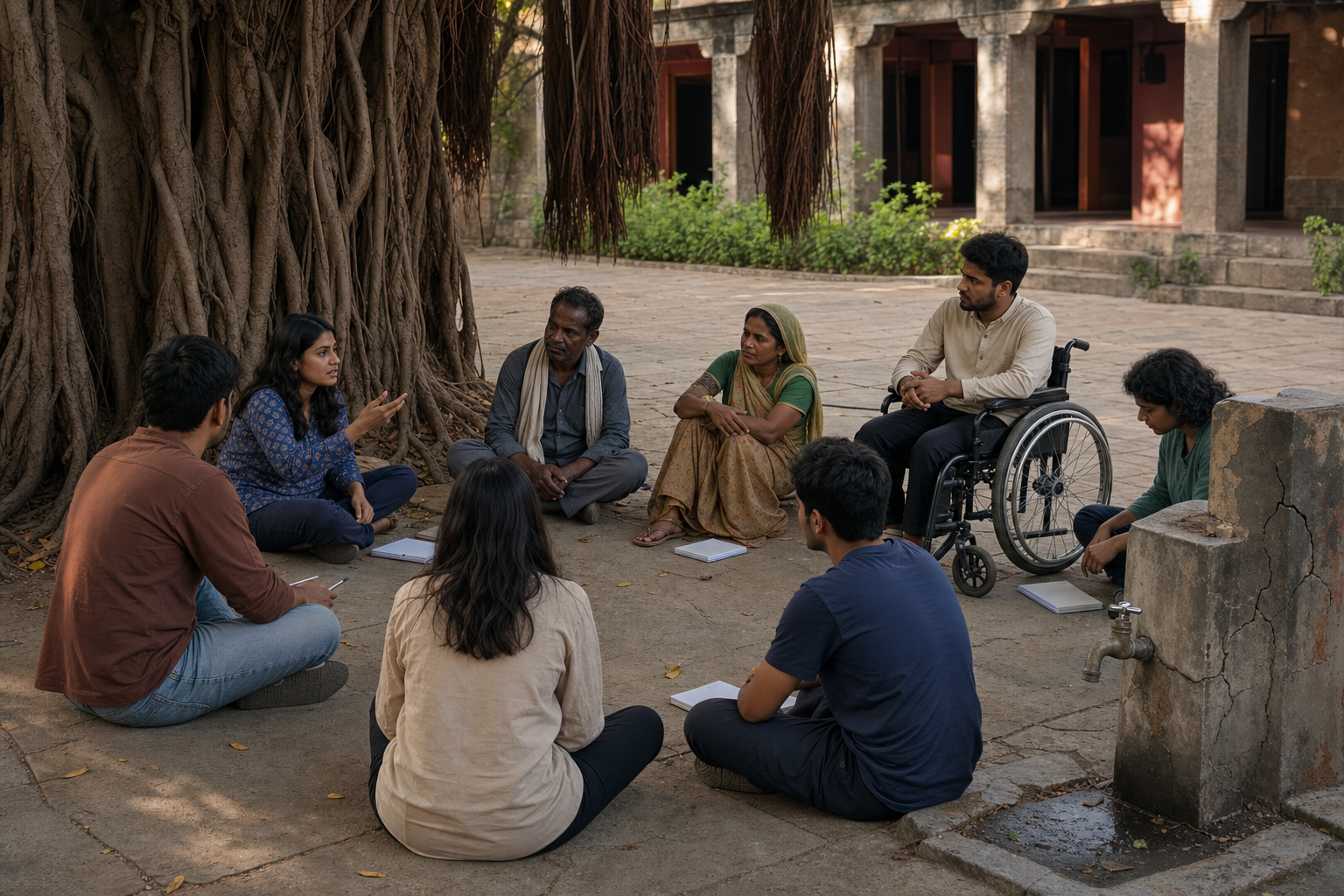
Nation, government, party and policy are not synonyms. You can be devoted to Bharat while challenging a government decision, rejecting a party line or exposing institutional failure. Criticism does not become anti-national merely because it is uncomfortable. Nor does criticism become wise merely because it is loud.
A mature patriot asks two questions at once: What is wrong here, and what do I owe toward setting it right? The first protects you from blind obedience. The second protects you from the vanity of permanent denunciation.
This balance was central to Sri Aurobindo’s appeal to young Indians. The coincidence is fitting: 15 August marks both India’s Independence and his birth anniversary. He wanted the young to think for themselves, reach beneath appearances and “accept nothing on trust”. That is not a licence for reflexive suspicion. It is a demand for intellectual responsibility.
It is the young who must be the builders of the new world.
Sri Aurobindo
Before you endorse a cause, publish an accusation or join a campaign, put it through a simple test:
- Verification: What do you know, and how do you know it? A cropped image, a slogan and a confident voice are not independent confirmation.
- Precision: Are you naming a particular decision, practice or failure, or condemning an entire community because precision is harder?
- Fairness: Can you state the strongest opposing argument accurately before answering it?
- Outcome: What change are you asking for? “Awareness” is not enough unless you can say what an informed person should then do.
- Ownership: What part of the remedy are you willing and able to carry?
A pro-Bharat position should survive truthful scrutiny. If your claim collapses when inconvenient evidence appears, loyalty does not require you to defend it. Correcting yourself protects the cause from a larger loss of trust later.
Turn outrage into a problem someone can own

Anger is good at identifying a boundary that has been crossed. It is poor at assigning roles, keeping records, resolving disagreements or maintaining a programme after attention fades. Those jobs require a different posture: the builder must define the problem narrowly enough for responsible action.
| Starting impulse | How it commonly stalls | The builder’s correction |
|---|---|---|
| Anger | Endless denunciation | Name a concrete deliverable and its owner |
| Civilizational pride | Refusal to admit error | Verify claims and correct mistakes publicly |
| Nostalgia | Recreating appearances without present value | Identify the inherited principle and adapt it to a real need |
| Charisma | Dependence on one personality | Document roles, decisions and succession |
| Seva | A memorable event with no continuity | Create a routine, record and handoff |
Before announcing a project, write a short project brief. If you cannot complete it plainly, you are not yet ready to mobilise other people’s time.
- Need: State the problem in one sentence without blaming a whole population.
- People affected: Name the people who experience the problem. Speak with them before deciding what they need.
- Evidence: Separate what you observed directly from what you heard, inferred or judged.
- Deliverable: Name the useful thing that will exist when the work is done.
- Method: Describe the smallest responsible intervention you can actually complete.
- Steward: Assign a person to each essential task. “Everyone” is not an owner.
- Proof of usefulness: Decide what you will inspect to learn whether the intervention helped.
- Handoff: Record what another person would need to continue without the founder.
Suppose you are concerned that students know little about local Bharatiya history. “Raise awareness” is too vague. A buildable response could be a source-checked reading circle with a published bibliography, clear discussion rules and notes that another facilitator can use. If a mandir needs volunteer support, coordinate with its authorised caretakers and create a task roster instead of arriving with an unrequested campaign. If distorted claims circulate online, produce a concise correction that shows its references and provides a visible way to report errors.
None of these actions solves every structural problem. That is not the standard. The standard is whether your intervention is honest about its scope, useful to real people and designed to teach the next effort something.
Train the capacities that slogans cannot supply

Bharat does not need young people who can only react faster. She needs people who can investigate, teach, organise, repair, translate, design, mediate and keep their word. Public passion without competence makes a cause dependent on appearance. Competence turns conviction into service.
Your formation as a nation-builder has several parts:
- Knowledge discipline: Read beyond quotations selected to confirm your view. Consult primary texts when available, retain publication details and distinguish a historical record from a later interpretation. When traditions disagree internally, describe the disagreement rather than manufacturing a single convenient position.
- Practical craft: Choose a capability that a real project needs. Teaching, translation, bookkeeping, archival work, software, event operations, research, fundraising and public communication all become national assets when practised responsibly.
- Character discipline: Keep commitments, account for resources, credit other people’s work and correct false statements. A Dharmic label does not compensate for careless conduct; it raises the standard by which the conduct will be judged.
- Collaborative discipline: Record decisions, clarify authority and give dissent a legitimate channel. A group that treats every internal question as betrayal will hide mistakes until those mistakes become public failures.
- Civilizational literacy: Learn enough to represent a tradition in its depth, not merely as a collection of reactions to hostile claims. Study language, context, practice and living communities alongside arguments about identity.
A Dharmic readership does not need to pretend that Hindu, Buddhist, Jain and Sikh traditions are interchangeable. They are not. Yet young people across these communities can meet on demanding ethical ground: truthful conduct, self-restraint, service, courage and responsibility for the consequences of one’s actions.
Keep a builder’s record for any sustained effort. At each review, answer: What did we promise? What did we deliver? What failed? What did we learn? What have we documented for the next person? This record is more valuable than a feed full of praise because it exposes the gap between intention and capacity.
Make seva survive the original volunteer

To see Bharat as Mother is not merely to feel reverence. It is to accept an obligation of care. Sri Aurobindo described the nation not as land or an invented abstraction but as a “mighty Shakti” formed through her millions of people. The metaphor becomes serious when it changes how you treat those people and what you leave for those who come after you.
One-off service can meet an immediate need. Nation-building begins when useful service acquires memory. The progression is straightforward:
- Event: People gather and complete a useful task.
- Practice: The task is repeated because the need continues.
- Process: The method, roles and safeguards are written down.
- Team: Responsibility is distributed instead of resting on one enthusiast.
- Institution: The work can retain standards, learn and continue through a change of leadership.
You do not need a large organisation to apply this logic. A language class becomes more durable when it has reusable lessons, attendance records, facilitator notes and a way to train another teacher. A heritage project becomes more trustworthy when each claim is cited, permissions are recorded and the archive has a storage and stewardship plan. Festival volunteering becomes institutional knowledge when the team preserves contacts, task sequences, accounts and a post-event review. Mentoring becomes fairer when eligibility, expectations and feedback are clear rather than controlled through personal access.
Before expanding any initiative, produce the basic artefacts that continuity requires:
- a plain statement of purpose and limits;
- a list of roles and decision rights;
- a record of resources received and used;
- a checklist for recurring work;
- a method for correcting factual or operational errors;
- a note explaining how responsibility can pass to someone else.
This is patient work. It attracts less attention than a confrontation, but it is how ideals become social capacity. A campaign asks people to care now. An institution helps them keep caring when the original urgency has passed.
Choose work that fits your present responsibility
You do not have to imitate a public activist to serve Bharat. Your best contribution usually lies where a genuine need meets your actual skill, legitimate access and willingness to remain accountable.
- If you are a student: Learn your field seriously, form a disciplined reading group, tutor where there is a stated need, or help a campus organisation preserve records and hand over roles properly.
- If you are a professional: Mentor a younger practitioner, lend a defined skill to a credible community effort, improve ethical standards in your workplace, or translate specialist knowledge into material ordinary people can use.
- If you are a creator: Check names, dates and quotations before publishing. Link claims to evidence, distinguish commentary from fact and make corrections easy to find.
- If you are building an enterprise: Ask whether the work solves a real problem, develops people’s capabilities and deals fairly with workers, customers and partners. National rhetoric cannot redeem exploitative practice.
- If you live outside Bharat: Learn and teach a Bharatiya language, preserve family and community histories with permission, support credible institutions, and explain Bharat without reducing her either to exotic spectacle or defensive propaganda.
Use a final filter before you join, fund or lead an initiative. Is the need real? Are affected people treated as participants rather than props? Are the claims verifiable? Does the team have the necessary competence? Can it admit error? Is there a concrete result? Can the work continue without worship of a founder?
Refuse causes that require you to lie, dehumanise, conceal accounts or place a leader above correction. Refuse the claim that cruelty becomes Dharmic when directed at the “right” target. Refuse empty mobilisation that repeatedly asks for attention but never reports what it accomplished. Means are not administrative details; they reveal the kind of nation your action is already creating.
Key takeaways
- Questioning can be an expression of national attachment, but a responsible question must be verified and precise.
- Protest identifies what must stop; nation-building defines what should exist in its place and who will build it.
- Young people need knowledge, practical craft, character and collaborative discipline, not merely ideological confidence.
- Seva becomes institution-building when the work is documented, repeatable, accountable and transferable.
- The right project is not necessarily the loudest one. It is the one that joins a real need to your present capacity and leaves something useful behind.
Open a blank page and write these lines: need, affected people, evidence, deliverable, steward and handoff. If you cannot fill them honestly, keep listening and learning. If you can, make the first commitment and record it. Bharat does not need every young person to become a public figure. She needs many young people to become dependable builders.
References
