

You may feel close to Ishvara before a murti, during aarti, or while repeating a sacred name, yet still wonder whether a more mature spirituality should leave form behind. Or the formless may make perfect sense to you philosophically while leaving your actual practice dry, vague, or difficult to sustain.
You do not have to settle this by declaring one path superior. The Bhagavad Gita recognizes both worship through form and worship of the formless as capable of leading to Ishvara, while treating the formless approach as more difficult for the embodied mind. The practical question is simpler: which discipline helps you remember Ishvara steadily, loosen the hold of ego, and live with greater dharmic clarity?
The choice is about how your attention becomes devotion
Sakara worship approaches Ishvara through a perceivable form. A murti, sacred image, name, mantra, lila, or divine quality gives the mind somewhere definite to return. You can offer, bow, speak, listen, remember, and gradually establish a relationship of reverence.
Nirakara contemplation turns toward Ishvara without relying on a visible or imaginable form. It asks you not to reduce the Divine to any object appearing before the senses or within the mind. Whatever can be seen, pictured, named, or mentally grasped is recognized as limited; contemplation remains oriented toward that which is not confined by those limits.
These are not merely two opinions about religious imagery. They place different demands on attention. Form gathers attention through relationship and symbol. Formlessness asks attention to remain awake without holding a sensory object or mental picture.
Hindu sampradayas do not all explain the relationship between form, formlessness, Ishvara, and ultimate reality in the same way. Do not flatten those differences into the claim that every school secretly teaches an identical doctrine. If you belong to a lineage, let its siddhanta govern your metaphysical understanding. When deciding how to begin or repair a personal practice, however, you can still ask an immediate question: what helps you become present rather than merely appearing spiritual?
What worship through form gives the mind and heart
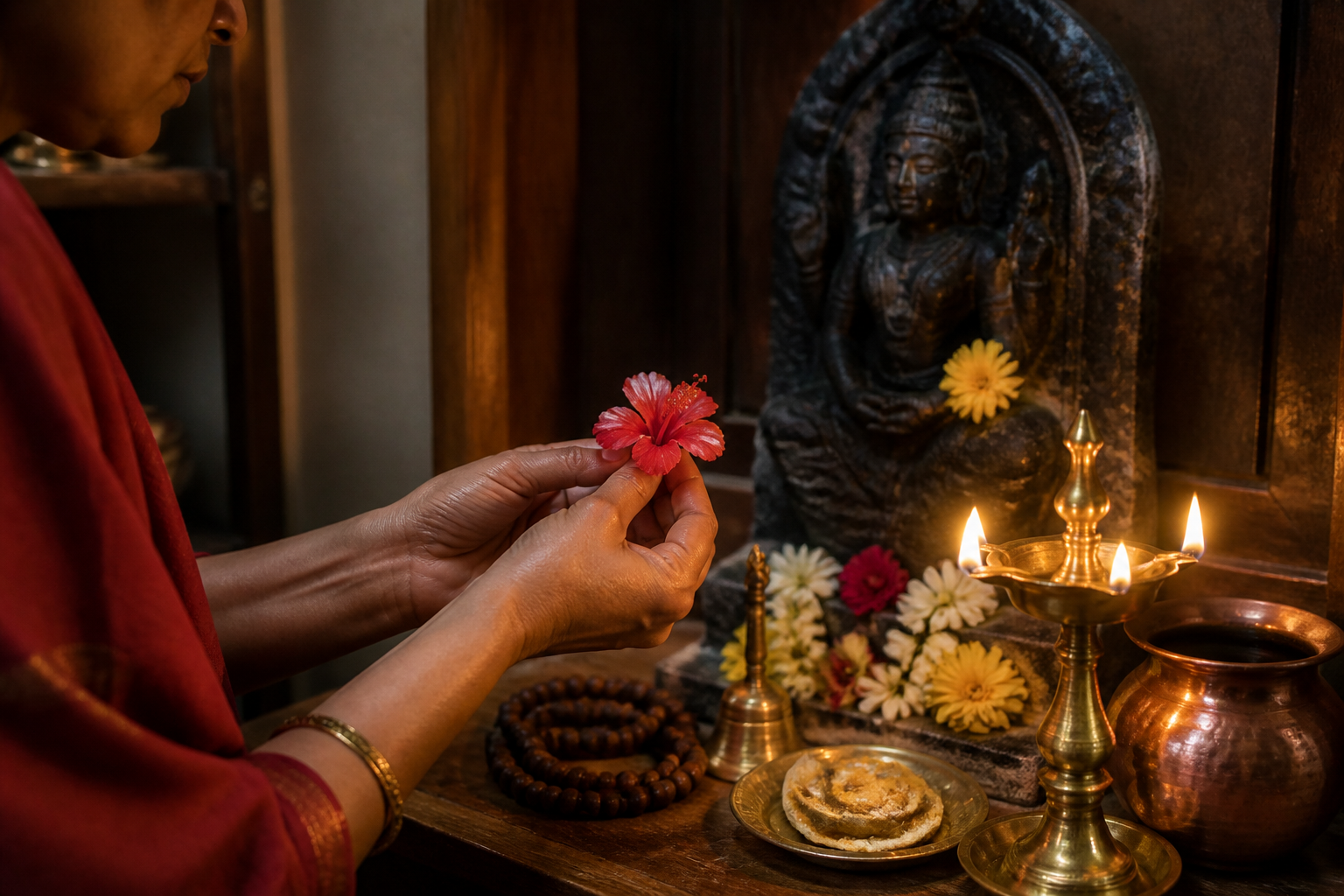
A sacred form turns devotion into a concrete act. Instead of trying to feel reverence in the abstract, you clean the place of worship, light a lamp, offer water or flowers, recite a name, contemplate a divine quality, and bow. The body participates with the mind. Repetition then makes remembrance easier to recover during ordinary life.
This does not require believing that Ishvara is imprisoned within an image. The form establishes a point of relationship; it need not establish a boundary around the Divine. You can approach Krishna, Shiva, Devi, Rama, Ganesha, or another cherished form with complete devotion while understanding that Ishvara is not exhausted by what the eyes can see.
If you are starting a sakara practice, keep it simple enough to repeat:
- Choose a stable focus. Remain with one ishta-devata or the form given by your family, guru, or sampradaya. Constantly changing the object of worship can keep you chasing novelty instead of deepening attention.
- Use a dependable cue. Keep the murti or image in a clean place and return at a regular part of your day. The familiar setting reduces the effort needed to begin.
- Engage deliberately. Offer a simple pranam, look attentively at the form, and repeat a name or mantra that legitimately belongs to your practice. Do not rush through the external action while the mind is elsewhere.
- Contemplate a quality. Bring to mind compassion, courage, wisdom, steadiness, or another quality associated with the form you worship. This keeps puja from becoming a mechanical exchange of objects.
- Carry the worship into conduct. Before leaving, decide where that divine quality must shape your next action. Devotion to a compassionate form should affect how you speak; devotion to a form of dharmic courage should affect what you refuse to evade.
Judge this practice by its ordinary fruit, not by whether it produces an unusual feeling. Are you remembering Ishvara more readily? Is your prayer becoming less transactional? Are you less careless in speech and action after worship? A dramatic mood that disappears at the first inconvenience is a weaker sign than quiet improvement in conduct.
The main danger is not form itself but forgetfulness of what the form is doing. Worship can shrink into bargaining, social display, or anxious rule-keeping. When that happens, restore attention to relationship: make the offering carefully, remember the quality represented, and give up the demand that every act of devotion produce an immediate worldly result.
Why the formless path requires subtler steadiness

The senses naturally present shapes, sounds, and objects. The mind then adds memories, labels, and images. Nirakara contemplation asks you to recognize all of these without mistaking any of them for the limitless reality toward which the practice is directed. That is why the formless path may sound simple in a discussion yet prove demanding in silence.
Formlessness is not a picture of empty space. Empty space is still something the mind can imagine. Nor is the aim to become dull, suppress every thought by force, or sit inside a vague cosmic mood. A blank mental state can be another passing condition; it should not automatically be treated as realization.
A restrained nirakara practice can proceed like this:
- Settle before inquiring. Sit in a stable posture and allow the breath and body to become quiet. A restless beginning does not become formless merely because you close your eyes.
- Notice what appears. Sensations, sounds, images, emotions, and thoughts will arise. Recognize each as an appearance known to awareness rather than as the unconditioned Ishvara.
- Release the attempt to manufacture an image. Do not replace a deity’s form with a black field, a point of light, or an imagined infinity and then call the replacement formless.
- Remain alert. When attention becomes foggy, return to an established support such as a sacred name, prayer, or deliberate recollection. Using support is more honest than confusing dullness with transcendence.
- End in dharmic recollection. Let the practice issue in humility and careful action. If contemplation makes you indifferent to duty or contemptuous of devotees who use form, something has gone wrong.
The test is clarity without grasping. You should become better able to notice how quickly the mind turns every reality into an object it can possess. You should not become proud of having no image, no ritual, or no chosen deity. Superiority is still attachment, even when its language sounds philosophical.
If you repeatedly become scattered or sleepy without a devotional support, accept that information. It does not prove that you are unfit for spiritual life. It shows that your attention currently benefits from form, sound, relationship, and repetition. Begin there and build steadiness through abhyasa rather than adopting an advanced identity your daily practice cannot support.
Choose a primary practice by its fruit, not its rank
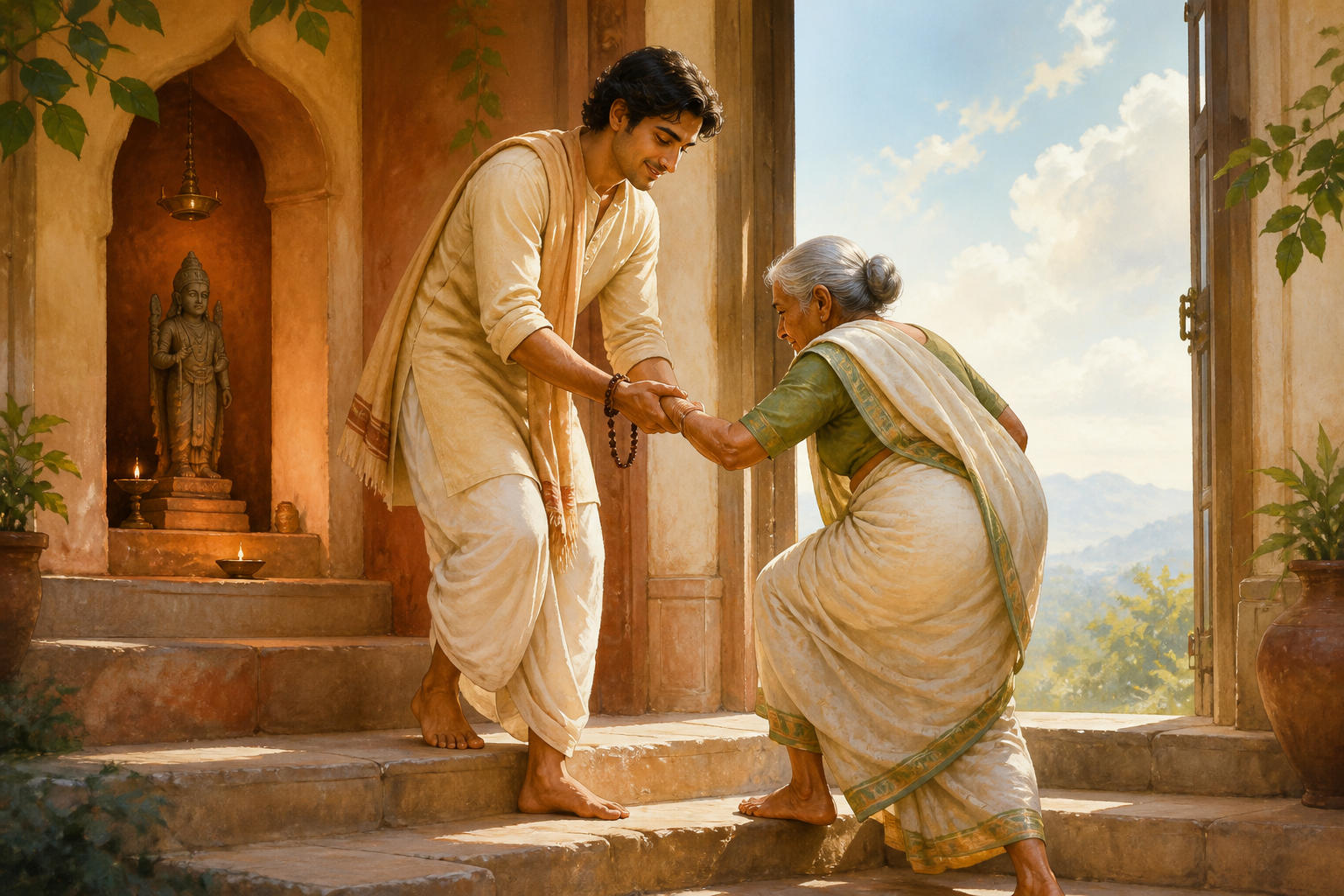
You can make this decision without resolving every philosophical debate. Observe what actually happens when you practice. The following questions expose the difference between genuine affinity and an attractive self-description:
- When your mind is disturbed, does a divine name or form help you return to reverence, or do you recite while remaining emotionally absent?
- When you release images and words, does attention become quiet and lucid, or merely vague and sleepy?
- Does personal prayer awaken gratitude, surrender, and responsibility, or does it remain forced and performative?
- Does formless contemplation reduce grasping, or does it give the ego a subtler claim to superiority?
- Which practice are you willing to repeat when there is no novelty, social recognition, or immediate emotional reward?
- Has a guru or sampradaya already given you a discipline whose depth you have not yet tested?
Choose one primary orientation and stay with it long enough for novelty to wear off. Keep the conditions simple and reasonably consistent. After practice, write a single sentence answering three things: whether attention was present, whether devotion or clarity was sincere, and what changed in your next interaction. Look for a stable pattern rather than one memorable sitting.
If a sacred form reliably gathers your attention and converts affection into dharmic action, make sakara worship primary. If you can remain lucid without an object and feel a sustained pull toward what cannot be represented, nirakara contemplation may be primary. If each supplies something the other lacks, use a structured combination while remaining clear about the role of each practice.
If you have received diksha or formal instruction, do not replace it casually with a self-designed method. Discuss persistent difficulty within that tradition. A practice can feel uncomfortable because it is exposing restlessness, not because it is unsuitable; guidance helps distinguish fruitful discipline from mere confusion.
Key takeaways
- Worship through form and contemplation of the formless can both orient you toward Ishvara; neither needs to be dismissed as spiritually worthless.
- Sakara worship is often more accessible because form, name, gesture, and relationship give attention a definite place to return.
- Nirakara contemplation demands alertness without a sensory or imagined object; blankness and dullness are not the same as formless realization.
- Your best primary practice is the one you can sustain sincerely and translate into less ego-driven conduct.
- Respect the distinctions of your sampradaya instead of combining incompatible doctrines merely because their vocabulary sounds similar.
Let form and formlessness keep each other honest

You do not have to turn a primary path into an exclusive psychological habit. A devotee of form can remember that no image confines Ishvara. A practitioner drawn to the formless can use a name, prayer, or pranam to collect a wandering mind before releasing that support. Form protects the practice from vagueness; the formless prevents the mind from treating its chosen representation as a limit on the Divine.
A simple bridge is to begin with reverence, worship through the form with full attention, and then sit quietly without demanding another image or experience. The silence does not cancel the puja. It allows the heart gathered by puja to stop grasping. If formless contemplation is primary, you can reverse the emphasis: begin with a short act of surrender, allow the support to steady attention, and then release it deliberately.
This sequence is a practical bridge, not a declaration that every Hindu school makes the same metaphysical claims. Where your lineage prescribes a different order or understanding, follow its discipline. Integration should make practice more coherent, not turn inherited traditions into a collection of interchangeable techniques.
For your next sitting, choose the orientation you can approach without pretence. Decide on the exact support you will use, remove what usually distracts you, and name the quality that should appear in your conduct afterward. Then practice. Your path becomes clear through steady remembrance and transformation, not through winning an argument about which vocabulary sounds highest.
References

Leave a Reply
You must be logged in to post a comment.