
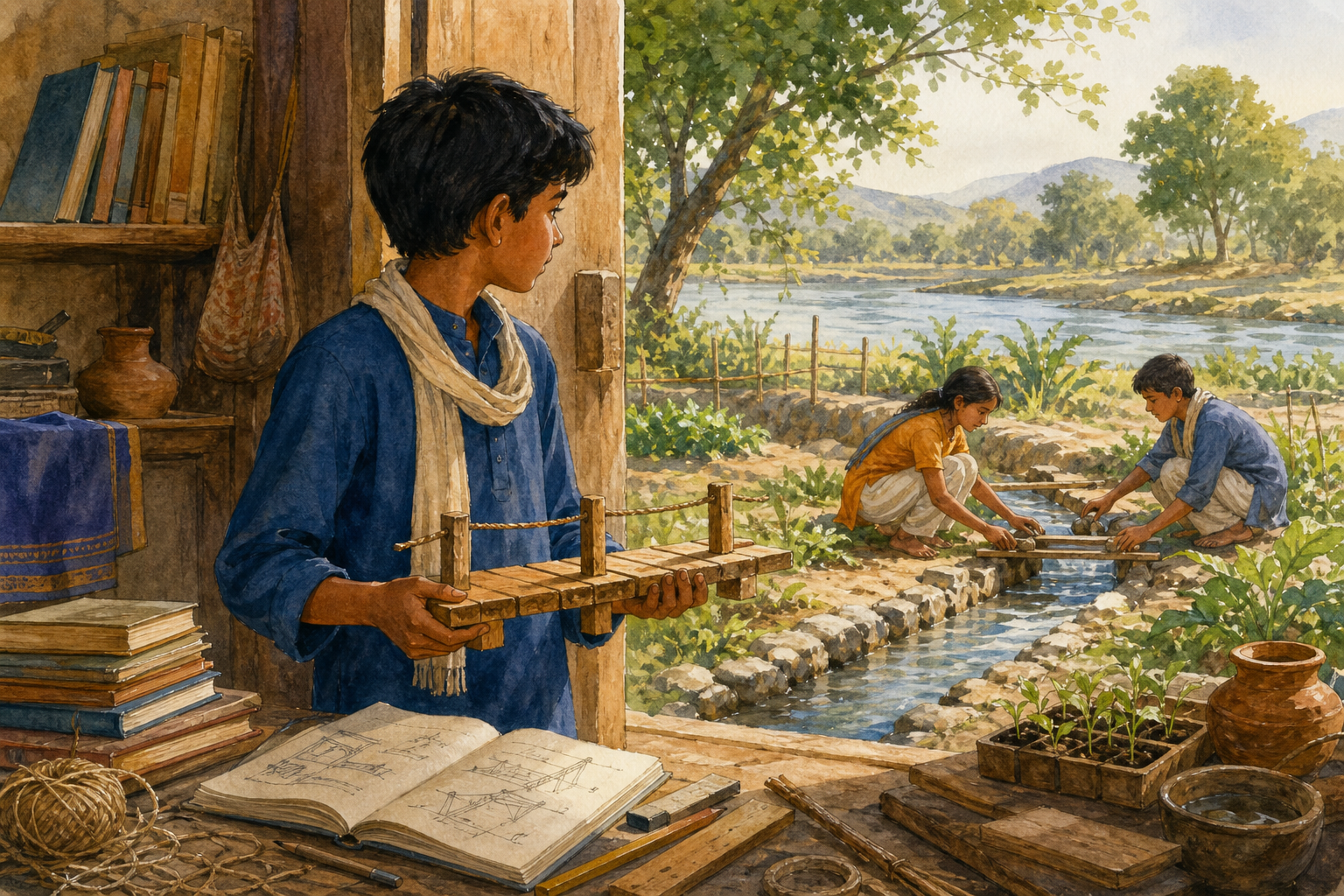
Your child may bring home high marks and still become helpless when a task has no model answer. They may recite a chapter yet struggle to decide what matters, explain a choice, recover from an error, or use what they know in an unfamiliar situation.
If you sense this gap, you do not have to choose between academic seriousness and practical ability. The better question is whether knowledge has crossed the distance from memory to judgment and conduct. You can test that distance in ordinary lessons, conversations, and school decisions.
The river test: knowledge must be answerable to reality
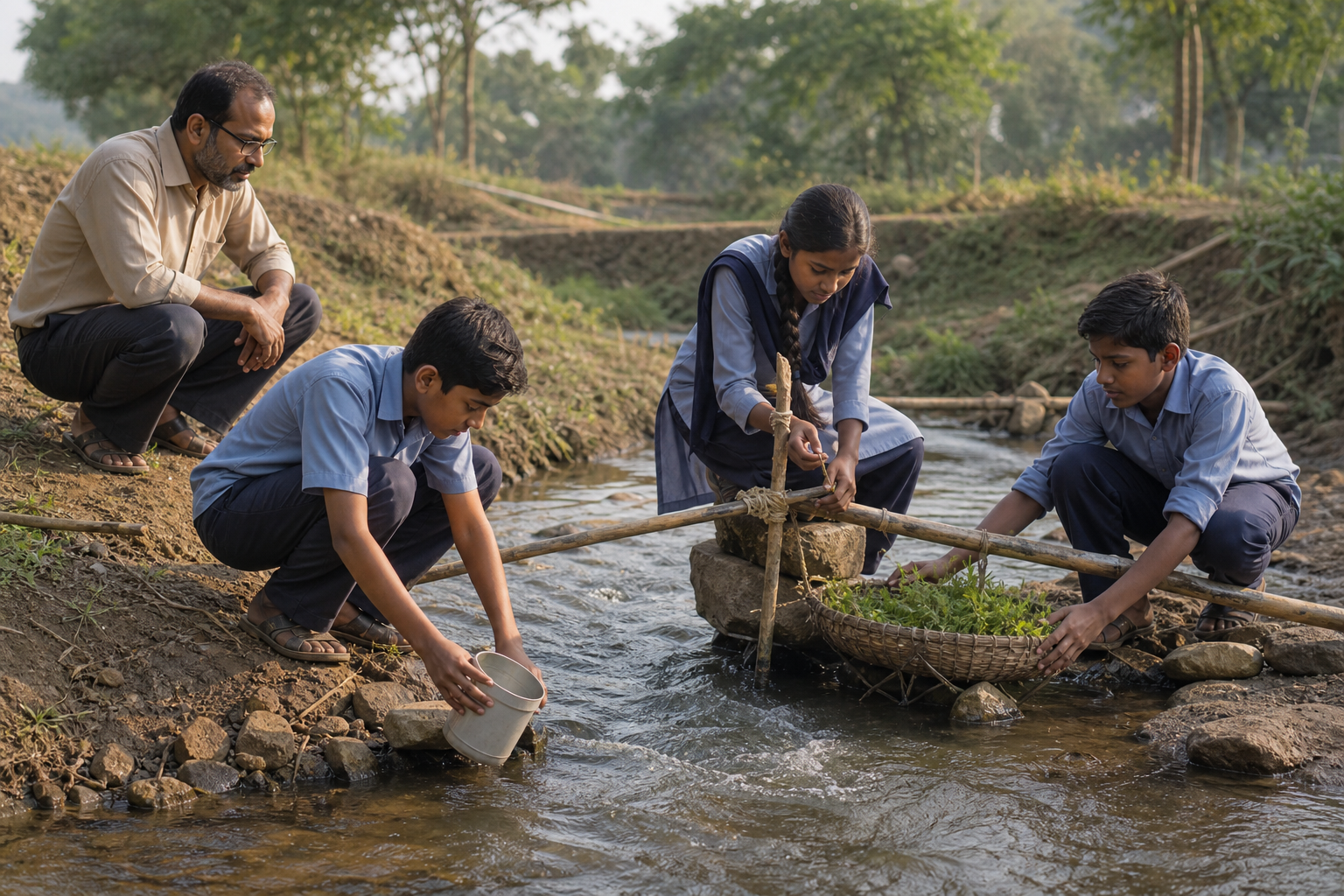
A familiar river-crossing teaching associated with Sri Ramakrishna places a highly learned pundit in a small boat with a humble boatman. The pundit questions whether the boatman has studied Sankhya, the philosophical system concerned with matter and consciousness. The boatman lacks that formal learning. Yet when the situation turns upon the ability to swim, the hierarchy of knowledge is reversed.
The lesson is not that philosophy is useless. That would merely replace one narrow prejudice with another. Sankhya can train the mind to examine profound questions; swimming can preserve life in water. Practical wisdom consists partly in knowing which knowledge the present situation requires.
The pundit’s deeper mistake is to treat his own vocabulary as a complete measure of another person’s education. He can ask whether the boatman knows the names he knows, but he does not ask what the boatman can perceive, judge, or do. He mistakes possession of information for mastery of life.
A dharma-minded parent should resist two similar reductions. Education is not merely the production of examination results. It is also not merely training for a salary. Both marks and employability matter, but neither is an adequate account of a human being. Education should help a learner know accurately, act competently, choose responsibly, and discipline the self that is doing the choosing.
This gives you a simple river test for any lesson: If circumstances change, what can the learner still understand and do? A memorized answer that collapses outside its original wording has not yet become usable knowledge.
Look for four kinds of evidence, not marks alone

Marks are evidence of performance under a particular assessment. They may show real effort and real knowledge. They do not automatically show that a learner can transfer an idea, make a sound decision, or act with integrity. Instead of dismissing marks, place them inside a wider picture.
- Accurate knowledge: Can your child state the idea clearly, distinguish it from a similar idea, and identify what they do not yet understand? Ask for an explanation without the textbook open. If the answer consists only of memorized phrases, ask for the same idea in ordinary language.
- Capable action: Can your child use the idea without being handed the exact procedure? Change the surface details of a familiar problem. Ask them to choose a method before carrying it out, and then ask why that method fits.
- Responsible judgment: Can your child make a choice when more than one consideration matters? Ask who may be affected, what duties are present, what remains uncertain, and what consequence might follow. The aim is not to force agreement with you; it is to require reasons.
- Disciplined conduct: Does learning appear in habits such as attention, honesty about mistakes, persistence, care for shared work, and willingness to correct harm? Do not label a child from one lapse. Look for patterns and for the way the learner responds after a lapse is noticed.
Each form can be faked when assessed badly. A student may reproduce a definition without understanding it. A polished project may have been copied or completed by an adult. A morally impressive speech may have no connection to conduct. Quiet obedience may look like character even when the learner has never exercised judgment.
That is why replacing examinations with projects is not, by itself, a solution. The form of the assignment matters less than the thinking it requires. A practical-looking task becomes another memory test if every step has already been demonstrated and every decision has already been made.
When reviewing a piece of work, ask four separate questions: Is it accurate? Is it independently usable? Is the reasoning visible? Was it produced responsibly? Keeping those questions separate prevents one attractive result from concealing a serious weakness elsewhere.
Turn an ordinary lesson into a cycle of practice

You do not need a new institution or an elaborate educational philosophy to begin. Take one lesson your child is already studying and move it through the following cycle. The same cycle can guide home learning, classroom teaching, religious instruction, or professional training.
- Receive: Learn the concept accurately from the teacher, text, demonstration, or discussion. Practical education still needs sound knowledge; application cannot repair a false premise.
- Restate: Close the material and explain the idea in fresh language. Name its important parts and give an example. If the learner can repeat the original sentence but cannot restate it, return to understanding before adding more content.
- Transfer: Apply the same principle to a situation whose wording and surface details are different. Do not announce the required method. Make the learner recognize which idea is relevant.
- Deliberate: Add a choice. Ask what should be done, who or what must be considered, and why one option is preferable. If the learner assumes facts that were not provided, ask them to separate what is known from what is inferred.
- Review and repeat: Identify the first point at which the reasoning went wrong. Correct that point, then try a different situation. The goal is not merely to replace a wrong final answer with the right one; it is to repair the process that produced the error.
Different subjects require different transfer tasks. After a mathematical procedure, present a new situation in which the learner must decide whether that procedure is appropriate. After a history lesson, ask them to separate a claim, the evidence offered for it, and the inference drawn from that evidence. After a language lesson, ask them to write instructions that another person can actually follow. After a moral or philosophical teaching, ask for a situation in which it applies and another in which two duties appear to pull in different directions.
For a Dharmic teaching, do not stop at recitation or at the ability to name a doctrine. Ask what the teaching would change in a real choice. Then make the case harder: What if truthfulness carries a personal cost? What if duty to one person conflicts with responsibility to a larger group? What further facts would be needed before deciding? These questions turn reverence into inquiry without treating the tradition casually.
When your child gets stuck, resist the impulse to supply the procedure immediately. Ask: What have you tried? At which step did your confidence change? What fact are you using? What other method might fit? Assistance should help the learner regain agency, not make the difficulty disappear through someone else’s agency.
Depth sometimes requires leaving a topic before every possible exercise has been completed. If you must choose, protect the moments in which the learner retrieves, applies, chooses, and corrects. Covering more material has little value when none of it remains available outside the original page.
Use the same standard when choosing a school or course
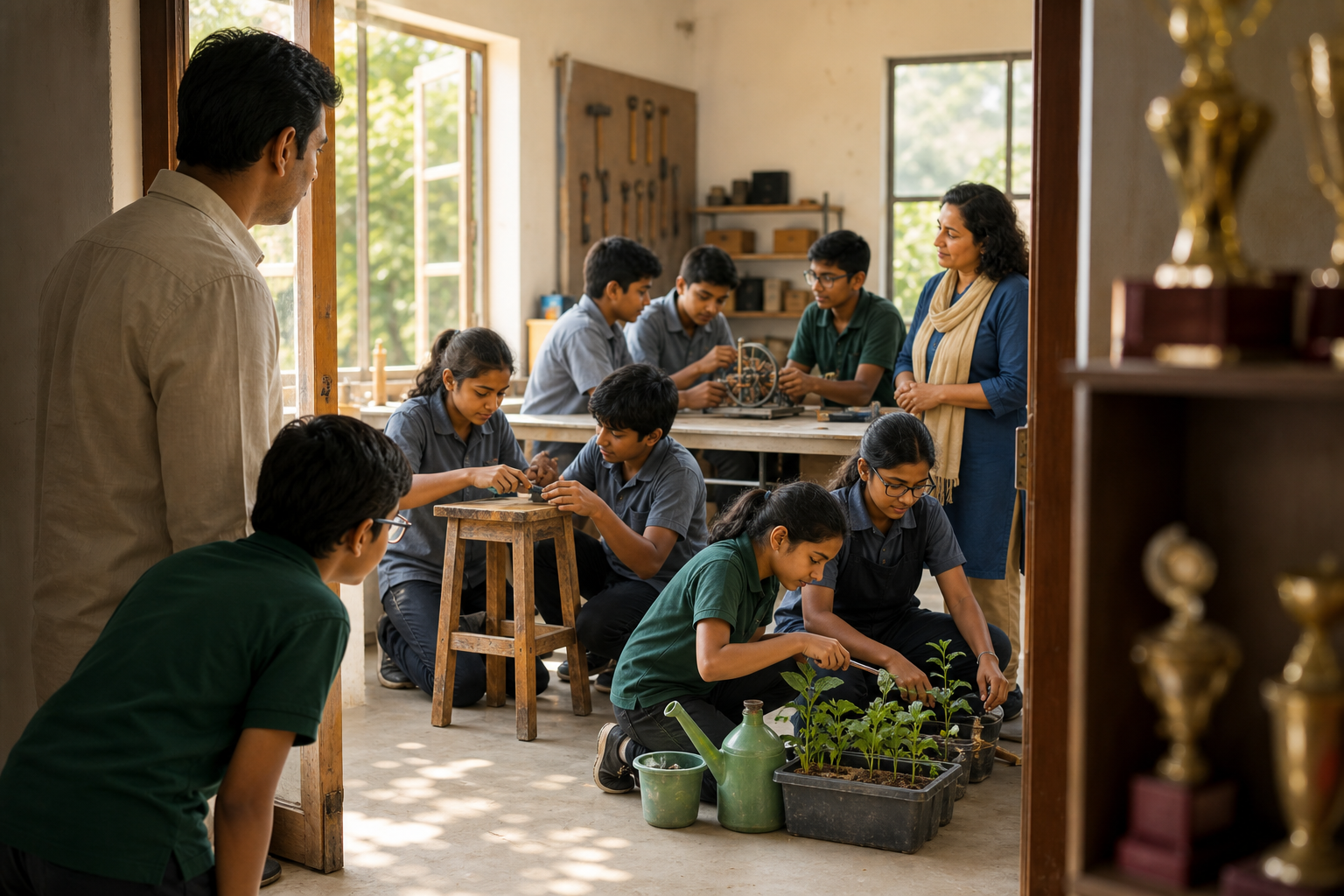
Schools often use broad words such as excellence, values, innovation, and holistic development. Those words become meaningful only when you can see what learners repeatedly do. During an admission decision or a meeting with a teacher, ask for concrete examples rather than a longer statement of ideals.
- For a major unit, what can learners do at the end that they could not do at the beginning?
- Can you see an assignment that requires transfer, not only recall?
- What happens when a learner uses a defensible method different from the teacher’s model?
- How must students show the reasoning behind an answer?
- How are mistakes revisited after a grade has been given?
- Where do learners face choices involving responsibility, consequences, or competing considerations?
- Which parts of a project must be completed independently, and how is that independence verified?
- Can learners produce something genuinely intelligible or useful to another person?
A strong answer will point to actual learner work, a clear teaching routine, or a specific assessment practice. A weak answer will simply repeat the institution’s values in more polished language. You are not demanding that every lesson simulate an emergency. You are asking whether the curriculum regularly crosses the boundary between recognition and use.
Watch for a second danger as well: practical education can become a collection of busy activities. Building, presenting, travelling, volunteering, or using technology may look active while requiring little reflection. Ask what principle the activity teaches, what decisions belong to the learner, and how the learner examines the result. Activity without understanding is no better than theory without application.
Character education deserves the same scrutiny. If good conduct means only silence, compliance, or institutional reputation, learners may never practice moral judgment. A serious values programme should make room for truthful disagreement, responsibility for consequences, correction after wrongdoing, and service that respects the person being served.
Key takeaways
- Do not ask only what your child remembers; ask what they can recognize, choose, perform, and explain when the situation changes.
- Keep academic knowledge, practical capability, judgment, and conduct visible as separate forms of evidence.
- Move each important idea through a cycle of accurate learning, restatement, transfer, deliberation, correction, and renewed practice.
- Judge educational promises by learner work and teaching routines, not by attractive labels.
- Do not confuse activity with application or obedience with character.
Begin with the next lesson, not a complete reform
Practical wisdom grows through abhyasa: repeated, attentive practice. It will not appear because a school adds a life-skills period or because a parent delivers a lecture about the real world. It develops when knowledge is repeatedly brought into contact with changing circumstances, consequential choices, honest correction, and responsibility toward others.
Before your child’s next study session, write one sentence: After this lesson, the learner should be able to… Complete it with an observable action rather than “know” or “understand.” Then prepare one unfamiliar situation in which that action is required. Let the learner attempt it, explain the decision, and revise the process.
That modest change restores the proper relationship between learning and life. The book supplies knowledge. Practice makes it available. Judgment directs it. Character determines how it will be used.
References
